Someone recently asked, what’s the big deal about a shortlist?
What’s the big deal?
A shortlist groups together the best!
It acknowledges the most accomplished of a long and always healthy collection of entries.
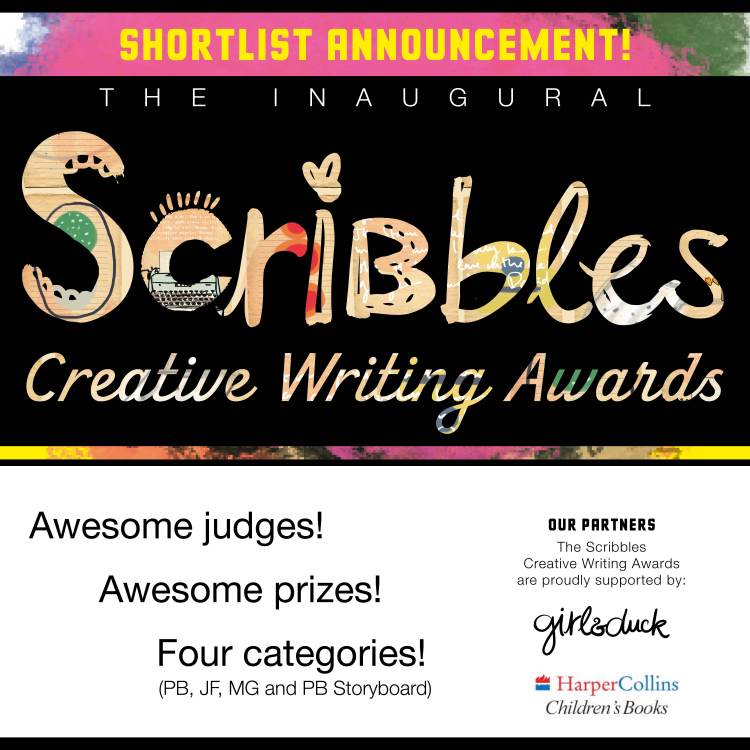
It’s also how we make competitions like the Scribbles Creative Writing Awards, manageable — both for the judges and for the competitors.
Imagine if we only gave out two prizes, two ‘nods’, per category. Judges would tear out their hair. Creators would feel jaded and demoralised. And rightly so!
A shortlist gives more people a chance to shine. It spreads the love a little further.
Yes, indeedy. To be on a shortlist is a great honour. And a great thrill.
Not only can it boost us emotionally, psychologically and creatively, it can also boost our career.
Publishers and agents care about shortlists. Funding bodies care about…
It’s a bright, breezy Saturday morning and I’m doing light housework when I hear a knock on the front door. On the weekend nobody knocks at the front door at this time of day. Nobody except salespeople touting a product, charity or religion. I go to the window and look down at the doorstep, which doesn’t have a porch covering, and I see two people. A fair-haired woman who is thumbing through an iPad and a man in a jaunty hat. The window is open so I lean out, say a loud hello and they look up. Predictably, they respond with surprise, the man uttering the usual “A voice from above” and I give a weak smile. The woman swallows and clears her throat. She launches straight into her patter which goes something like this “We are currently in your neighbourhood discussing death and dying and what this means to families, your family…etc, death cropping up several times…and what are your thoughts on this subject?” My first reaction is annoyance, she hasn’t said who she represents. The invisible signs are as obvious as the outward message. My second reaction is one of astonishment. Do they really expect me to talk over such a matter with them, total strangers, door-knocking my street, making dogs bark, trying to look deep and meaningful on a topic which is universally devastating no matter what the circumstances? My third and final reaction is to look her in the eyes and say “I’m sorry, I do not wish to participate.” She smiles, he smiles, I offer them a polite good-bye and they wish me a happy weekend. As I’m drawing back, I catch a momentary look of relief on the woman’s face. ♥Gretchen Bernet-Ward
Australians really love their pet pals – one in three won’t go on holidays because it would mean leaving their pet behind. A recent survey examined the lifestyle of 1,000 pet owners regarding the impact pets have on their travel habits. I found the results interesting.
National Seniors and Trusted Housesitters research demonstrates that with 5.7 million households owning a pet in Australia (over 13 million people) roughly four million people choose to stay at home rather than holidaying due to concerns about their pet’s well-being.
Apparently those who did take a break (69%) said they had felt guilty when leaving their pet behind, while over one-third of Australian pet owners (36%) have turned down a weekend away, citing being unable to arrange pet care as the reason.
Pets often disrupt their owners’ social lives, with 18% of respondents having regularly missed social engagements in favour of staying at home to ensure their pets were cared for. Of those surveyed, 6% avoided going on dates, choosing their pets over romance.
When it comes to Australian pet owners who regularly take holidays, 29% opted for a trusted pet sitter versus putting their pet in a boarding kennel (21%), while 35% of pet owners organised friends or family to care for their furry friend.
One in four participants said they would never travel overseas or interstate without their pet. Presumably this pet is a dog and the owner is wealthy!
In a British study of veterinary experts conducted by Trusted Housesitters UK, 100% believed animals responded better to a new carer than a new environment, as animals were particularly bonded to their home. Is there bias in this result?
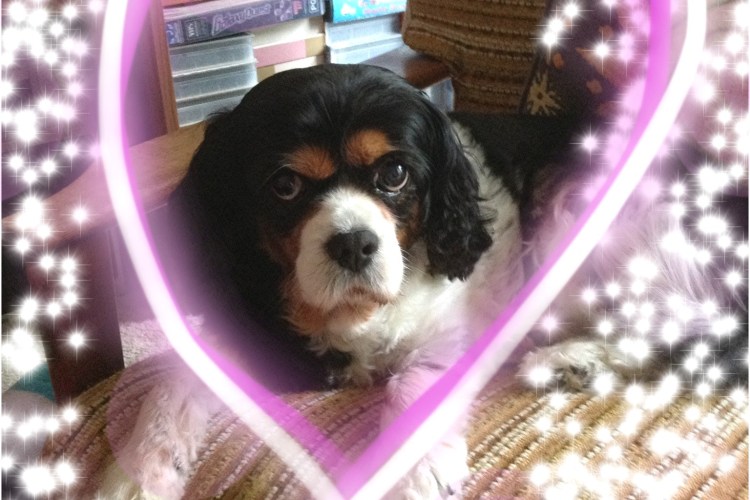
I’m not making any pronouncements for-or-against. I’ve loved and cared for every one of my darling pets and by making arrangements in advance, none ever stopped me from travelling away from home. But the guilt was there.
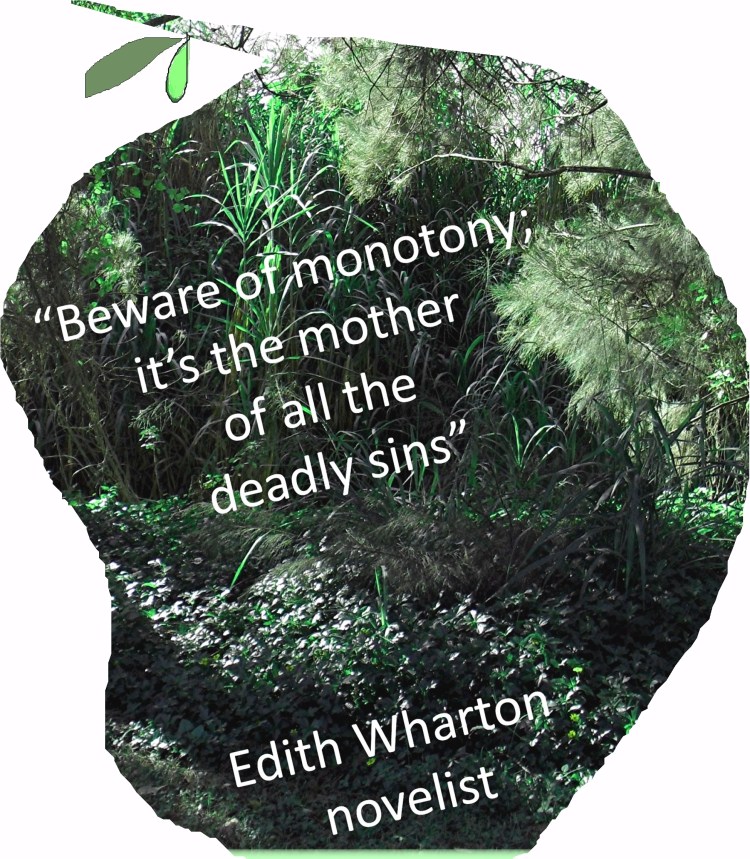
Edith Wharton (1862-1937) was born into a tightly controlled society at a time when women were discouraged from achieving anything beyond a proper marriage. Wharton broke through these strictures to become one of America’s greatest writers https://www.edithwharton.org/discover/edith-wharton/
Mature people from the 20th century may feel a twinge of nostalgia when reading the words ‘board game’ . I have visions of crouching over a cardboard square with family or friends, munching snacks, rolling the dice and moving discs, cards or tiny symbols around the board to shouts of glee or great annoyance depending on who was winning.
A board game has a goal each player aims to achieve. This means instant winners and losers. No reboot, no power-up, no regeneration, no second tries unless you’re a four year-old and burst into tears. Any game of chance has pitfalls, but when you flip that top card and see what you’ve got, it sets your mind racing not your thumbs.
I’ve played Halo, Assassin’s Creed, Grand Theft Auto and other equally absorbing, equally time-guzzling computer games which controlled my moves even if it didn’t feel like it. My Virtual Reality experiences offered yet another form of ‘visual involvement’ and the feeling of taking another step down the ladder to human isolation.
With an old-fashioned board game, the players’ moves are initially controlled by the dice and random Lady Luck. Thereafter, players can take a certain amount of responsibility for their movements and actions without the use of screen projections. They can survey the limits of the board and plan their course using opponents body language.
To tweak youthful reminiscences, I have compiled a list of my favourite board games for you. Scraps of paper and a pencil (for scoring) are optional. I’ve added some photographs of our boxed sets which have survived two generations. Regrettably I can’t seem to locate Trivial Pursuit! At one stage, maybe 1985, there were two big blue boxes on the shelf for special nights.
Ah, those fun-filled nights of comfy clothing, junk food, fizzy drinks and overheated face-to-face discussions <cue Back To The Future soundtrack>
♥Gretchen Bernet-Ward
MY MEMORY LIST––I’M SURE THERE’S MORE
Cluedo
Scrabble
Monopoly
Tiddly-Winks
Trivial Pursuit
Snakes & Ladders
Chinese Chequers
Mastermind
Pictionary
Draughts
Shipping
Mouse Trap
Blankety Blank
Chess (of course)
Escape from Colditz
It’s a Knockout
Quandary
Mahjong
Risk
the list goes on…
SPECIAL MENTION: ‘War of the Daleks’ (from early days of TV series Dr Who) which I never played but would have love to––players moved tiny Daleks around the board, obviously saying ‘Exterminate, exterminate’. There are newer board games like ‘Time of the Daleks’ and electronic interactive TARDIS versions.
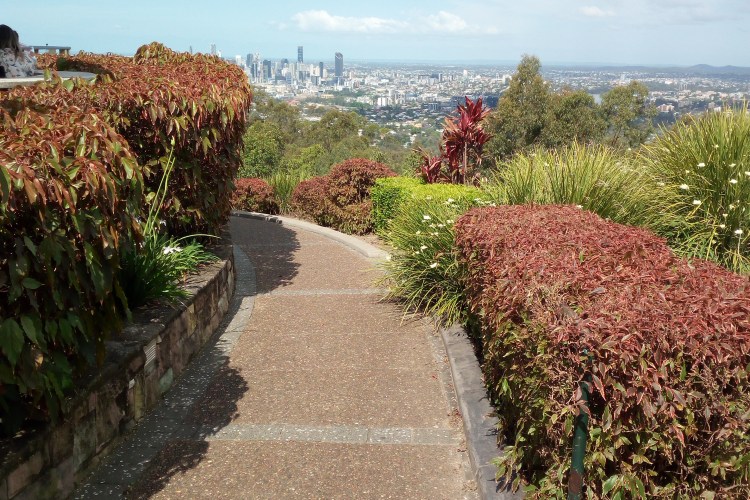
It’s a sunny, springtime day in subtropical Brisbane and we are heading towards Mt Coot-tha, the ‘mountain’ which is really a hill. The temperature is balmy and the drive is easy, out along a flat highway which decimated countless trees and native bushland.
Mt Coot-tha “Summit” Restaurant & Bar.
Ascending the steps…
We cruise by the Botanical Gardens, the Planetarium, the quarry (!), the cop with a radar speed gun, the tourists in an overheating VDub Kombi-van and climb towards the summit lookout which sits atop what was colloquially known as ‘One Tree Hill’.
Plenty more trees now, well, there is at the moment but Brisbane City Council may revert to one. The council is keen to upgrade the area, adding tourist lures like a zipline and tree-top canopy walk. Bye-bye quiet little harmless native animals and birds who take sanctuary there from the six-lane highway below.
Lunch in the shade of Kuta Café atop Mt Coot-tha, Brisbane.
Hardy plants in the sun all day.
We reach the carpark of our destination, fluke a spot, and notice the air smells eucalyptus fresh. It’s an interesting walk through various nationalities of smiling, picture-taking tourists. We join the milling crowd and peruse the Summit Restaurant & Bar menu before deciding the dollars signs are for high class meals. It is easier to tag onto the lunchtime queue at Kuta Café with its two-tiered eating decks.
Old natural stone from the surrounding area.
View from almost the top tier of the lookout.
I enjoy a delicious chicken salad wrap and share a huge bowl of baked potato wedges with heaps of sour cream and sweet chill sauce. After keenly snapping views towards the river and western suburbs, Brisbane CBD, and Moreton Bay with Moreton Island sandhills way in the distance, we detour the gift shop and head back to the car.
A friendly magpie lands on the car mirror, enquiring about food, but we have none to give, so it takes off—see below for this gripping encounter.
The Xanthorrhoea plant is uniquely Australian. It grows in the South East of Australia thriving in well-drained, aerated soils with low nutrient content.
Sticky-beak Magpie looking for food.
We agree not to drive the long way, the full circuit around Sir Samuel Griffith Drive which passes leafy barbecue areas, transmission towers and headquarters of local television stations.
Heading down the hillside, the city views and far-reaching scenery becomes less and less until ground level, then the highway roundabout appears, perfectly positioned opposite Toowong Cemetery.
The City of Brisbane is growing, the traffic is growing, the drivers are getting faster. Or am I turning into a grumpy older person? Time for a nap!
Today 11/11/2018 is the Centenary of Armistice and Remembrance Day in Australia.
We remember those who fought and those who died––
My grandfather heading off to war.
At 11am on 11 November 1918 the armistice treaty, which Germany had signed earlier that morning, came into effect. The Great War, the ‘war to end all wars’ which had begun on 28 July 1914 was finally over.
Like millions of other Australians, I’ll follow tradition and observe a two-minute silence at 11am (no matter where I am) to honour the 420,000 men who enlisted and the 62,000 who didn’t return.
In Flanders Fields
Poem by Dr John McCrae, May 1915
In Flanders fields the poppies blow
Between the crosses, row on row,
That mark our place; and in the sky
The larks, still bravely singing, fly
Scarce heard amid the guns below.
We are the Dead. Short days ago
We lived, felt dawn, saw sunset glow,
Loved and were loved, and now we lie
In Flanders fields.
Take up our quarrel with the foe:
To you from failing hands we throw
The torch; be yours to hold it high.
If ye break faith with us who die
We shall not sleep, though poppies grow
In Flanders fields.
A local newspaper notice attracted my attention. Did I read that correctly? A camel farm excursion? Here is the true story of my expedition into camel territory.
I’d heard about camel milk and wanted to know more, so I contacted the organiser National Seniors secretary. Of course, they had me at “camels” but when I see meals included, I’m there. The itinerary read “East Coast Coach depart 9am and arrive Summer Land Camel Farm, Harrisville, morning tea and guided farm tour. Lunch at Commercial Hotel (adjoining Thirsty Camel bottleshop) before travelling home via scenic route 4pm.” Hooked and booked!
On boarding the coach, I was given a warm National Seniors welcome, and on disembarking the coach 45 minutes later, the first thing I noticed was the vast blue sky over Summer Land Camel Farm. A rolling vista spread out around me. In the distance the smudged outline of the Scenic Rim, part of the Great Dividing Range, and in the foreground hundreds of camels! It was an odd sight, camels of different sizes grazing in the paddocks, until I realised they were at home in the landscape.
Now, first let’s clear up some camel falsehoods. Camels do not spit but alpacas do. Camel footpads are better suited to protect vegetation than cows and horses. Of course, it’s common knowledge that a camel can walk over a hundred kilometres without water and carry heavier loads than a horse. But did you know that they are excellent swimmers? Who’d have thought but it’s true.
We strolled to the beautiful old Queenslander homestead where a spread of fresh scones, homemade jam and cream awaited. Then we realised what we were eating. The white fromage cream I dobbed on my scones and the milk in my coffee were not from a dairy cow but a camel. Delicious! And, as we subsequently found out, very good for our digestive tract. Camel milk is like an immune boost, an anti-inflammatory which can benefit our gut, skin and hair.
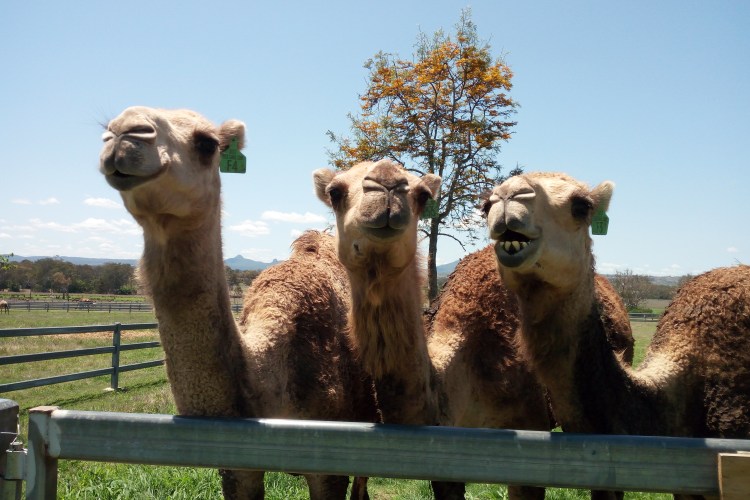
I loved meeting the camels at the fence, talking to them as they blinked their long eyelashes, obviously assessing if I had anything edible in my hand. When they saw the camera, I believe they actually posed, holding quite still while I took full advantage of this photo opportunity. See the camel on the right smiling! Everything was peaceful and the air smelt fresh. No camel aroma wafting on the breeze. Then my models wheeled away to check out an inviting dust bath.
In Australia we have dromedary camels, one hump. The dromedary is the smaller of the two species of camel and female gestation period is 13-14 months or around 410 days. I saw a baby camel, 24-hours old, all spindly legs, wobbling and flopping yet determined to stand. I asked if I could sponsor a camel, an adorable critter to watch grow up. Not yet, but one day this may be possible. In the meantime I joined the Summer Land Camels Club and harbour happy thoughts of riding a camel on my next visit.
Jeff Flood, CEO Summer Land Camel Farm, Business Strategist, Biochemist and Nutritional Immunotherapist.
Our group walked to a vast shed where the cheese, cream and milk are tested and processed. We sat in the breezeway while Jeff Flood, biochemist and immunotherapist, delivered an intelligent, informative and heartfelt talk on all things camel. Even biomes got a mention, and Jeff is very open about the farm operations. I wished my school days had involved such an absorbing field trip.
A passionate cameleer from a farming background, Jeff Flood is CEO and co-founder of Summer Land Camel Farm, the largest of its kind in Australia. Apart from playing rugby and completing several scientific degrees, he discovered that the immune protein and nutritional content of camel milk has healing benefits, showing positive results when used to treat his young son’s eczema.
Then onward to the open-air camel dairy, where we learned the long road to milking. Camel milk and by-products are not high volume in Australia but its the largest commercial-scale camel dairy operation outside the Middle East and the third largest of its kind in the world. Jeff and co-founder Paul Martin are training wild camels, breeding, researching, testing and pioneering the way. Not only for Australia but the rest of the world. Why can’t camel milk sit in the fridge next to other beverage flavourings? Camellatté has a nice ring to it.
Jeff is concerned for the welfare of camels and told us some horrible yet true stories of the brutal decimation of the wild camel population in Australia. The camel is a neglected animal among the policymakers. Incorrect data is perpetuated to this day, mainly through ignorance and government propaganda.
During the tour, it became obvious to me that camels have been given a raw deal. They are well-suited to our Australian climate and in some ways more beneficial than imported European farm animals. A bit of racism involved here? Camels do not have top teeth yet they like rugged food; they can eat feral weed plants such as prickly pear and they don’t need lush green pastures to thrive. During drought years, companion-herds of camels and cows survive better. Camels can act as watchdogs, they have the intelligence of a six year-old child which is greater than a dog. Plus they can take you on very, very long walks!
Back at the homestead, we enjoyed some taste-testing and Summer Land Camel Farm staff excelled with their hospitality. Unlike almond milk or soy milk, I had an instant attraction to camel milk. It suited my palate without the “I’ll get used to it” phase. Being lactose-intolerant, that’s a blessing. I perused items for sale; from camel milk and cheeses through to soap, hand-cream and artwork by Fiona. If you forget the Esky, cold bags can be purchased for a nominal amount and my Camel Persian Feta and other goodies were safely tucked away.
Time to head off down the road and partake of a pub lunch at the Commercial Hotel in Harrisville. After our meal, we strolled around the small township. I looked left and right before crossing the road but it wasn’t really necessary.
The coach swayed gently as we headed homeward, and I was pondering this enjoyable day out when my thoughts reached a conclusion. I had looked into the eyes of a camel and seen a friendly, interested gaze. I think the world needs more friendly interest in camels. And more camel milk in coffee!














 Thoughts Become Words