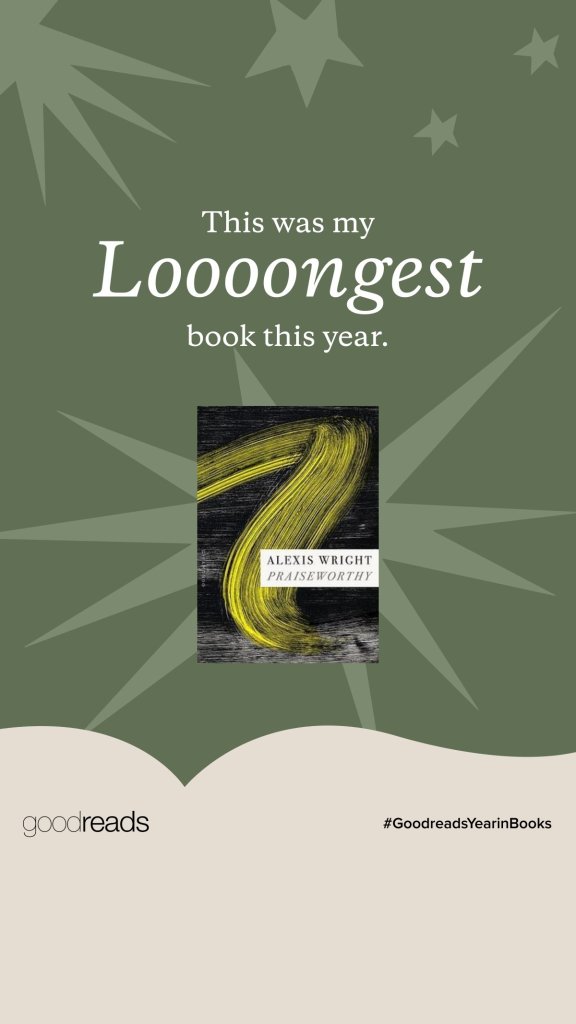
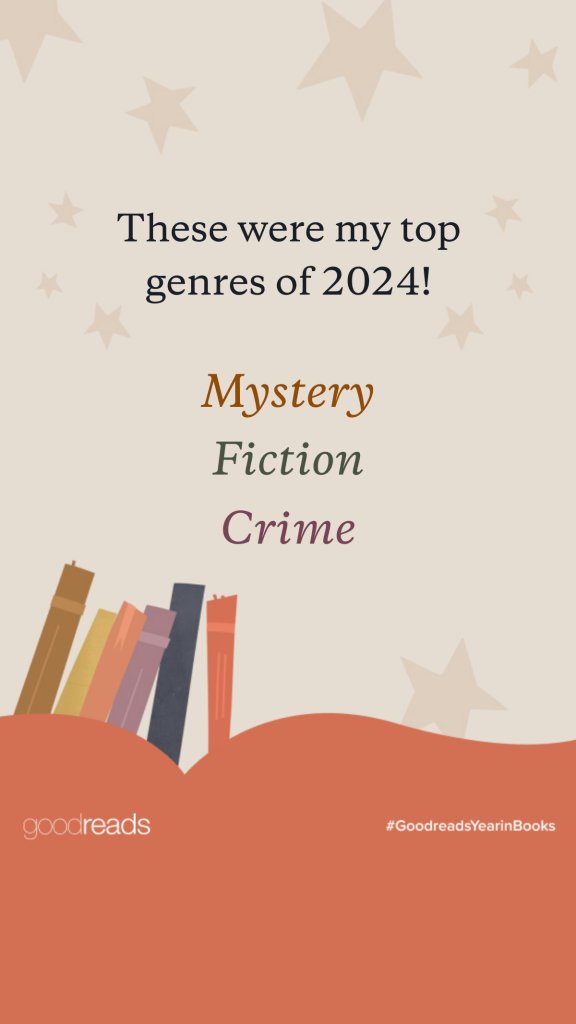
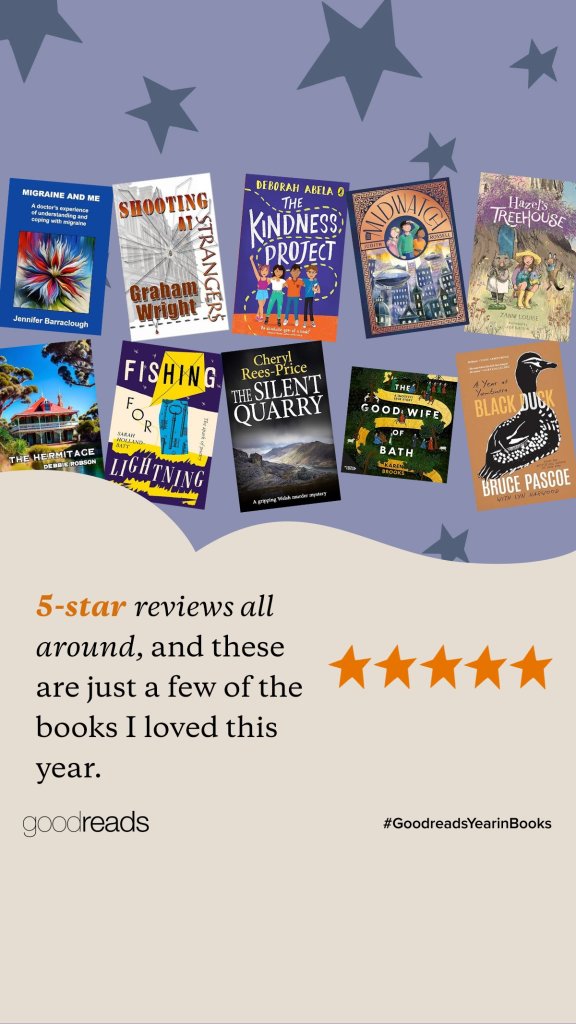
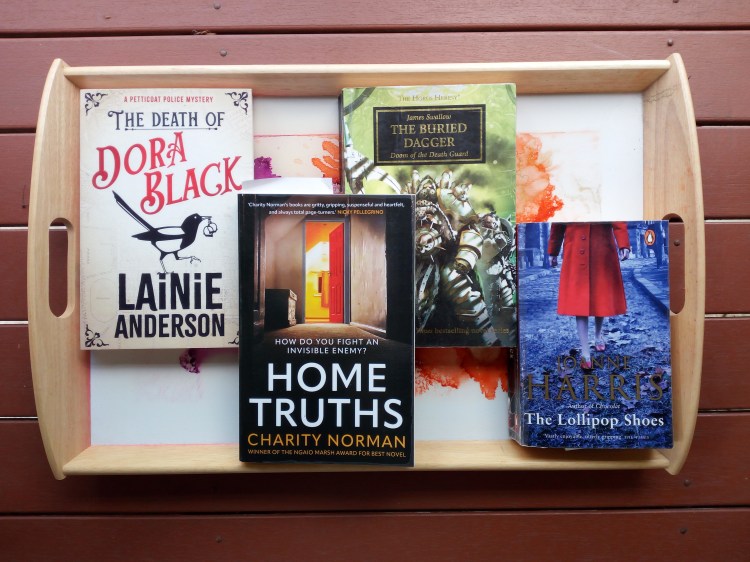
Totally surprised by this information from Goodreads. Yes, I do read a lot but when I saw it all laid out like this, well, it was a pleasant shock to read the stats.
I did not realised that I had read such a varied collection of good books over one year. Perhaps many other Goodreaders were sent a similar result? Maybe we should form our own book group? Either way it is nice to think the algorithms ‘liked’ me enough to let me know.
In the back of my mind I am torn between being happy and being dubious about having my reading habits logged so meticulously when only a handful of books were absolute standouts for me. Only a few are loved unconditionally!
Gretchen Quote: ‘Books are the Three E’s, Entertainment, Education and Enlightenment.’
Just could not go past these two new children’s books without buying them! I am sure many younger and older readers will enjoy reading them too. One is fabulous fun with fine furry friends, and the other is an exciting adventure with intrepid young orphans in the big city. Read on…
A truly delightful book from start to finish. In ‘Hazel’s Treehouse’ author Zanni Louise has created adorable characters and oh so wonderful dialogue between a young girl Hazel and her four Australian bush animal friends. The treehouse is a snug place from which stories unfold and adventures begin. There are lovely little kindness explanations from Hazel when things go awry or plans go askew. She is like the older sister with rambunctious siblings, the one who peps things up or calms things down by showing a different way of looking at situations; particularly taming the dark before bedtime. But not always, as in ‘Small Pants Friday’ the rainy-stuck-inside-day when everyone gets a bit grumbly.
Then there’s Kevin, their new neighbour who has a continent-sized smile but a troubling agenda which causes Poky echidna to turn a bothered colour of grey. I’ll let you find out how that turns out. In ‘Hazel’s Treehouse’ the creativity, seasonal indoor and outdoor fun are beautifully rendered by Judy Watson, her joyous illustrations enhance the story and my favourite character is Odette, an active pademelon wallaby. When a little burst of reading happiness is needed, it is well worth having this gem on your kidlit bookshelf. Also suitable for a little bit of inspiration on those long lazy summer holidays. GBW 2024
Totally besotted with this book! I have read and adored previous books by author/illustrator Judith Rossell, featuring intrepid Stella Montgomery, and loved the stories so much I couldn’t wait to get my hands on a hardcover copy of ‘The Midwatch’ featuring unwanted orphan Maggie Fishbone and her adventures in what I think may be a parallel universe; although disconcertingly similar to early twentieth century America.
Maggie is banished to the notorious Midwatch Institute for Orphans and everything happens from there. Immersive, detailed and beautifully illustrated this is so unlike the world I inhabit yet similar at the same time. It is a story of fearless kind brave clever young characters speaking in the vernacular of that time, ready to face airships, scary monsters and villains. What does the ritzy Tiergarten Hotel hold..? A wardrobe but no lion, something far more ferocious. Then humour pops up at unexpected times.
Chapter 14, in the city library, is one of my favourites. “Nell’s eyes were shining. ‘I never knew there were so many books,’ she whispered. ‘Imagine reading them all. You’d know just about everything in the world, wouldn’t you?” As the story evolves, Maggie and her cohort have so much to investigate, a valuable brooch, a kidnapped friend, leading the reader not only with words and deeds, tension and suspense, but through the superb visualisations, and the occasional odd tip like “How to Escape from Quicksand”. I think this book is the bees knees for middle grade school readers looking for something different featuring engaging young adventurers. Good gravy there is even a chocolate cake recipe! GBW 2024
Rich dark chocolate cake baked by Dot Bernet from ‘The Midwatch’ recipe by author/illustrator Judith Rossell 2024
About Me: Reader, Writer, Reviewer, Blogger. My book reviews cover many genres and I don’t believe in writing one side of my reading experience. There are chunks of praise and criticism. Favourite books are Crime, Quirky, Mystery, History but much more.
What is it with the anonymous people who give a one-star rating on Goodreads without having read the book? I call them Bad Goodreaders. They don’t even pretend to know the author, the contents of the book or the country of origin. How foolish they appear to real readers by giving a well rated new book a one-star rating for no reason whatsoever.
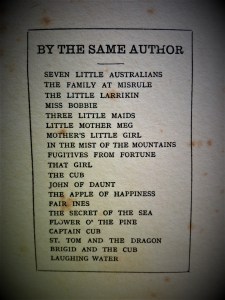
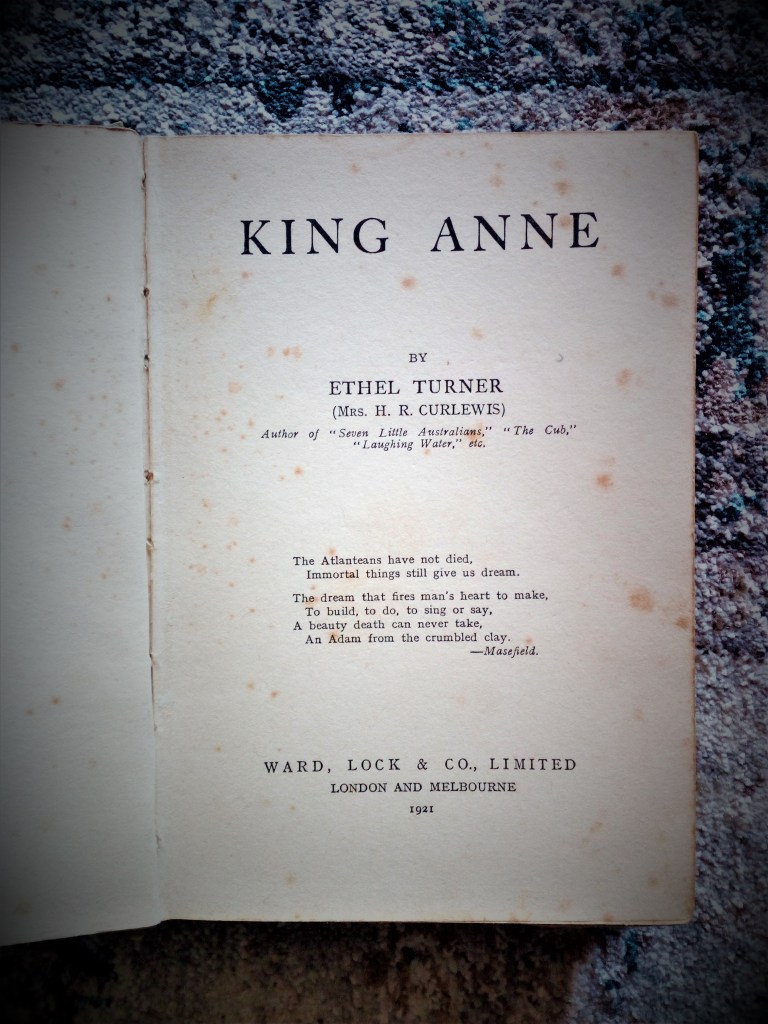
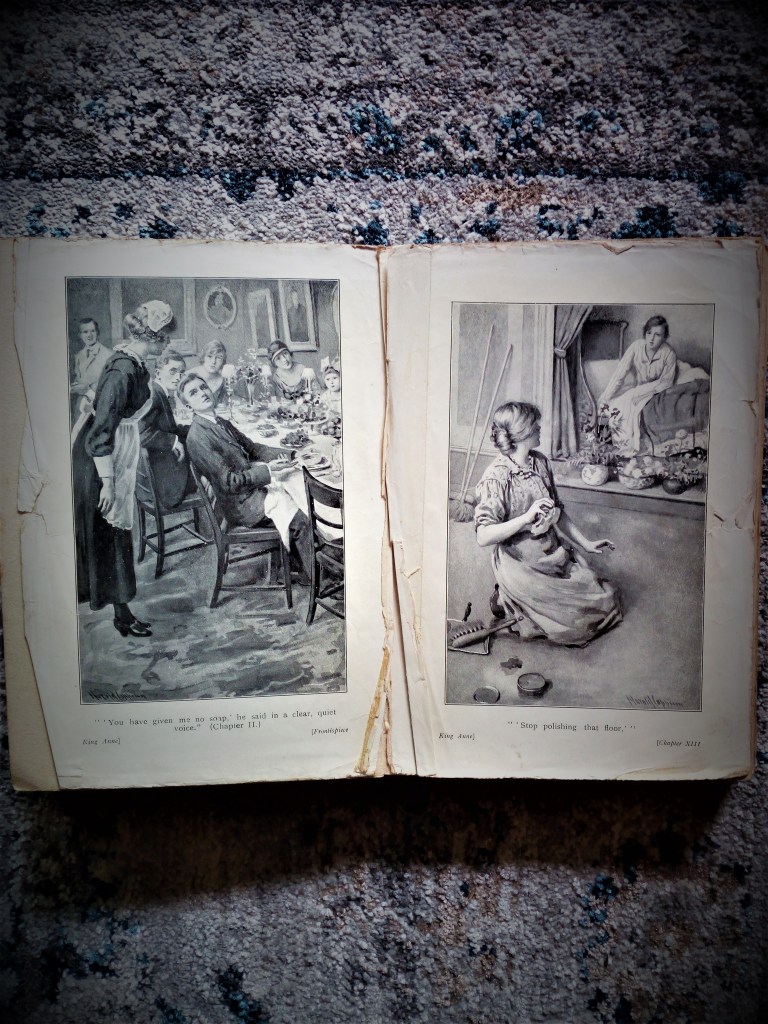
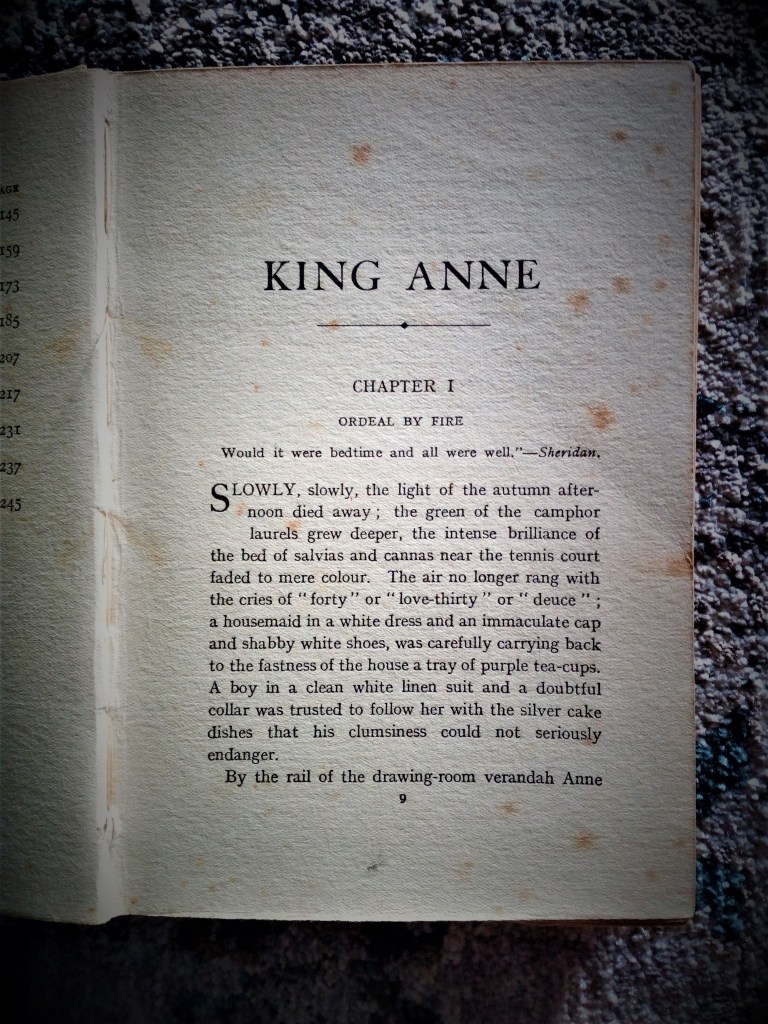
I know this anonymous deceit is done, and done frequently throughout the Goodreads website. I have a very old volume of ‘King Anne’ written by Ethel Turner, pseudonym of Mrs. H.R. Curlewis, a well-known Australian children’s author in early 1900s. It is a hardcover book with illustrations, owned by my great-aunt and her sister who was my grandmother. It was bequeathed to me when I was a teenager and I though nothing about it until many years later.
I believe the ‘King Anne’ book has been out-of-print for many many years; perhaps it will never be republished but rare copies are available. There is a blank bookcover on Goodreads but I posted the real bookcover with my review.
This book has attracted a couple of genuine star ratings and, without a shadow of doubt, two random one-star ratings from two anonymous people. It would seem to me that they did not know the author or the age of the book. It is not a contemporary story. Come on, one hundred years ago, guys! Of course, it may not be thrilling reading for today’s young readers but it’s part of the Australian classics and there is no need to give it a worthless rating just because you feel spiteful. Move on if you don’t know anything about it.
Are these Bad Goodreaders hiding behind anonymity because they are unhappy, bitter ex-readers who cannot bear a book to be successful or popular or well liked? Perhaps because they themselves are not liked? Are they lashing out with their single click because it represents the only meanness or passive/aggressive behaviour available to them without repercussions from social media or cyber police? There is no government body assigned to prosecute a non-reader, or issue a fine for a rating from an anonymous person who gives a single star reflecting their malcontent with life and literature.
Could these non-readers be resentful of devoted readers and perhaps authors they have met who are successful when they themselves have received publishers rejection? That seems feasible because we all know our own work is best. However, all the more reason to give another author a helping hand because “what is given is given in return”.
So next time, One-Star Reviewer, unless the book is actually terrible or one you hated as a child, why not pass over that random book you are about to give a poor rating and get involved in computer gaming instead? Battle it out with something animated, something virtual that can at least challenge you.
All in all, the Goodreads website may be clunky but it’s about the best book reader website surviving on the world wide web today. Just don’t get me started on spoilers or huge tracts of a book sometimes reproduced without acknowledgement or consent from the original author.
In closing, Dear Reader, we can differ in our opinions. But just so we see both sides of the page, be aware of book reviewers who are known to give too many stars to boost their favourite author. This is also misleading for readers who are looking for a good book.
Be fair, be honest, you may gain more followers by giving a genuine rating and review from what you have actually read.
Call me timid (Neil Gaiman books scare me) but this is a ferociously upsetting fantasy story of an ancient Yew tree and an adolescent boy awash with fear, sadness, anger, and the unforgiveable nature of death.
Conor O’Malley’s mother is dying in hospital. Conor and his father and grandmother are not handling it well. One night Conor gets up and goes over to his bedroom window and looks out. A monstrous untameable Yew tree stands near his house, looking right back at him. It proceeds to raise a gnarled woody fist to punch through the wall of his bedroom. The monster says “I will tell you Three Stories. Three tales from when I walked before.” But Conor sends the monster away and it’s gone for the time being.
Of course it returns, laced with dark fantasy and symbolism, and eventually the Fourth Tale comes from twelve year old Conor himself. What does Conor and the reader learn from this? Many things. Note, I personally would not recommend either the book or movie for children of a young age, it could raise more fears than it can soothe. You may love it!
So that’s my short synopsis of a tense, wrenchingly sad story written by Patrick Ness about imagination and the monstrous fears within us. It contains school-yard violence, sweet Lily, ancient tree wisdom and modern day parenting which leaves Conor awash with misery, confusion and a bad temper for everyone apart from his sick mother.
This story could be shelved in the Fantasy/Horror section of a library except for its very serious topic and acutely observed symptoms of grief; a complicated boy lashing out at everyone, unable to alleviate his mother’s suffering nor deal with her impending death. Time grinds on regardless, Conor’s bossy grandmother arrives and nothing is as it seems. Allegory, clock metaphor, various telling moments.
As mentioned, I personally think this story is best read by an adult to younger children so questions can be answered. A guide book of sorts, reality is hard to understand, dying even harder to accept, but eventually it’s a bitter fact of life we all have to face. It’s up to the individual reader to find their own way through the story; ending with comfort, confusion or clarity?
The construction company boss has an accident or is it something more sinister? A ten minute read, dialogue driven, no chapters, no indents or page breaks (courtesy of unwieldy formatting) and I originally wrote it for writing group. Certainly an interesting result.
Erica Brook of Brook Constructions looked across the messy building site and was not happy. Work progress was slow, money was tight. And she’d been doing some thinking. She parked the Tesla and fastened the velcro on her hi-vis jacket. Time to ditch the altruistic ideals and read the riot act to the tradies, most of whom she’d known for years. As Erica crossed the site, the right boot of her R.M. Williams caught on unfinished paving and she sprawled sideways across half-finished brickwork which crumbled under her weight and sent her down onto an exposed foundation spike. “Erica!” shouted bricklayer Joan Campbell. “You all right, boss?” Erica’s stricken look betrayed her pain. Blood was leaking through the leg of her jeans, white bone jutting through the fabric. She passed out and came back to reality in the ambulance. “Don’t worry,” Joan’s face mirrored the white of her hard-hat. “Things’ll be okay.” Erica rasped through the oxygen mask. “Not likely, Joanie.” She grabbed Joan’s hand firmly. “Want to become a partner in the business?” Joan winced. “I think you’re a bit delirious.” As the ambulance swung into the Emergency bay, Joan made a quick decision. “Okay, I’m in.” Outside the hospital ward, Joan diligently phoned everyone to advise of Erica’s impending leg operation. Post surgery, she returned and sat beside Erica’s bed in a screened off cubicle, nervously twisting her hard-hat in her hands. Opposite her sat Erica’s wafer-thin wife Michelle who trilled “Trieste needs the vet for a nail clip.” Erica managed a groan through her swollen jaw. A light-footed nurse in a blue Covid mask entered holding a glass of water and medication. The charged glance the nurse shot Joan took her breath away. Michelle sat stiffly, gazing out the window, while the nurse neatly administered pills to Erica then left the cubicle. “Erica,” Joan asked, “Want anything to eat? Chiko Roll from the cafeteria?” Erica’s glazed eyes managed to look hopeful. “No,” snapped Michelle, “she’s on a diet.” Disconcerted, Joan muttered “Okay, the site manager should phone soon, I’ll be off then.” She scrambled to leave ahead of Michelle. At the nurses station she leaned over the counter towards Erica’s nurse and read her name tag. “Annalise”. Keeping a blank face she asked Annalise if Erica was going to be okay. Annalise replied in a low voice “She’s suffering from external symptoms.” Realisation dawned on Joan. “Oh, her wife, I get it…” Annalise put a finger to her lips to shush Joan and pointed towards the lift doors. Already wearing sunglasses, Michelle prodded furiously at the buttons, saw a plaque on the wall, and almost tripped through the opening doors. Joan broke the silence “I’m going down to the cafeteria, want anything?” “No thanks.” Annalise grimaced. Joan wondered if that was directed at her or the food. Over lunch Joan checked the news reports and came back thirty minutes later to ask Annalise if she’d seen her hard-hat. “Under the chair where you sat, silly.” Joan walked the squeaky linoleum floor, entered the ward and stopped at the wrong cubical. “Sorry,” she said, backing out. She found her hard-hat and bid poor Erica’s taped and tubed body a sombre goodbye. At home, Joan Campbell was detained by police and told that she and nurse Annalise would be taken to Central police headquarters to be interviewed separately regarding the unexpected death of construction billionaire Erica Brook. Their second interview was together, without legal representation, in a windowless room at a police detention centre. Joan wanted answers but the only response from a tall uniformed constable was a paper cup of water and his advice to wait patiently. Drumming her fingers, Annalise stared blankly at the pockmarked white wall until finally it was confirmed that Erica had been murdered. “Murdered!” Joan stared at Patricia Ruben, the incumbent Senior Detective with small yet stunning earrings no doubt frowned upon by her boss. “How?” asked Annalise. Detective Ruben sat down and glanced at her papers. “Death from suffocation.” She turned to Joan. “Ms Campbell, tell me your movements from when you arrived to when you left the hospital.” “Well, there was the site accident, an ambulance ride, a chat around Erica’s bedside, I spoke to Annalise, had lunch, went back to get my hard-hat, and left.” Annalise shrugged. “Standard treatment. The patient was stable and resting.” Ruben turned again to Joan. “Ms Campbell, I must warn you that building on past events, your return to the cubicle makes you a suspect. Joan flared up. “No way.” “And,” Ruben held up a long straight finger, “you inherit the Brook Constructions company.” “Totally not right.” Joan felt weak and slouched back in the chair. Ruben passed her the water cup. “You had a discussion in the ambulance.” “Erica was emotional with pain. It wasn’t some high-powered business transaction.” “From her hospital bed Ms Brook had informed her wife Michelle of company changes, best to check with her.” Ruben shuffled documents. “Meanwhile did you notice anything odd?” Joan sighed. Annalise gazed at the ceiling, arms folded across her pale blue uniform. “The whole day was screwed,” she said and continued when the detective tilted her head. “There were patients, visitors, couriers, cleaners, florists and maybe small Paul.” At that name, Ruben frowned. “Elaborate.” “He’s short and gets mistaken for a child.” Joan straightened up. “Just remembered! I went to the wrong cubicle, there was a youngster in the bed.” “Nobody was in there all day,” snapped Annalise dismissively. “There was, I saw him.” Joan was adamant. Detective Ruben scribbled furiously. “Is he likely to still be there?” “Check the discharge papers at the hospital,” drawled Annalise. Overlooking this remark, Ruben asked if anything else had occurred. “Michelle, er, Mrs Brook certainly left in a hurry,” said Joan. Annalise jabbed her finger in recollection. “She was pushing the lift buttons as if her life depended on it.” Ruben made another quick file notation. “I went back for my hard-hat,” Joan mused. “My work clothes had left dust on the chair seat. I noticed a shoe print.” “Describe the imprint.” The expensive midnight blue pen scrawled across the page. “Smallish, not a boot, more casual.” “I’ll be right back.” Ruben left the solid door ajar. The constable closed the door and blocked it with his looming presence. Joan crushed the empty paper cup without thinking. The warm interview room thrummed, making her sweat uncomfortably. She missed her phone and became mesmerised by Annalise finger-grooming her balayage hair but the seductive gestures were spoiled by a what-are-you-looking-at scowl. Joan leaned forward when a paper-rustling Ruben and the constable regrouped. “Forensics are still checking,” Ruben advised, “but nobody had seen or heard a youngster.” She opened a spiral bound notepad, wrote quickly, ripped out the page and showed it to Annalise and then Joan. Turning it around, she read “One of you is lying.” She scrunched the paper. “And what are you going to do about it?” Annalise stood up. “I’m not speaking any further.” Joan felt a stab of despair. How could she have been so blind? She launched herself out of the chair and grabbed Annalise by the shoulders. The alert constable stepped forward but Detective Ruben raised her palm. “Why?” shouted Joan, shaking Annalise who flinched and twisted away. “Enjoy your broken building company.” “You killed a good friend!” shrieked Joan. “She used you like she used everyone,” mocked Annalise. Ruben checked that she had left the audio recorder running. She gestured Joan to sit and pinned Annalise with a glare. “Tell me how you knew Ms Brook?” “By her lousy reputation. Brook and brainless here never cleaned up their work place, never fixed broken equipment or fences or filled deep holes even though council specified it.” “That’s not right.” Joan squirmed at her lie. “What harm did she cause you?” Annalise clenched her fists, eyes glazed. “It was a case of sooner or later. I waited until she eventually came into Emergency.” She refocussed. “Remember the child who got run over by one of your site vehicles?” “Y-yes,” Joan hesitated. “I had just started, but I did see a plaque near the hospital lift.” Detective Ruben obviously knew where this was going. She wrote quickly, documenting a nightmare as Annalise marked off items on her fingers. “No security, no hazard warning signs, no site training, no first aid post.” Joan’s stomach lurched again. “That plaque. Your child.” Raising her folder, Ruben read “Legal wrangles dragged on. Erica offered no settlement or financial assistance although she was the mother of Annalise’s adopted son.” “Her workplace negligence killed my boy Paul,” Annalise screamed. “She blamed me but I got even.” Joan’s thoughts were spinning as Detective Ruben read out the arresting procedure. Another uniformed officer arrived and Annalise was steered out of the interview room. She was held by both arms and lead down the corridor, her piercing shrieks echoing back to them. “Erica Brook was easy to smother, I’m glad the bitch is dead!” A heavy door slammed shut. “Off to be processed.” Ruben stacked paperwork and glanced at her phone before noticing Joan’s stunned expression. “Forensics already had a match on the shoe print. Maybe she checked for witnesses.” “There was a child in the next bed.” Joan was quite sure of that. “Hospital staff didn’t see anyone.” Ruben slowly capped her pen. “That memorial plaque isn’t detailed but allegedly her son used to detour through the worksite on his way to visit the hospital.” “Poor kid,” thought Joan feeling light-headed, “he saw her retribution.” Guilt gnawed at her stomach. Instead of confronting Erica about the construction site mess, her obstacle course prank had backfired and caused another deadly outcome.
Public libraries are a privilege, the right of everyone to freely borrow, read and return books. In my opinion readers do not have the right to eat or drink over a library book.
It doesn’t happen regularly but I don’t want to see a smeared thumb print, a coffee stain, toast crumbs or bath water-wrinkled edges of carelessness. Food blobs or drink spills are not acceptable and are downright contemptuous, showing no respect for the book, the author of the book, the library staff and ultimately all other library patrons.
A definition of cruelty is to crack the spine of a new book. What arrogance the reader of a new book must have to think they possess the right to break the binding? The self-entitled recipient of a new library book must believe that, because the books cost them nothing, they have the right to fracture the binding which marks the spine of the book inside and out and weakens the support of the pages.
Then, adding insult to injury, they have the audacity to fold the corners of a page to mark their place. Some of these book-bullies think they are discreet, they will fold a tiny portion of the page corner as to be almost unnoticeable – so they think. Often exploited is a small rip in the page. Instead of using a flat bookmark, a random piece of paper or library checkout slip, they weaken and deface the pages for future readers.
Borrowing books written from throughout the world, every genre for every age group, is a wonderful service but a grubby-fingered book is not wonderful. Keep it clean for the next reader. Of course, if you read e-books or listen to audio-books this does not apply. Should a mishap occur (e.g. your budgerigar nibbled ‘War & Peace’) please draw it to the attention of library staff. Even a note inside the book will assist the librarian in discard or damage repair.
A level of care and thoughtfulness applies to all items including magazines and DVDs borrowed from any library. Remember, it’s a no-no to initial the back page of a book to indicate you have read it. Oh, and don’t forget to remove your bookmark especially if it’s a favourite. Many backroom library walls are papered with beautiful bookmarks which nobody claimed. Happy reading!
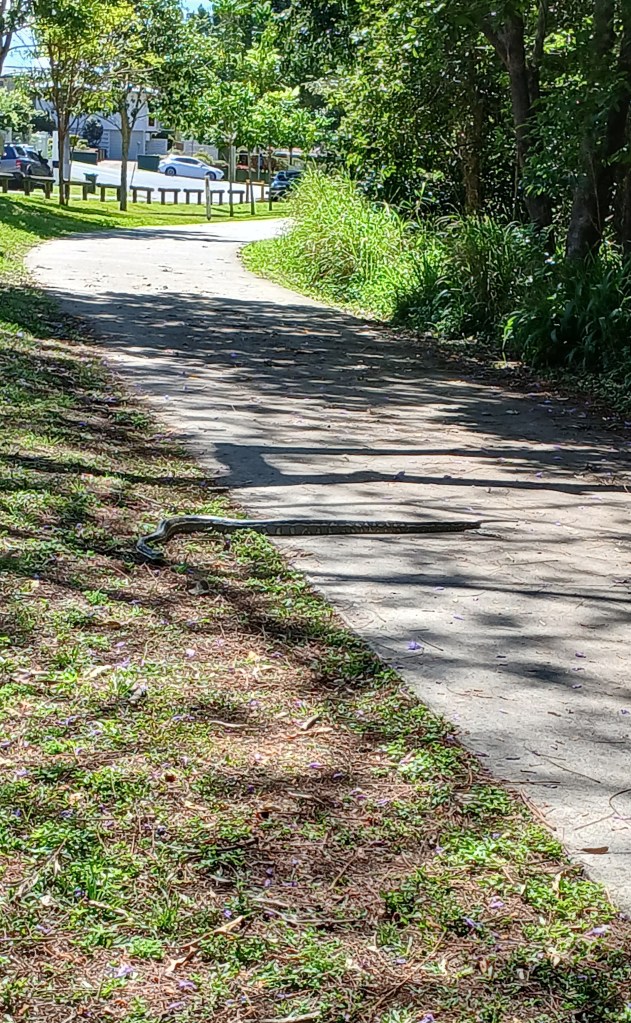
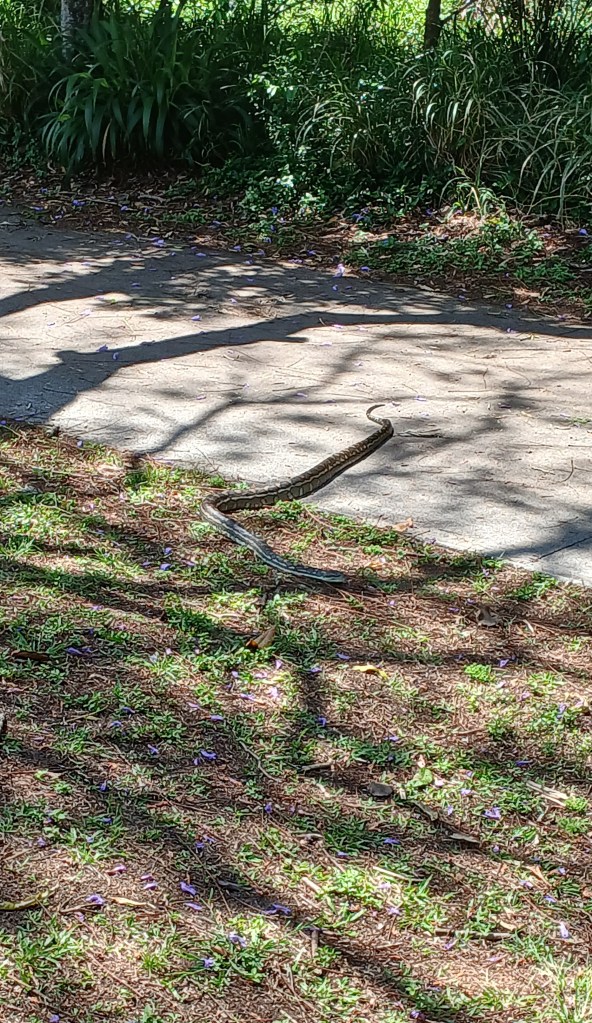
MY PHOTOGRAPHS show a carpet python resting on the pathway where I walk beside the creek. It prompted this blog entry. I have added the wonderful D.H. Lawrence ‘Snake’ poem in a similar vein although much deeper and more meaningful than something I could write. 🧡 Gretchen Bernet-Ward 2024
MY EXPERIENCE felt almost primordial. The snake must have just woken from its winter slumber and was enjoying the September spring sunshine and the warmth of the concrete path. It looked a bit thin and I hoped it wasn’t unwell. Perhaps it had not yet eaten, not fattened up on creek rats and other creatures of the murky water mixed with suburban drains. This carpet snake had chosen to stop just in line with the shadows of the tree branches. An instinctive gesture? But I saw him first. I spoke to him/her (are living things really its) in a conversational tone saying ‘Now don’t you go up that embankment to the road. It wouldn’t be a good idea.’ The head turned and watched me as I snapped two photos and walked up the grassy embankment and stepped between the low pine-log fence posts. I looked around but saw no-one. It was nice to know a cyclist or mother with a pram were not coming this way. Poor python, he’d never get lunch if he attracted a crowd. I hope that patterned smooth skinned creature grows and matures and lives a quiet life. He’s probably asleep now on a flat grey rock at the edge of the creek, a bulge in that otherwise slim body. I went on my way to post a letter, how old-fashioned of me. GBW.
‘Snake’ is one of the best-known poems from D. H. Lawrence’s nature-themed collection Birds, Beasts and Flowers (1923) D.H. Lawrence was born 11th September 1885, Eastwood, Nottinghamshire, England and died 2nd March 1930, in Vence, France. He was an English author of novels, short stories, poems, plays, essays, travel books and letters. His ‘Snake’ poem is in the public domain.
‘SNAKE’ by POET D.H. LAWRENCE A snake came to my water-trough On a hot, hot day, and I in pyjamas for the heat, To drink there.
In the deep, strange-scented shade of the great dark carob tree I came down the steps with my pitcher And must wait, must stand and wait, for there he was at the trough before me.
He reached down from a fissure in the earth-wall in the gloom And trailed his yellow-brown slackness soft-bellied down, over the edge of the stone trough And rested his throat upon the stone bottom, And where the water had dripped from the tap, in a small clearness, He sipped with his straight mouth, Softly drank through his straight gums, into his slack long body, Silently.
Someone was before me at my water-trough, And I, like a second-comer, waiting.
He lifted his head from his drinking, as cattle do, And looked at me vaguely, as drinking cattle do, And flickered his two-forked tongue from his lips, and mused a moment, And stooped and drank a little more, Being earth-brown, earth-golden from the burning bowels of the earth On the day of Sicilian July, with Etna smoking.
The voice of my education said to me He must be killed, For in Sicily the black, black snakes are innocent, the gold are venomous.
And voices in me said, If you were a man You would take a stick and break him now, and finish him off.
But must I confess how I liked him, How glad I was he had come like a guest in quiet, to drink at my water-trough And depart peaceful, pacified, and thankless, Into the burning bowels of this earth?
Was it cowardice, that I dared not kill him? Was it perversity, that I longed to talk to him? Was it humility, to feel honoured? I felt so honoured.
And yet those voices: If you were not afraid you would kill him.
And truly I was afraid, I was most afraid, But even so, honoured still more That he should seek my hospitality From out the dark door of the secret earth.
He drank enough And lifted his head, dreamily, as one who has drunken, And flickered his tongue like a forked night on the air, so black, Seeming to lick his lips, And looked around like a god, unseeing, into the air, And slowly turned his head, And slowly, very slowly, as if thrice adream, Proceeded to draw his slow length curving round And climb again the broken bank of my wall-face.
And as he put his head into that dreadful hole, And as he slowly drew up, snake-easing his shoulders, and entered further, A sort of horror, a sort of protest against his withdrawing into that horrid black hole, Deliberately going into the blackness, and slowly drawing himself after, Overcame me now his back was turned.
I looked round, I put down my pitcher, I picked up a clumsy log And threw it at the water-trough with a clatter.
I think it did not hit him, But suddenly that part of him that was left behind convulsed in undignified haste, Writhed like lightning, and was gone Into the black hole, the earth-lipped fissure in the wall-front, At which, in the intense still noon, I stared with fascination.
And immediately I regretted it. I thought how paltry, how vulgar, what a mean act! I despised myself and the voices of my accursed human education.
And I thought of the albatross, And I wished he would come back, my snake.
For he seemed to me again like a king, Like a king in exile, uncrowned in the underworld, Now due to be crowned again.
And so, I missed my chance with one of the lords of life. And I have something to expiate: A pettiness.
POSTSCRIPT Morelia spilota, commonly known as the carpet python, is a large snake of the family Pythonidae found in Australia, New Guinea, Bismarck Archipelago, and the northern Solomon Islands.
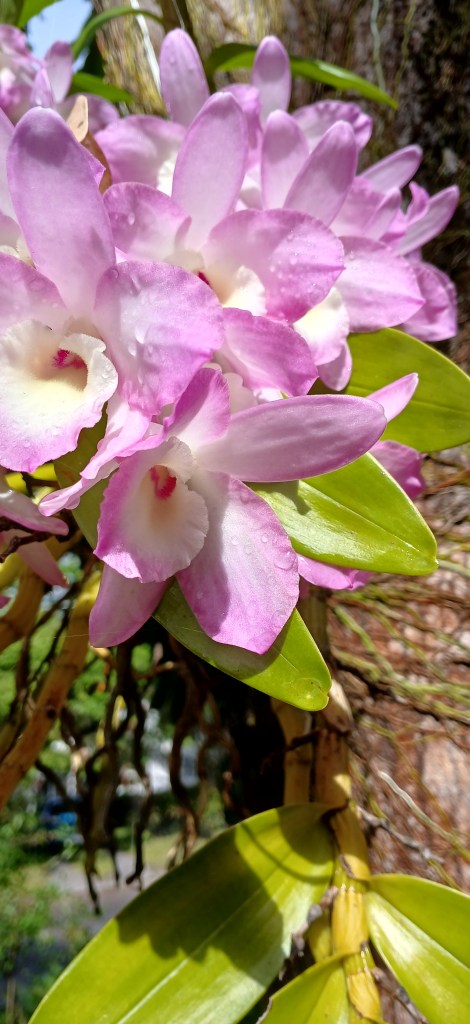
Our tree orchid is thought to be an Orchid Dendrobium native of the Asia-Pacific region. Maybe even a Cymbidium Orchid. I have checked various sources (eBay included) and almost went cross-eyed with the stunning varieties but cannot find an exact match. Do orchids change regularly like fashion? Perhaps my WordPress friend (Literary Lad and horticulturist) Graham Wright has the answer. GBW.
Our tree orchid flowers every September, springtime in Brisbane, and coincides with my birthday every year. It features in many, many happy family photographs and it is the most hardy exotic flowering plant I have ever known. It wraps its delicate tendrils around an old Illawarra Flame Tree and they seem to enjoy each others company. Through drought, flooding rains and intense summer heat, it happily covers its stalks in pink flowers, needing no special care, and survives even when the possums take a nibble or two. There are suspicions that the blooms were ‘stolen’ one year when in full flower. It could have been ravenous possums, or a neighbour making a bouquet for a wedding, or perhaps a floral display at the local aged care centre. At least I like to think they were used for something lovely and not financial gain. I myself have never picked them and I doubt I ever will.
Linda wasn’t quite sure if she should go. After all she had never been invited into the manager’s office upstairs.
Viv the senior receptionist snapped “Please put this envelope on his desk,” then added ominously “and come straight back.”
Possibly seeing the shock and hesitancy in the young girl’s eyes, Viv softened her voice. “Go on, love, he won’t bite and you’ll be back in time for the fire drill.”
It wasn’t biting or fire drill that Linda was worried about. His temper was known throughout the industry, voices were lowered in his presence, the accountant scampered around, flapping papers for signatures when a meeting was due, and shareholders routinely refused tea and biscuits on the pretext of another urgent meeting.
There was no staff interaction and she had the feeling that the boss did not know their names, or did not care, because they came and went on a regular basis. What if he shouted at her? What if she fainted? But Linda enjoyed her reception work, the customers were nice, although edgy, constantly looking over their shoulders.
The small flat switchboard was new and easy to use and the company name was not hard to pronounce when she answered in that singsong voice of all new receptionists.
Plus she had an intercom and a proper ergonomic faux leather desk chair which swivelled.
The other employees were mildly friendly as if to keep her at arms length because she could be gone by the end of the month. She needed this job, she was going to stick it out, and the gloss had not yet worn off. However, she did not want to have anything to do with the notorious Mr. Arthur Roberts of Roberts & Co Pty Ltd.
Linda whispered to one of the office girls “Maybe it would be better if you popped it on his desk, Joanne.” The reply was quick. “Too busy minding your switchboard.”
“Get hopping,” instructed Viv, “and put it in the middle of the sheet of blotting paper on his desk.” Apparently Mr. Roberts still used a fountain pen. Occasionally it leaked Quink and he often requested a document be retyped due to a spreading stain.
Linda thought it was all too quaint and old-fashioned compared to what she was taught in business college but she went along with it. Until he started shouting at someone.
One of her duties was typing invoices on the new IBM Golf Ball typewriter. It made a satisfying clatter. And for the time being she was the envy of her friends, many of whom had left school to work in the public service or one of the lesser banks in town. Linda had her sights set on the travel industry and the glamour of free flights. Leaving Roberts & Company far behind.
Ignoring the office boy’s wink, she stood up and tucked a strand of hair behind her ear before smoothing her dress, always grateful she did not have to wear a skirt and blouse emblazoned with the company name. An airline hostess uniform would be far more elegant.
The shaky old lift in the foyer stank of cigarettes and Linda had taken an instant dislike to it. Fortunately it only took a few minutes to go up the back stairs where she emerged onto the luxurious deep blue carpet of the fifth floor. Then realisation hit her.
The envelope was still on her desk.
With a huff of annoyance, she was turning back to the stairwell when she heard raised voices. One, of course, was Mr. Roberts and the other was a very angry woman. Moving a bit closer she saw that Mr. Roberts office door was ajar so she stood listening. It was obviously an argument over money. She had heard enough of those from her parents when her father handed over his weekly pay packet.
Linda sucked in a deep breath then slowly, inexorably, found herself drawn towards the heavily panelled door. There was a gasp, the sound of a pained groan and something fell. A spurt of adrenaline coursed through her body before her brain caught up. She turned back to the stairwell door but was too late to stop a fast moving woman reaching it first.
This wild-eyed woman sported a nasty red stain across her chest but had no difficulty in pushing Linda aside. Just as the woman entered the fire door, Linda went into her brother’s favourite soccer slide. She tripped the woman who staggered down several metal steps before falling flat on her face on the next level. There was a metallic clang as a knife fell from her grasp.
“Hey, what’s going on up there?” shouted Viv from below.
A wet cough behind Linda made her turn around, slowly, slowly.
There was Mr. Roberts. He stood with his face the same shade as the blotting paper pressed against his left shoulder. “I’ve buzzed security,” he said. “Best if you ring for an ambulance.” He swayed then sank to the plush carpet and passed out.
“Viv,” screamed Linda, “get the first aid kit!”
At home next day, after several telephone calls from police and workmates, Linda was told different versions of what must have transpired but the knife wound was definitely inflicted by Mr. Robert’s estranged wife Eileen.
“The person you sent catapulting down the back stairs,” Viv observed dryly, “that’s one way to miss fire drill.” The envelope remained undelivered.
Mr. Roberts was recovering in hospital and probably shouting at the nurses. Eileen was held in another wing under police guard pending investigation. Linda, on the other hand, was ensconced at home in her favourite lounge chair, feet up and a big bowl of mixed lollies beside her on the TV tray.
“What if I had not gone up those stairs?” Linda mused, then shrugged it off.
“It was the shock really,” she explained to everyone who called to asked how she was feeling. “My legs just went all wobbly.” That was her story and she was sticking to it.
NOTE: Originally titled “What If” a Short Story for U3A Writing Class read at end-of-term. Fictional events but some elements are retro autobiographical. First draft Wednesday 4th September 2024. GBW.
The Centenary Theatre Group, a company based in Chelmer, Brisbane, has made an official announcement calling for actors to fill roles in Agatha Christie’s inimitable stage production of ‘Verdict’ with opening night in November 2024. You may like Agatha Christie novels, or perhaps keen to tread the boards with this seasoned amateur group, read on—
SYNOPSIS Karl Hendryk, a brilliant professor who, with his wife and her cousin, have fled persecution in their homeland to find themselves ensconced in London. This stage play revolves around human experience and relationships. ‘It satisfied me completely. I still think it is the best play I have written with the exception of Witness for the Prosecution,’ said Agatha Christie.
AUDITION For Centenary Theatre Group PRODUCTION OF ‘VERDICT’ by Agatha Christie (opening November 2024) TIME & DATE: 2.00PM SATURDAY 14 SEPTEMBER 2024 LOCATION: CHELMER COMMUNITY HALL, 15 QUEENSCROFT STREET, CHELMER, BRISBANE. GOOGLEhttps://maps.app.goo.gl/GPWBBYnpwgjcncKS7
‘Verdict’ Written by Agatha Christie Directed by David Bell ‘Verdict’ is a 1958 stage play by British mystery writer Agatha Christie. It is unusual from other Agatha Christie plays: it is an original not based on a story or novel and, although there is a murder, it is more than a typical ‘whodunnit’ mystery.
CAST REQUIRED Lester Cole 25 years old. Mrs Roper 40 years old plus, gruff and rude. Lisa Koletzky Early 30’s, attractive. Professor Karl Hendryk 45 and handsome (German accent). Anya Hendryk 38, invalided in wheelchair and Karl’s wife (German accent). Dr Stone 60 years old and a typical family doctor. Helen Rollander age 23 and beautiful. Sir William Rollander middle age, tall and Helen’s father. Detective Inspector Ogden 40’s and pleasant nature. Police Sergeant Pearce sergeant’s age open, mid-thirties plus. NOTE All cast need to be proficient in English accents.
SETTING This 2-act play will be set in the year it was written – 1958. ‘Verdict’ is one of only a few Christie plays written directly for the stage and not adapted from another story. It originally opened at Strand Theatre in West End, London, May 1958.