Great excitement is being generated by the forthcoming stage production from Centenary Theatre Group featuring the famous crime duo Sherlock Holmes and Dr Watson. Script by Jeffrey Hatcher. Directed by Gary Kliger. Audition time: 10am Saturday 23rd August 2025 Place: Cnr Queenscroft and Halsbury Streets, Chelmer, Brisbane, Queensland Australia.
SYNOPSIS QUOTE: The world is shocked! The famous detective Sherlock Holmes and his nemesis Moriarty are dead, locked in combat, both falling into the treacherous Reichenbach Falls. Holmes is dead — but is he? Dr Evan’s who runs an asylum on an island, a desolate location, has in his care three men who each claim to be the real Sherlock Holmes. Who can work out which of them is the real Holmes? Who else but Dr Watson. Surely Holmes’ best friend and confidant?
AND: That’s just the start! This is a twisty, teasing romp, designed to baffle and entertain in equal measure. Come and be part of the theatre fun!
CAST REQUIRED: Dr Evans – age open though probably best 30s to 50s. Dr Watson – age open though same range suggested as for Evans. Orderly at the asylum – age range the same. Matron/The woman doubling up role – age open dazzle us. Holmes 1 tall, thin, sharp featured classic Holmes. Holmes 2 same as H1 but with long hair, moustache and beard. Holmes 3 same as H1 but shaved head, pale face, glazed look. The Inspector’s age is open and may double with a Holmes depending upon timing and costuming. The Client wears a mask/doubles with Moriarty. Moriarty age open seen in flashbacks.
STAGE NOTE: There is fight scene choreography needed so anyone with stage combat skills come and make yourself known! This is an escapade of the most exhilarating kind, perfect as the CTG end of year production. They cannot wait to have you be a part of it! So don’t forget Chelmer auditions 10am Saturday 23rd August 2025.
ACKNOWLEDGMENTS: Holmes & Watson audition details received from Centenary Theatre Group Inc, Queenscroft and Halsbury Streets, Chelmer, QLD 4068 Australia. Sign up to get their opening night news direct. https://centenarytheatre.com.au/faqs/
I will certainly book tickets when the box office opens. 💗 Gretchen Bernet-Ward 2025
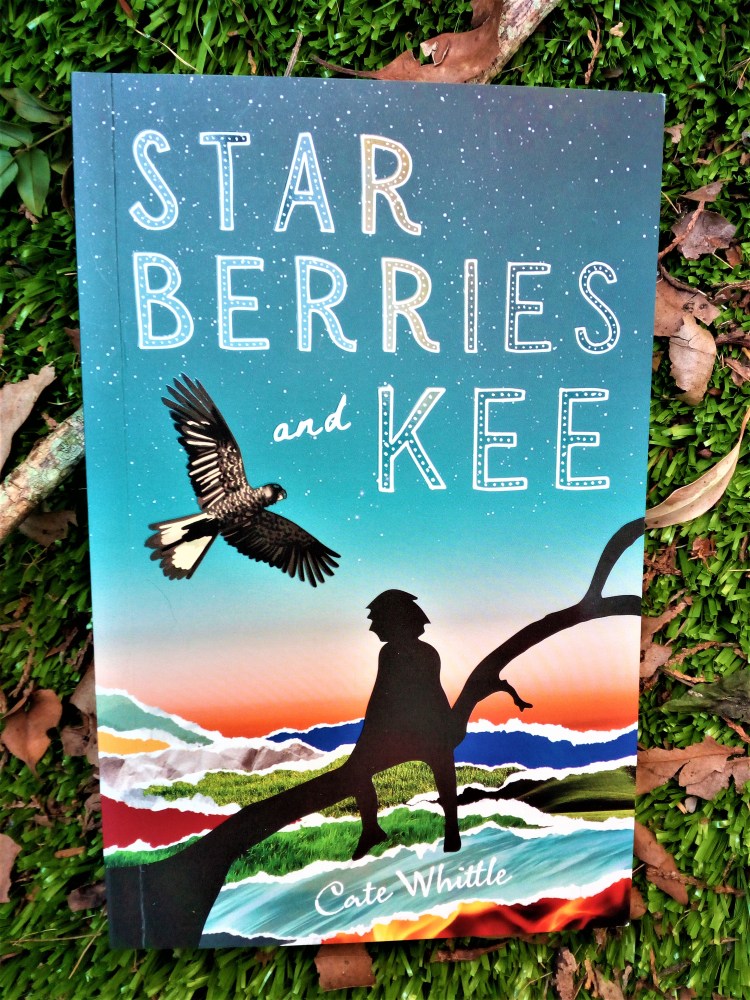
A wonderful children’s author I have known for some time, Cate Whittle, posted on her Substack page about success and failure and trying again. A cooking failure was turned around and she will experiment further to refine her recipe. Read here: https://catewhittle.substack.com/p/having-your-cake
My reply to Cate was prompted by a happy memory and perhaps an old lesson people could use more often. ‘If at first you don’t succeed, try, try, again.‘ Here is what I wrote on Cate’s July Substack page:
“Lovely, just what I needed to read with my cuppa! Your warming newsletter brought back some lovely memories of my daughter’s first foray into cooking. Initially, her first attempts were not that good and one particular dish was a disaster. I said ‘Oh well, let’s try it again and see what happens‘ and fortunately it worked. She is now an excellent cook and will try most recipes including exotic international dishes which are beyond me. We keep a photo file of my daughter’s greatest triumphs. Recently she told me that ‘Let’s try it again‘ day was a pivotal moment for her cooking skills.
Looking forward to another version of your tea cake, Cate!” Follow Cate’s literary life ‘A Cuppa With Cate’ Substackhttps://catewhittle.substack.com/
Our current era has been around for 60 million years and gradually comprised every species including mammals currently living on earth today – regardless of their circumstances or how much they sleep.
What is this Cenozoic Era? A time when Earth’s flora and fauna evolved into those of the present day.
The Cenozoic ‘New Life’ era can also be named ‘Age of Mammals’. Interestingly we humans often don’t care very well for other humans or our animal mammals do we?
My theory: This could be why past civilisations and animal species died out and are still disappearing.
Is this a good thing or a bad thing? I personally dislike AI on the grounds that it does not enhance knowledge, it takes away incentive to pursue and learn. Anyway, I was scanning my stats and noticed that twice I have been viewed and possibly, hopefully, ‘recommended’ by Artificial Intelligence as a source for two readers. Okay, that’s kind of flattering but what post of mine was viewed/recommended? Who was the reader? Will this offer any benefit to me?
Importantly, have I been acknowledged as the original source?
I guess once I put my work out there, it stands to reason it will be seen and read and maybe used, but we bloggers always acknowledge our source or include a website link especially to anything we re-post.
Artificial Intelligence (like most of the internet) has been launched on the world wide web without workable social, legal, ethical or cultural boundaries. Humankind may melt down into one homogenous mass. Perfect conditions for a maniacal dictator.
Lots of questions need to be answered, especially since an AI ‘borrower’ cannot be traced. At least not by me, so I may never know the source or where my material ends up. How can I truly know where my blog posts end up anyway? Certainly readers can cut and paste anything they like but they are genuine readers. I think a faceless nameless Artificial Intelligence is invasive until proven otherwise.
Ask a human novelist about AI rip-offs and AI non-existent royalties. Meta allegedly used pirated books to train AI. Jonathan Franzen, John Grisham, Jodi Picoult, George R.R. Martin and others have filed a class-action suit, still unresolved, alleging OpenAI Inc copied their works without permission or payment. https://www.theguardian.com/books/2023/sep/20/authors-lawsuit-openai-george-rr-martin-john-grisham
Of course many people will benefit. There are quite a lot of AI sites out there, Gemini, Claude, Copilot, etc, the first being Perplexity AI. Also Character.ai is a neutral (as if!) language model chatbot service. Another human job lost? Of course, there are strong opinions on all of this and numerous disagreements for various reasons.
We humans like shortcuts more than memory retention. Ask anyone studying. Internet users can take a detour but often it can misdirect or misinform, as in the case of a person who used ChatGPT for a literary book club review and gave a dry, soulless analysis of the story. In my opinion, do your own homework.
I like to personally do my own web surfing and pick up interesting and genuinely human stuff along the way – alternatively I read words on real paper. Under my mythical (as in not real) Creepy or Could-be section, I imagine one future day an AI bot will activate a microchip implant in a school student’s brain which will find web logs (blogs) or text books and release classic volumes straight into their grey matter.
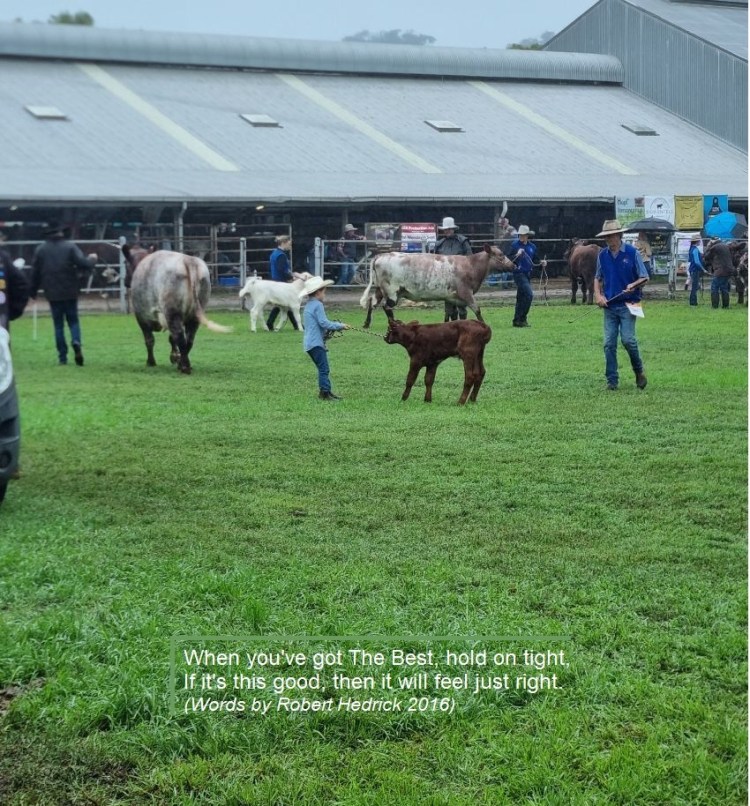
….you don’t succeed, try, try again. This young wrangler is just as determined as his calf. After a bit of encouragement, then some serious tugging, the calf relinquished its stance and trotted along with the boy. My photograph was taken at the Toowoomba Royal Show, a yearly event showcasing all things country. From animals to artwork, photography, flowers, fruit and wonderfully handmade arts and crafts. Of course there was produce and vegetable displays (a huge pumpkin!) plus cookery prizes and a plethora of handmade goods from soap to hats and even a whip-cracking demonstration.
I am not a fan of sideshow alley so detoured the rides full of screaming people and investigated the horse arena, so beautiful, the precision, the presentation, those trotting horses were as well groomed as their riders. Next was a huge shed full of model trains whizzing around elaborate tracks. The ‘station master’ set up a particularly long train for me to video and he watched on with pride as it weaved in and out of hills down to the railway station with realistic sound against a country town backdrop. Miniature train heaven!
Countless stallholders goods tempted me but those ubiquitous hot chips were a magnet not to be ignored because the weather was rainy and show-goers were wet and feeling the cold. So very unusual for Queensland! On theme, there was an aquatic acrobat display on the lake. After watching the adorable dogs trotting around their own mini arena in the rain, it was time to think about the animals in the huge (dry) sheds across the vast site; sheep, goats, cows, chickens, etc. The rain curtailed some arena events but there was certainly enough to enjoy. The relaxed people, the fresh country air and lush green grass was totally worth it.
The People First Bank Toowoomba Royal Show is an unrivalled production of the very best in entertainment and agriculture displays on the Darling Downs Queensland since 1860. https://www.toowoombashow.com.au/royal-show/entertainment/
Here is the official version: Every yearthis show has new entertainment for the whole family, enjoy world class acts, competitions and exhilarating rides in sideshow alley, plus livestock, show judging, produce and crafts. Of course, there is always agricultural equipment for the enthusiast. This year Toowoomba Royal Show was held from 27th to 29th March 2025. Over 500 volunteers assisted during the show. Without their dedication and effort this local event could not function. If you would like to volunteer at the People First Bank Toowoomba Royal Show 2026, please contact them via email at rasqadmin@rasq.com.au for a great experience.
The building in my photograph, with the two people either cleaning or repairing the clock tower, are on the Ann Street side of the Roma Street railway station in Brisbane. These intrepid workers could see a view across ANZAC Square to the General Post Office which denotes the centre of the city. Officially the station area is known as Brisbane Passenger Station, Brisbane Terminal Station, and Brisbane Terminus yet, surprisingly, on the main façade at the Ann Street entry level there is an art deco-style sign proclaiming ‘Central Station’ and that is what the majority of commuters name it.
The train platforms can be accessed a number of ways but I guess these intrepid workers either came from inside the clock tower or climbed up it. The BCC bus sign seems to have spotted them but the commuters below failed to see what was unfolding. The two workers were untangling their ropes!
My bus came and I will never know what transpired that day.
💗 Gretchen Bernet-Ward 2025
On theme, this steam roller is different but of the same era. Queen’s Park, Toowoomba, Queensland.
Public libraries are a privilege, the right of everyone to freely borrow, read and return books. In my opinion readers do not have the right to eat or drink over a library book.
It doesn’t happen regularly but I don’t want to see a smeared thumb print, a coffee stain, toast crumbs or bath water-wrinkled edges of carelessness. Food blobs or drink spills are not acceptable and are downright contemptuous, showing no respect for the book, the author of the book, the library staff and ultimately all other library patrons.
A definition of cruelty is to crack the spine of a new book. What arrogance the reader of a new book must have to think they possess the right to break the binding? The self-entitled recipient of a new library book must believe that, because the books cost them nothing, they have the right to fracture the binding which marks the spine of the book inside and out and weakens the support of the pages.
Then, adding insult to injury, they have the audacity to fold the corners of a page to mark their place. Some of these book-bullies think they are discreet, they will fold a tiny portion of the page corner as to be almost unnoticeable – so they think. Often exploited is a small rip in the page. Instead of using a flat bookmark, a random piece of paper or library checkout slip, they weaken and deface the pages for future readers.
Borrowing books written from throughout the world, every genre for every age group, is a wonderful service but a grubby-fingered book is not wonderful. Keep it clean for the next reader. Of course, if you read e-books or listen to audio-books this does not apply. Should a mishap occur (e.g. your budgerigar nibbled ‘War & Peace’) please draw it to the attention of library staff. Even a note inside the book will assist the librarian in discard or damage repair.
A level of care and thoughtfulness applies to all items including magazines and DVDs borrowed from any library. Remember, it’s a no-no to initial the back page of a book to indicate you have read it. Oh, and don’t forget to remove your bookmark especially if it’s a favourite. Many backroom library walls are papered with beautiful bookmarks which nobody claimed. Happy reading!
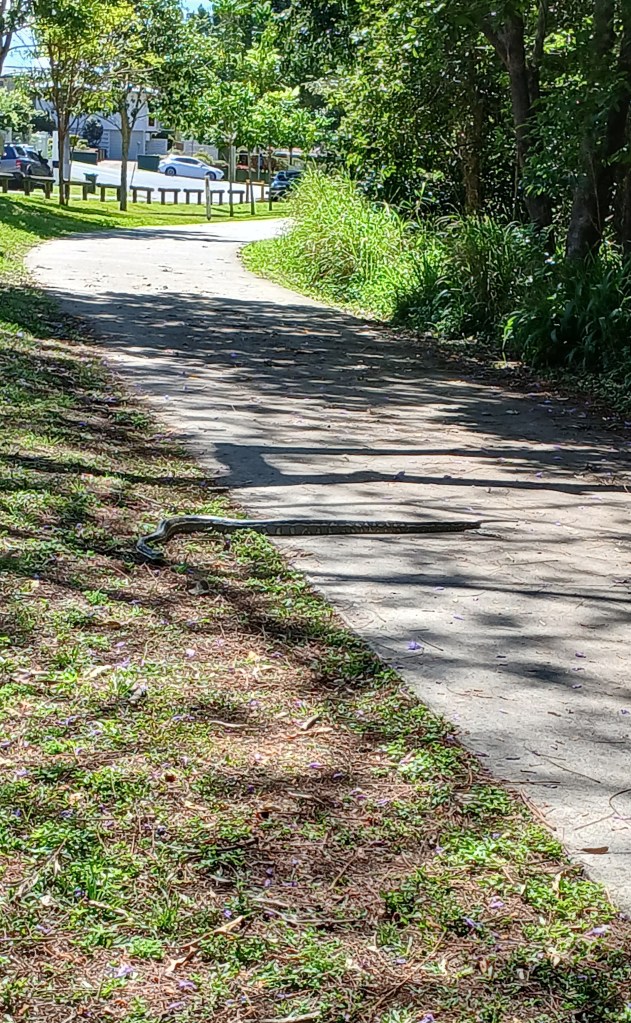
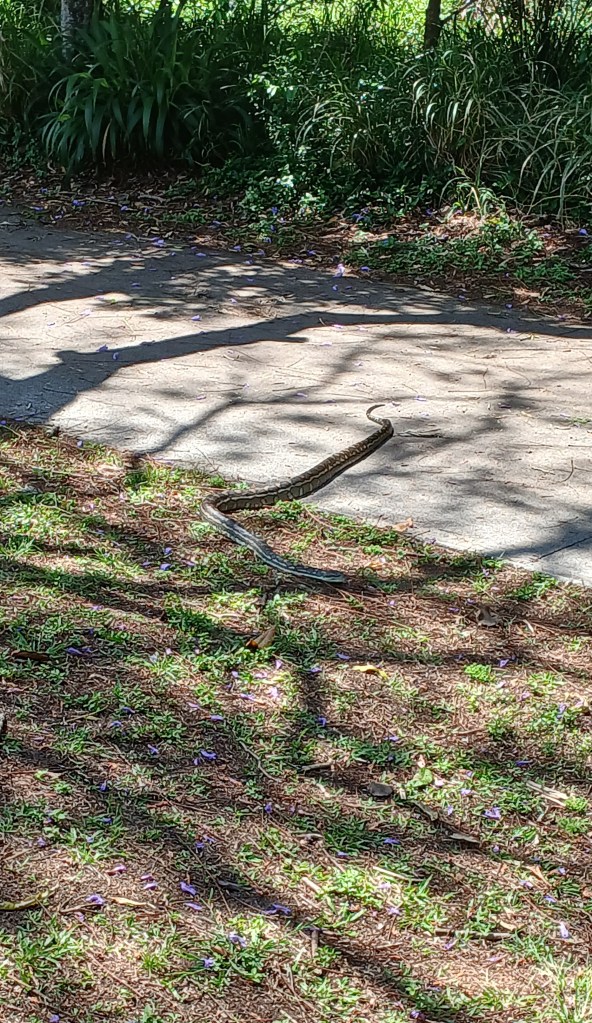
MY PHOTOGRAPHS show a carpet python resting on the pathway where I walk beside the creek. It prompted this blog entry. I have added the wonderful D.H. Lawrence ‘Snake’ poem in a similar vein although much deeper and more meaningful than something I could write. 🧡 Gretchen Bernet-Ward 2024
MY EXPERIENCE felt almost primordial. The snake must have just woken from its winter slumber and was enjoying the September spring sunshine and the warmth of the concrete path. It looked a bit thin and I hoped it wasn’t unwell. Perhaps it had not yet eaten, not fattened up on creek rats and other creatures of the murky water mixed with suburban drains. This carpet snake had chosen to stop just in line with the shadows of the tree branches. An instinctive gesture? But I saw him first. I spoke to him/her (are living things really its) in a conversational tone saying ‘Now don’t you go up that embankment to the road. It wouldn’t be a good idea.’ The head turned and watched me as I snapped two photos and walked up the grassy embankment and stepped between the low pine-log fence posts. I looked around but saw no-one. It was nice to know a cyclist or mother with a pram were not coming this way. Poor python, he’d never get lunch if he attracted a crowd. I hope that patterned smooth skinned creature grows and matures and lives a quiet life. He’s probably asleep now on a flat grey rock at the edge of the creek, a bulge in that otherwise slim body. I went on my way to post a letter, how old-fashioned of me. GBW.
‘Snake’ is one of the best-known poems from D. H. Lawrence’s nature-themed collection Birds, Beasts and Flowers (1923) D.H. Lawrence was born 11th September 1885, Eastwood, Nottinghamshire, England and died 2nd March 1930, in Vence, France. He was an English author of novels, short stories, poems, plays, essays, travel books and letters. His ‘Snake’ poem is in the public domain.
‘SNAKE’ by POET D.H. LAWRENCE A snake came to my water-trough On a hot, hot day, and I in pyjamas for the heat, To drink there.
In the deep, strange-scented shade of the great dark carob tree I came down the steps with my pitcher And must wait, must stand and wait, for there he was at the trough before me.
He reached down from a fissure in the earth-wall in the gloom And trailed his yellow-brown slackness soft-bellied down, over the edge of the stone trough And rested his throat upon the stone bottom, And where the water had dripped from the tap, in a small clearness, He sipped with his straight mouth, Softly drank through his straight gums, into his slack long body, Silently.
Someone was before me at my water-trough, And I, like a second-comer, waiting.
He lifted his head from his drinking, as cattle do, And looked at me vaguely, as drinking cattle do, And flickered his two-forked tongue from his lips, and mused a moment, And stooped and drank a little more, Being earth-brown, earth-golden from the burning bowels of the earth On the day of Sicilian July, with Etna smoking.
The voice of my education said to me He must be killed, For in Sicily the black, black snakes are innocent, the gold are venomous.
And voices in me said, If you were a man You would take a stick and break him now, and finish him off.
But must I confess how I liked him, How glad I was he had come like a guest in quiet, to drink at my water-trough And depart peaceful, pacified, and thankless, Into the burning bowels of this earth?
Was it cowardice, that I dared not kill him? Was it perversity, that I longed to talk to him? Was it humility, to feel honoured? I felt so honoured.
And yet those voices: If you were not afraid you would kill him.
And truly I was afraid, I was most afraid, But even so, honoured still more That he should seek my hospitality From out the dark door of the secret earth.
He drank enough And lifted his head, dreamily, as one who has drunken, And flickered his tongue like a forked night on the air, so black, Seeming to lick his lips, And looked around like a god, unseeing, into the air, And slowly turned his head, And slowly, very slowly, as if thrice adream, Proceeded to draw his slow length curving round And climb again the broken bank of my wall-face.
And as he put his head into that dreadful hole, And as he slowly drew up, snake-easing his shoulders, and entered further, A sort of horror, a sort of protest against his withdrawing into that horrid black hole, Deliberately going into the blackness, and slowly drawing himself after, Overcame me now his back was turned.
I looked round, I put down my pitcher, I picked up a clumsy log And threw it at the water-trough with a clatter.
I think it did not hit him, But suddenly that part of him that was left behind convulsed in undignified haste, Writhed like lightning, and was gone Into the black hole, the earth-lipped fissure in the wall-front, At which, in the intense still noon, I stared with fascination.
And immediately I regretted it. I thought how paltry, how vulgar, what a mean act! I despised myself and the voices of my accursed human education.
And I thought of the albatross, And I wished he would come back, my snake.
For he seemed to me again like a king, Like a king in exile, uncrowned in the underworld, Now due to be crowned again.
And so, I missed my chance with one of the lords of life. And I have something to expiate: A pettiness.
POSTSCRIPT Morelia spilota, commonly known as the carpet python, is a large snake of the family Pythonidae found in Australia, New Guinea, Bismarck Archipelago, and the northern Solomon Islands.
The Centenary Theatre Group, a company based in Chelmer, Brisbane, has made an official announcement calling for actors to fill roles in Agatha Christie’s inimitable stage production of ‘Verdict’ with opening night in November 2024. You may like Agatha Christie novels, or perhaps keen to tread the boards with this seasoned amateur group, read on—
SYNOPSIS Karl Hendryk, a brilliant professor who, with his wife and her cousin, have fled persecution in their homeland to find themselves ensconced in London. This stage play revolves around human experience and relationships. ‘It satisfied me completely. I still think it is the best play I have written with the exception of Witness for the Prosecution,’ said Agatha Christie.
AUDITION For Centenary Theatre Group PRODUCTION OF ‘VERDICT’ by Agatha Christie (opening November 2024) TIME & DATE: 2.00PM SATURDAY 14 SEPTEMBER 2024 LOCATION: CHELMER COMMUNITY HALL, 15 QUEENSCROFT STREET, CHELMER, BRISBANE. GOOGLEhttps://maps.app.goo.gl/GPWBBYnpwgjcncKS7
‘Verdict’ Written by Agatha Christie Directed by David Bell ‘Verdict’ is a 1958 stage play by British mystery writer Agatha Christie. It is unusual from other Agatha Christie plays: it is an original not based on a story or novel and, although there is a murder, it is more than a typical ‘whodunnit’ mystery.
CAST REQUIRED Lester Cole 25 years old. Mrs Roper 40 years old plus, gruff and rude. Lisa Koletzky Early 30’s, attractive. Professor Karl Hendryk 45 and handsome (German accent). Anya Hendryk 38, invalided in wheelchair and Karl’s wife (German accent). Dr Stone 60 years old and a typical family doctor. Helen Rollander age 23 and beautiful. Sir William Rollander middle age, tall and Helen’s father. Detective Inspector Ogden 40’s and pleasant nature. Police Sergeant Pearce sergeant’s age open, mid-thirties plus. NOTE All cast need to be proficient in English accents.
SETTING This 2-act play will be set in the year it was written – 1958. ‘Verdict’ is one of only a few Christie plays written directly for the stage and not adapted from another story. It originally opened at Strand Theatre in West End, London, May 1958.
Originally published in the American Magazine (September 1928) and included in the Philo Vance Investigates omnibus. Reproduced here (September 2024) as one big scroll almost a century later.
Full credit goes to author S.S. Van Dine, AKA Willard Huntington Wright who was born 15th October 1888, Charlottesville, Virginia, USA. He died 11th April 1939 (aged 50) New York City, USA.
THE DETECTIVE STORY is a kind of intellectual game. It is more — it is a sporting event. And for the writing of detective stories there are very definite laws — unwritten, perhaps, but none the less binding; and every respectable and self-respecting concocter of literary mysteries lives up to them. Herewith, then, is a sort of Credo, based partly on the practice of all the great writers of detective stories, and partly on the promptings of the honest author’s inner conscience. To wit:
1. The reader must have equal opportunity with the detective for solving the mystery. All clues must be plainly stated and described.
2. No wilful tricks or deceptions may be placed on the reader other than those played legitimately by the criminal on the detective himself.
3. There must be no love interest. The business in hand is to bring a criminal to the bar of justice, not to bring a lovelorn couple to the hymeneal altar.
4. The detective himself, or one of the official investigators, should never turn out to be the culprit. This is bald trickery, on a par with offering someone a bright penny for a five-dollar gold piece. It’s false pretences.
5. The culprit must be determined by logical deductions — not by accident or coincidence or unmotivated confession. To solve a criminal problem in this latter fashion is like sending the reader on a deliberate wild-goose chase, and then telling him, after he has failed, that you had the object of his search up your sleeve all the time. Such an author is no better than a practical joker.
6. The detective novel must have a detective in it; and a detective is not a detective unless he detects. His function is to gather clues that will eventually lead to the person who did the dirty work in the first chapter; and if the detective does not reach his conclusions through an analysis of those clues, he has no more solved his problem than the schoolboy who gets his answer out of the back of the arithmetic book.
7. There simply must be a corpse in a detective novel, and the deader the corpse the better. No lesser crime than murder will suffice. Three hundred pages is far too much pother for a crime other than murder. After all, the reader’s trouble and expenditure of energy must be rewarded.
8. The problem of the crime must be solved by strictly naturalistic means. Such methods for learning the truth as slate-writing, ouija-boards, mind-reading, spiritualistic séances, crystal-gazing and the like, are taboo. A reader has a chance when matching his wits with a rationalistic detective, but if he must compete with the world of spirits and go chasing about the fourth dimension of metaphysics, he is defeated ‘ab initio’ ‘from the beginning’.
9. There must be but one detective — that is, but one protagonist of deduction — one ‘deus ex machina’ ‘God from the machine’ ‘contrived solution‘. To bring the minds of three or four, or sometimes a gang of detectives to bear on a problem, is not only to disperse the interest and break the direct thread of logic, but to take an unfair advantage of the reader. If there is more than one detective the reader doesn’t know who his ‘conductor’ is. It’s like making the reader run a race with a relay team.
10. The culprit must turn out to be a person who has played a more or less prominent part in the story — that is, a person with whom the reader is familiar and in whom he takes an interest.
11. A servant must not be chosen by the author as the culprit. This is begging a noble question. It is a too easy solution. The culprit must be a decidedly ‘worthwhile person’ — one that wouldn’t ordinarily come under suspicion.
12. There must be but one culprit, no matter how many murders are committed. The culprit may, of course, have a minor helper or co-plotter; but the entire onus must rest on one pair of shoulders: the entire indignation of the reader must be permitted to concentrate on a single dark nature.
13. Secret societies, camorras, mafias, et al, have no place in a detective story. A fascinating and truly beautiful murder is irremediably spoiled by any such wholesale culpability. To be sure, the murderer in a detective novel should be given a sporting chance; but it is going too far to grant him a secret society to fall back on. No high-class, self-respecting murderer would want such odds.
14. The method of murder, and the means of detecting it, must be rational and scientific. That is to say, pseudo-science and purely imaginative and speculative devices are not to be tolerated in ‘roman policier’ ‘romantic police officer’. Once an author soars into the realm of fantasy, in the Jules Verne manner, he is outside the bounds of detective fiction, cavorting in the uncharted reaches of adventure. (That’s changed!)
15. The truth of the problem must at all times be apparent — provided the reader is shrewd enough to see it. By this I mean that if the reader, after learning the explanation for the crime, should reread the book, he would see that the solution had, in a sense, been staring him in the face – that all the clues really pointed to the culprit — and that, if he had been as clever as the detective, he could have solved the mystery himself without going on to the final chapter. That the clever reader does often thus solve the problem goes without saying.
16. A detective novel should contain no long descriptive passages, no literary dallying with side-issues, no subtly worked-out character analyses, no ‘atmospheric’ preoccupations. such matters have no vital place in a record of crime and deduction. They hold up the action and introduce issues irrelevant to the main purpose, which is to state a problem, analyse it, and bring it to a successful conclusion. To be sure, there must be a sufficient descriptiveness and character delineation to give the novel verisimilitude.
17. A professional criminal must never be shouldered with the guilt of a crime in a detective story. Crimes by housebreakers and bandits are the province of the police departments — not of authors and brilliant amateur detectives. A really fascinating crime is one committed by a pillar of a church, or a spinster noted for her charities.
18. A crime in a detective story must never turn out to be an accident or a suicide. To end an odyssey of sleuthing with such an anti-climax is to hoodwink the trusting and kind-hearted reader.
19. The motives for all crimes in detective stories should be personal. International plottings and war politics belong in a different category of fiction — in secret-service tales, for instance. But a murder story must be kept ‘gemütlich’‘agreeable’, so to speak. It must reflect the reader’s everyday experiences, and give him a certain outlet for his own repressed desires and emotions.
20. And (to give my Credo an even score of items) I herewith list a few of the devices which NO self-respecting detective story writer will now avail himself. They have been employed too often, and are familiar to all true lovers of literary crime. To use them is a confession of the author’s ineptitude and lack of originality:
(a) Determining the identity of the culprit by comparing the butt of a cigarette left at the scene of the crime with the brand smoked by a suspect.
(b) The bogus spiritualistic séance to frighten the culprit into giving himself away.
(c) Forged fingerprints.
(d) The dummy-figure alibi.
(e) The dog that does not bark and thereby reveals the fact that the intruder is familiar.
(f) The final pinning of the crime on a twin, or a relative who looks exactly like the suspected, but innocent, person.
(g) The hypodermic syringe and the knockout drops.
(h) The commission of the murder in a locked room after the police have actually broken in.
(i) The word association test for guilt.
(j) The cipher, or code letter, which is eventually unravelled by the sleuth.
And there you have it. Not a modern gadget in sight!
Willard Huntington Wright (S.S. Van Dine) 1887-1939 Fantastic Fiction https://www.fantasticfiction.com/v/s-s-van-dine/ 1. The Benson Murder Case (1926) · 2. The Canary Murder Case (1927) · 3. The Greene Murder Case (1928) · 4. The Bishop Murder Case (1928) · 5. The Scarab Murder Case (1930)