Lucy V Hay ‘Criminally Good’ Advice

After reading Lucy V Hay’s two informative books “Writing and Selling Thriller Screenplays” and “How NOT to Write Female Characters” the next logical step was to subscribe to her website and learn more.

The first thing I noticed was that Lucy is very active and her site holds a plethora of information. Then I was delighted to receive a free copy of The Lynmouth Stories, three of Lucy’s short stories titled “In Plain Sight”, “Killing Me Softly” and “Hell and High Water”, twisters which certainly pack a psychological punch.

Here’s what it says on her website—

Lucy is an author and script editor, living in Devon with her husband, three children and six cats. She is the associate producer of Brit Thrillers Deviation (2012) and Assassin (2015) both starring Danny Dyer. See Lucy’s IMDB page HERE and other movies and short films she’s been involved in, HERE.

In addition to script reading and writing her own novels, Lucy also blogs about the writing process, screenwriting, genre, careers and motivation and much more at her blog Bang2write, one of the most-hit writing sites in the UK. Sign up for updates from B2W and receive a free 28 page ebook (PDF) on how NOT to write female characters, HERE or click the pic on her website.

For more scriptchat, leads and links, join Lucy’s online writing group, Bang2writers. It’s something I am going to explore further!

Gretchen Bernet-Ward

ADDENDUM—For a free copy of The Lynmouth Stories and more, join Lucy’s EMAIL LIST—My post heading comes from the title of Lucy’s email CRIMINALLY GOOD where she interviews fellow crime writers and asks them five questions.  She says “It’s fascinating to read their answers, especially as they are all so different!”  Today I have the choice of Ian Rankin, Sophie Hannah or Peter James. GBW. 

ANZAC Park in Toowong

20200808_141556

RECENTLY I was fortunate enough to take a pleasant stroll in a modest yet important piece of parkland.  From 1916 to the present day, ANZAC Park is one of the oldest ANZAC parks in the world – a war memorial and a green space for everyone.

I HAVE visited ANZAC Park on and off for many years and have seen some old trees removed and new ones planted, the circular roadway improved, a dog park installed, children’s area expanded, the duck lagoon which overflows or dries up depending on the seasons and, of course, enjoyed many picnics sitting on a tartan rug on the sloping hillside away from the hum of the city.

APPROXIMATELY 15 minutes or 7km from Brisbane CBD, in times gone by it was a day’s outing at the end of the tram line.  It is opposite the significant landmarks of Toowong Cemetery and Mt Coot-tha Botanic Gardens, linked by the Toowong pedestrian and cycle bridge recently named Canon Garland Overpass.

More on Canon Garland further down . . .

20200808_140904


ANZAC is the acronym formed from the initial letters of the Australian and New Zealand Army Corps.  This was the formation in which Australian and New Zealand soldiers in Egypt were grouped before the landing on Gallipoli in April 1915 during the First World War.


THE CONFLICT commemorated in ANZAC Park is the First World War 1914–1918 and memorial types were Garden/Avenue/Tree.  Inscriptions within the park consisted of small brass and metal plaques located in front of memorial trees, bearing the details of local men from the district who died at Gallipoli and on the Western Front.  No plaques remain today nor is there a stone monument.

YEARS of petitioning from a community-based campaign to honour the memory of Anglican clergyman and military chaplain Canon David Garland, the Queenslander who gave ANZAC Day to the world, culminated in the renaming of the pedestrian and cycle bridge which crosses the busy Western Freeway.  Officially named Canon Garland Overpass, it pays tribute to the man who championed the formation of “ANZAC Day” as our nation’s “All Souls’ Day”.

This photo was taken as I walked across the bridge – a safe yet disconcerting experience.

20200808_135138 Brisbane
Canon Garland Overpass for pedestrians and cyclists across Western Freeway at Toowong, Brisbane, looking towards Mt Coot-tha — the camera was held straight — View shows the enclosed AU$5.4 million overpass constructed between 2008-2009 and later renamed “Canon Garland Overpass” after the man who pioneered ANZAC Day. The bridge provides a safe way for pedestrians and cyclists to cross the busy Western Freeway with links to and from ANZAC Park to Mt Coot-tha Botanical Gardens, historical Toowong Cemetery, Western Freeway Bikeway, main bus routes and local cafes. The overpass features a 60 metre-long freeway-crossing, 160 metres of elevated structure and fully enclosed screen protection — https://garlandmemorial.com/2019/10/09/canon-garland-overpass/

AFTER A LIFETIME of service to the community, Canon Garland (1864–1939) was buried across the road in Toowong Cemetery, not far from The Stone of Remembrance and The Sword of SacrificeThe official unveiling of these two memorials makes stirring reading.  On 25 April 1924, they were unveiled by the Governor-General as Australia’s first “national” ANZAC Memorial, thanks to the tireless efforts of Canon Garland.

FROM ITS POSITION on the corner of Wool Street and Dean Street, and Mt Coot-tha Road, Toowong, ANZAC Park has easy access to places mentioned above as well as bushland walks and picnic areas within Mt Coot-tha Reserve.

Friends of ANZAC Park have beaut photographs on their website.
Queensland War Memorials insight includes planting an honour avenue of palms.


JUST TO CONFUSE things, an ANZAC monument stands in Toowong Memorial Park, a heritage-listed memorial park at 65 Sylvan Road, Toowong, City of Brisbane, Queensland, Australia.  The Toowong War Memorial is composed of brown Helidon freestone and was built to commemorate those men of the district who died in service or were killed in action in World War One.  It was designed by George Rae and built c.1922 by Toowong monumental stonemasons Andrew Lang Petrie & Sons.  It was added to the Queensland Heritage Register in September 2007.  This monument sits on a hill and has twelve small stone pillars around it.


20200808_130660
Sandwiches — cheese and tomato, egg and lettuce, corned beef and salad, chicken and mustard mayonnaise.

I am writing this post on 1st September 2020, the first day of Spring, so time to get outside and breathe that fresh air – don’t forget the picnic rug!

Gretchen Bernet-Ward

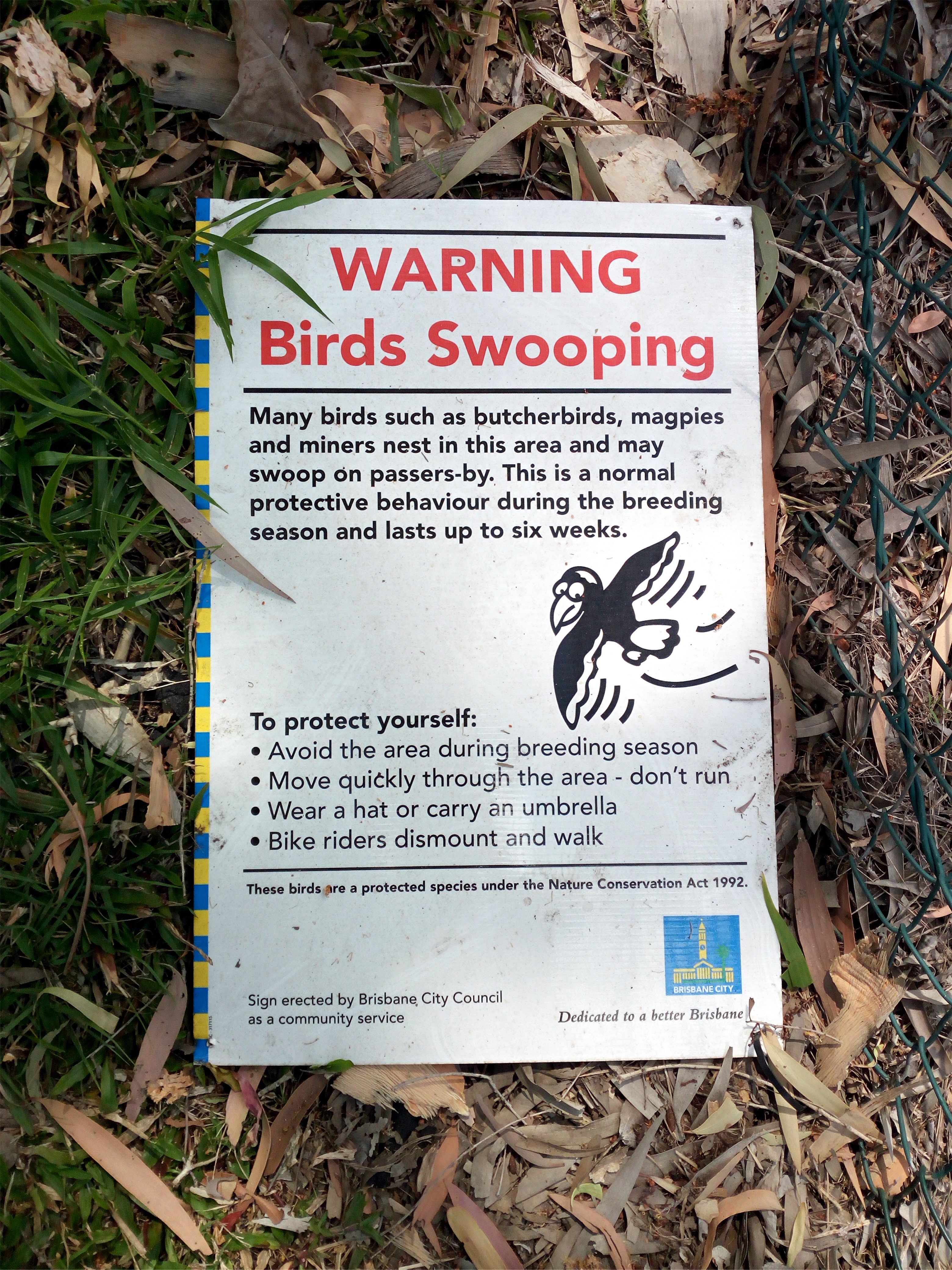
Swooping Season – Watch Out!

IMG_20200826_115359
This sign had fallen off the fence onto grass under a eucalypt tree but whether caused by human or bird intervention is anyone’s guess. GBW.

Magpies in Australia are well-known for swooping humans and pets during their breeding season between July and December, but peak swooping month is September in Brisbane.  This is normal defensive behaviour in springtime as the birds are trying to protect their eggs or newly hatched young in the nest.

Walk the long way home!  Swooping season can be a nuisance to some people, but often Magpies will accept the presence of people within their territories (they do get to know human families) however when attacks do occur, they usually take place within a hundred metre radius around the tree containing their nest.

I know from experience that a sudden rush of wings and a sharp, snapping beak at the side of your head is a very scary thing.

While most Magpie attacks are mild, they could cause serious injury to your eyes and head.
Seven tips to protect yourself against swooping birds:

(1)  Wear a hat or carry an umbrella

(2)  Wear sunglasses to protect your eyes

(3)  Do not interfere with the birds or their nest

(4)  Watch the birds while walking away quickly and calmly

(5)  A bird is less likely to swoop if it knows you’re watching

(6)  If you ride a bike, dismount and walk

(7)  Never aggravate a Magpie as this can make the bird defensive and lead to a more severe swooping attack next time.

Some people paint big eyes on their bike helmets or stick drinking straws on their hats to repel Magpies, but I’m not sure these ideas work.  Wearing head protection stops wayward claws from tangling in hair.

Magpies are vocal birds with a carolling call.  They adapt well to open and cleared environments and thrive in large areas of lawn (like parks, golf course, school grounds) which provide foraging sites, and where there are scattered trees available for nesting, and a water source.

Usually Magpies eat garden pests and insects but they are inventive when it comes to cat food.  In my photo sequence this one peered into the car scrounging for a snack.

The nest of a Magpie is bowl-shaped and made from dry sticks with a lining of grass, bark and other fibres.  The clutch size is usually around three to four blue-grey eggs, though this varies according to season, predators and health of the parents.  Magpie lifespan is about 25 years and I have had two hanging around my place for several years.  Both parents raise their young and guard their territory and they are a natural part of my outdoor life.

Pen Paper Clipart Boy Holding PencilPLEASE NOTE The Australian Magpie (Cracticus tibicen) is a native Australian bird and is PROTECTED under the State Wildlife Legislation (Nature Conservation Act 1992).  It is a serious offence to harm Magpies and penalties apply for attempting to harm them.  Information Brisbane City Council Biodiversity Living with Wildlife.

Gretchen Bernet-Ward

Wild Flamingos in Australia?

IMG_20200510_170134
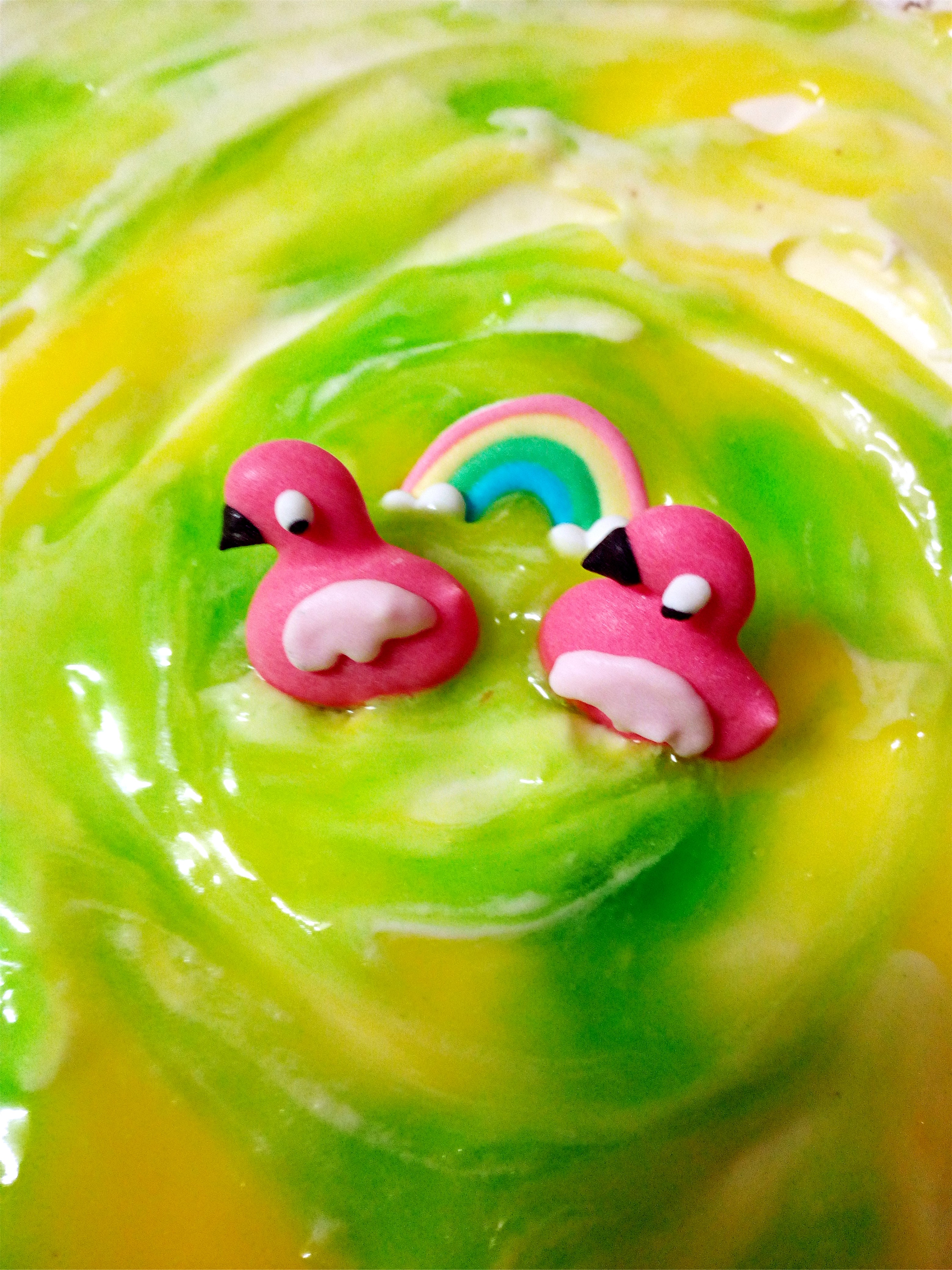
Flamingos swamped by cheesecake topping 2020

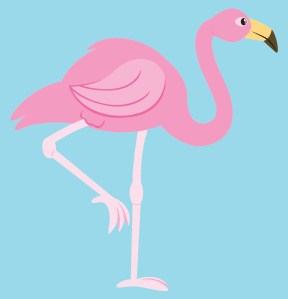
Australia was once a continent graced by flamingos.  These tall pink birds are more associated with Africa and the Americas, but a long time ago they called Australia home.  For at least 20 million years, flamingos thrived on vast Australian inland lakes, until a drying of the outback ended their reign, perhaps a million years ago.

The Lake Eyre region in South Australia once had three species, more than Africa today.  Altogether Australia had at least six flamingo species, including the Greater flamingo – the main flamingo in Africa.  Australian museums have accumulated more of their fossils than of some regular Australian birds such as parrots.  At some sites their remains lay near those of outback crocodiles, dolphins and lungfish.

Flamingos are still regarded as Australian birds, for a very tenuous reason.  In 1988 a Greater flamingo dropped in on North Keeling Island, a remote Australian territory 2750km north-west of Perth, staying a couple of months.  Greater flamingos are found in Asia and southern Europe as well as Africa and this one had wandered over from India or Sri Lanka.

In Adelaide Zoo you could have seen the only flamingo left in Australia, a Chilean flamingo known warmly as ‘Chile’.  She was thought to have been imported in the late 1970s.  For quarantine reasons flamingos are now forbidden imports, which means that Australia is destined to become a flamingo-free zone unless another long-legged pink nomad wanders over from Asia.

FlamingoSource Australian Geographic by Tim Low February 6, 2017

More flamingo facts and fabulous photographs:
https://www.australiangeographic.com.au/topics/wildlife/2017/02/australia-was-once-full-of-flamingos/

Gretchen Bernet-Ward

Test Tube Alien Resurrection 2020

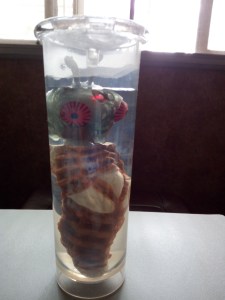
After remaining dormant for approximately thirteen years, encased in a white crystalline cocoon in a test tube at the back of a bookcase, the Alien was resurrected on St George’s Day 23rd April 2020.  He had patiently waited for this momentous day.

Test Tube Aliens were released in UK and Australia in late 2006.  My photographs show an Alien named Samaru given as a birthday gift in 2007.  Apparently there were good Aliens and bad Aliens.  I certainly hope this fellow is a ‘good’ Alien because he was revealed at the height of COVID-19 pandemic.

Originally named Samaru by the manufacturer, he has been nicknamed Boris.  There was no packaging or paperwork with his test tube, and apart from the now adult owner remembering throwing out a sachet of sloog (activation powder), Boris was a completely unknown quantity.  First, he had to be rinsed out.

Test Tube Alien Samaru Boris appears to be fully functional and quite a sophisticated toy.  Like the gift-giver, he had been forgotten long enough for creator websites to be inactive.  He cannot ‘phone home’.


Invented by JKID Ltd and released by 4Kidz Inc, the following information has been sourced from:

https://www.japantimes.co.jp/community/2007/03/10/general/hits-failure-to-woo-japan-baffles-inventor/#.XrZyrzngqpo

IMG_20200505_121227Mike Simpson, the inventor of Test Tube Aliens, started up his own Japanese company called Mike Simpson Design.  It was through hooking up with another British inventor, Matthew Bickerton back in the UK, that Simpson was able to create a new toy company called JKID and together he and Bickerton co-invented Test Tube Aliens.
QUOTE  Inventor Mike Simpson said “There are six Aliens to choose from, all with names with a Japanese twist, the most obvious of which is Shako. (He’s a baddie, by the way.)  Each Alien comes in a clear plastic test tube, inside which is a solid cocoon.  Pour in water and the cocoon fizzes and dissolves to reveal the Alien with a visible heartbeat.  They then have to be fed (with sloog) and cared for to stay alive.

“These aliens, who have liquid-and-light-sensing technologies, physically grow to fill their test tubes within the first couple of weeks of their lives.

“Enter TTA’s Web site, and the first message received reads: The Invasion Begins: From a dying world they come to our own! The better you treat ’em, the longer they live!

“Kids are encouraged to use their imagination and take responsibility.  Cause and effect.

“Each Alien has its own number that can be registered and certified online. The background to each character — the story of how and why they have come to earth — place the characters in context.  Children can also interact with their Alien pal online through asking questions and provoking it directly by holding it up to the flashing screen.

“TTA is the Web’s first interactive toy,” Simpson says happily.”  UNQUOTE

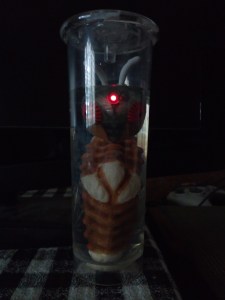
Older websites have information on some of the Test Tube Alien clan but not specifically IMG_20200510_135031Samaru Boris, and he is not able to connect with the company’s disabled website.  He does have Red Light meaning ‘comfortably happy’ and Green Light meaning ‘uncomfortably drowning’ as shown in my photographs.  On activation, he did momentarily flash an Amber Light but the meaning of this is unknown.


There is a blog post written Friday 28th December 2007
http://nunyaax.blogspot.com/2007/12/test-tube-aliens.html
and a fan wiki
https://extraterrestrials.fandom.com/wiki/Test_Tube_Aliens

To quote Alien Wiki “The evil Aliens were responsible for the destruction of Nratuatuko and pursued the five good Aliens throughout the Universe, determined not to let their quarry escape for good.  However, in 2011 it was revealed that all of the Aliens were evil, including the ‘good’ Aliens.  The true good Aliens were in the Test Tube Aliens X series.  The Aliens wanted to be marketed in test tubes so that they would appear to be dead, they would be thrown into a rubbish bin, so that they could take over the rivers and seas of the Earth. This was followed by the release of the Test Tube Aliens: Pure Evil series, with six ‘pure evil’ Aliens.”

“New Alien Invasion a Must-have” shouted the headlines in Central Queensland News on 15th July 2011 and apparently “They’re ultra-cool and they’re pure evil.  The Electronic Test Tube Aliens are back – and they are the ‘must-have’ toy for 2011.”
https://www.cqnews.com.au/news/new-alien-invasion-a-wicked-must-have/905581/

What TTA clan does Samaru Boris belong to?  More research is needed, just in case…

He responds to movement (I found this out when I accidentally bumped him over) and light.  He needs 12 hours of daylight and 12 hours of night-time.  After this was observed, he stopped getting fast flashes and settled into a steady beat.  Likewise if his water level is low, his green light will blink rapidly in distress until topped up.

The test tube is not able to be opened without breaking it.  There is a small opening to drip water into the tube but sadly he is entombed for life.  A quasi-humorous website claims the Alien test tube is a ‘malicious and cruel torture device’. IMG_20200509_182453

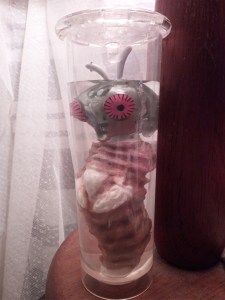
I am not sure of Alien growth rate but at the time of writing, May 2020, Samaru Boris is nearly four weeks old and approximately 16cm tall with antennae almost bumping the top of his test tube.  He has filled out and his features are steadily becoming more defined.

He almost looks like a portly older gentleman surveying his domain.

You may know more about these Aliens; you may have raised one.  Or there may be one lurking at the back of your cupboard.  Perhaps your Alien is waiting to connect telepathically with Samaru Boris and together they will activate their master plan.

Gretchen Bernet-Ward

EPILOGUE: Sadly, I regret to advise that Samaru Boris quietly passed away on Friday 7 May 2021 just over a year from his activation.  He still sits on the table in his test tube tomb, no longer blinking the minutes away, but he is still part of the family. GBW.

ANZAC Day At Home

ANZAC Day At Home 2020

IMG_20190424_214443

IMG_20190420_160106

As part of the RSL Queensland’s ‘Light up the Dawn’ campaign, all residents are encouraged to say The Ode and take the pledge by standing in your driveway, on your balcony or in your living room at 6am on ANZAC Day to remember all those who have served.  You can learn more on the link below.

RSL https://rslqld.org/News/Latest-News/Light-up-the-Dawn

In memory of the men and women in my family.

♥ Gretchen Bernet-Ward

Imagine a Mature-Age Diana, Princess of Wales

In July 2020, Lady Diana, Princess of Wales, would have been 59 years old.  I don’t know about you but that makes me feel old!

Like millions of others in the late 20th century, I watched Diana’s life unfold through newspapers, magazines and television. 

I guess I kept these magazines as a small piece of vicarious history, a trip down memory lane.  Photographs are taken from my old copies of Hello! (August 1997) The Australian Women’s Weekly (May 1998, June 2000) and Who Weekly (June 2001) in memory of the late Princess of Wales.

IMG_20200314_214315

These days there are several ways we can view the past, or a computer-generated future.  For a more mature-age Diana see link below.

BIOGRAPHY

The late Diana, Princess of Wales, was born The Honourable Diana Frances Spencer on Saturday, 1 July 1961, in Norfolk England.  She received the title Lady Diana Spencer in 1975, when her father inherited his Earldom.

Lady Diana Spencer married Charles, The Prince of Wales, at St Paul’s Cathedral in London on Wednesday, 29 July 1981, becoming Princess of Wales.  The ceremony was watched on television by millions of people around the world.  As I recall her silk wedding gown looked crushed as she alighted from the royal carriage.

One warm night in April 1983 I waited beside the bitumen road as Charles and Diana left Government House, Brisbane, to travel into the city for an official function.  The Rolls Royce was lit from within and I recall how Diana glowed and smiled even though the figures beyond her window would have been shadows. 

IMG_20200314_213808

During her marriage, the Princess of Wales undertook a wide range of royal duties with extensive overseas travel.  Family was very important to Diana, who had two sons: Prince William and Prince Henry (Harry).  After her divorce from The Prince of Wales in August 1996, the Princess continued to be regarded as a member of the Royal Family.

IMG_20200314_215355

Post-divorce, Lady Diana filmed a controversial interview about her marriage.  She died on Sunday, 31 August 1997, following a tragic car crash in Paris, believed to be caused by paparazzi chasing her vehicle through a tunnel.  After purchasing the Courier-Mail newspaper, my father told me the news and I was disbelieving, shocked.

There was widespread (and world-wide) public mourning over the sudden death of Lady Diana, Princess of Wales, a hugely popular royal, culminating with her funeral at Westminster Abbey on Saturday, 6 September 1997.  After the funeral, there was a long cavalcade by road to a small island on Althorp Estate, her family’s ancestral home in Northhampshire, England.  The streets around my home were silent, everyone watching Diana’s last journey.  It is hard to forget the funeral hearse driving past so many sad faces and billowing seas of flowers on route to her final destination.

A website link was shown here which contained a computer-aged photograph of Lady Diana and what she possibly could have looked like as a mature-age woman. Unfortunately the link became unreliable and I have deleted it.

Even after her untimely death, the Princess’s work lives on in the form of commemorative charities and projects set up to help those in need.  And also through her married sons Prince William (heir to the royal throne) Prince Harry, and in time their respective children.

Gretchen Bernet-Ward

IMG_20200314_220414
Internet advice taken from The Australian Women’s Weekly issue June 2000 which shows how far we have come and how the Diana-look was still in vogue.

‘One Moonlit Night’ has Arrived!

Excitement!  My copy of ‘One Moonlit Night’ by Welsh author Caradog Prichard has arrived safe and sound.

I could read any Welsh literature but now I have the opportunity to air my views in the weekly discussions on Book Jotter’s Dewithon20 in conjunction with Wales Readathon 2020.

READ MY REVIEW
https://thoughtsbecomewords.com/2020/04/09/review-one-moonlit-night-by-caradog-prichard-for-wales-dewithon20/

For further details on this event (and the book) have a look at these websites:

Book Jotter information
https://bookjotter.com/2020/03/01/wales-readathon-2020/

DHQ 2020
https://bookjotter.com/2018/03/26/dhq-dewithon19/

Week 1 Discussion
https://bookjotter.com/2020/03/06/dewithon-20-week-1-one-moonlit-night-by-caradog-prichard/

Gretchen’s stuff
https://thoughtsbecomewords.com/2020/02/21/are-you-ready-for-wales-readathon-2020/

Try something new!  Join us!

Gretchen Bernet-Ward

‘Share Your Story’ Writing Competition and Anthology

IMG_20200312_163859
LEGENDARY BULLOCK TEAM leaving Jondaryan Woolshed, west of Toowoomba, Queensland, loaded with bales of wool. In his heyday 1858-1862 manager James White employed 88 blade shearers in this huge T-shaped woolshed. Illustration hand-printed 1985 by H. Sperring.


Submissions are open for ‘Bedtime Yarns and Ballads from the Australian Bush’ in 2020 Share Your Story.

Here’s what coordinator, author and literary entrepreneur, Michelle Worthington has to say in her newsletter:  ‘This year’s theme ‘Bedtime Yarns and Ballads from the Australian Bush’ will have judges looking for creative, engaging short stories or poems inspired by life in Australia, Australian animals, the Outback or overcoming adversity which will appeal to children aged 0 to 12 years to be read at bedtime.’

Map of Australia 06A ‘yarn’ is a rambling story, particularly one that is implausible, and poetry must be in traditional Australian ballad format.  Michelle encourages writers to think of a modern version of Blinky Bill, Banjo Patterson, Dorothea Mackellar, ‘Wombat Stew’ (I add my own personal favourite ‘Snugglepot and Cuddlepie’) for a new generation of readers.

Michelle Worthington goes on to say ‘We would love aspiring authors of all ages to have the chance to be published in our next Anthology to raise money for Aussie’s doing it tough, with proceeds donated to the NSW Rural Fire Service’.

NOTE:  ‘The winning entries will be included in an Anthology to be launched in October 2020, and all successful authors and illustrators will be invited as VIP Guests to the Pyjama Party Book Launch at the Queensland Children’s Hospital and locations around Australia during the launch month.’

Entries open 1 Feb 2020 and close 9pm 30 April 2020

Poetry Clipart 08For competition guidelines and entry requirements, visit the website to sign up for Share Your Story newsletter

https://shareyourstorypublishing.com/

Michelle Worthington is an international award-winning author and business woman.  As Founder of Share Your Story Australia, she waves her wand to coach aspiring authors and illustrators all over the world to achieve their dreams of publication.  Michelle is also available for speaking engagements, book signings and school visits.  She runs diverse workshops, and if you are thinking of becoming a writer, check out Share Your Story or visit Facebook or contact Michelle for further information.


IMG_20200315_105328
Maybe you could rework the legend of NED KELLY (December 1854 – November 1880) an Australian bushranger best known for wearing a suit of bulletproof armour during his final shootout with the police.