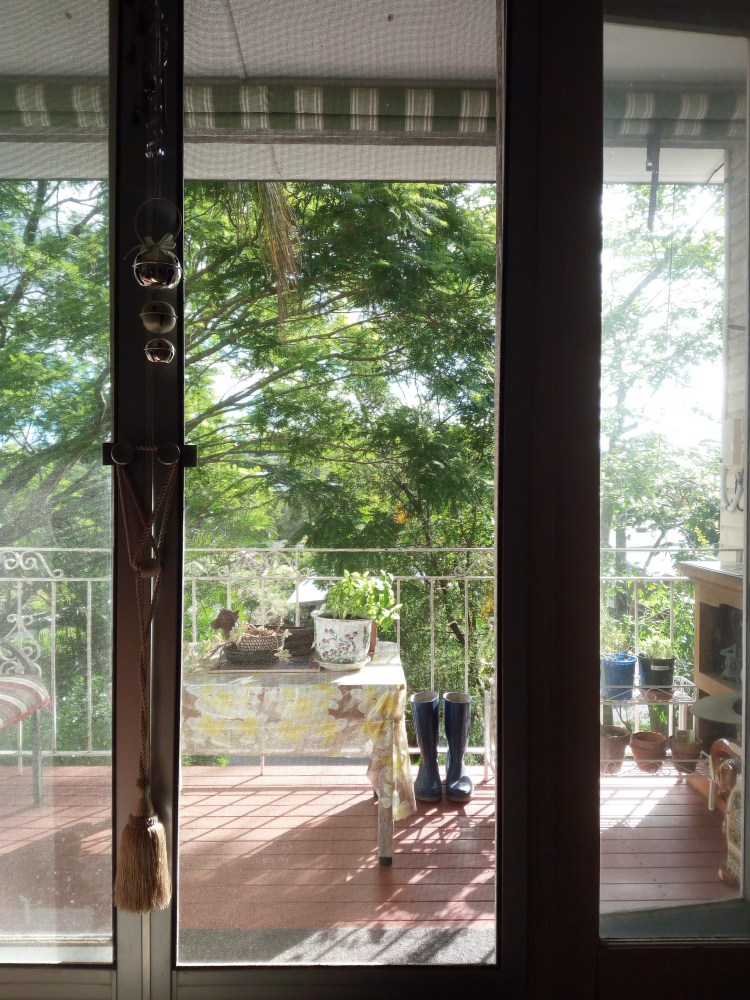
What can you see? What can you surmise from this scene? Is it in suburbia or the mountains or maybe near the sea?
Can you name the trees? Or guess the potted plants? What time of day, or time of year, do you think the photograph was taken?
And who might live there? Who owns those gumboots?
You could write a short story about someone who walks out onto this balcony. Perhaps it’s the home of the Capulet family? There is a good reason why Juliet walks out onto a balcony.
Valentine’s Day is nearly here! Imagine an alternate ending. A happy, sad, good, bad or exciting scene… Writers, write about it in your own hand! Put it in an envelope and present it to your loved one.
❤️ Gretchen Bernet-Ward
Postscript: I will write my own version on traditionally the most romantic day of the year 14th February 2022.
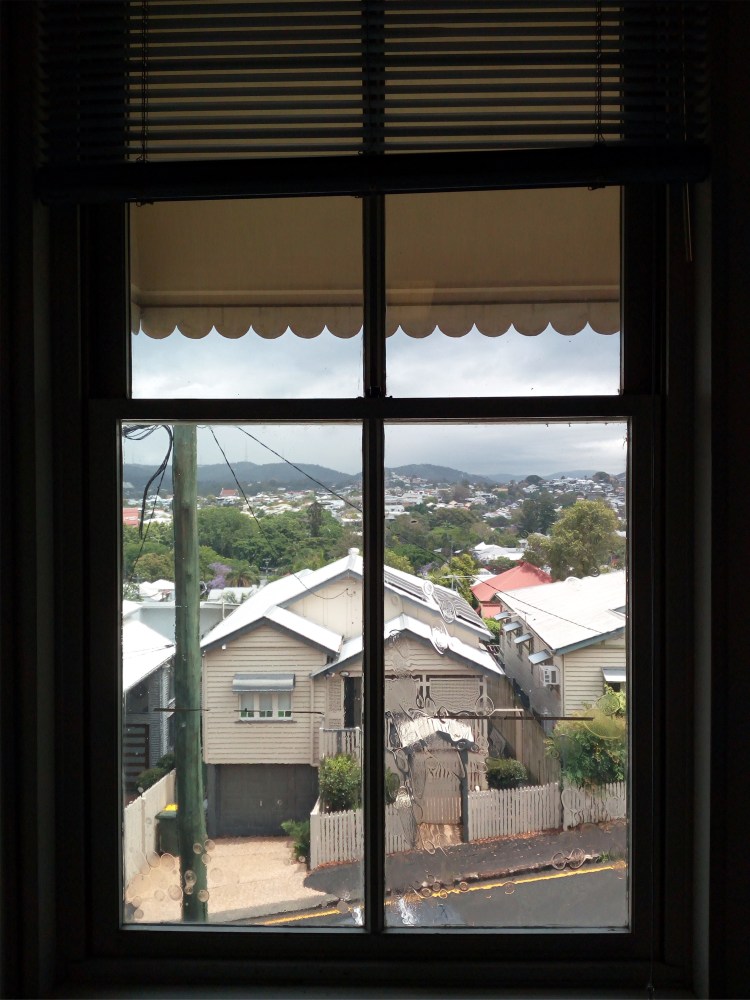
My photograph of the window (and view to Mt Coot-tha on an overcast day) was taken from Royal Queensland Art Society building on Petrie Terrace, Brisbane.
I don’t know the age of this window but the visual wobble was initially disconcerting until my eyes worked out what was going on! GBW
It wasn’t until afterwards that I saw the bubbles in the glass pane following my visit to the RQAS portrait exhibition. In this case, the bubbles clustered together are called ‘seed bubbles’ and enhance the old-fashioned charm of the window.
Bubbles in old glass bottles and windows are actually air pockets that became trapped during the manufacturing process. True air bubbles are rare in glass produced after 1920, so the presence of a bubble may help to date a bottle or window.
Crude glass almost always contains bubbles, which often adds to its appeal and value among collectors. Apparently collectors do not view bubbles as ‘flawed’ or ‘damage’ and some even prefer bubbles because they add to the visual appeal of the glass.
On a sunny Friday morning, waiting to enter GOMA Queensland’s Gallery of Modern Art, I did not photograph the great long queue of people. However, there were no privacy issues, every single person was wearing a mask. Patiently observing restrictions, we were all determined to view the European Masterpieces exhibition on loan from The Met, Metropolitan Museum of Art, New York.
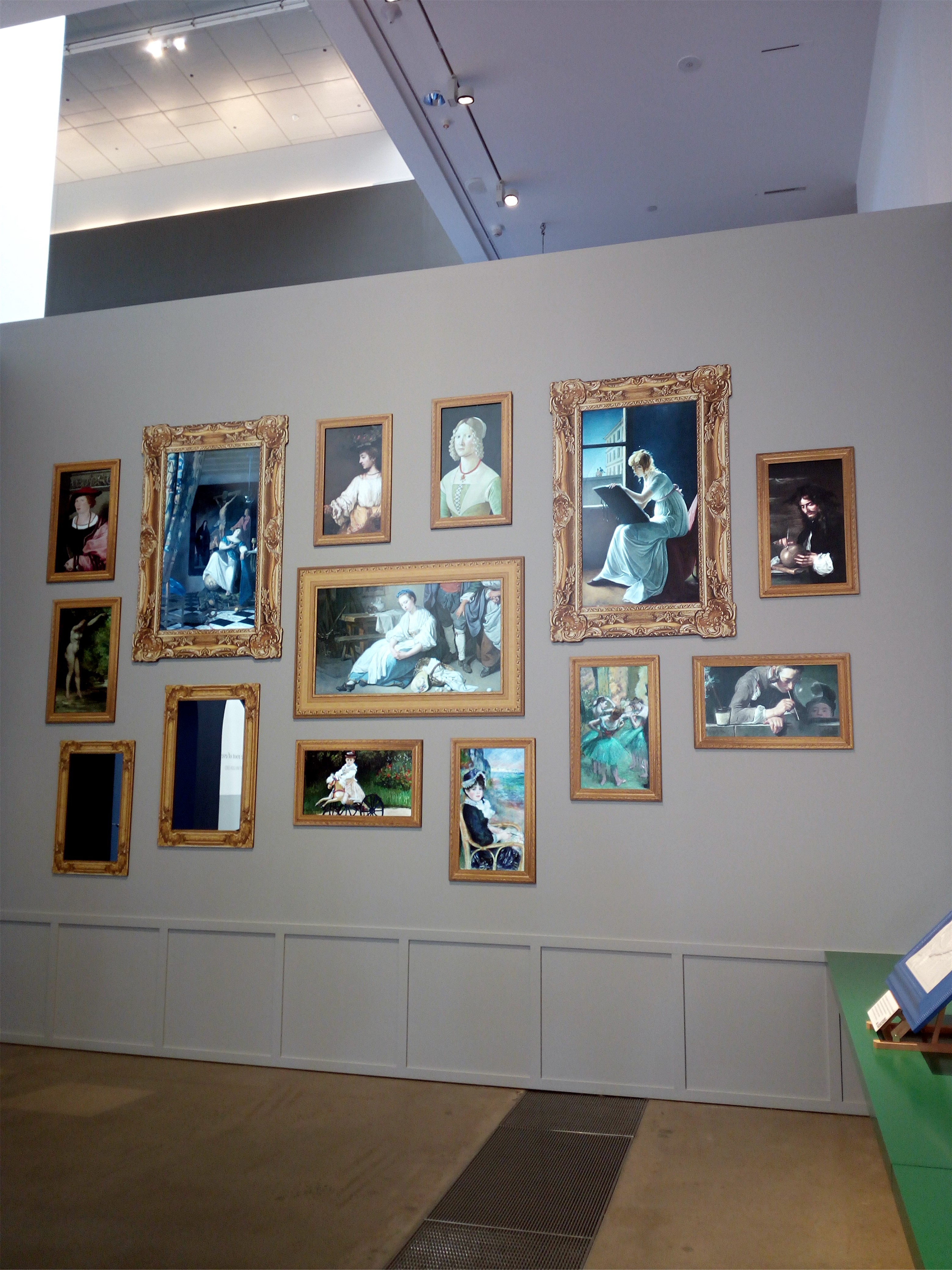
Once inside, after a quick squirt of lavender hand-sanitiser, directions from the highly organised gallery staff were followed, and metered groups were ushered through the necessary sign-in to enter a specially designed viewing area. I say ‘area’ but it was more like roaming around inside someone’s home. Admittedly a large home with muted lighting and grey walls but it was what hung on those walls that definitely became awe-inspiring.
The galleries were split into three groups:
1. Devotion and Renaissance
2. Absolutism and Enlightenment
3. Revolution and Art for the People
From Giovanni di Paolo (Paradise, 1445) to Claude Monet (Water Lilies, 1916) I have written a quick overview of my visit—and I only took a handful of photographs. There are 65 works of art on display, and so famous they do not need my documentation.
Deep down I have to confess that the age and history of many of the paintings captured my attention more than the artwork itself. Scary moments frozen in time, dramatic posturing, gloomy scenes were not the order of the day for me. I loved the works with life and action and, let’s face it, realism.
French painter Georges de La Tour’s work ‘The Fortune Teller’(see main entrance photo above) finally made sense to me when I saw it for real. It’s not about the old fortune teller at aLL.
GBW 2021
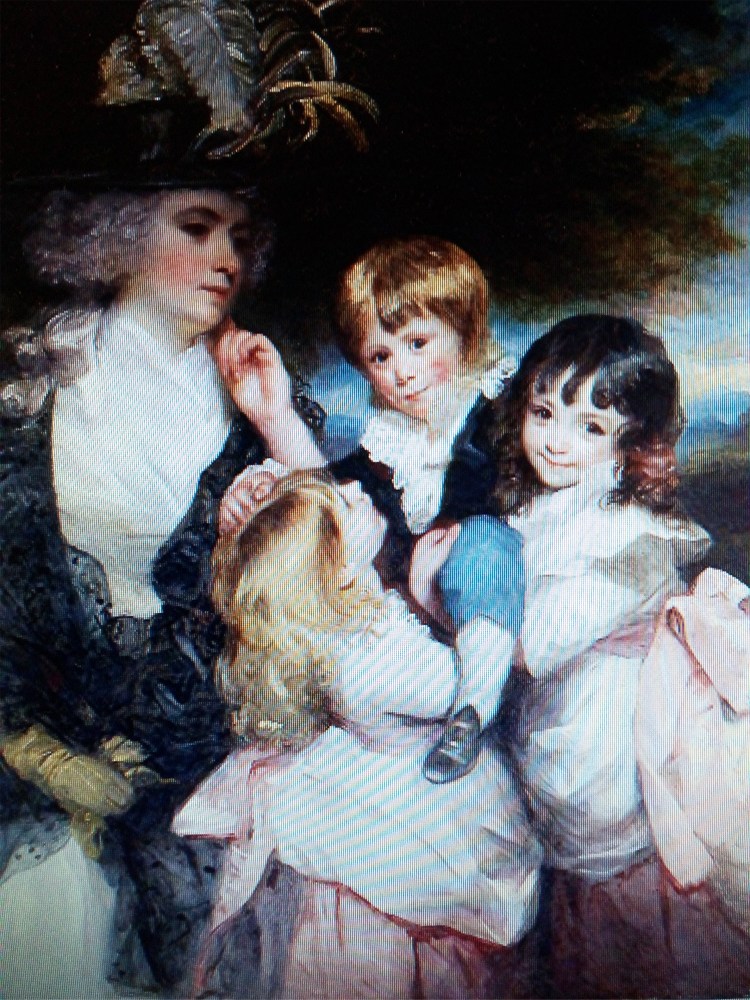
I liked the ‘essence’ of Lady Smith (Charlotte Delaval) and her children George, Louisa and Charlotte, in this family portrait where she appears lost in thought while her children tussle beside her, glancing at the viewer. The portrait by Sir Joshua Reynolds (England) was commissioned by Lady Smith’s husband, a baronet and member of Parliament. Expressing cultural ideals of femininity and upper-class childhood, this work was a popular exhibit at the Royal Academy in 1787 the year it was painted.
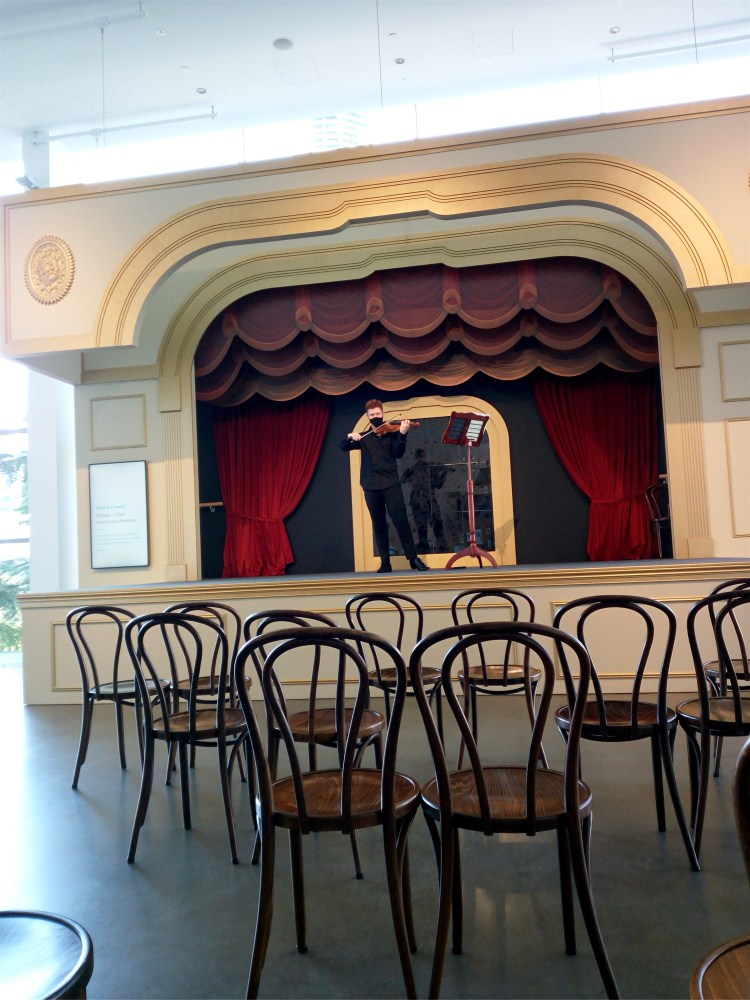
I wandered past El Greco, Rubens, Caravaggio, Vermeer, Goya, Rembrandt, Renoir, et al, and was drawn towards the sound of violin music. I left the dimmed rooms and walked into a brightly lit area where a lone violinist was playing. He finished with a flourish and an elderly gentleman and myself clapped enthusiastically but he appeared a tad embarrassed, nodded his thanks and exited the stage.
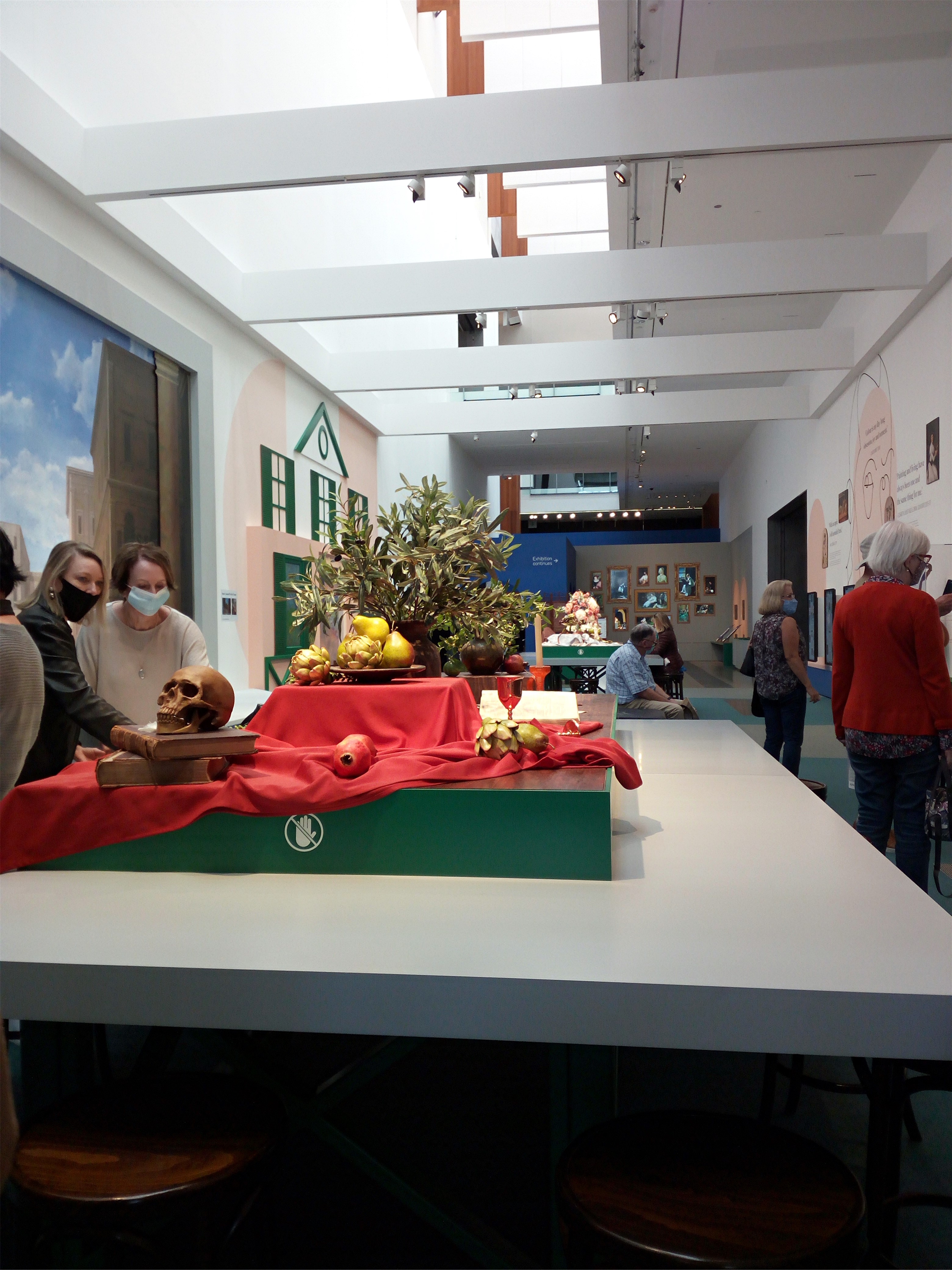
Directly behind me was The Studio, a long gallery set out with still life objects for the budding artist to create a modern masterpiece. There is a Renaissance backdrop for live models at special times. My eyes were drawn to the interactive displays and ‘paintings’ which brought the original art to life. Shades of Harry Potter, both clever and spooky!
The theatrette was not heavily patronised and after hearing the big bosses talk, I decided to seek out one of my favourite colourful artists and that is Paul Gauguin (France 1848-1903). His ‘Tahitian Landscape, 1892’ is smaller and less vibrant than I expected. A pleasant rural scene (below left) but not his usual tropical effervescence.
Claude Monet (France 1840-1926) and his sombre ‘Water Lilies’ wished me bon voyage and I was back into the real world.
As any person who frequents an exhibition knows, the exit is via the gift shop. This low-key store had some nice items but I wasn’t feeling it. The Library Café was looking inviting.
When I thought about the great works of art I had just seen, I pondered which one I could single out, which one I thought was the cream of the crop. The pleb in me rather enjoyed a large 1670 work by Jan Steen (Netherlands) ‘Merry Company on a Terrace’ for its rich vibes and domestic disorder. The original is bigger and brighter than the image (above right) shown here.
I think perhaps Covid-19 had something to do with the way I responded to the Met Masterpieces… and it was interesting to see how each century lightened the mood.
GBW 2021
To quote architect and designer Frank Lloyd Wright (1867 – 1959)“Respect the masterpiece, it is true reverence to man. There is no quality so great, none so much needed now.”
♥Gretchen Bernet-Ward
—–European Masterpieces—–
12 June 2021 – 17 October 2021 GOMA | Gallery 1.1 The Fairfax Gallery, Gallery 1.2, Gallery 1.3 Eric & Marion Taylor Gallery | Ticketed
I received an email from Michelle Worthington of Authors Online who wrote “Tabitha Page has been working hard on a new venture which I am excited to share with you. Tabitha, children’s author and disability advocate, is currently setting up an online database under the name Forevability, where she is compiling as many books as she can for children through to young adults which have the following themes:
Disability Illness Medical conditions Medical Procedures Anxiety Sensory Bullying Diverse Own voice Inclusion Grief/Death/Loss
“Tabitha is also looking for books by authors and illustrators who have a disability or illness themselves, and she plans to have a showcase page of their work.”
“In addition to these resources and showcases, Tabitha will also be compiling a database of podcasts/videos/blogs/articles related to the same categories as noted above” and aims to make Forevability an easy place to find books, podcasts and more.”
“The goal of this project is to create an online space where people can find resources when they face challenges…”
Tabitha Page says “We hope to inspire, empower, teach and support”.
If you have a book, or books, which would make a good match for Forevability database, or you are an author or illustrator who has a disability or illness, check to see if your book fits one of the categories in the guidelines on the website and make a submission.
Hey, you can find out more about the dynamic book fairy Michelle Worthington here.
Brooding rain clouds hang over the Stanthorpe Historical Museum gate.
Out the back is the blacksmith’s workshop mentioned in Part One. A guided tour of Stanthorpe Regional Art Gallery was an eye-opener (costumes next) and the Stanthorpe Post Office 1901 was the first in Queensland. Its style is informal with Edwardian Baroque Revival elements and Royal coat-of-arms, but inside it’s 21st century business as usual.
Napoleon, Ferdinand and The Alchemist.
Both Ferdinand and The Alchemist have elaborate tail coats trailing behind their heavily detailed jackets. Dr Denise Rall used a variety of mediums but my photos don’t capture the sumptuousness of the bling-covered fabric. There were two prints of the Rooster and I almost took the cheeky fellow home! The Gallery has an array of art techniques including landscapes by local artists and thought-provoking ceramics.
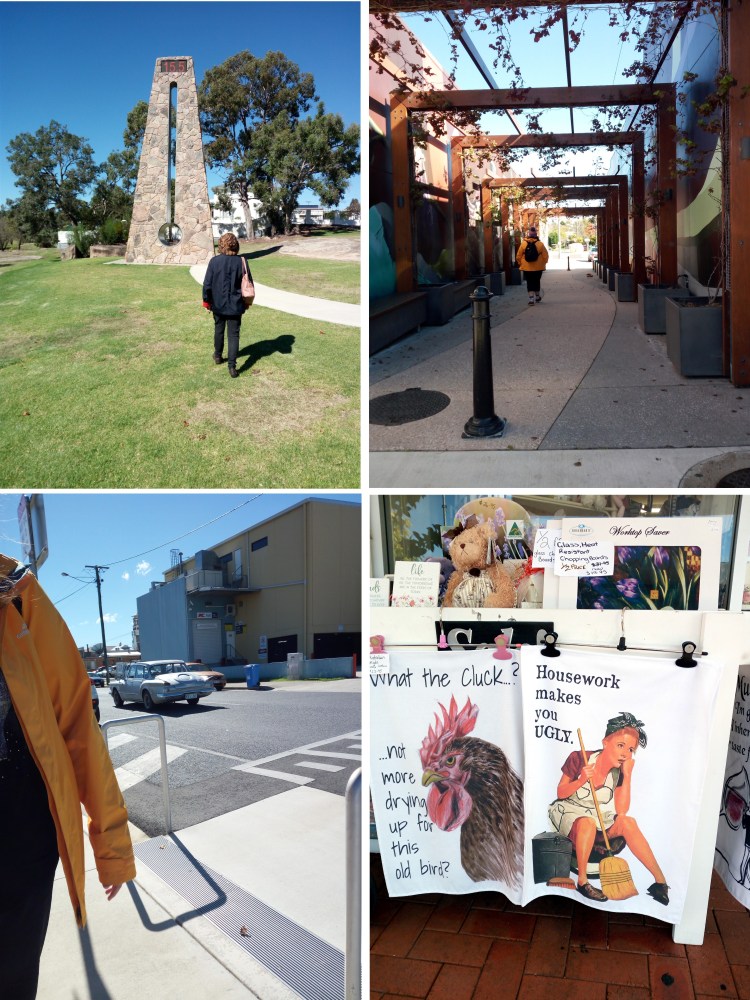
Took a stroll through town.
This must be the biggest stone thermometer in Australia. A detour between buildings lead to a sculpture with an ibis taking flight (used in my ‘Exercise Makes You More Attractive’ post). During lunch I read the local newspaper Stanthorpe Today and discovered the old white 1960s Valiant sedan I had photographed cruising the streets was taking part in a Classic Car Rally. Just love those teatowels!
A pyramid in a paddock.
This one is made of local stone and called The Ballandean Pyramid. It was originally built for the Henty Vineyards former owner, Stuart Moreland.
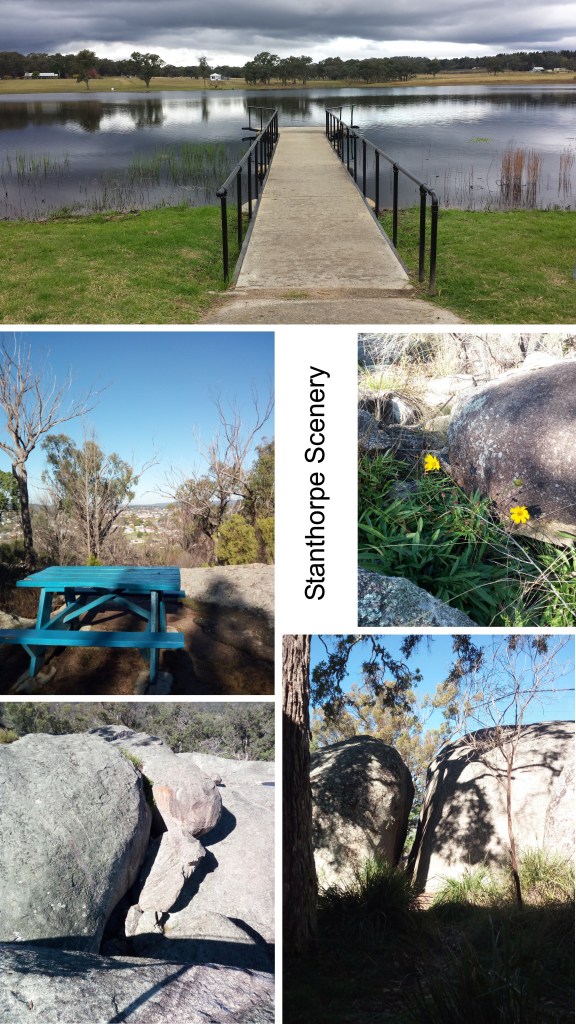
Storm King Dam on a suitably overcast day.
Although not as cold as I was lead to believe. The lake has bungalows to cater for fishing enthusiasts. The view from Top of the Town Tourist Park down to the centre of town with a blue picnic table for contrast. Daisies amongst granite rocks, and more granite rocks and boulders at Donnelly’s Castle, almost impossible to photograph their size—but not teetering like giant hard-boiled eggs in some parts of the region. Captain Thunderbolt, an expert horseman and highway robber, used to hide in these geological wonders.
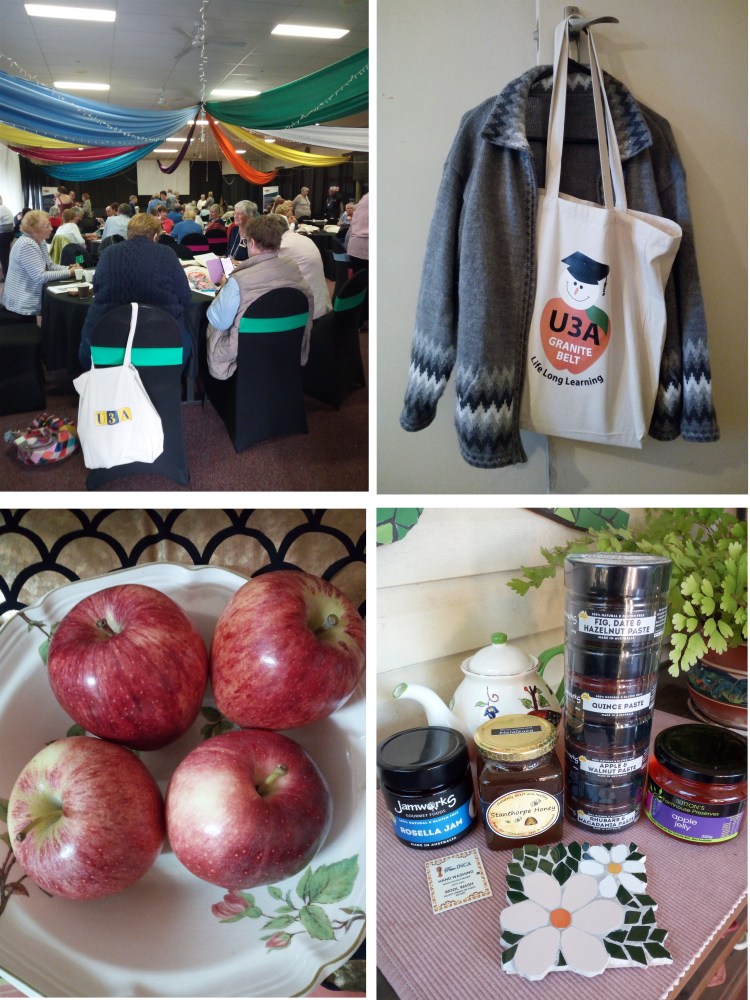
The U3A Conference 2021 in Stanthorpe.
A packed 2-day Program of informative U3A events with eloquent guest speakers, living up to the title of ‘Coolest’ Conference. A highlight for me was Copyright with Irene Sachs, a straight-forward look at Australian copyright laws. Everyone got a goodies bag and the Daisy mosaic tile was hand-made specially, a different one in each bag. There’s my grey Alpaca cardigan from Pure Inca. Fresh-picked fruit abounded, Stanthorpe apples were prominent—I love them! Local food take-home’s included Jamworks Rosella Jam, Sutton’s Apple Jelly, Stanthorpe Honey, Jersey Girls cheese, minus bakery delights consumed on route.
The evenings were misty and quiet…
… except for a heifer escaping after dark and running around mooing at midnight! The daytime sky changed colour often but mostly May sunlight shone on country Stanthorpe and the whispering eucalypt leaves. A return visit is inevitable.
Here’s to life-long learning!
♥Gretchen Bernet-Ward
At an altitude of 811 metres (2,661 ft), Stanthorpe holds the record for the lowest temperature recorded in Queensland at −10.6 °C (12.9 °F) on 23 June 1961. My blog post compiled on Queensland Day 6 June 2021.
The views change dramatically driving along the highway from Brisbane to Stanthorpe.
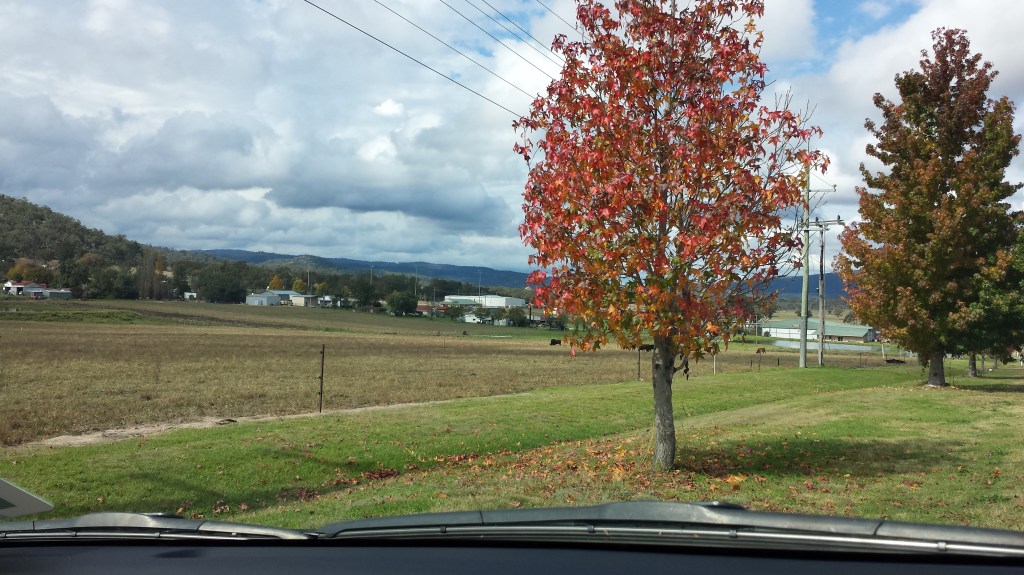
Through farmland, over Cunninghams Gap and the Great Dividing Range (Eastern Highlands) Australia’s most substantial mountain range and the third longest land-based range in the world. Through ‘Rose and Rodeo Capital’ Warwick then into the Granite Belt region renowned for fruit-growing and wine-making. The air becomes cooler, the May autumn leaves turn russet and the landscape is littered with huge granite boulders.
Stanthorpe is a pretty little town with a lot of history as I found out when I attended my first U3A conference.
Actually the 2021 conference was a good reason to visit this fabulous part of Queensland! On arrival, after traversing the town, the next stop was Top Of The Town Tourist Park’s well-appointed accommodation in The Cottage. A modern cottage, small and cute and separate from the other cabins and campers. That didn’t stop me talking to the locals for a good chinwag. The historical museum is nextdoor and that warranted a visit on the last day, so much to see inside! Anyway, it was a quick drive into town and a visit to the supermarket, and a Peruvian Alpaca wool shop just in case there was a cold snap. I did buy a handwoven cardigan which is very warm and snuggly. My photo shows the walk down to Quart Pot Creek. The sky was a clear blue and the water reflections sparkled.
Looking across Quart Pot Creek on the path to the Tourist Information Centre.
A huge stone thermometer read 15 degrees Celsius (59 Fahrenheit) and a tourist bus had just arrived so there were a lot of people milling about inside looking a handmade souvenirs and ordering morning tea. I picked up several leaflets and information on local sites of interest plus must-do events, like wineries, Girraween National Park, Wallangarra Railway Station Museum & Cafe (sadly not managed this trip) Truffle tour with Truffle dog hunts, Jersey Girls Cheese factory (what an experience!) and Donnelly’s Castle which are a jumble of prehistoric granite boulders at the end of a winding gravel road. After climbing these huge mystical boulders, the view was fantastic. Then it was time to head back for a delicious lunch at Lily’s Cafe in the High Street.
My next post will feature another side of Stanthorpe. The diversity surprised me.
A visitor to Stanthorpe would need a couple of weeks to visit all the internationally renowned wineries and local attractions, both natural and man-made like The Pyramid out in a paddock! And I loved the individuality of farm produce and accommodation. Top Of The Town had a trail up the hillside where you can stand on a granite rock and look out over the town in the company of native birds and pretty wildflowers. Brisbane doesn’t get much in the way of autumn leaves (although the weather does cool down) so this blog post features red, yellow, golden leaves.
In Part Two, I will post more photographs and write briefly about the U3A Conference. The conference ran over two days and the first guest speaker was Mike Hayes, Director of Viticulture and Chief Winemaker from Sirromet Wines, Ballandean, located in the Southern Downs near the Queensland/New South Wales border.
These two ducks were not very happy that I was walking past their pond.
The Stanthorpe Regional Art Gallery pond had rainwater in it from a storm the night before but otherwise water is very precious in southern Queensland. I doubt the centre fountain is ever full although it does add to the feel of the season. The U3A Conference organised a guided tour of the Art Gallery and in my second post I will show two of the local artists creations. I was particularly taken by the work of costumier Denise N Rall; landscapes beautifully rendered in different mediums; an illuminated-style book of art.
Grape vine leaves, not in a vineyard but the Stanthorpe Historical Museum.
These leaves caught my eye outside the blacksmith’s workshop. Inside was a blackened fireplace, anvil and countless tongs, pliers, buckets and metal utensils, hung around the slab bark hut. I don’t remember seeing the leather bellows to fan the flames but there must have been. The blacksmithy had a physically demanding yet highly necessary job in every town in days gone by. I found it difficult to even lift the hammer which would have been used to shape the red hot iron. And I have no doubt countless horseshoes and metal implements were forged in sheds like this with its corrugated iron roof, dirt floor and rough log seating.
Bye from sweet, sunny Stanthorpe until my next post Part Two also compiled on Queensland Day 6 June 2021.
To view stunning photographs of breathtaking scenery and villages around Wales which inspired Welsh authors, poets and artists to create their world-famous works, I can highly recommend Visit Wales “The word trail: 8 journeys through Welsh literary landscapes” website—
Creatives, some well-known, some not so, feature on the list including my favourite Dylan Thomas, who spent his final years in Laugharne, where he lived in a boathouse down on the estuary.
Read about contemporary poet Gillian Clarke (I have already downloaded her “Collected Poems”) and Medieval European poet Dafydd ap Gwilym (14th century) who was born into a noble family in the parish of Llanbadarn.
There’s even a giant peach commemorating Roald Dahl’s eponymous children’s story.
Kate Roberts, hailed as “Brenhines ein Llên” (Queen of Our Literature) chronicled the lives of slate workers. The South Wales coalfields attracted thousands of migrant workers, but the North Wales slate mines were almost exclusively worked by Welsh-speaking local men, which had a major influence on cultural life. Yet it was a woman – Kate Roberts (Caernarfonshire 1891-1985) – who was the greatest chronicler of the lives of men, women and children in the slate-producing north.















 Thoughts Become Words