Henry Van Dyke (born 10 November 1852, Germantown, Pennsylvania, USA, and died 10 April 1933, Princeton, New Jersey USA) He was a Presbyterian minister, short-story writer, poet and essayist popular in the early decades of the 20th century. Van Dyke married Ellen Reid in 1891 and they had nine children.
A leading writer of his age, Henry van Dyke wrote profusely in the fields of religion, literature, diplomacy, education, nature and public service. He was an admirer of Alfred, Lord Tennyson and met him while overseas.
Van Dyke’s great love of the outdoors was a crucial part of his Christianity, and in the early twentieth century he became a conservationist speaking out for the preservation of Yellowstone. His belief in nature and religion drove his literary criticism and other writings throughout his life.
Sara Teasdale (born 8 August 1884 Missouri U.S. and died 29 January 1933 New York New York) An American poet whose short, personal lyrics were noted for their classical simplicity and quiet intensity.
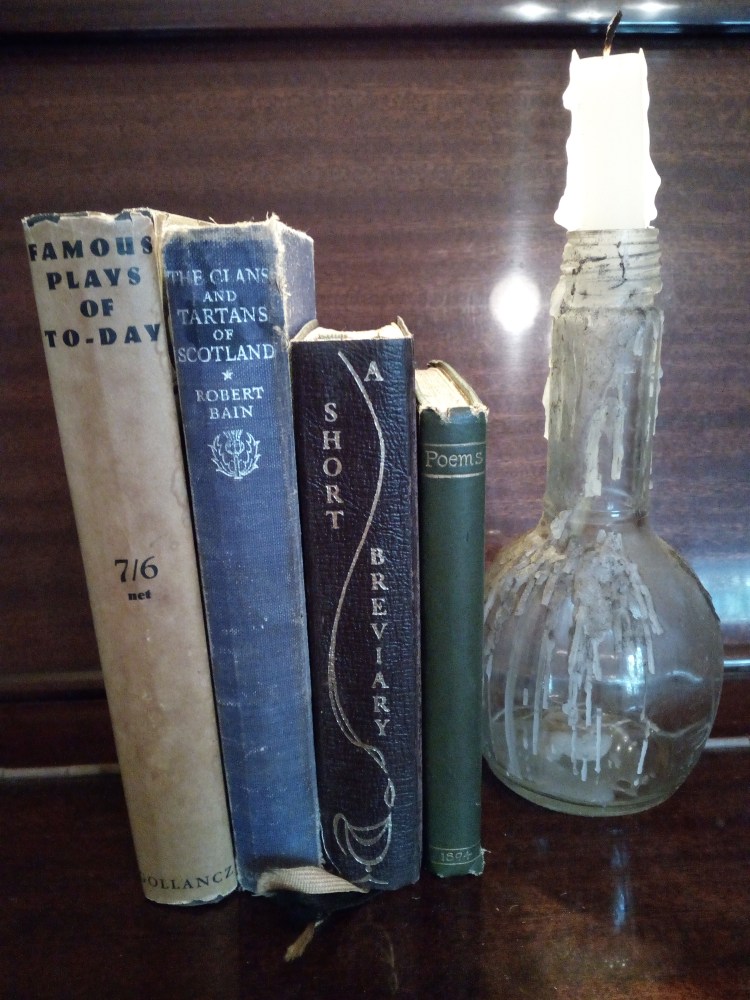
The small green book nearest the candle is simply titled “Poems”, a volume of verse by John B Tabb. Each poem is on a single page and has been written in similar length to Twitter and Instagram. All the way from 1894—I had to share it with you!
There are 172 pages, one short poem per page, extolling nature, love, life and death. I guess Tabb wanted only his poetry to shine because there is nothing personal inside.
The first page has an important red logo with lilies and Latin written on it, not for the poet but the company insignia of Copeland and Day, Boston, MDCCCXCIV (1894)
The second page states “Entered according to the Act of Congress, in the year 1894, by Copeland and Day, in the Office of the Librarian of Congress at Washington.”
The back page reads “This first edition of poems by John B. Tabb is limited to five hundred copies, which have been printed during the autumn of 1894 by John Wilson and Son, Cambridge, Massachusetts.”
A slim volume which appears to have been well handled over many years, and the pale deckle parchment is showing its age—see below.
The big question is “How did this volume arrive at a book fair in Brisbane Australia 127 years later?”
GBW 2021
After the formality of the front pages comes a seven page index (in tiny print) which has intriguing titles listed under headings. I guess the first are general rhymes, the next Quatrains and then Sonnets.
Here are some of my favourites—
The Phonograph
Hark! What his fellow-warblers heard And uttered in the light, Their phonograph, the mocking-bird, Repeats to them at night.
Imagination
Here Fancy far outdoes the deed; So hath Eternity the need Of telling more than Time has taught To fill the boundaries of Thought.
The Dandelion
With locks of gold to-day; To-morrow, silver gray; Then blossom bald. Behold, O man, thy fortune told!
Evolution
Out of the dusk a shadow, Then, a spark; Out of the cloud a silence, Then, a lark; Out of the heart a rapture, Then, a pain; Out of the dead, cold ashes, Life again.
Compensation
How many an acorn falls to die For one that makes a tree! How many a heart must pass me by For one that cleaves to me!
“We may use different words but emotions are eternal”
Who was this man John B Tabb? Well, his full name and title was Father John Banister Tabb (22 March 1845 – 19 November 1909) and he was an American poet, Roman Catholic priest, and professor of English Contents. He was born into a wealthy family in Amelia County, Virginia, was a blockade runner for the Confederacy during the Civil War, converted to the Roman Catholic Church in 1872, taught Greek and English at Saint Charles College (Ellicott City, Maryland) and was ordained as a priest in 1884. Among his other works, Father Tabb published eight poetry books and was widely published in prestigious magazines of the day including Harper’s Monthly and The Cosmopolitan. The Tabb Monument in Amelia County, Virginia, is dedicated to his memory. Source https://en.wikipedia.org/wiki/John_B._Tabb




 Thoughts Become Words