Ethel Turner Wrote More Than Seven Little Australians

King Anne by Ethel Turner was published in 1921 and my great aunt gifted this novel to her sister, my paternal grandmother, at Christmastime in 1922 after she had first read it. Many years passed by and when Grandma thought the time was right she passed King Anne on to me.

Unfortunately at that time I was not the least bit interested.

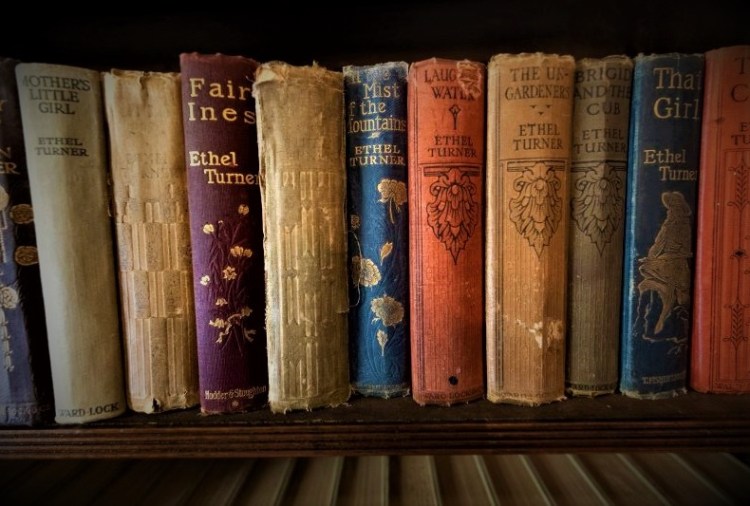
British-born Australian author Ethel Turner (1870-1958) was a novelist and children’s literature writer. She wrote over 30 books and collections of short stories and verse, mostly centred around girls and for girls. King Anne was Turner’s thirty-sixth published work.

Perhaps because I didn’t quite get into her first novel, the epic family saga Seven Little Australians (1894) of which NSW State Library holds the original hand-written manuscript, I therefore gave pseudo-royal King Anne’s weighty tome (as it seemed to me at the time) a wide detour.

The bookcover faded and King Anne languished for many, many years on the family bookshelves, sandwiched between ancient copies of Kidnapped, Pilgrims Progress and Wind in the Willows, and enduring several moves until by some quirk of fate I reached for it today February 2022 when my great aunt and grandmother would have read it one hundred years ago. (Shivers)

I have no memory of the storyline. Now I WILL have to read it!

First I shall create a pictorial and some background information—

The book has foxing and is not in good condition but you can see the etiquette of the time. Written in brackets underneath ETHEL TURNER is the abbreviation Mrs coupled with her husband’s name thus Mrs H. R. Curlewis. Herbert Raine Curlewis was a judge.
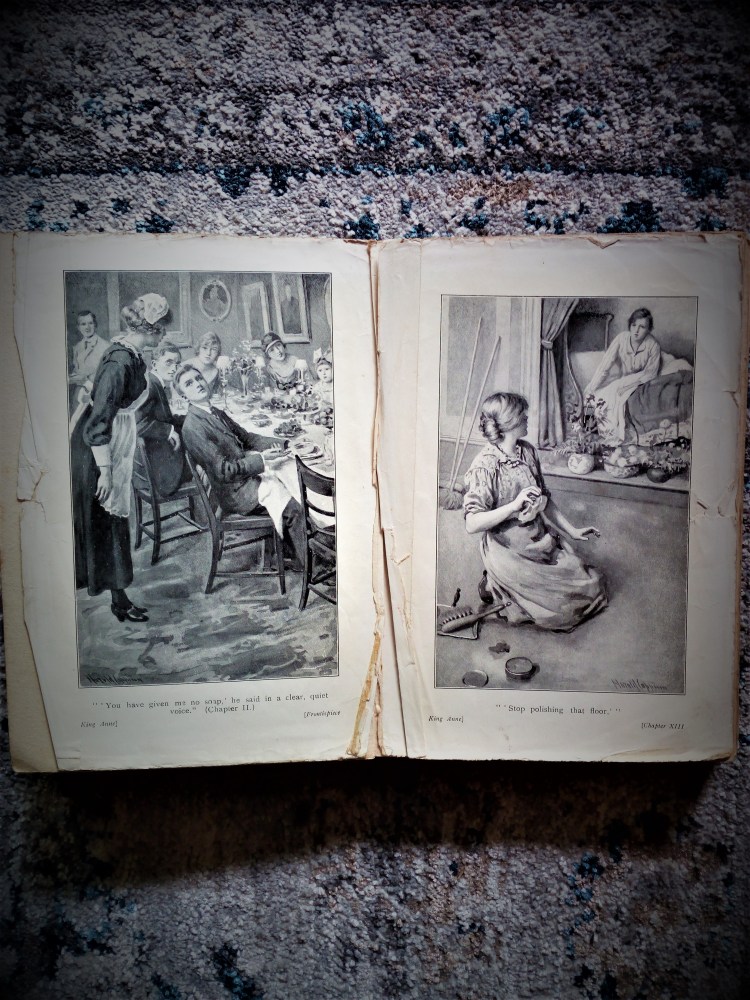
The frontispiece and three illustration plates are beautifully rendered, showing family life at the time. They are miniature works of art in their own right, sometimes removed and framed by the book owner. The far right image was adapted and embossed on the front cover of King Anne.

The artist has not been acknowledged and from online booksellers information you can take your pick. Possibly Harold Copping, and it seems A.J. Johnson‘s small-format illustrations were later replaced by full page works from J. Macfarlane. Each had illustrated books for Ethel Turner.

Inside the back leaves of King Anne (you leaf through a book because the pages are called leaves) under the heading Charming Stories by Isabel M Peacocke – another author of similar genre – there is a rather ambiguous book review of My Friend Phil (1915) from a Queensland Times reviewer which reads “… without doubt the best since Ethel Turner took the reading world by storm with her ‘Seven Little Australians’…” poor Isabel M Peacocke.

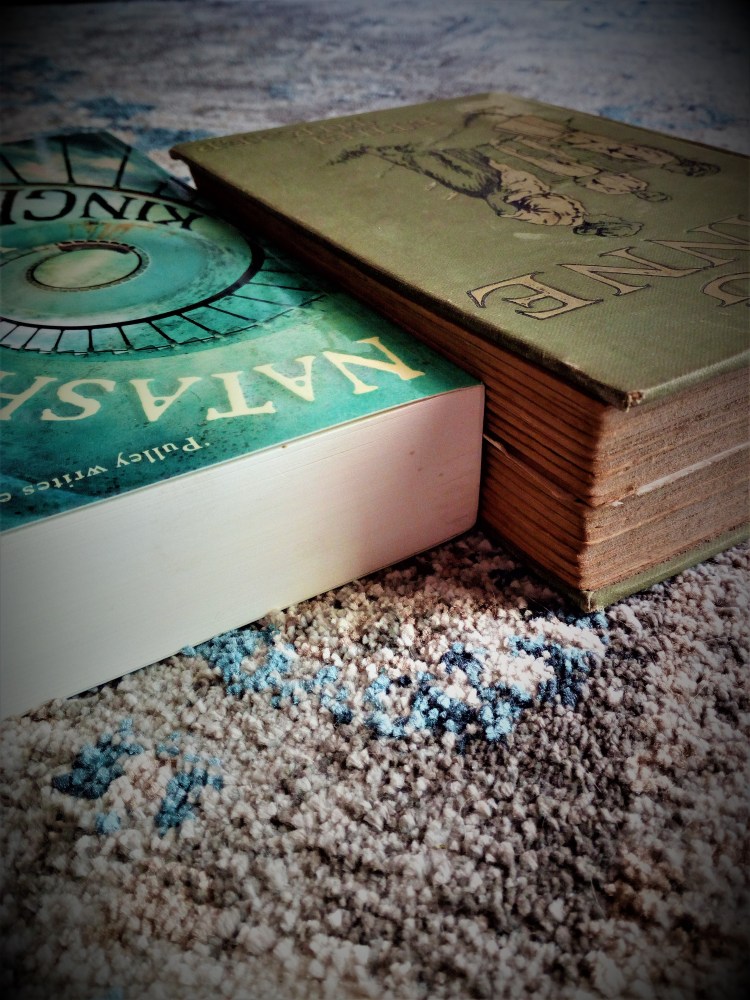
The difference between the size and weight of these two books was misleading until held in my hands. Natasha Pulley’s The Kingdoms is a slimmer volume with a lighter bookcover and thinner pages compared to Ethel Turner’s bulky King Anne with its fabric-over-cardboard bookcover, cotton stitching and stiff parchment-like pages. The modern publication is 200g heavier.

Australian author Ethel Turner booklist:

Seven Little Australians (1894)
The Family at Misrule (1895)
Story of a Baby (1895)
Little Larrikin (1896)
Miss Bobbie (1897)
Camp at Wandining (1898)
Gum Leaves (1900)
Three Little Maids (1900)
Wonder Child (1901)
Little Mother Meg (1902)
Raft in the Bush (1902)
Betty & Co (1903)
Mothers Little Girl (1904)
White Roofed Tree (1905)
In the Mist of the Mountains (1906)
Walking to School (1907)
Stolen Voyage (1907)
Happy Hearts (1908)
That Girl (1908)
Birthday Book (1909)
Fugitives from Fortune (1909)
Fair Ines (1910)
An Orge up to Date (1911)
Apple of Happiness (1911)
Fifteen & Fair (1911)
Ports & Happy Havens (1911)
Tiny House (1911)
Secret of the Sea (1913)
Flower O’ the Pine (1914)
The Cub (1915)
John of Daunt (1916)
Captain Cub (1917)
St Tom & The Dragon (1918)
Brigid & the Cub (1919)
Laughing Water (1920)
**King Anne (1921)
Jennifer, J. (1922)
Sunshine Family (1923)
(with Jean Curlewis her daughter)
Nicola Silva (1924)
Ungardeners (1925)
Funny (1926)
Judy & Punch (1928)
**King Anne is Number 36 on this list and according to the list in my book (photo above) this was her 21st novel.

Ethel Turner’s literary works have been largely forgotten but she, and a handful of other women writers, paved the way for Australian books for Australian children. My grandparents were educated with, and read, British books, so I admire Ethel Turner’s achievements. The following websites make interesting reading – GBW.

Tea With Ethel Turner by author blogger Rowena (link below) is exceptionally well written and researched. On my own research, so far I have found scant reference to King Anne.

https://teawithethelturner.com/category/seven-little-australians/

https://biblio.com.au/king-anne-by-turner-ethel/work/1139377

https://adb.anu.edu.au/biography/turner-ethel-mary-8885

https://www.fantasticfiction.com/t/ethel-turner/

https://australianwomenwriters.com/

Important Addendum: Australian Women Writers Challenge The Early Years is concentrating on past Australian women writers of all genres who were published then faded away. AWW have restructured their blog to highlight the writing of earlier Australian women; works published 50+ years ago. If you happen to find and read a forgotten gem, AWW would be interested in your book review.

I will be posting my King Anne review in due course. In the meantime, perhaps YOU might find another first edition little-known Ethel Turner on your bookshelf?

Classics deserve to be read again!

 Gretchen Bernet-Ward

Ethel Turner’s first home ‘Woodlands’ NSW as it was in 1892. Ethel is pictured on the right side of the verandah, her older sister and fellow author Lillian is on the left. The gentleman on the horse is unnamed, possibly Herbert Curlewis. The residence has been added to and greatly altered over many years. Picture: Mrs Phillipa Poole

‘Woodlands’ (circa 1884) information and photographs compiled by Alison Cheung, writer and real estate reporter.

‘Avenel’ (circa 1906) compiled and posted by David Carment Lost Mosman from various sources with his photographs and others courtesy of Mosman Library.

Book Review ‘Sweet Jimmy’ by Bryan Brown

Background orchids image © Gretchen Bernet-Ward 2021 and photographed at The Tropic Gardener of Brisbane https://thetropicgardener.com.au/

I was absorbed and entertained all the way through this book.  Pared down storytelling, laced with moral ambiguity, shouting Australian crime noir.  Does author Bryan Brown know these blokes, hear good stories down the pub, or possess a very robust imagination?

Love his unabashed style ‘Clinton buys himself a pepper pie and a chocolate milk’.

Australians need no introduction to Bryan Brown, an actor of many characters in many movies around the world yet he remains true to his homeland (see ABC1 TV series ‘Old School’) and this new book of short stories highlight his considerable talent as an author.

It is refreshing to read a book of short stories which speaks to my generation of Australians: relationships, morals, turn-of-phrase, scenery, all genuine and if you can’t keep up that’s your problem – work on it.

Even if short stories are not your thing, be surprised at how well these work in such a compact way.

‘Sweet Jimmy’

Professor Leong asks why Frank missed his last counselling appointment.  ‘It gets in the way of my revenge,’ says straight-forward Frank. My favourite!

These men love their families yet, like Frank, they show questionable behaviour to avenge them.

The bookcover image, a Phalaenopsis orchid, ties-in with a story where both sides of the law are involved.

Alert – Sexist comment ahead…

From a woman’s perspective I thought Typical Males but I think from a male’s point of view the characters could be genuine mates in a bad place.  Not their fault, they scheme, they seek revenge.  They plot their way through sad, unjust or criminal situations which end with a tenebrous finale.

Also, there is one story I consider to be a Stephen King homage.

This compilation encapsulates the essence of crime fiction. Reminiscent of Peter Corris’ Cliff Hardy series, Bryan Brown plays it low-key but maybe one of his laconic blokes will soon score their own book. 

Gretchen Bernet-Ward

Book Review ‘Apples Never Fall’ Liane Moriarty

Photograph © Gretchen Bernet-Ward 2021

Years ago, I wrote on the office whiteboard “Big Little Lies by Liane Moriarty is going to be huge.”  And it was. Now comes Apples Never Fall, another exceptional addition to the Moriarty canon, an enthralling novel of thought-provoking misdirection, a blueprint of interior family life, a drama so emotionally complex that I thought it was either a memoir, or years of studying suburban families.

In this case it’s the Delaney family with their tennis fixation, the obsessive training and competition of tennis, and its aftermath soaking into decades of their family relationships.

I followed the sudden arrival of stranger Savannah Pagonis, a cooking wiz, into the unsuspecting Delaney household, and discovered how Joy and Stan Delaney handle this peculiar arrangement while coping with retirement and the dysfunctional lives of four Delaney children now adults.

When matriarch Joy mysteriously disappears, the overarching plot hinges on “Joy, dead or alive?” and is set in present time with flashbacks. Husband Stan and deceptive Savannah are under suspicion, and here clues are planted, the trail of breadcrumbs laid for the observant reader.

Sprinkled throughout the story are friends, neighbours and comic relief from police duo DC Christina Khoury and PC Ethan Lim who struggle with their missing person investigation.

In the case of Savannah and the Delaney siblings Amy, Troy, Logan and Brooke, as youngsters they never seemed to trot off to school. Perhaps an alert teacher could have helped. However, I am sure readers will recognise their fraternal traits as grown-ups.  Character-wise I think son Logan is great, followed by unfathomable dad Stan.

Seventy-one domestic drama chapters unfold in all their glory; chapter 52 is cataclysmic, chapter 53 almost poetry.  At times the plot framework showed, the screenwriting element intruded, and I did not particularly like the odd use of “Troy’s father” or “Amy’s mother” instead of their names but these are minor points; the dialogue pulsates and glows.

Liane Moriarty writes breathtaking dialogue and suspenseful moments leaving no stone unturned on this rocky domestic landscape.

“Apples Never Fall”

The sense of place is strong and even though there is a lot going on, Moriarty has written an intimate narrative of social and relationship enlightenment which got me recalling my own younger life, the missed cues and insights the older me now recognises.

As the innermost workings of the Delaney family are laid bare, Moriarty’s writing transcends game, set and match, particularly relating to Joy and motherhood.  Wow, I could read out pages of Joy and defy any woman to say she hasn’t felt the same at some point in her life.

I thoroughly enjoyed reading this novel.

Gretchen Bernet-Ward

Rating “Apples Never Fall”

Rating: 5 out of 5.
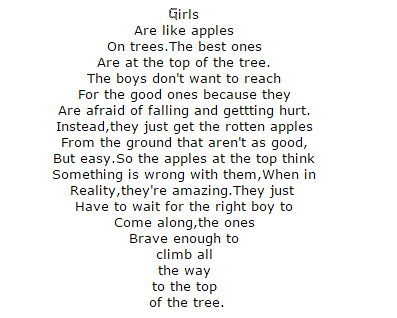
Shape poetry source unknown

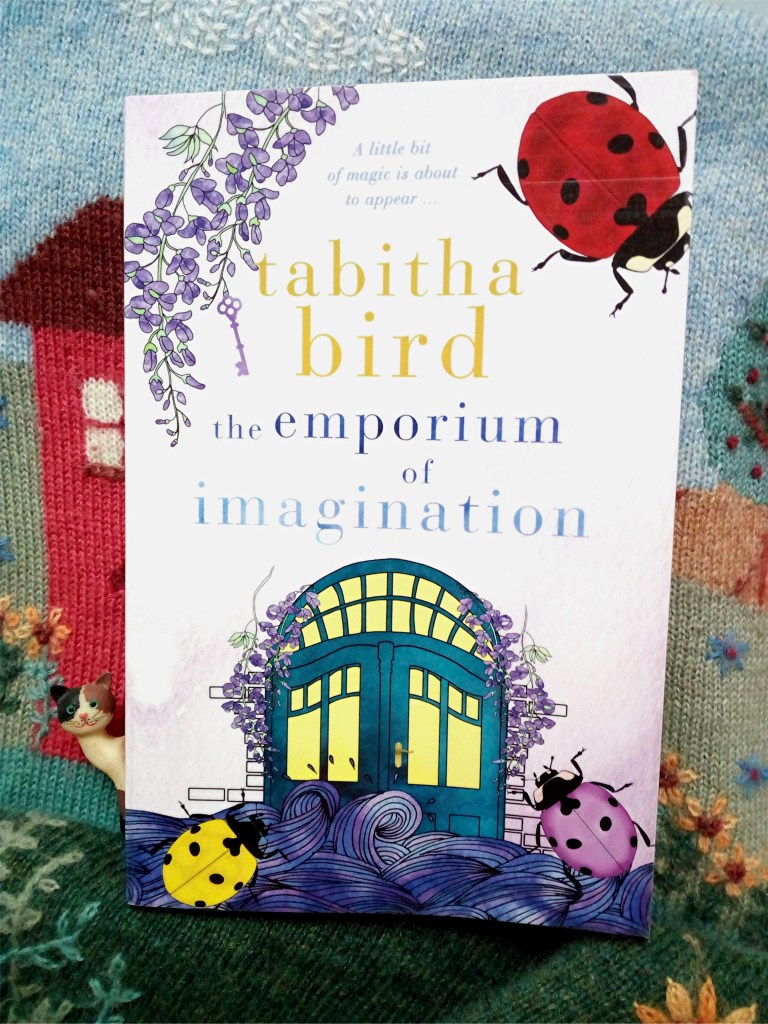
Review ‘The Emporium of Imagination’ Tabitha Bird

Image © Gretchen Bernet-Ward 2021

A tale of love, loss, grief and healing wrapped in magical realism and suitable for a wide range of readers.  Families in this story have lost loved ones and are either handling their grief, not handling it, or ignoring it.  They carry suppressed fears, squashed desires, and unfulfilled dreams but The Emporium of Imagination is here to help.  And help it does, in the strangest of ways.  I know the town of Boonah (and the camel farm) and felt an affinity as the story unfolded but apart from Story Tree café and Blumbergville Clock in High Street, similarities ended there.

A man, a cat and a key arrive with The Emporium and set up shop in the main street of Boonah, offering special ‘phones’, strange notes on scraps of paper and the ability to hear human grief in all its stages.  Although this may sound gloomy, at worst depressing, the characters keep things moving, offering the reader many POVs and scenarios ranging from timidity to teen humour, guilt to anger, regret, and worse case scenarios like replaying the death of a loved one.  The narrative often has dreamlike suspension of disbelief but the heartache is real.  

The iconic clock mentioned in the book is named after the original Blumbergville settlement in Boonah and is made out of old farming and industrial equipment. In 2014, Boonah artist Christopher Trotter created the clock with Boonah clock-maker David Bland designed to mark the town’s rural heritage.

The Emporium’s former custodian, Earlatidge Hubert Umbray, gives way to a new curator who decides not to answer the special ‘phone’ but believes the townspeople of Boonah deserve hope ‘I can’t take that away from them’ although cynical me wonders if it would give false hope?  Surely a nicely worded pep talk about getting on with your life and following those cherished dreams would work?  However, the story is more restrained than that and gently imparts the whys and wherefores of coping with grief. 

I felt the inside of The Emporium was a bit Disney-movie.  While I tried to put my own emotions into a character, the practicable side of me could not relate to uncertain concepts.  Would a final ‘phone call’ to the recently deceased help the person in mourning, or would it tip them over the brink?  Items include Ladybird lollipops (nobody pays for goods); special connections to memorabilia; a notebook which turns up in the oddest places for select clientele; and a subtle cat with an unsubtle name.

In the last pages of the book I found the experiences of author Tabitha Bird just as moving as the characters in the book (poor dear Enoch) but that’s just me.  There is an end page headed The Owner’s Guide To Grieving in keeping with The Emporium’s roving notebook, offering the opportunity to write in ‘A quiet space to simply be’. I read a new library book so abstained from writing on the page—I bet someone does.

Now I’m off to bake Bedtime Muffins from Isaac’s (Enoch’s dad) recipe!

Gretchen Bernet-Ward

Grantham Gatton Helidon Road vintage shop © Gretchen Bernet-Ward 2019

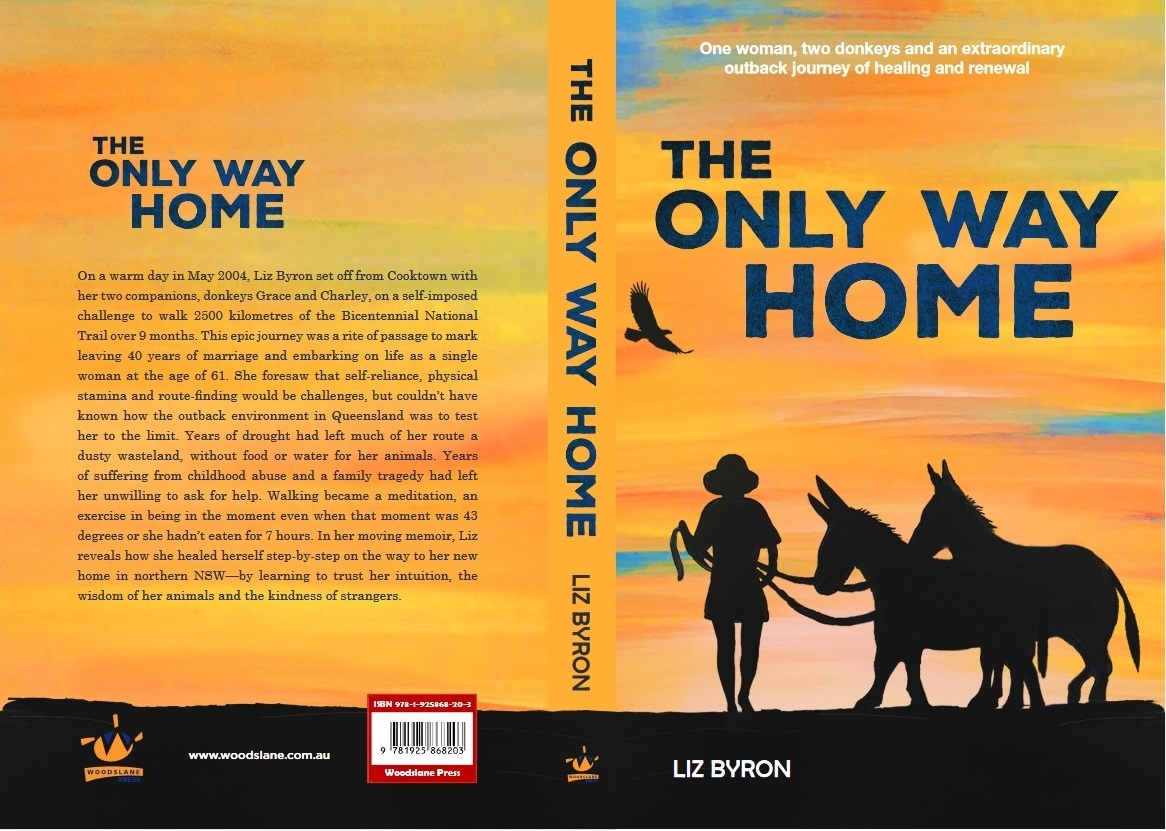
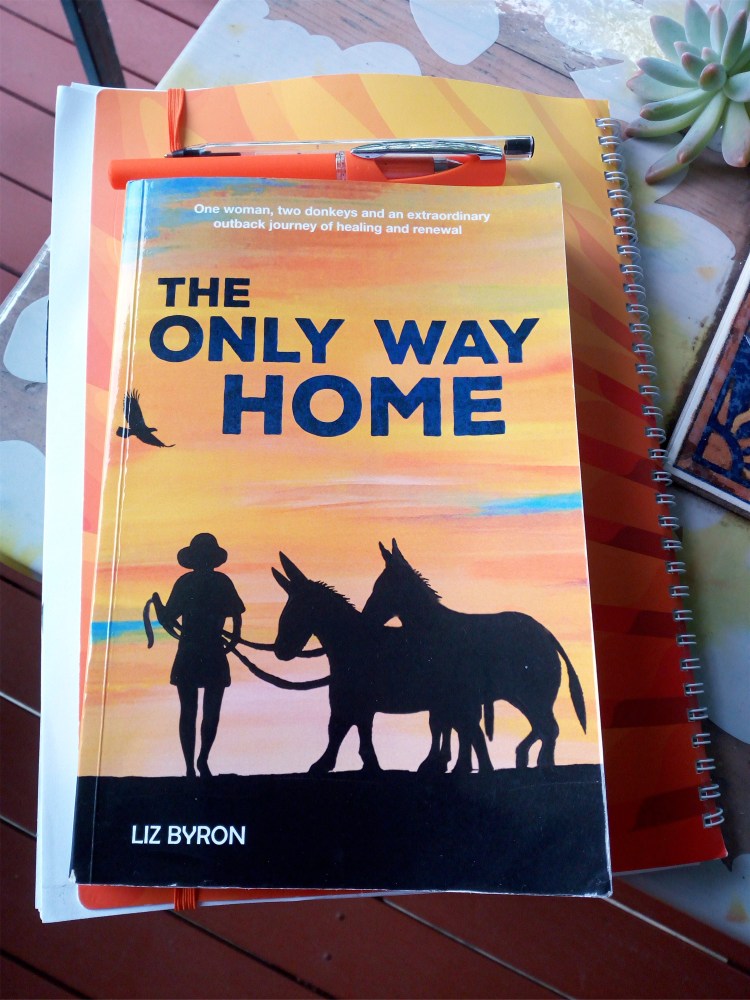
Donkey Trekking Tips ‘The Only Way Home’ Liz Byron

In her memoir ‘The Only Way Home’ and YouTube video (see below) Liz Byron explains what it meant leaving her roller-coaster marriage, career, family dinners, large library and a comfortable, charming home to trek 2,500 kilometres through rural Queensland on the rugged Bicentennial National Trail.

Liz, mother and semi-retired sociolegal researcher, writes from her New South Wales Northern Rivers home.  Her writing is confronting and visceral in its honesty.

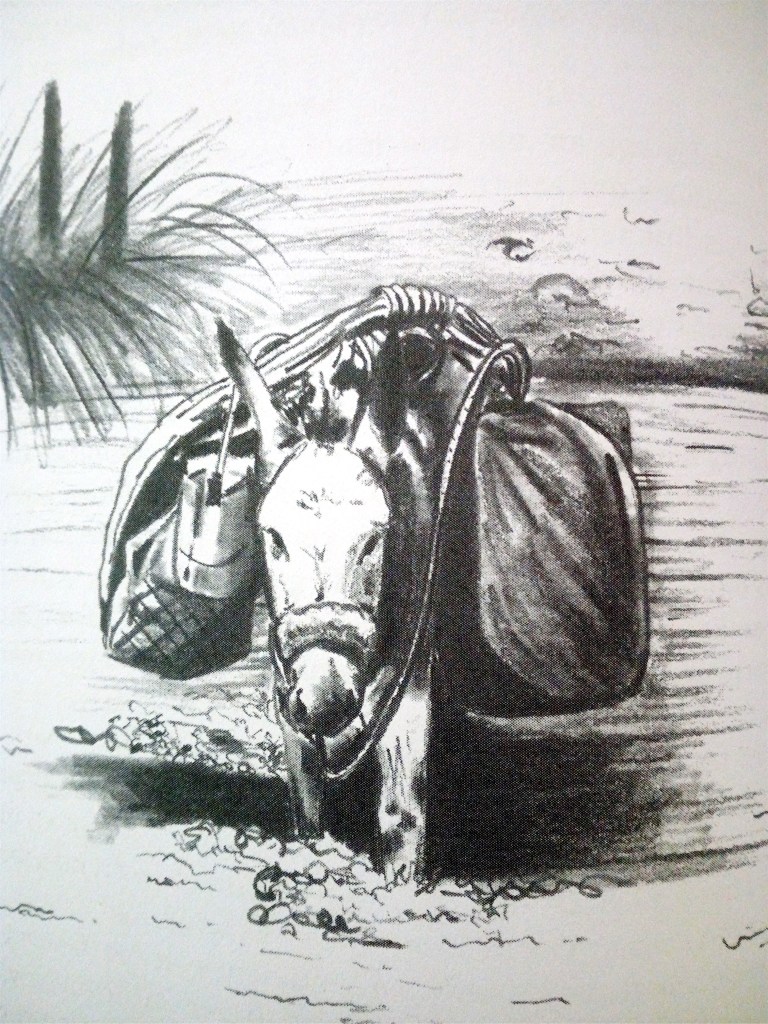
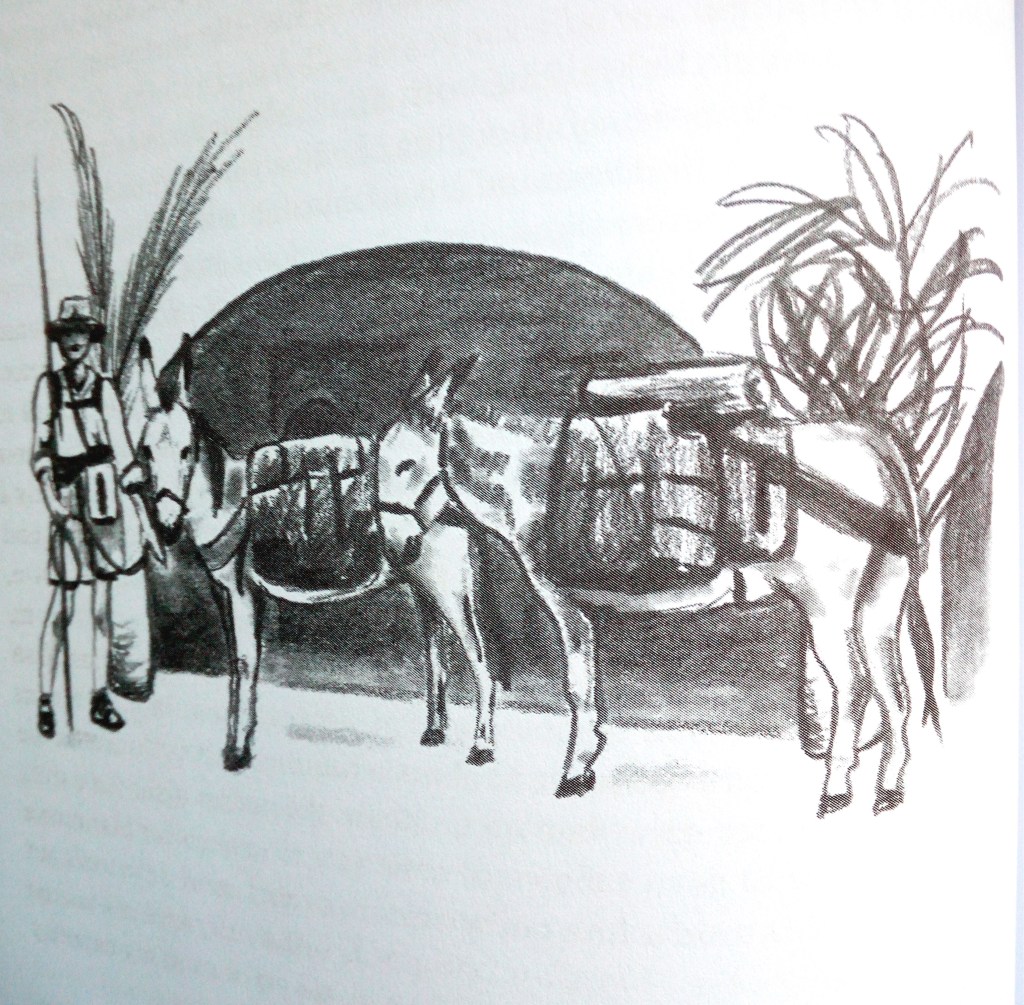
Each step on this radical journey of self-discovery helped Liz make sense of grief and trauma, including the tragic loss of one of her four children.  Liz’s fierce independence was confronted daily as she tackled details of equipment, food supply, lack of drinking water, thorny grass seeds and the hilarious will of her two devoted donkeys Grace and Charley.

PHOTOGRAPH COURTESY OF AUTHOR

EXCERPTS FROM LIZ BYRON INTERVIEW

What advice would you give to someone wanting to do a long distance trek?

LIZ : From the various facets involved in a long-distance trek, consider where you might lack experience and spend time acquiring the experience you need. From thirty years of overnight bushwalking, I was experienced at living outdoors, packing light, negotiating difficult terrain and camping, cooking in all weathers. However, I had no experience with large animals and allowed myself four years to get to know my donkeys, learn how to handle them on the road and have them face as many scary situations as I could predict might arise.

What was your most essential piece of equipment?

LIZ : My hoof pick. Everything about trekking depends upon the donkeys’ feet.

You talk about having to learn about adjusting your standards of what to expect, how did the BNT trek compare to what you expected?

LIZ : Adjusting my standards was more about adjusting my expectations of other people and myself. A strong theme in the book is that – because of all my outdoor experience – physical challenges were easily overcome. It was almost as if surviving physically demanding situations was no longer part of the lessons I needed to learn. The challenges were much more about relating to people from whom I needed help – because of the extremely dry conditions and NEVER part of my trek plan – so accepting my limitations, and theirs, changed my standards of what to expect in all sorts of social situations.

What was the most important thing that working with donkeys taught you about yourself?

LIZ : Accepting the way things are, like donkeys do, is far healthier, for both mind and body, than getting lost in thoughts about how things should be.

Several years have passed since you walked the Bicentennial National Trail, have the lessons you learned endured?

LIZ : Yes. Because lessons learned from experience, in other words, from our mistakes, naturally endure.

Thank you, Liz, I enjoyed reading ‘The Only Way Home’. Your unique memoir shows strength of purpose and insights into your remarkable journey.

Gretchen Bernet-Ward 2021

WOLLONGONG CITY LIBRARIES – YOUTUBE

MY BOOK REVIEW HERE

THE ONLY WAY HOME


PURCHASE BOOK HERE

Liz Byron ‘The Only Way Home’ Book Review

A memoir of singularity of purpose and a deep determination to overcome all obstacles.  Liz Byron challenges herself in every way, mentally, physically and spiritually to start afresh by walking the rugged Bicentennial National Trail towards a new, independent life.  The BNT on the Great Dividing Range on the east coast of Australia has some of the most unforgiving landscapes in the world.  Her companions on this journey are two donkeys with the wisdom of ages and Liz’s symbol, the wild watchful wedge-tail eagles.

‘The Only Way Home’ is an intimate memoir with a heartbreaking look into family life, the pain Liz suffers and the repercussions for those involved.  It also captures the freedom of walking through wide-ranging bushland, fording rivers, and making camp with two charming character-filled donkeys Grace and Charley.

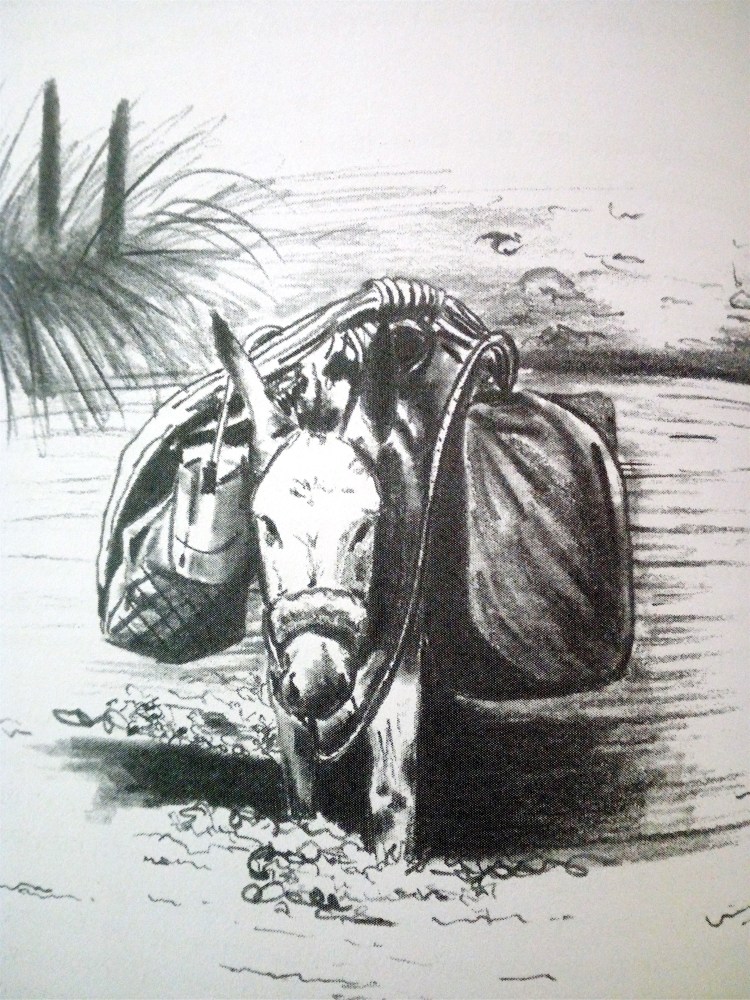
Liz had previously done a lot of bushwalking but without encountering such a harsh and challenging environment. Taking the extremes of drought country in their stride, her donkeys are clever and observant, and prove they can be stubborn for good reason.  Humans just have to work out what those reasons are! Liz shows love and respect for her companions, their hardiness and their intuition. Grace and Charley each carried a load, packed and balanced, and it was amusing how they behaved when released to graze.

Interspersed with walking the Queensland section of the BNT, a trail originally intended for horses, Liz writes candidly about her fractured marriage, the love of her children and losing a child, the trauma of her own childhood and soothing meditation. A mixture of grief, courage and sheer willpower drives her forward as she launches herself into a second life in one of the most demanding ways imaginable. 

Admittedly I am not an adept hiker but some of the trials and tribulations Liz encountered would have had me stumbling to the nearest township, flagging down a four-wheel drive and heading back to Brisbane.  At one stage the soles of Liz’s hiking boots came adrift, not to mention needle-thin grass seeds digging into her skin.  Sometimes the track was marked and sometimes it was not; they traversed barren sections, steep topography, waist high grass, slippery rocks and rested at the occasional restorative oasis.

Along the way, Liz kept a journal rather than taking photographs and if she stopped for the night in solid accommodation in lieu of pitching a tent, all she needed was a table and chair to update her journal.  Liz often met farmers, cattlemen, country people, who were informative and willing to help with advice on the terrain ahead, plus an overnight paddock for her two stalwart pals.

Memorable lines from Liz ‘Folks in rural, remote, drought-stricken Queensland understood only too well the interdependent nature of being human.  I, on the other hand, was trying to resolve an inherent dichotomy: seeking my independence as a woman at the same time as being a homeless wanderer heavily reliant on cattle station people’ – Liz is a vegetarian and food was a source of uneasiness, both getting and eating, and fresh produce was always a joy – ‘My commitment to receive help graciously was Step One.’   

Charlie, the archetypal Australian bushman said ‘Don’t be tempted to leave the roadway. The country is the same in every direction. Getting lost around here is a lot easier than getting found.’

‘The Only Way Home’

I liked the way the chapters and timeline were introduced.  Backstory arrives at pertinent intervals with sections of Liz’s life before, during and after she walks the Bicentennial National Trail.  Through Liz’s retelling more shocking revelations emerge, putting her quest in sharper focus.

Just reading, without travelling alone for 2,500 kilometres with two Equus asinus companions, this memoir invoked many emotions in me. From an embattled marriage to conquering those kilometres, Liz shares the insights gained on her path to independence and healing.

Gretchen Bernet-Ward


ISBN: 9781925868203
Format: Paperback
Number of Pages: 257
Published: 24 Feb 2020
Publisher: Woodslane Pty Limited NSW

In her introduction, Liz Byron says ‘It was 2006, when I had been writing academic material for 20 years, before I decided to try writing my story. I had five lecture pads full of journal notes about the 2,500 kilometre trek I’d recently completed with my two donkeys. This seemed like a good place to start.  And so I did. I wrote on and off for nearly fifteen years before feeling as if I understood myself and my life well enough to explain why I had done the trek.’ My thanks to Liz Byron for a review copy, the book is available on her website here.

LIZ BYRON Q&A INTERVIEW HERE

The Bicentennial National Trail - Australia
The Bicentennial National Trail (BNT) originally known as the National Horse Trail, is one of the longest multi-use, non-motorised, self-reliant trails in the world, stretching 5,330 kilometres from Cooktown, Queensland, through New South Wales and the Australian Capital Territory to Healesville, 60 km north-east of Melbourne, Victoria. This trail runs the length of the rugged Great Dividing Range through national parks, private property and alongside wilderness areas. The BNT follows old coach roads, stock routes, brumby tracks, rivers, fire trails and was originally intended for horses.  The Trail would take most of one year to walk.

Review ‘The Animals in That Country’ Laura Jean McKay

Australian native animals not include with book © Gretchen Bernet-Ward 2021

My reading was floundering until this gleaming gem came along!  ‘The Animals in That Country’ is a novel with strange overtones and intense undercurrents.  Certainly a distinctive story with fear, confusion and confronting chapters involving the catastrophic side effects of human zooflu virus and the subsequent fallout for the animal world.

Kind of dystopian, kind of quirky,
this book made me think, it made me cringe,
it fascinated me, it troubled me,
and it will stay in my mind for a long time.

People succumb as the virus spreads across the country, or they try to outrun it, and some eventually arrive at the animal park where alcoholic ranger Jean Bennett works.  Her initial despair permeates these early chapters, both for the animals and her wayward son who causes problems.  Jean is careworn by events and decides to leave the native animal sanctuary with Dingo Sue to find her runaway family.

I may not like the disarray Jean and Dingo Sue get into as the pandemic spreads but it certainly makes riveting reading.  I trekked with them along dusty outback roads via devastated townships to reach the ocean.  They meet rough characters and conmen but Jean believes in Sue’s unerring instincts leading them towards the hypnotic seashore.

With a singular writing style, author Laura Jean McKay tackles a pandemic from a different angle.  The animals and birds are not anthropomorphised in the usual sense, and definitely not suitable for children.  At first Dingo Sue is unintelligible until gradually Jean understands the patterns of mind matching physical dialogue, and ‘speech’ is cleverly enhanced by page layouts.

The subtle yet resilient nurturing instincts of both human and animal infuses the story and this primitive and powerful connection twisted my brain.  I was gripped by the overwhelmed and distraught characters who learned that we are part of nature, dependent upon it for our existence and survival but it can drive us mad.

As I was nearing the final chapters, I heard that author McKay had won the coveted Victorian Premier’s Literary Awards 2021.  In a statement McKay said she had been writing a draft several years before coronavirus devastated the real world.  Apparently she was unwell with malaria-like symptoms while writing and said this may have accounted for the creeping darkness of the story, the uncertainty and panic is eerily similar.

This novel cries out for an Australian native animal bookcover ‘The clouds have parted, leaving the lit-up ghost of a dingo, a pale and vengeful ancestor on the passenger seat beside me … Her hair shifts.  Body ripples with messages that join like drops of water in the sea.’

Thoughts on ‘The Animals in That Country’

An earthy, supernatural tale, a reminder of Earl Nightingale’s quote ‘Never compete. Create’ and Laura Jean McKay has excelled.

I can highly recommend the audio book read by the author, it boosts the story to yet another level.

Gretchen Bernet-Ward

PROFILE
Laura Jean McKay is the author of ‘The Animals in That Country’ (Scribe 2020) and ‘Holiday in Cambodia’ (Black Inc. 2013) shortlisted for three national book awards in Australia.  Dr McKay is a lecturer in creative writing at Massey University NZ, with a PhD from University of Melbourne focusing on literary animal studies.
LINKS
Laura Jean McKay’s bio journal
http://laurajeanmckay.com/
McKay is the ‘animal expert’ presenter on ABC Listen’s ‘Animal Sound Safari’.
https://www.abc.net.au/radio/programs/animal-sound-safari/
FURTHER READING
Victorian Premier’s Literary Awards 2021
https://www.wheelercentre.com/projects/victorian-premier-s-literary-awards-2021
Scribe Publications information
https://scribepublications.com.au/books-authors/books/the-animals-in-that-country
The Dingos of Fraser Island Queensland
https://parks.des.qld.gov.au/parks/kgari-fraser/about/fraser-island-dingoes/dingo-ecology

Review ‘Consolation’ by Garry Disher

IMG_20210126_125655

When I read a good book by an author whose work I always enjoy, it is hard for me to express my thoughts without going overboard so I tried to apply self-restraint with Garry Disher’s ‘Consolation’ and hope I convey my message.  For the full impact, I suggest you read the first two books but Tiverton’s only police officer Constable Paul ‘Hirsch’ Hirschhausen conveys his job and lifestyle with great clarity so this story can stand alone.

Constable Hirsch does a huge amount of driving given the vast distances of his country South Australian beat.  He is calm, diplomatic, intelligent, sensitive, and has a lovely woman in his life.  Several threads run throughout the story; Hirsch gets stalked, good characters die, ordinary people are murdered and baddies steal money.  Not as mundane as it sounds.  For starters who are the goodies and who are the baddies?  There is more going on than I first thought.

This story is populated by a fair amount of unstable people, at the very least people with problems.  The Ayliffe family are atop the big-problems tree.  They snake in and out of the plot, stealing from homesteads, frightening farmers, bent on their own personal rampage.  Hirsch moves ever forward, ever thinking, trying to stay one step ahead, or picking up the pieces after another tragic crime has been committed.

Redruth Burra South Australia 02

Hirsch knows the land better than the city cops sent to help in their black SUVs with matching attitudes.  A high wind chill factor features throughout, rain turns the roads to mud and cars bog, naturally conditions are not conducive to high speed chases.  Also, someone is nicking knickers from ladies clotheslines, and elaborate extortion schemes are in play with devastating repercussions, each investigated by Hirsch with Redruth police back-up.

There are tough themes: child abuse, parental negligence, childcare system.  The abuse of the elderly, not so much physical but extortion, dishonesty and controlling behaviour.  The harsh reality of criminal behaviour, and its impact on Constable Hirsch’s rural beat, is an immersive experience.  He combats the weather on his early morning foot patrols.  Quote “There was ice everywhere on Thursday morning. Hirsch tramped the streets of Tiverton in the saw-teeth of another frost.”

Author Disher’s rural characters have personality, and naturally not all are good honest citizens so it is gratifying when they are caught.  The master of Hirsch’s POV, Garry Disher is also the master of the neat transition.  Instead of slowing down the action, backstory came when “As Hirsch reconstructed it later…” so important, so human.

An absorbing story with everything unfolding in an almost lyrical flow of actions and emotions, and a series well worth reading.

Gretchen Bernet-Ward


“Consolation”
Format: Paperback
Extent: 400pp
Text publication date: 3rd November 2020
ISBN: 9781922330260
AU Price: $32.99
NZ Price: $38.00
Categories: Crime & Thriller, Rural Police, Australian, Fiction
https://www.textpublishing.com.au/books/consolation

Happily I only spied one typo on page 368 when “Vikki Bastian, who’d had been on her knees flicking…” GBW.

Author Info:
Garry Disher has published fifty titles across multiple genres. He has won multiple German Crime Prize and Ned Kelly awards, including the Ned Kelly Lifetime Achievement Award. To quote from Text Publishing interview “The dryness, the heat, the sense of space and the sparseness of human presence inform every page and drive every action. It is a quintessentially Australian setting for a quintessentially Australian subgenre of crime – it’s been dubbed ‘rural noir’ and Garry Disher is one of its pioneers. In fact, without him, it might not exist at all.  Farming country in the mid-north of South Australia is where Garry Disher grew up, and although he hasn’t lived there for years, the area still holds a special place in his heart…”

Read more:
https://www.textpublishing.com.au/blog/this-place-won-t-let-me-go-the-importance-of-landscape-in-garry-disher-s-crime-fiction

IMG_20210126_115008
My book review of CONSOLATION by Garry Disher was posted on Australia Day (as it is currently named) so I was eating a lamington shown in lower left corner © Gretchen Bernet-Ward 2021

Three Australian Flags 2021

Review ‘Death in Daylesford’ by Kerry Greenwood

IMG_20210102_184518
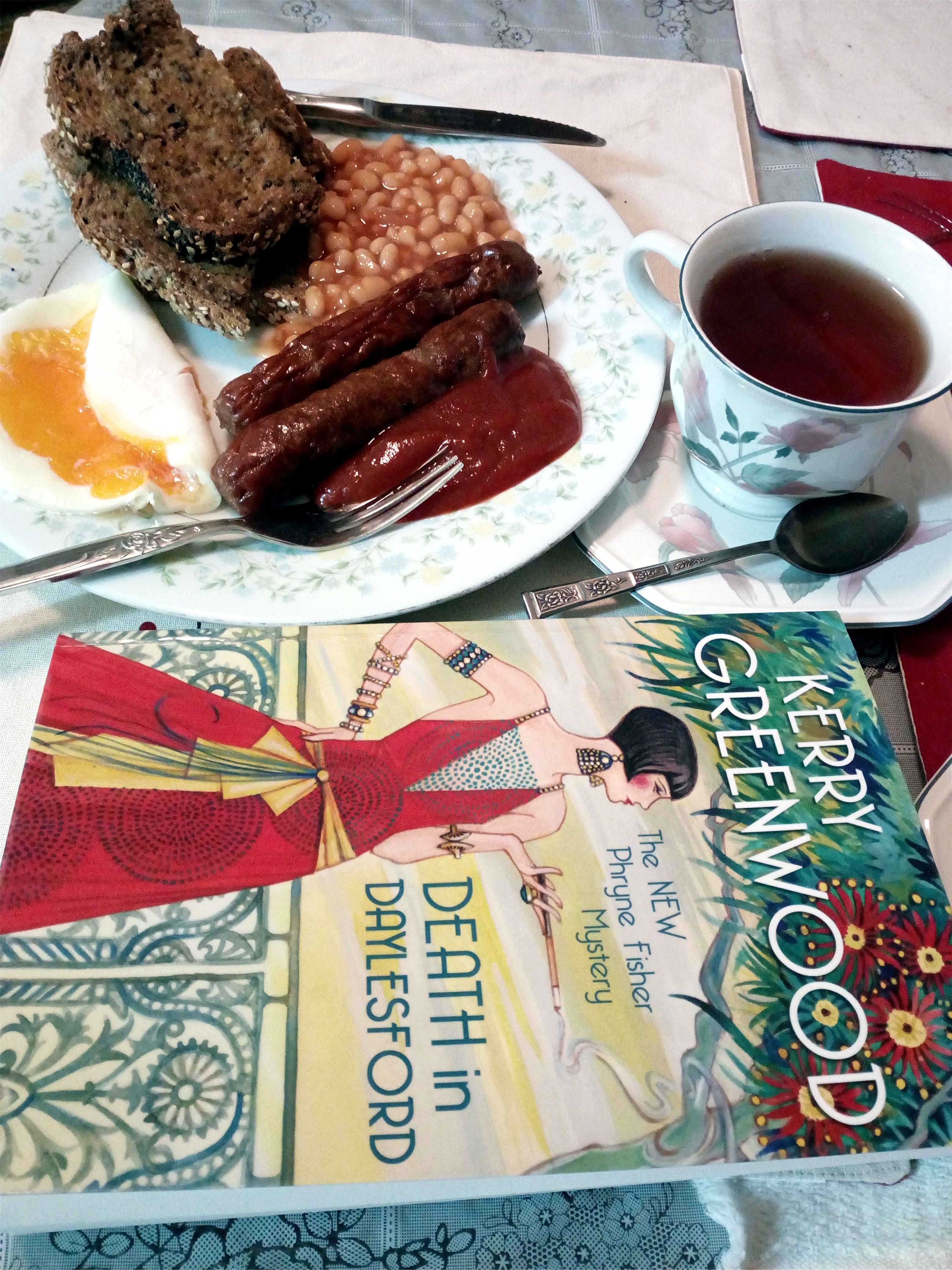
GUESTHOUSE BREAKFAST of wholegrain toast, baked beans, beef sausages, tomato sauce and one egg with a cuppa and a good book © Gretchen Bernet-Ward 2021

Supposedly on a short holiday to check out the healing benefits of mineral water for returned soldiers, while staying at Mooltan Guesthouse in the health spa town of Hepburn Springs near Daylesford, Phryne Fisher and Dot Williams bump into nice and not so nice individuals.  A cunning murderer gets to work killing men in broad daylight, while throughout the novel the Temperance Hotel and knitting entwine with a strong sisterhood bond.  

In the adventurous 1920s, fabulous Phryne Fisher is a wealthy, upper-class, down-to-earth lady detective who lives in bayside Melbourne, Australia.  She solves all kinds of crimes with the assistance of her dour maid Dot (also sleuthing companion) and is occasionally helped by the mighty Bert and Cec who are wharfies and stirrers, plus two stalwart policeman, Inspector Jack Robinson and Dot’s suitor Constable Hugh Collins.

IMG_20210104_095239
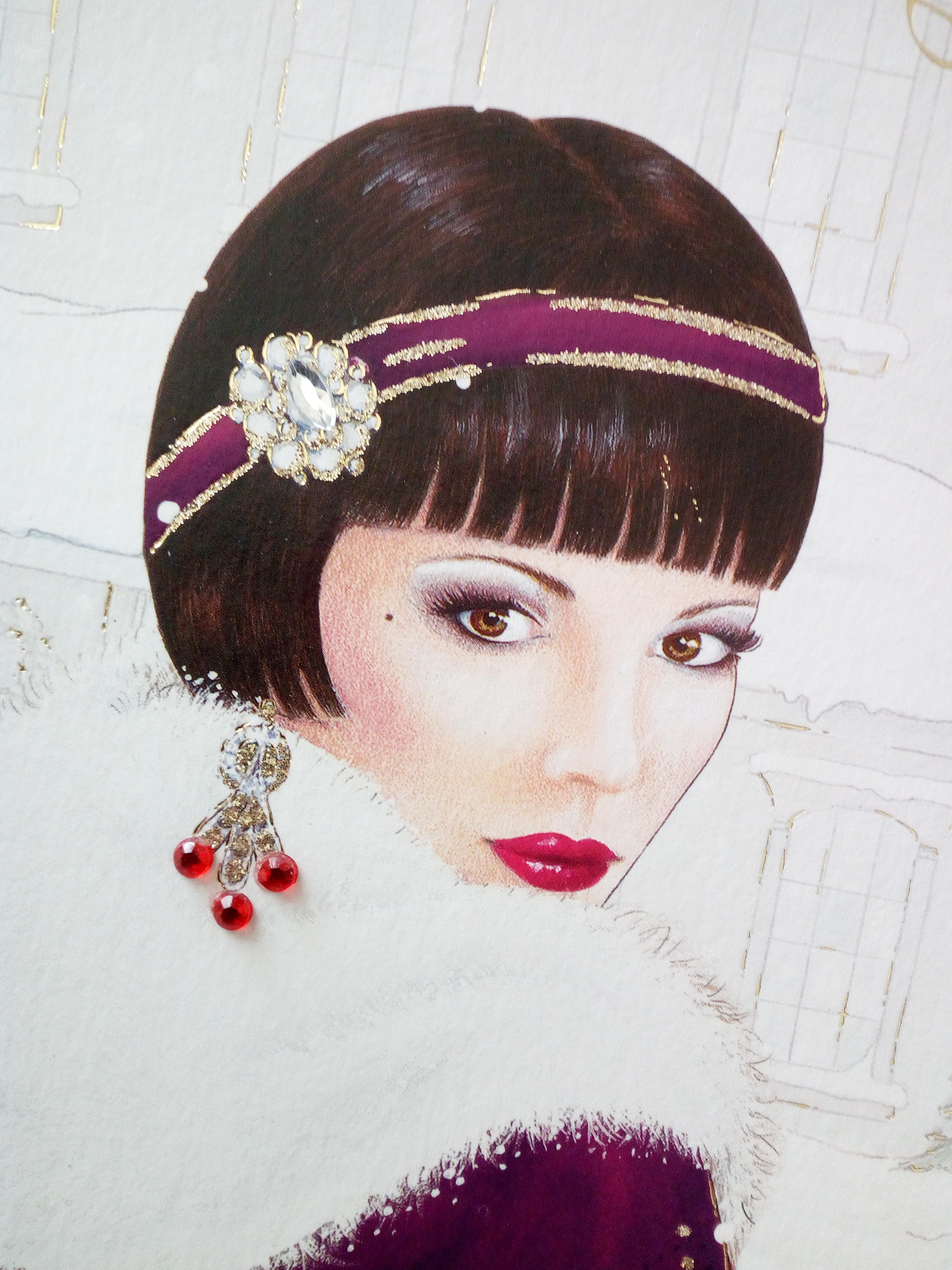
Snapshot from DECO Watermark Publishing Ltd and John Sands Greeting Cards

The Honourable Miss Fisher features in this long-running series of novels, and on TV and cinema screens, whilst recently author Kerry Greenwood has included keen young Tinker and adopted daughters Ruth and Jane who get their fair share of investigative work in “Death in Daylesford” although not in the company of Phryne.  A suspected murder arises for them back in Melbourne while Phryne and Dot roam the countryside.

Kerry Greenwood has nailed the era.  Apart from a doubtful reference to broccoli (was it available then?) and later a toilet roll (in an outside dunny on a country farm no less) she writes with vigour and a lust for life, and has the knack of enhancing a scene with extra intrigue.  Chapters are populated with a variety of characters like luscious barmaid Annie, copper Mick Kelly, handsome Captain Spencer and gun-toting suffragette Miss McKenzie. 

My favourite quote “Alice glowed like a hurricane lamp.  ‘I am so pleased!  Do you think that Violette…’  She left the sentence hanging in the air, like a house brick under the influence of anti-gravity.”  Gems of this type are used sparingly yet with great effect, especially when I knew hanky-panky was afoot.  Miss Phryne Fisher is more risqué than her on-screen counterpart.

Real locations are used in this story and I don’t remember but apparently I visited the mineral springs as a child.  “Death in Daylesford” is the 21st book in the series.  I have read Kerry Greenwood’s contemporary series featuring baker/private eye Corinna Chapman but self-assured Phryne keeps luring me back with her fast driving, rule-flouting and cheeky disregard for social conventions.  Always with her brain ticking over and a winning smile.

Gretchen Bernet-Ward

Two images from “The World Turns Modern”
Art Deco from National Galley of Australia Collection
Ipswich Art Gallery 2019
My original Art Deco post https://thoughtsbecomewords.com/2019/10/24/art-deco-delights-on-display/

In memory of my father who grew up in the same inner city streets of Melbourne.
He would have known what an Hispano-Suiza was… the car Phryne Fisher drives.
GBW 10th January 2021

Book Review ‘Trust’ by Chris Hammer

IMG_20201229_121821
“Millie the Money Box” from Westpac Bank in conjunction with Sydney Olympic Games 2000. Used for illustration purposes only. My tie-in with the crime novel “Trust” which involves a bank and lost millions. Millie is not only memorabilia, she once held pocket money in the form of 50cent pieces. I wonder if coins, pocket money and piggy banks will exist in the future? © Gretchen Bernet-Ward 2020

—Review—

Martin Scarsden is the central character but in “Trust” he shared the limelight.  His girlfriend Mandalay Blonde’s story was just as valid as Martin’s but I found events lacked drama when it came to poor-girl-makes-good-gets-stuck.  She did get her act together when a group discussion propelled her into action.  Unbeknown to Mandy she would soon face major problems from an old-boy network, creepy co-worker, money laundering and large scale corruption.  Two major questions swirled around Mandy regarding her former fiancé and her place of employment, viz, “What was Tarquin Molloy playing at?” and “Where are Mollisons missing millions?”

Backstory is not the story and I started to lose interest in author Chris Hammer’s exposé on Mandalay and her stressful life.  She arrived in Sydney and quote “She wants to flee, to get back to her son, to protect him.  And yet the past is coming, it’s here, she can’t carry it back to Port Silver; she can’t risk it getting a trace of her boy…”  The ship had sailed on that one.  In previous books, she and Martin were in the media, the talk of the town, easily found by adversary Zelda Forshaw.

Halfway in, I wanted to shake up the action and indirectly Mandy obliged even though she was on an emotional rollercoaster.  She met a dodgy cop in a dingy café in a tunnel under Central Railway station without a companion, without telling anyone where she was going.  I said “Organised crime, Mandy, people were being murdered!”  Thus the script-writing elements showed with Chris Hammer’s talking heads and scene-setting rather than people who moved through their surroundings.  Ancillary characters were great, from the homeless to corporate high-flyers, a computer geek to a retro assassin and, of course, ruthless newspaper men. 

Poetry Clipart 04

Anomalies were Australian judge Elizabeth Torbett with Tory politics; Martin, a seasoned journo who relied on technology and a laptop but made novice mistakes; Mandy did not regularly check on son Liam in Port Silver; Martin had coffee with Montifore in Chapter 33 but “Goffing returns with the drinks…” Oops.

“Trust” the perfect title, and Chapter 28 and Chapter 29 alone were worth the price of the book.  Martin visited Justice Clarence O’Toole of the New South Wales Land and Environment Court and asked him a few questions.  The old judge was very ill but talked at length about his membership with The Mess, a private club, and the sudden death of Martin’s mentor and friend.  Afterwards Martin thought about his journalistic career and the slow agonising demise of print newspapers.  I went straight out and bought an edition of The Courier Mail.

Chris Hammer future-proofed his crime novel with coronavirus, and mentioned the pandemic several times, but it flopped for me.  Covid-19 was not over when I read the book.  At this point in time, Sydney still has coronavirus outbreaks and restrictions.  “Wash your hands, wear a mask, keep your distance”.

Martin and Mandy’s ordeal took place over seven days and I would not have enjoyed being in their shoes, but I enjoyed the Australian setting and frontispiece map of Sydney.  There was a wonderful iffy, dicey feel to the plot which at times stretched tropes and credibility, like the ASIO meet-up, or the dance of death, however a clever twist enhanced the story and the ending was unexpected.  On the whole, I liked this third instalment, quote “some huge story, some grand conspiracy” so cheers to more books and great reading in 2021 New Year.

Gretchen Bernet-Ward

“Smartphones on and life-cancelling earbuds in”

From Trust Martin Scarsden crime series
by Chris Hammer 2020