Temp Work Trials and Tribulation

An autobiographical tale condensed into a short story for my writers group on Tuesday, and yes, you get to read it here first!

Due to the nature of my story, I have not used paragraphing or dialogue so there is one continual flow of consciousness.

Brisbane River CBD red arrow marks the approximate area where the warehouse building in my story exposé was located in 1970s.

One thing I disliked about doing temp work for a small city employment agency was the tedious, repetitive and uncomfortable jobs I was sent to do without so much as a ‘Would you like this assignment?’ or ‘Does this one suit you?’ No, I was just shunted off without any idea of what I was going to be doing. You could bet on it being the worst office job, the one that no staff member would touch, nor would they give any help to the newbie. Off I would trot to a dingy 1970s office with old-fashioned equipment, uncomfortable chairs and messy desks with tea mug stains which I was supposed to miraculously turn into a fully functioning, pristine work environment in eight hours. At least, I always hoped my assignments were one-off because more than a day would usually send me around the bend. Particularly if the staff were snobby or the boss was grumpy. One fellow sat like a school principal on a raised platform and watched everyone to see that they only took five minutes for tea break. I learned from other assignments to take my own snack pack of biscuits and fruit to sustain me throughout the long, long day. Once I had a manager who actually checked my waste paper basket to see if I was making mistakes and using up his precious stationery. Another time, I was assigned to a city real estate agency in a grim, gloomy warehouse office somewhere alongside the Brisbane River near the Story Bridge off-ramp to Ivory and Ann Streets, now luxury apartments. I swear that day I never saw another staff member except the front desk receptionist. Surrounded by dust motes and empty desks of the old dark wood sharp-cornered style, I was given the job of typing mail-out letters and addresses on envelopes, a task I was always particular about, and phoning the Courier Mail real estate advertisement section to place ads for forthcoming auctions. I did not understand any of the in-house jargon and I am sure they did not understand my misinformation. At lunchtime, without a briefing, I found myself substituting for the reticent front desk receptionist who may or may not have gone to lunch. This was transition time, the 1970s on the cusp of the 1980s with the 21st century looming. An office world ruled by paper, bookkeeping ledgers, staplers, hole-punchers and Liquid Paper. Also this was the era of IBM golf-ball typewriters and weird flat switchboards; plus there was a two-way radio for the real estate sales reps to call in with information on new clients, or when they were on lunch (probably the pub) or just plain going home for the day. Without a test run, I botched that two-way connectivity twice. The dusty potted plant in the corner seemed to shrug in commiseration. Whatever. I put on my best smile when a woman wearing heels and heavy make-up walked in to pay her rent money. She pulled a wad of fifty dollar notes from her handbag. Back then apparently it was all cash unless you paid with a bank cheque. And she asked for a receipt. What? How was I meant to know where the receipt book was? The searing question uppermost in my panicking brain was ‘What do I do with all this cash?’ The renter helped me muddle through, flashing her long red nails in the direction of the desk drawers and a large manilla envelope. I was very uncomfortable with the whole situation. The reception desk was closely aligned with the open front door and as I hand-wrote a carbon-copy receipt, the noise, grit and heat of the city washed across me. No ducted air-conditioning in those days, even the old pedestal fan couldn’t handle summertime. Of course, one of the selling agents called again on the two-way. Again, I fumbled the call. I have a hazy memory of what transpired next, another rent payer perhaps? One who had the good sense to say they would come back later. Subtext: when a more competent staff member was on duty. As I sat there, I could almost feel the old walls oozing the gloom of years of suffering, clerical staff clock-watching their lives away. I had an epiphany. When the real receptionist returned to her post, I showed her where I’d shoved the money, turned and clip-clopped across the wooden floor boards back to the end-row of desks where I had stowed my handbag. Without hesitation I picked up my belongings and headed for the front door. I walked passed the receptionist on a phone call and gave her a quick nod loaded with nuance. She blinked slowly then went back to the caller. I left that building never to return. I cannot remember if I was paid for half a day’s work, I did type a pile of addressed envelopes. However, there were no repercussions from my unscheduled walk-out. On that day, as the glare shimmered up from the concrete footpath, I took a deep breath of freedom knowing I would resign from the employment agency and find a permanent job, one that I could really love. Happily I did, but there was a lot of typing along the way as new equipment superseded the old. I embraced the electronic era, the internet and email connectivity, the computer functions, the fabulous formatting and home printers. And thankfully unchanged keyboards. However, I will never embrace Excel and I will always love books, pens, paper clips and days off. GBW.

ⓒ Written and compiled by Gretchen Bernet-Ward ❤ 2024.
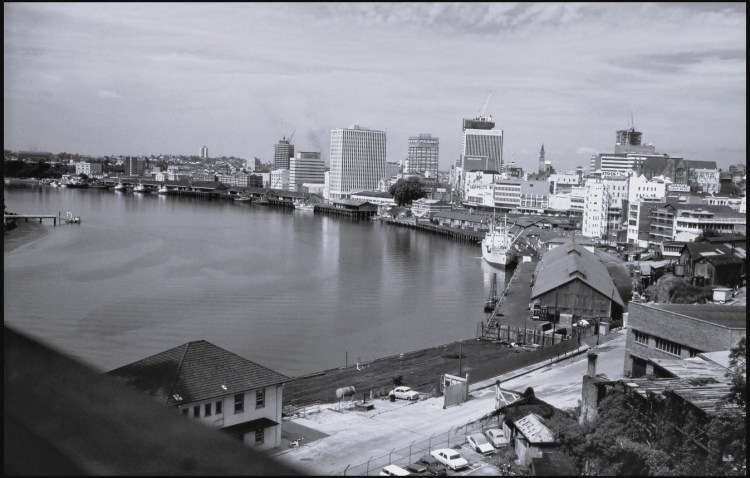
Brisbane River Wharves 1970 viewed from Story Bridge – Original image attributed to Queensland University of Technology.

Review of Mocco Wollert’s Life in Darwin, Northern Territory

IMG_20200107_191959

The book title is a typical Darwin expression with good connotations, and Mocco says she is an optimist, she lives on hope and in hope.  Originally from Germany, she worked hard with what she had, overcame obstacles and adapted to Australian life with her Aussie-born daughters Susan and Kim and beloved husband Niclas.

The other love in her life is Darwin, 1950s Darwin, at the Top End of Northern Territory.  No supermarkets, no fancy restaurants, definitely no air-conditioning, miles and miles of dirt roads, and at that time populated by about 8,000 people.  Tough, rough and ready people at that.

The strength of a woman when put to the test reverberates powerfully through Mocco Wollert’s narrative.  From good, bad and ugly circumstances, Mocco’s words shine.  She comes across as forthright in her opinions, honest, funny, emotional, grumpy yet ultimately loveable.  She certainly faced challenging circumstances, some which made me wince and some which would have seen me walk away, but not Mocco!

The chapters of Mocco’s book are grouped under headings, for example ‘Beginning the Adventure’, ‘Career Change’ (actually a couple of career changes) ‘Health Matters’ and ‘Decision Time’ all of which prepared me for her decade of thought-provoking reading.

Understandably there are heart-rending moments like depression in ‘A Night of Gin’ and the 1974 Cyclone Tracy devastation.

I remember sitting under our ceiling fan watching the ABCTV news on Boxing Day, 26th December, as black and white film footage showed our nation the flattened landscape which was once Darwin.  On a lighter note, it was rebuilt and continues to thrive, as did Mocco.  Small moments often stick and I enjoyed Mocco’s recollection of wigs and frizz hair-related matters in ‘Hairdressers’ where men were taboo.

Under the subheading ‘Sport’ on page 211, I think this paragraph typifies the tenacity of Darwinites and perhaps a large area of northern Australia.  “In spite of the heat and humidity, people played sport.  Golf was Niclas’ passion and he became quite a good golfer with a handicap of 16.  Watching today’s golf tournaments on television, I marvel at the green fairways and manicured greens.  There was none of this in Darwin.  The fairways were rough and, in the dry season, as dusty as a (cattle) station in drought.  The ‘greens’ were sandy plains without a blade of grass.”

IMG_20200107_192349

There are 47 photographs throughout the book, vivid examples of the era, and a pictorial of Darwin homelife which includes Mocco in weather so scorching she wore a bikini to hang washing on the Hills Hoist.  And there is a great little story behind the snapshot of her small daughter meeting Queen Elizabeth II.  Not telling, you’ll have to read the book!

‘Bloody Bastard Beautiful’ is Mocco Wollert’s tribute to Darwin, an intimate recollection of a more rugged time in 20th century Australia, told openly and honestly, and ultimately life-affirming.

Gretchen Bernet-Ward


AUTHOR PROFILE

IMG_20191122_183655Born in Germany but a true-blue Darwinite by 1960, Mocco Wollert is now a recognised poet and author who lives in Brisbane, Australia.

Mocco has nine poetry books published as well as winning prizes for poems published in newspapers and anthologies.

Her Darwin memoir ‘Bloody Bastard Beautiful’ was first published by Historical Society of Northern Territory and later by Boolarong Press 2017.

For information on today’s Northern Territory, visit https://www.australia.com/en/places/northern-territory.html

Jimmy Barnes Working Class Rock Star Book Review

It is said Jimmy Barnes is the heart and soul of Australian rock and roll…if you like his style.  His rasping voice was the sound of the Eighties and everyone knew his song lyrics.  Four decades later and he’s still going strong. 

James Dixon ‘Jimmy’ Barnes (né Swan) was born in Glasgow, Scotland on 28 April 1956 and raised in Elizabeth, South Australia.  His career as the lead vocalist with the rock band Cold Chisel, and later as a solo performer, has made him one of the most popular and best-selling Australian music artists of all time.

From 1973–present, Barnes career has spanned singer-songwriter-musician with vocals, guitar, harmonica and flute and he has received tonnes of music awards (and two Australian Book Industry awards) been inducted twice into the ARIA Hall of Fame and presented with the Order Of Australia medal.

Jimmy Barnes 08

Underneath the gravelly vocals and rough exterior, Jimmy Barnes struggled with an inferiority complex which manifested itself in alcohol and drug addiction for many years.  The question on everyone’s lips was ‘How did he survive?’  Barnes wrote two autobiographies ‘Working Class Boy’ and ‘Working Class Man’ to answer this question.

I doubt his first book ‘Working Class Boy’ (published 2016) was fully edited.  Raw and basic, it is a litany of hope, fear, addiction and the search for acceptance.  Acceptance from his violent father, his mates and his audience.  He writes about childhood abuse, how he ran amok through the towns of Elizabeth and Adelaide and later the Australian east coast, singing, drinking, finding a dealer, finding a girl and not sleeping for 24 hours or more.  A son, performer David Campbell, is the result of a fling in his teenage years.  Barnes’ second father, the man whose name he adopted, was a mentor of sorts until rock music became the epicentre of his life.

Jimmy Barnes 01
Jimmy Barnes ‘My Criminal Record’ collectors edition in vinyl

Barnes second book, a sequel titled ‘Working Class Man’ (published 2017) chronicles his thoughts of suicide and his continuous drug-taking and excessive alcohol consumption to the point of tedium.  A horrible thing to say when I think of the mental and physical torment he was trying to escape.  Still, it didn’t stop him singing—albeit clutching a Vodka bottle on stage every night—nor did it stop him gaining more and more success and greater financial stability as his music career took off.  He began to live the life of a rock star.

Then Jimmy Barnes body let him down.  After surgery, he tried to calm down and write his life story.  It’s not a pretty read, examining old memories, but it’s honest.  There are plenty of photographs and name-dropping, and Barnes talks about his wife Jane Mahoney, their children and extended family.  He is now a grandfather and this shocked me the most!

“If you want to write a memoir, you’ve got to be ready to bare your soul” Jimmy Barnes

No rating because of the ‘chicken and egg’ situation, did his fame boost the books or did the books boost his fame?

Gretchen Bernet-Ward

Website https://www.jimmybarnes.com/
Biography https://www.jimmybarnes.com/biography/
Books https://www.jimmybarnes.com/books/
Press Interview and Movie Clip  https://www.smh.com.au/entertainment/music/for-hyperactive-jimmy-barnes-new-album-and-tour-is-just-the-beginning-20190528-p51s26.html

Jimmy Barnes 02
https://www.jimmybarnes.com/news/tour-announcement-jimmy-barnes-is-shutting-down-your-town/

Reflections on WAM Writers’ Festival

An enlightening literary look at events on the Victorian/New South Wales border; interesting books and even more interesting authors, and a bookshop with the perfect name.