Birdlife co-exists with humans in every big city. Not sure if this Bush Stone-curlew was initially at the South Bank Cultural Centre to visit the Gallery of Modern Art or the Museum’s ornithological displays, but seemingly for dinner. Curlew was guarding its meal and nervously waiting until the walkway was clear.
Bush Stone-curlews live on the ground and are mostly nocturnal. This night it was not wailing its unnerving cry, just waiting for me, the photographer, to leave so it could get on with the job of takeaway for the family.
Feeding Habits: Bush Stone-curlews have a wide-ranging diet for such a fragile-looking bird, they prefer to feed on insects, molluscs, small lizards, seeds and occasionally small mammals. Feeding takes place at night. During the breeding season, nesting birds will search for food in the vicinity of the nest site, while at other times the birds may travel large distances. All food is taken from the ground. Bon Appétit 〰🐤
Kookaburra with yabby crayfish claw, Crows Nest, Queensland 2022
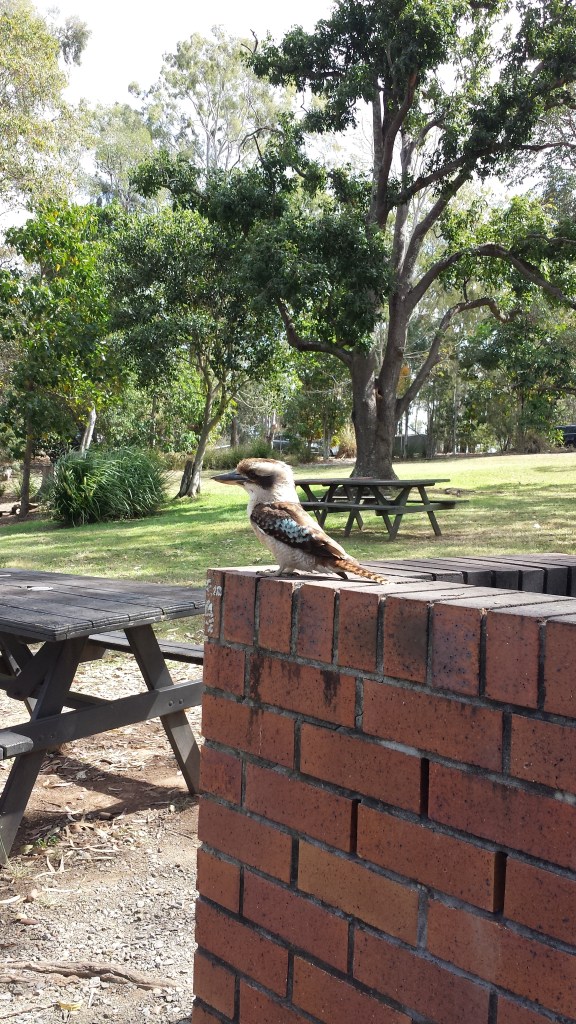
The Laughing Kookaburra can be identified immediately by both plumage and call. The cackling laugh is often used in scary jungle movies.
Laughing Kookaburras are found throughout eastern Australia. They feed mostly on insects, worms and crustaceans (like the yabby crayfish above) although small snakes, mammals, frogs and birds may also be eaten. Prey is seized by pouncing from a convenient perch. The meal is eaten whole, but larger prey is killed by bashing it against the ground or tree branch.
The kookaburra photograph (above) was taken at Crows Nest, located 44km north-east of Toowoomba on the Great Dividing Range, Queensland. It is one of the larger members of the kingfisher family with a wingspan 64cm-66cm (25in-26in).
I have always loved keen-eyed, stocky little kookaburras. Suburban kookaburras living in parkland sometimes loiter around barbecue cooking areas. They are not dangerous birds and rather stand-offish but I would not encourage them with human food. That powerful beak is better suited to nature’s diet.
Laughing Kookaburra feathers are generally off-white below, faintly barred with dark brown, and brown on the back and wings. The tail is more rufous, broadly barred with black. There is a conspicuous dark brown eye-stripe through the face, like an old-fashioned burglar mask.
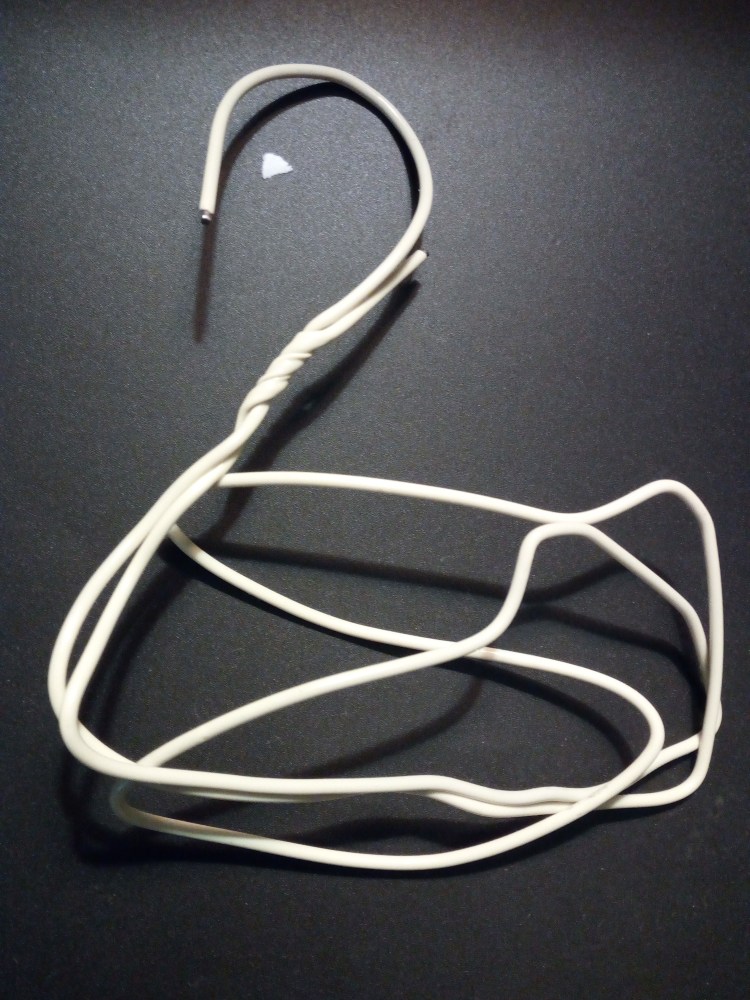
My grandfather was an artist, woodcarver and bespoke furniture maker, and he designed and cast this laughing kookaburra (above) in a plaster mould. After hand-painting the kookaburra, he framed it in the minimalist style of 1960s. Both he and my grandmother (a needleworker extraordinaire) created Australian designs when many things were influenced by British and European artisans.
The kookaburra’s scientific name is Dacelo novaeguineae but the name ‘kookaburra’ is generally believed to be derived from the original term ‘grab a stick’ or ‘gougou garrdga’ in Kamilaroi/Euhlayi language.
Group kookaburra calls are best heard in early morning and at dusk, and are crazy loud if you are standing under their tree.
A group of kookaburras is called ‘a riot of kookaburras’ because of the raucous noise.
Studies have shown that kookaburras pair for life. The nest is usually a bare chamber in a naturally occurring tree hollow. The breeding season is August to January and every bird in the family group shares parenting duties. The ideal set-up really.
I like relativity and quantum theories because I don’t understand them and they make me feel as if space shifts about like a swan that can’t settle, refusing to sit still and be measured; and as if the atom were an impulsive thing always changing its mind.
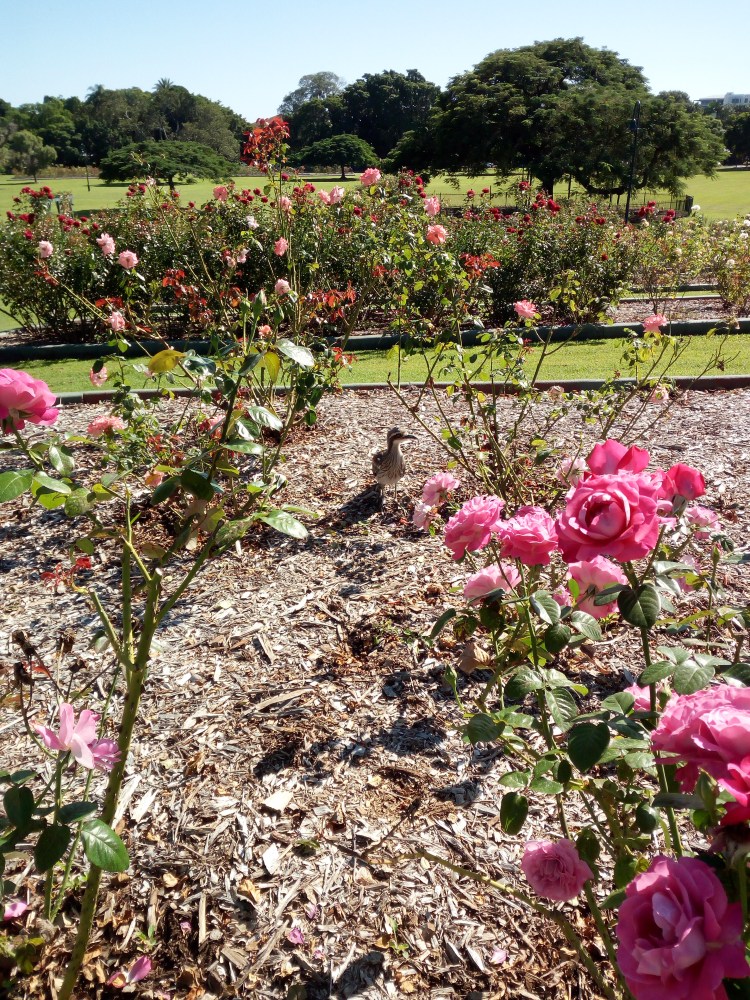
The Bush Stone-curlew or Bush Thick-knee (Burhinus grallarius) is a large ground-dwelling bird with a life span of up to 20 years. The bush curlew is endemic to Australia and found in Brisbane, usually in parkland. The curlew will adopt a rigid posture when it becomes aware of an observer, as this one did, poised amongst the roses in New Farm Park.
Curlews are terrestrial predators adapted to stalking slowly at night. Their preferred habitat is open landscapes which give them good visibility at ground level where they search for invertebrates such as insects. The grey-brown coloration is distinguished by dark streaks, its eyes are large and legs are long. Both male and female care for two eggs laid on the bare ground, usually sited in a shaded position near a bush, stone wall or fallen branch.
Queensland Bush Stone-curlews are capable of flight but rely on the camouflage of their plumage to evade detection during the day. Domestic animals are their biggest threat. At night their call is an evocative and unforgettable sound, a sort of wailing cry which echoes across open ground.
The curlew candid camera (below) is memorable!
♥Gretchen Bernet-Ward
Video by FAME 2019, Mt Rothwell in Victoria, Australia
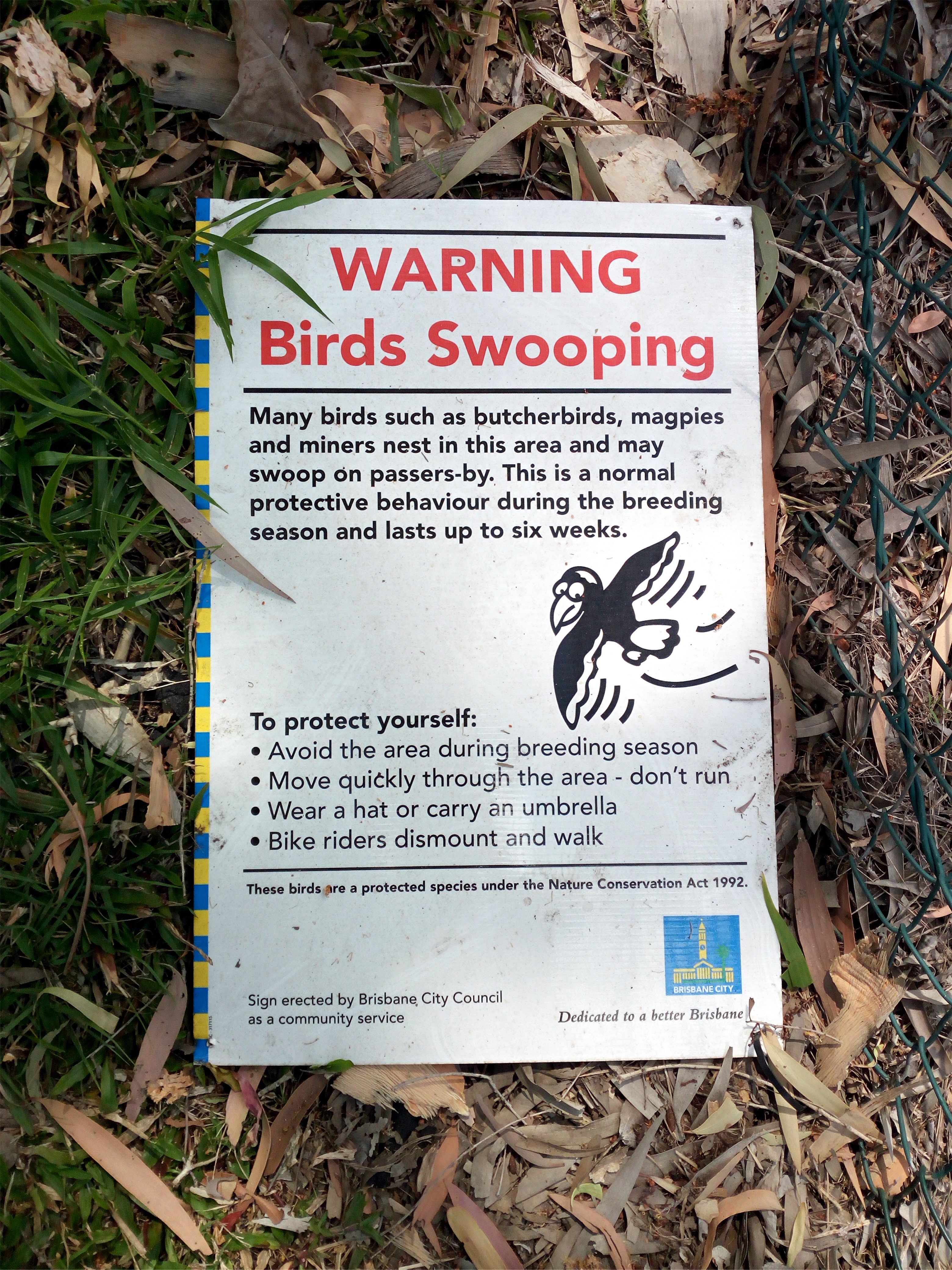
This sign had fallen off the fence onto grass under a eucalypt tree but whether caused by human or bird intervention is anyone’s guess. GBW.
Magpies in Australia are well-known for swooping humans and pets during their breeding season between July and December, but peak swooping month is September in Brisbane. This is normal defensive behaviour in springtime as the birds are trying to protect their eggs or newly hatched young in the nest.
Walk the long way home! Swooping season can be a nuisance to some people, but often Magpies will accept the presence of people within their territories (they do get to know human families) however when attacks do occur, they usually take place within a hundred metre radius around the tree containing their nest.
I know from experience that a sudden rush of wings and a sharp, snapping beak at the side of your head is a very scary thing.
While most Magpie attacks are mild, they could cause serious injury to your eyes and head. Seven tips to protect yourself against swooping birds:
(1) Wear a hat or carry an umbrella
(2) Wear sunglasses to protect your eyes
(3) Do not interfere with the birds or their nest
(4) Watch the birds while walking away quickly and calmly
(5) A bird is less likely to swoop if it knows you’re watching
(6) If you ride a bike, dismount and walk
(7) Never aggravate a Magpie as this can make the bird defensive and lead to a more severe swooping attack next time.
Some people paint big eyes on their bike helmets or stick drinking straws on their hats to repel Magpies, but I’m not sure these ideas work. Wearing head protection stops wayward claws from tangling in hair.
Magpies are vocal birds with a carolling call. They adapt well to open and cleared environments and thrive in large areas of lawn (like parks, golf course, school grounds) which provide foraging sites, and where there are scattered trees available for nesting, and a water source.
Usually Magpies eat garden pests and insects but they are inventive when it comes to cat food. In my photo sequence this one peered into the car scrounging for a snack.
The nest of a Magpie is bowl-shaped and made from dry sticks with a lining of grass, bark and other fibres. The clutch size is usually around three to four blue-grey eggs, though this varies according to season, predators and health of the parents. Magpie lifespan is about 25 years and I have had two hanging around my place for several years. Both parents raise their young and guard their territory and they are a natural part of my outdoor life.
PLEASE NOTE The Australian Magpie (Cracticus tibicen) is a native Australian bird and is PROTECTED under the State Wildlife Legislation (Nature Conservation Act 1992). It is a serious offence to harm Magpies and penalties apply for attempting to harm them. Information Brisbane City Council Biodiversity Living with Wildlife.
Australia was once a continent graced by flamingos. These tall pink birds are more associated with Africa and the Americas, but a long time ago they called Australia home. For at least 20 million years, flamingos thrived on vast Australian inland lakes, until a drying of the outback ended their reign, perhaps a million years ago.
The Lake Eyre region in South Australia once had three species, more than Africa today. Altogether Australia had at least six flamingo species, including the Greater flamingo – the main flamingo in Africa. Australian museums have accumulated more of their fossils than of some regular Australian birds such as parrots. At some sites their remains lay near those of outback crocodiles, dolphins and lungfish.
Flamingos are still regarded as Australian birds, for a very tenuous reason. In 1988 a Greater flamingo dropped in on North Keeling Island, a remote Australian territory 2750km north-west of Perth, staying a couple of months. Greater flamingos are found in Asia and southern Europe as well as Africa and this one had wandered over from India or Sri Lanka.
In Adelaide Zoo you could have seen the only flamingo left in Australia, a Chilean flamingo known warmly as ‘Chile’. She was thought to have been imported in the late 1970s. For quarantine reasons flamingos are now forbidden imports, which means that Australia is destined to become a flamingo-free zone unless another long-legged pink nomad wanders over from Asia.






 PLEASE NOTE
 Source


 Thoughts Become Words