Why, Sue Grafton, Why?

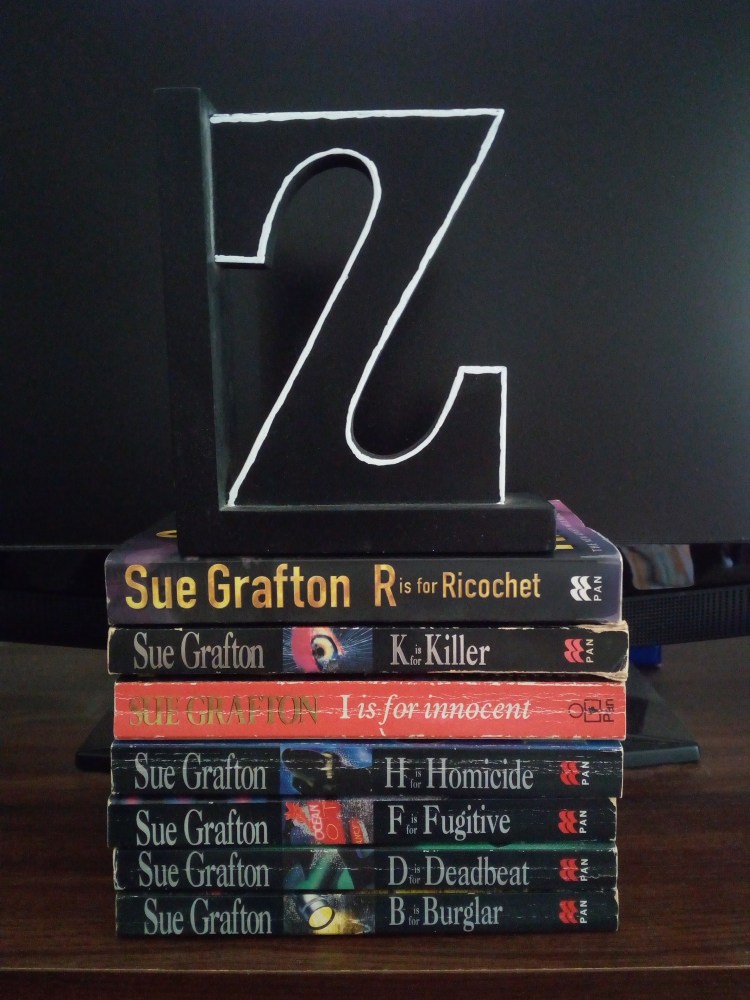
Sue Grafton Bookstack

American author Sue Grafton passed away in Santa Barbara on 28 December 2017 after a two-year battle with cancer.  On hearing the sad news, millions of readers, writers and fans must have screamed “Noooo” and fallen to the ground, arms raised to the sky, wailing “Why, Sue Grafton, why?”  Well, at least I did, and that’s no lie.

Famous for her 25-book Alphabet crime series, Sue Grafton’s last Kinsey Millhone book Z will remain unwritten.  To quote her family “The alphabet stops at Y” and this has been echoed around the world.

Sue Grafton brought me back into crime reading and showed me the joys of a good detective novel.  I was floundering in a bad ten years of my life where I’d lost my father and was struggling with the care of my ailing mother while battling my own ill-health when, quite out of the blue, I was given a second-hand paperback of Grafton’s book “K is for Killer”.

PI Kinsey Millhone walked into my life.  Grafton’s detective series listed below – “H is for Homicide”, “N is for Noose”, “V is for Vengeance” and so on – transported me into a place I understood, 1980s an era I knew, yet detailed the life of a woman in a job which was so foreign, so far removed from my own experiences that I was immediately entranced.  Or as my father would have said “Caught, hook, line and sinker.”

This fortuitous state of affairs meant I had many books to read before I was up-to-date with the current publications.  Here I would like to thank my cousin Laurie who willingly sent me several paperbacks to feed my addiction.  So I read one and moved straight onto the next, graduating from that first battered paperback to hardcovers and finally e-book editions.

The major characters are unchanging; Kinsey is a private detective in California who joined the police force then left to acquire her detective licence; landlord Henry Pitts is now forever in his kitchen; gregarious Rosie; love interest Cheney Phillips and Robert Dietz.  It was fascinating watching Kinsey evolve, if that’s the right word, because in all she only advanced a couple of years and is destined to remain immortalised in her thirties.

It seems Sue Grafton did not even draft a copy of her final book.  The old adage “Leave them wanting more” is true but not the case.  Her family is adamant that although Grafton had a working title (prophetically) “Zero”, there will be no final book, no ghost writer, no movie and no happy ending – just a blank space on the bookshelf.

My condolences to her family.  The final chapter has ended for Sue Grafton and Kinsey Millhone RIP.

Gretchen Bernet-Ward

Sue Grafton Alphabet Crime Series Featuring Kinsey Millhone

  1. A is for Alibi (1982)
  2. B Is for Burglar (1985)
  3. C Is for Corpse (1985)
  4. D Is for Deadbeat (1987)
  5. E Is for Evidence (1988)
  6. F Is for Fugitive (1989)
  7. G Is for Gumshoe (1989)
  8. H Is for Homicide (1991)
  9. I Is for Innocent (1992)
  10. J Is for Judgement (1993)
  11. K Is for Killer (1994)
  12. L Is for Lawless (1995)
  13. M Is for Malice (1996)
  14. N Is for Noose (1998)
  15. O Is for Outlaw (1999)
  16. P Is for Peril (2001)
  17. Q Is for Quarry (2002)
  18. R Is for Ricochet (2004)
  19. S Is for Silence (2005)
  20. T Is for Trespass (2007)
  21. U Is for Undertow (2009)
  22. V Is for Vengeance (2011)
  23. W is for Wasted (2013)
  24. X (2015)
  25. Y is for Yesterday (2017)

‘Kitty Peck Music Hall Murder Mysteries’ Kate Griffin Book Review

London winter 1880, Limehouse, and chorus girls are disappearing from music halls in Paradise, the criminal precinct run with ruthless efficiency by the ferocious and opium addicted Lady Ginger aka The Lady.

Kitty Peck and the Music Hall Murders
Published 2013
(First book in the Kitty Peck series)
A novel by Kate Griffin

Seventeen-year-old Kitty Peck, a seamstress at The Gaudy, is summoned by The Lady and blackmailed to perform a hair-raising act every night to uncover vital information about the missing girls.  Kitty is taunted by The Lady who withholds the truth about her family, particularly her beloved brother Joey.  Before long Kitty becomes the talk of London with her daring show and the plan begins to work.  Gradually she’s drawn into the world of high society ‘toffs’ and embroiled in depravity and murder.  With only her two friends Peggy and set painter Lucca for support, Kitty is shocked to find herself facing an adversary more horrifying than The Lady crime baron.

First of all, the pace and atmosphere is superb throughout the books.  Immediately I was right in the action and swept along on a very dark ride.  The characters evolve nicely and flesh out into interesting and tortured human beings who find themselves in rather bizarre circumstances.  They have subplots with much to hide, emotions seesaw as their personal history gradually unfolds.

There’s a heavy dose of Cockney slang which, due to an Anglophile father, I picked up quickly enough.  Some reveals are to be expected but one took me by surprise!  The novels have adult content.  However, don’t expect true romance.  It’s the Queen Victoria version of an action movie.  Grim, grimy, cold, damp London of the 19th century is a backdrop to dirty deeds done by black-hearted people and Kitty must keep her wits about her to survive.  The endings are cliff-hangers which lead into each book.

Kitty Peck and the Child of Ill-Fortune
Published 2015
(Second book in the Kitty Peck series)
A novel by Kate Griffin

Due to spoilers, I cannot reveal too much about Book Two or Three.  Certain text in the following review has been taken from the book blurb:

London’s East End, March 1881 and Kitty Peck, a spirited but vulnerable young woman, is the reluctant heiress to Paradise, the criminal empire previously overseen by the formidable Lady Ginger aka The Lady.  Kitty is now The Lady, with all that entails; servants, buildings, stock, music halls and vicious crime barons.  Far from the colour and camaraderie of the music hall where Kitty had been working, this newfound power brings isolation and uncertainty, and a disdainful lawyer Telferman.

Desperate to reconnect with Joey, her estranged brother, Kitty travels to Paris with Lucca.  She is unable to refuse the request of a handsome stranger to take a child back to London.  Within days of their return, it’s clear she has been followed by someone, and this someone is determined to kill the child and anyone who stands in their way…starting with Kitty.

There are mesmerizing and harrowing scenes throughout this book which serve to shape Kitty and her world.  More of the secondary characters emerge and betrayal rears its ugly head.  Tension builds as Kitty nears the deadline to meet the other Barons of London, merchants, jewellers, bankers, the controlling elite who are rotten to the core. Will they break her and destroy the Paradise she has inherited?

Kitty Peck and the Daughter of Sorrow
Published 2017
(Third book in the Kitty Peck series)
A novel by Kate Griffin

London, the hot summer of 1881, and the streets of Limehouse are thick with coal smoke and opium; and Kitty Peck is choking on the ever-present bitterness of evil.  At eighteen Kitty has inherited Paradise, she is The Lady of a sprawling criminal empire on the banks of the Thames.  Determined to do things differently from the fearsome Lady Ginger, she now realises that the past casts a menacing and treacherous shadow.

Plagued by city heat, haunted by a terrible secret and facing more deaths, Kitty is stalked by a criminal league intent on humiliation and destruction; she should never go out alone.  But she’s ready to fight for the future of everyone she cares for and more.  Including journalist Sam Collins?

Always difficult to review books with clever twists and turns one cannot expose.  ‘Descriptive’ and ‘gripping’ hardly does them justice.  Sense of place, POV and clothing are beautifully transcribed.  There is one minor point I noticed when reading––there is little mention of food.  Tea and gin are drunk habitually, and champagne is used as a lever, but food is not often consumed.  No matter, they are gritty stories which had me on the edge of my seat.  While it is not an era I would like to inhabit, I can highly recommend this series with a shiny five star rating.

To be concluded in Book Four – Kitty Peck and the Parliament of Shadows – Coming July 2019

“Even though Paradise was riddled with rot, I reckoned I could make it a cleaner place for the poor types who came with the dirty trades. I could make them all love me, I thought.  I was wrong about that. I’ve been wrong about so much.”  My book review to be advised.

ABOUT THE AUTHOR
Kate Griffin was born within the sound of Bow bells, making her a true-born Cockney.  She has worked as an assistant to an antiques dealer, a journalist for local newspapers and now works for The Society for the Protection of Ancient Buildings.  “Kitty Peck and the Music Hall Murders”, Kate’s first book, won the Stylist / Faber crime writing competition and she has written other genres.  Kate’s maternal family lived in Victorian Limehouse and her grandmother told her many stories of life around the docks.  Kate lives in St Albans, north of London.

Further reading  Author Kate Griffin is interviewed by Sarah Oliver  a close look at her lifestyle and writing methods.

Gretchen Bernet-Ward

Australian Editors and Publishers Set Bar Too High

I have come to the conclusion that the Australian publishing industry and its associated editors and reviewers have set the bar way too high for Australian writers.  Emerging authors have a pretty slim chance of being published with huge odds against hitting the big time.

Strong-willed literature-controlling gurus rule our domestic market like school teachers from the 1950s.  They seek perfection, the best book of the year, often cerebral stuff ignored by half the population, and they disregard perfectly serviceable down-to-earth Aussie authors.  Also, when did parochialism creep in, e.g. Melbourne is the hub of all things literary?  Let’s focus on inclusive Australian content.  Oh, and stop changing words to suit international readers, they’re cool, they can work it out.

Publishing houses receive thousands of unsolicited manuscripts each year and the selection process is fierce.  Only a handful of authors are chosen, gather a following, write more books and hopefully make money.  The untried crime writer, for example, may not appeal to the literati judges, but, hey, there’s always that coterie of readers who will love them.  The way it is now, their work may never see the light of day.  Dive deep into that slush pile!

Book Publishing 04
Sure, there’s always the internet, WordPress, e-books, self-publishing, writing competitions (see below) and a gazillion non-traditional ways to be seen but nirvana is a publishing deal with a real-deal publishing house.


“Relax,” I say to publishers from my seat of ignorance.  “The shock of ebooks has faded, so forget micro-niche and churn out those books, get those names in print.”  What?  Too much of a risk, not financially viable?  Yeah, I guess that’s right.  Nobody wants risk in business.  I say “Lighten up, people, offer a broader spectrum of books to the general public”.  Stop book snobbery because, meanwhile, mediocre books with typos are flooding in from overseas and I’m getting a bit sick of it.

Did I hear our aspiring authors cannot compete with the overseas calibre?  Our readers are not savvy, interested or sincere enough to try a reasonably good newbie?  Come off it!  Peel back those layers.  An Australian author or reader is as good as the next person but needs the exposure, the push, the shove, the necessary connections and circumstances to make it work.

Chips on shoulders, the need to prove we Australians are well-read, has past. Forget the Cultural Cringe, dismiss ‘benchmark’ literary awards and too perfect prose and embrace the mass production of typically Australian-written and illustrated books and be proud of them.

Gretchen Bernet-Ward

FURTHER READING:  https://journals.uic.edu/ojs/index.php/fm/article/view/3353/3030  with quote taken from “Non-Traditional Book Publishing” by Jana Bradley, Bruce Fulton,  Marlene Helm, Katherine A Pittner in “First Monday” Journal and, although somewhat passé, it shows foresight.  EVEN FURTHER READING:  https://www.theliftedbrow.com/liftedbrow/2017/11/22/keep-your-eyes-on-the-prize-unpublished-manuscript-competitions-and-you  The Lifted Brow is a not-for-profit literary publishing organisation based in Melbourne, Australia, and Martin Shaw’s article explains an awful lot about the hidden terms and conditions of competition entry.

{NB. Gretchen has reviewed books, worked in the library industry and reads extensively.  As an aspiring writer, she may have shot herself in the foot}

Silent Reading and Socio-Cultural Development

Reading Readers 04

Among scholars, says Thu-Huong Ha, there is a surprisingly fierce debate around when European society transitioned from mostly reading aloud to mostly reading silently.  Thu’s latest article for Quartzy shines a light on the evolution of reading silently––

Finding Space
“The beginning of silent reading changed Westerners’ interior life”
By Thu-Huong Ha
Tuesday 19 November 2017

People think of reading as the introvert’s hobby: A quiet activity for a person who likes quiet, save for the voices in their head.  But in the 5,000 or so years humans have been writing, reading as we conceive it, an asocial solo activity with a book, is a relatively new form of leisure.

For centuries, Europeans who could read did so aloud.  The ancient Greeks read their texts aloud.  So did the monks of Europe’s dark ages.  But by the 17th century, reading society in Europe had changed drastically.  Text technologies, like moveable type, and the rise of vernacular writing helped usher in the practice we cherish today: taking in words without saying them aloud, letting them build a world in our heads.

Among scholars, there is a surprisingly fierce debate around when European society transitioned from mostly reading aloud to mostly reading silently—some even say the ancients read silently just as much as they read aloud—but there is one scene in literature they agree is crucial.  In St. Augustine’s Confessions, the titular professor describes the reading habits of Ambrose, the bishop of Milan:

“But when Ambrose used to read, his eyes were drawn through the pages, while his heart searched for its meaning; however, his voice and tongue were quiet. Often when we were present—for anyone could approach him and it was not his habit that visitors be announced to him—we saw him reading in this fashion, silently and never otherwise.”

The fact that this was so remarkable to Augustine, some scholars argue, is because in the 400s, silent reading wasn’t really a thing.

Other researchers say that this passage is meant more to point out Ambrose’s rudeness.  “It’s really that Ambrose would go on reading silently while he was there, like someone going on texting while you’re trying to talk to them,” says D. Vance Smith, a medievalist in the Princeton English department.  “[Augustine is] surprised by his rudeness at not reading out loud to share with him.”

Reading Readers 05

“The default assumption in the classic period, if you were reading around other people, you’d read aloud and share it,” says Smith. “For us, the default is we’ll read silently and keep it to ourselves.”

If silent reading was in fact rare or rude in ancient times, then at some point the expectation of readers in society shifted.  As late as the 1700s, historian Robert Darnton writes, “For the common people in early modern Europe, reading was a social activity.  It took place in workshops, barns, and taverns.  It was almost always oral but not necessarily edifying.”

But by the time Marcel Proust was writing in the late 1800s, his narrator hoping for time to read and think alone in his bed, reading privately had become more of a norm for wealthy, educated people who could afford books and idle bedroom rumination.

This came with the spreading of literacy and diverse kinds of reading material.  Writes Darnton, records from until as late as 1750 showed that people who could read had only a few books: perhaps the Bible, an almanac, and some devotionals, that they read and re-read. But by 1800, he writes, people were reading more voraciously—newspapers and periodicals—and by the late century they had branched out into children’s literature and novels.

Reading Guy 06

As reading shifted away from the social, some researchers believe this helped create what we now call an interior life.

Writes Alberto Manguel in his 1996 book, A History of Reading:

“But with silent reading the reader was at last able to establish an unrestricted relationship with the book and the words.  The words no longer needed to occupy the time required to pronounce them.  They could exist in interior space, rushing on or barely begun, fully deciphered or only half-said, while the reader’s thoughts inspected them at leisure, drawing new notions from them, allowing comparisons from memory or from other books left open for simultaneous perusal.  And the text itself, protected from outsiders by its covers, became the reader’s own possession, the reader’s intimate knowledge, whether in the busy scriptorium, the market-place or the home.”

“Psychologically, silent reading emboldened the reader because it placed the source of his curiosity completely under personal control,” librarian Paul Saenger writes in his 1997 book, Space between Words.  “In the still largely oral world of the ninth century, if one’s intellectual speculations were heretical, they were subject to peer correction and control at every moment, from their formulation and publication to their aural reception by the reader.”  As Saenger writes, asocial reading helped facilitate intellectual rigor, introspection, criticism of the government and religion, even irony and cynicism that would have been awkward to read aloud.

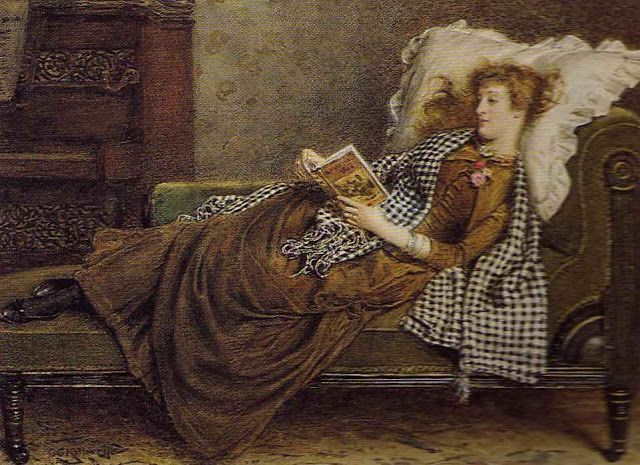
This strange new trend of reading to oneself naturally had its detractors.  Sceptics thought silent reading attracted day-dreamers and the “sin of idleness,” as Manguel writes.  And worse: it let people learn and reflect without religious guidance or censure.  Silent reading by the late 19th century was so popular that people worried that women in particular, reading alone in bed, were prone to sexy, dangerous thoughts.
Reading Girl 57

There isn’t much consensus between historians on why people would have started reading silently.  Saenger hypothesizes that a shift in the way words were laid out a page facilitated the change.  Latin words once ran all together, makingithardtoparsethem. Saenger argues that Irish monks, translating Latin in the seventh century, added spaces between words to help them understand the language better.  This key design change, he argues, facilitated the rise in silent reading.

M. B. Parkes, in his 1992 book “Pause and Effect: Punctuation in the West” argues something similar.  He writes that a “grammar of legibility”—the visual changes made to texts, like punctuation and word spaces—changed the way we read.  This early book technology was premised on the idea that the scribes, the people writing, didn’t know who their readers would be, or how fluent they might be in reading Latin, and so had to find a standardised way of telling them how to read: pause here; these are two separate words; this is a long “a.”

This scholarship applies for the most part to the Latin-based writing and reading of Europe.  In other major reading cultures of the world like Chinese, whose script doesn’t have spaces between words, and whose literature depends heavily on prosody, silent reading may have developed differently.

Mainstream historical accounts would have us think that the end of oral reading in the Middle Ages was part of the Renaissance, a new European preoccupation with the individual.  But it’s possible humans’ desire for privacy, the carving out of a little pocket in which to escape by way of a book, was there all along.  We just needed a little help getting there.

Written by Thu-Huong Ha for Quartzy newsletter, a weekly dispatch about living well in the global economy.  Original webpage The Beginning of Silent Reading was also the Beginning of an Interior Life.

Gretchen Bernet-Ward

Let Your Heart Be Light

Jen Storer is an established Australian children’s author brimming with imagination and inspiration. This post encapsulates her talent, personality and future plans. Jump into The Duck Pond and start paddling with emerging writers and illustrators!
Gretchen Bernet-Ward

girlandduck's avatarGirl and Duck

Hello!

I like writing blog posts at Christmas. No one expects much. Do they?

IMG_3967Writing: I finally finished Truly Tan: Baffled! (book seven) and delivered it to my publisher on time (working right up until December 15, the day it was due). Phew! Next year I’ll be waaaay more organised. Ahem.

Finalising: We signed off on Danny Best: Me First! Check out the full cover. Talk about The Best! 😉 Due out in Feb 2018.

DB_MEFIRST_FC2Receiving: I received a Christmas card from a Tan reader. The letter attached said, I know you like wolves. So here’s a card with a fox on it. God, I love my readers.

IMG_3984 2

Planning and: pondering 2018. I have some lovely plans for girl and duck, including a Scribbles Boot Camp in Feb, and an IRL (in real life) Scribbles master class in Melbourne in May. We will also be launching the Girl and Duck…

View original post 518 more words

Portraits of Readers Part Two

Initially I was gathering images for a compilation to promote reading but, instead, my gallery became a montage of book-reading men and boys over the last two centuries, photographed and painted, famous or otherwise.  With every viewing, the images reshuffle.  A montage of book-reading women and girls can be found under Part One.

Reading is rightness!

Gretchen Bernet-Ward

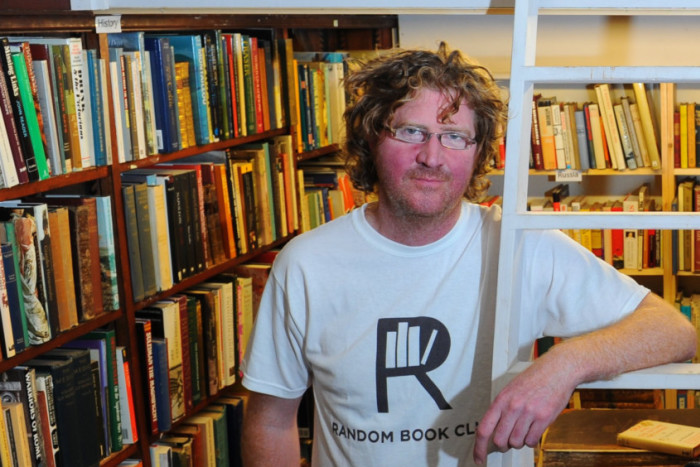
‘The Diary of a Bookseller’ by Shaun Bythell

Real life book shop owner Shaun Bythell tells of the humorous, exasperating and often crazy experiences he encounters working in The Book Shop, the largest second-hand bookshop in Scotland.  Also, The Book Shop is situated in Wigtown, known as Scotland’s ‘National Book Town’.  Bythell writes a compelling and amusing account of his daily life, from eccentric local characters to a decline in traditional ways of life where diversity is not always good news for rural farmers or booksellers.  A good book for booklovers or would-be book dealers.  Think I’ll stick to reading!

Read a full review by George Delaney:
Readings Review of ‘The Diary of a Bookseller’

Excerpt from The Diary of a Bookseller:

Shaun Bythell Bookshop Owner 02

“For a few years I have given over the formal drawing room above the shop to an art class for one afternoon a week. It is taught by local artist Davy Brown and takes place every Tuesday. A dozen or so retired ladies make up the group. At this time of year the house is bitterly cold, so I left Norrie instructions to light the fire and put the space heater on for an hour before they were due to arrive, but he forgot. One of them almost needed to be resuscitated. I would happily let them use the space for free, but they kindly pay me enough to cover the heating costs and a bit more beside.”

Shaun Bythell Bookshop Owner
Shaun Bythell (PIC: Robert Perry, The Scotsman newspaper) and website link The Book Shop Wigtown Scotland

Gretchen Bernet-Ward

Portraits of Readers Part One

Initially I was gathering images for a compilation to promote reading but, instead, my gallery became a montage of book-reading women and girls over the last two centuries, photographed, painted, and one carved in marble.  With every viewing, the images reshuffle.  A montage of book-reading men and boys can be found under Part Two.

Reading is rightness!

Gretchen Bernet-Ward
Gilbert Keith Chesterton

“An adventure is only an inconvenience rightly considered.  An inconvenience is only an adventure wrongly considered.”

Father Brown 02

Quote from G. K. Chesterton who was an early 20th century British writer, poet, philosopher, dramatist, journalist, orator, lay theologian, art and literary critic and biographer.  Apart from many literary works, Chesterton is well known for his book series of Catholic priest-detective Father Brown.  These books were produced for television by BBC One with Mark Williams in the lead role.

Here is a small selection of Chesterton novels:

The Napoleon of Notting Hill (1904)
The Man Who Was Thursday (1908)
The Ball and the Cross (1910)
Man Alive (1912)
The Flying Inn (1914)
The Return of Don Quixote (1927)

Chesterton once said “Education is simply the soul of a society as it passes from one generation to another.”

Gretchen Bernet-Ward

‘I Went Walking’ by Sue Machin

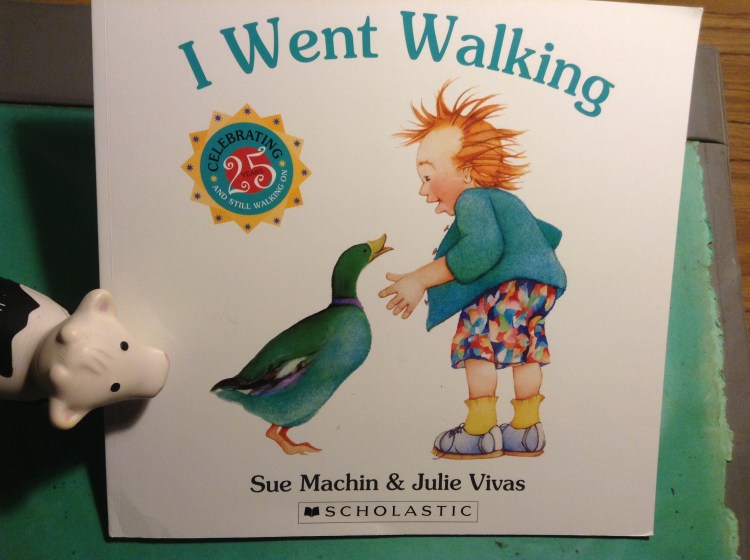
I Went Walking Picture Book
Quack

This is my first children’s picture-book book review.  Legions of preschool storytime fans are hanging out for this one!  Of course, you will have to read it to them.  I could have bored you with reams (remember reams?) of lucid, erudite adult book reviews but I’ve decided to revisit an all-time rollicking favourite “I Went Walking”.

In my no-holds-barred, honest-to-goodness style, I will explore the deeper meaning of taking a walk through a farmyard.  Or maybe it’s all just good fun.

“I Went Walking” written by Sue Machin and illustrated by Julie Vivas
An Omnibus Book from Scholastic Australia
First published 1989, reprinted approx 23 times, sometimes twice in one year.

My softcover copy of this slim 32-page volume celebrates 25 years of publication so that means at the time of writing it’s now 28 years old.  I am sure the book’s huge following of under 5s will be planning a suitable 30th shindig, perhaps everyone invited to come as their favourite barnyard animal.  There could be hay bales to sit on while devouring plate-loads of themed food.  The country and western band would…sorry, got a bit off-topic there…

The front cover artwork displays a young boy talking to a quacking duck.  Open to the second page and this young boy is putting on his coat.  Pay attention to this coat, and other parts of his apparel.  Naturally the page reads “I went walking” with the response on the next page “What did you see?” and thereafter.  Without going into too much detail, he sees a black cat, a brown horse, an apple tree, a red cow who offers him a ride, a green duck and the boy sheds his first piece of clothing.

“I went walking” and “What did you see?” other sidelines like a sack of potatoes but in this instance it’s a muddy pink pig which is hosed down, necessitating the removal of wet shoes, then socks and t-shirt.  The gang of farm animals is following the boy when he bumps into a friendly yellow dog.  He marches off with all six animals following.  They do a wild dance together and that’s the end of the story.

You really have to see the pictures in this picture book to appreciate it.  The clear, colourful drawings and uncluttered storyline combine to make a five-star bedtime reading experience.

Gretchen Bernet-Ward

Draw-a-Duck 02