Cultural Exchange or Death at the Museum

Birdlife co-exists with humans in every big city. Not sure if this Bush Stone-curlew was initially at the South Bank Cultural Centre to visit the Gallery of Modern Art or the Museum’s ornithological displays, but seemingly for dinner. Curlew was guarding its meal and nervously waiting until the walkway was clear.

Bush Stone-curlews live on the ground and are mostly nocturnal. This night it was not wailing its unnerving cry, just waiting for me, the photographer, to leave so it could get on with the job of takeaway for the family.

Cultural Exchange © image Gretchen Bernet-Ward 2023

Feeding Habits: Bush Stone-curlews have a wide-ranging diet for such a fragile-looking bird, they prefer to feed on insects, molluscs, small lizards, seeds and occasionally small mammals. Feeding takes place at night. During the breeding season, nesting birds will search for food in the vicinity of the nest site, while at other times the birds may travel large distances. All food is taken from the ground.
Bon Appétit 〰🐤

Gretchen Bernet-Ward

Bush Stone-Curlew Capers

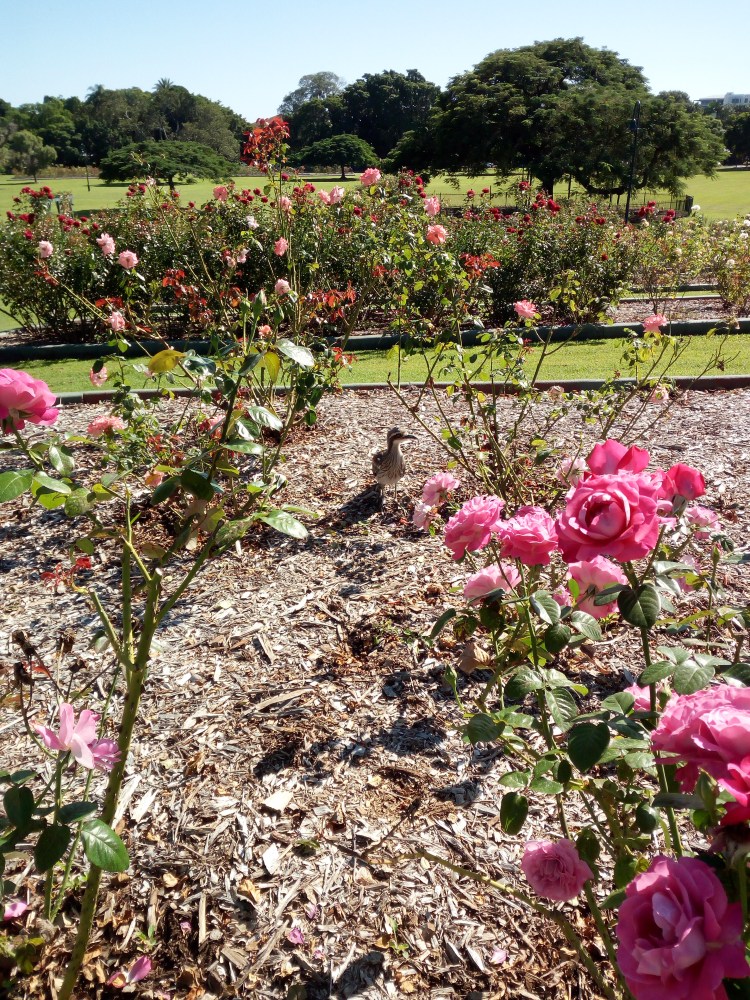
Bush Stone-curlew poised amongst the roses in New Farm Park, Brisbane © Gretchen Bernet-Ward 2021

The Bush Stone-curlew or Bush Thick-knee (Burhinus grallarius) is a large ground-dwelling bird with a life span of up to 20 years.  The bush curlew is endemic to Australia and found in Brisbane, usually in parkland.  The curlew will adopt a rigid posture when it becomes aware of an observer, as this one did, poised amongst the roses in New Farm Park.

Curlews are terrestrial predators adapted to stalking slowly at night.  Their preferred habitat is open landscapes which give them good visibility at ground level where they search for invertebrates such as insects.  The grey-brown coloration is distinguished by dark streaks, its eyes are large and legs are long.  Both male and female care for two eggs laid on the bare ground, usually sited in a shaded position near a bush, stone wall or fallen branch.

Queensland Bush Stone-curlews are capable of flight but rely on the camouflage of their plumage to evade detection during the day. Domestic animals are their biggest threat. At night their call is an evocative and unforgettable sound, a sort of wailing cry which echoes across open ground.

The curlew candid camera (below) is memorable!

Gretchen Bernet-Ward

Video by FAME 2019, Mt Rothwell in Victoria, Australia