Afternoon Tea and Fancy Food


“There are few hours in life more agreeable than the hour dedicated to the ceremony known as afternoon tea” Henry James, The Portrait Of A Lady.
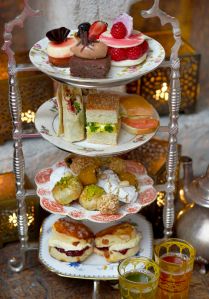
Afternoon tea offers a variety of rich, creamy cakes and sweet pastries. Ribbon sandwiches are sometimes served with savoury nibbles but the ubiquitous tea, scones, crumpets and homemade preserves are still in evidence.
The British aristocracy conceived Afternoon Tea a long time before their working classes began to consume High Tea in the evening. Traditionally afternoon tea is lighter than high tea, the latter consisting of heavier food like meats and fish which possibly morphed into dinner. Who knows? I’m only going on what I’ve read.
Australia was founded by the British so, up until recently, a fair amount of our eating habits were ever-so-English and afternoon Tea For Two was practiced both domestically and in cafés until the advance of a more universal drink – coffee. Most people are lucky if they get afternoon tea now, e.g. in my experience people have a break at ‘morning tea’ time.
My grandmother’s hand-stitched tablecloth and serviettes were linen and a deliciously laden 3-tiered cake stand was placed in the centre of the table on a crocheted doily. A posy of fresh flowers was discreetly positioned beside the teapot, milk jug and sugar bowl. The cutlery was usually a knife, for spreading strawberry jam and cream, and a spoon for stirring your tea.
The crockery set was china or hand-painted porcelain and generally both cups and saucers displayed dainty flowers. I learned to tell the difference between a teapot and a coffee pot by the position of the spout. Not many people remember the design reason for this! Sometimes during pouring, a small tea strainer was used. I won’t go into the variety of teas available but traditionally alcohol was not served.



“Happiness for me is largely a matter of digestion” said writer Lin Yutang and added “There is something in the nature of tea that leads us into a world of quiet contemplation of life” ― Lin Yutang, The Importance of Living.
These are my thoughts becoming words and not necessarily historical facts; just how I remember it when I visited my grandmother in Melbourne, Victoria. As a child, in the homes of my friends, a serving of apple pie with ice-cream was just as good. Friday evening fish and chips were a treat, and when the first pizza was taken from the pizzeria oven, we were not sure how to pronounce it let alone eat it.
I have a pot of leaf tea with my breakfast and use a tea cosy. Teapots come in all shapes and sizes, and tea cosies, once the staple of the twentieth century Australian woman’s knitting repertoire, covered the pot and kept it warm. While the tea leaves brewed, a colourful and creative tea cosy added to the charm of many an afternoon tea table.
NOTE : Afternoon tea images may induce hunger pangs!
♥ Gretchen Bernet-Ward

History : https://afternoontea.co.uk/information/history-of-afternoon-tea/
Tea Party : https://www.bbcgoodfood.com/howto/guide/how-throw-afternoon-tea-party
Teapot Museum : http://www.bygonebeautys.com.au/tearooms/
Teatowels : https://thoughtsbecomewords.com/2017/10/01/teatowel-of-ignominy/