In the depths of a July winter here in Brisbane, Queensland, I am sitting with a cold nose and knees, contemplating warmer weather. Our winters probably seems mild to those countries with ice and snow. We have misty mornings then clear blue skies and by lunchtime some clothing layers can be removed for a couple of hours before the cold creeps in again.
The issue is home heating. Of course, I am not talking about the hermetically sealed grey boxes of the millennium. This older house is built like thousands of others—for the heat. We don’t have a fireplace, we don’t have insulation, we don’t have ducted heating, but we do have reverse cycle air-conditioning. Problem is the unit swirls the air around at the edges so it never feels warm enough.
Brrr! This is where an old three-bar radiator and a portable column oil heater come in handy for three months of the year.
So saying, we human beings are a contrary lot—I enjoy the wintertime.
Winter is more conducive to a brisk walk before settling down to writing. Cold weather calls for cosy pursuits. In a hot, humid summer, it’s more a case of lying around gasping after foolishly thinking some physical exercise like gardening was a good idea. The lush, rampant growth of a subtropical summer is a sight to behold but right now the garden lacks happy vegetation; the leaves are brown, the grass is sparse, the earth is hard and dry.
This morning the temperature is currently 8 degrees Celsius, the sun is shining but the air is freezing. Well, maybe not. We don’t really do freezing, more on the chilly side. I am going to make a hot beverage and pull on an extra pair of socks.
It is amazing how many books a person can read without really trying. I joined Goodreads mid-year but before that I never kept a tally of the books I read. Needless to say I am rather surprised! GBW.
Readers of my blog often go straight to my current post which detours Photo Of The Week on my Home page. I’ve gathered together some of my favourite shots—just in case you’ve missed a couple!
On a go-slow day at home, I clicked a link from a fellow writer and discovered this cool/cute/interesting Adobe Create personality test. It invited me to answer 15 questions. Eight creative types are on offer and once I’d completed the test I was given a full explanation of My Creative Type.
This quiz-like questionnaire gave me a joyful, colourful few minutes. I could take it or leave it, the results are rather like a horoscope, but it did give me a confidence boost.
‘Visionary’ Creative from Adobe Types Test
Apparently I am “VISIONARY – A visionary combines a vivid imagination with a desire for practical solutions. Your introspective and intuitive nature is balanced by a keen interest in the world around you.” The rest is private!
The Adobe Creators say “The Creative Types test is an exploration of the many faces of the creative personality. Based in psychology research, the test assesses your basic habits and tendencies—how you think, how you act, how you see the world—to help you better understand who you are as a creative. Answer these 15 questions and you’ll gain a deeper understanding of your motivations, plus insight into how to maximize your natural gifts and face your challenges.”
“These personality types aren’t black-and-white labels. Think of them more as signposts pointing you toward your full creative potential. While there’s probably one core type that best describes you, you may change types at different points in your life and career, or even at different stages of the creative process. As a creative, you have a little bit of all eight Types inside you.”
This faded old book jumped out at me. I believe interconnections exist everywhere in many forms but none so strongly as with books.
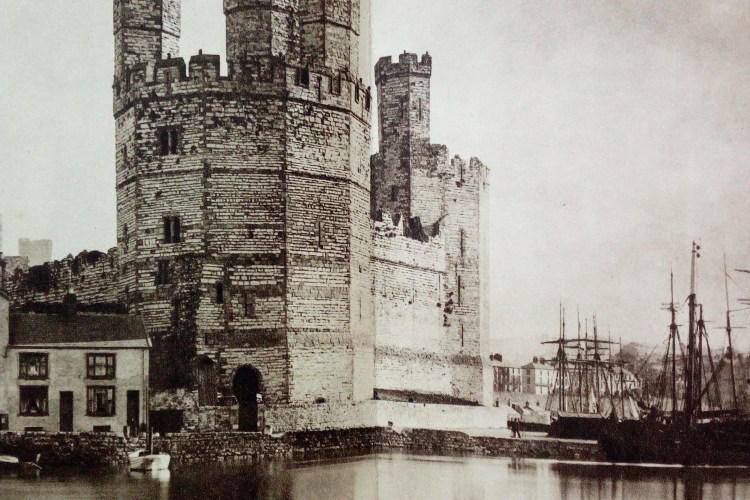
I spied this hardback ‘In Search of Wales’ by H.V. Morton, with sixteen illustrations and a map, resting on one of the tables at UQ Alumni Book Fair. It was published by Methuen & Co. Ltd London in 1932 and purchased by the Parliamentary Library in Queensland, Australia, on 27 July 1932. My photographs don’t convey the substance of this volume.
Apart from my purchase giving me a tenuous Queensland connection, since I have been blogging I have come to know bloggers from Wales like Book Jotter, and people with ties to Wales, so I guess I was curious to find out some early 20th century history.
There is a city named Ipswich, west of the capital Brisbane, Queensland, and it has Welsh heritage from the founding families, the legacy of coal mines, and street names I can’t pronounce. It was going to be our capital city but being situated inland away from sea ports (and always hotter in summer) Brisbane took over the coveted position.
When I look at the B&W images in this book, I can’t help but feel strong emotion for those Welsh families, the people who came to Queensland in 1851 and started afresh. Whether it was out of necessity, assisted passage, general interest or just sheer bravery, it was a long way to come to start a new life in a totally different land.
The three photos (below) are 1. Cornfields, 2. Druid ceremony conducted by the Archdruid at the Gorsedd Stone, 3. Cockle women of Penclawdd on the seashore. It looks cold! Throughout there are two-page spreads of dramatic valleys, stoney castles and heartbreaking portraits of mining men and soot-covered boys.
My new old book was deleted from the Old Parliament Library catalogue on 22 October 1996 and I wondered where it had been since then. ‘Oh well,’ I thought, ‘I am enjoying it now on 10 May 2019’. Then I saw a small pencilled Dewey notation on the back cover map UL914.29 Mor. It had probably languished in the University Library.
As yet I haven’t tracked down all the details of author, Henry Vollam Morton, and even though he was a well-known journalist and travel writer, the information in the final pages doesn’t give much away. There is an insightful personal comment (photo below) which ends with three tiny icons, perhaps foreshadowing today’s social media links.
Further material tells me that the author’s book ‘…is more than a travel book, it is a sensitive interpretation of a country’s people and their history.’ He wrote a series called ‘The Search Books’ and further along it reads ‘Since that time Mr Morton’s gay and informative travels…have gained him thousands of readers.’
At this late stage, a book review would be rather tricky—okay, it would be hard for me to get my head around. H.V. Morton travels far and wide through Wales and writes in depth. The voice, the style of that era (nicer than brash Bill Bryson) is easy to read and written in a friendly, personal way with warmth in every chapter. Allowing for the off-key words we don’t use today, there is factual information and humorous stories, and in Chapter Six he asks the usual traveller’s question and receives a great reply—
“The first village, commonly and charitably called Llanfair, provides the stranger with an impossible task among the Welsh place-names.
Its title is: Llanfairpwllgwyngyllgogerychwyrndrobwllllandysiliogogogoch This is no joke. It is only too true! The full name, however, is never used but it appears only slightly amputated in the Ordnance Survey maps.
The postal name is Llanfair P.G. or Llanfairpwll. I entered the first inn and said to those who were drinking in the bar ‘I will buy anyone a drink who can pronounce the full name of this place.’
There was an ominous silence until an old man, finishing his beer, stood up and sang it! ‘And what does it mean?’ I asked. ‘It means,’ I was told, ‘the Church of St Mary in a wood of white hazel near a rapid whirlpool and near St Tysilio’s cave close to a red cave’.”
Sounds magical to me. Daith yn hapus!
♥Gretchen Bernet-Ward
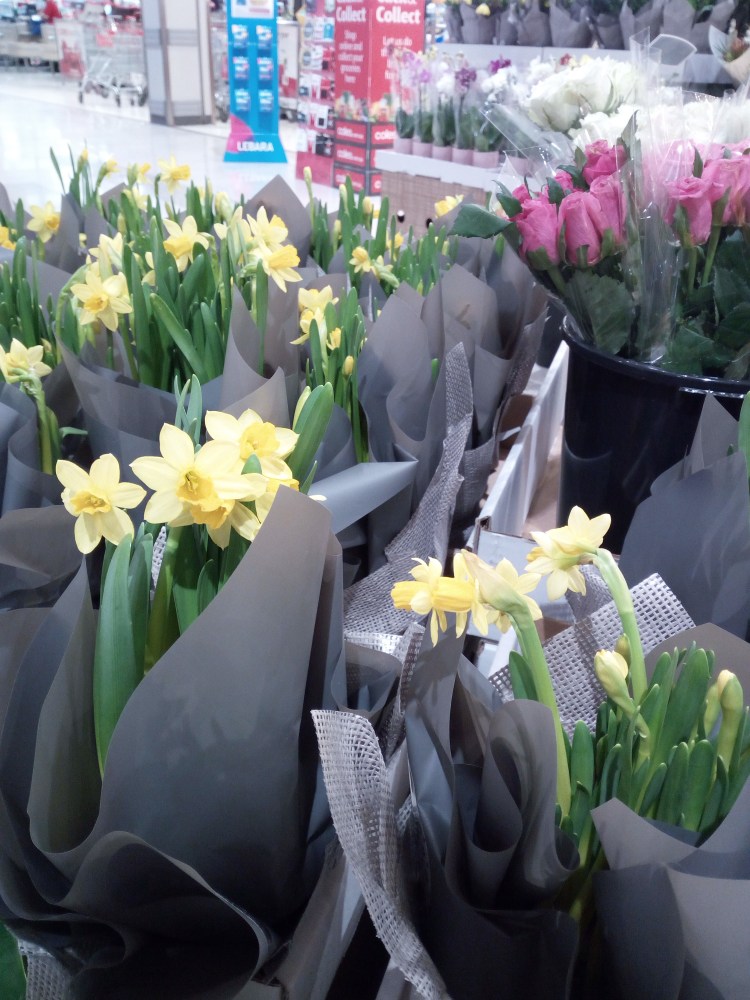
Another beautiful coincidence – it is not springtime in Australia, it is cool autumn weather. Yet these daffodils, a Welsh symbol, were outside my local supermarket the day after I purchased the book at UQ Alumni Book Fair.
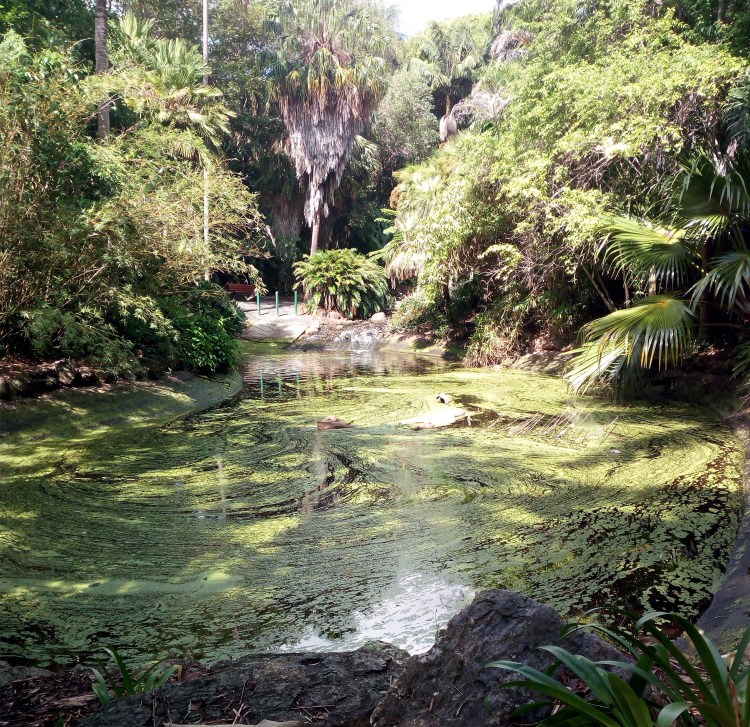
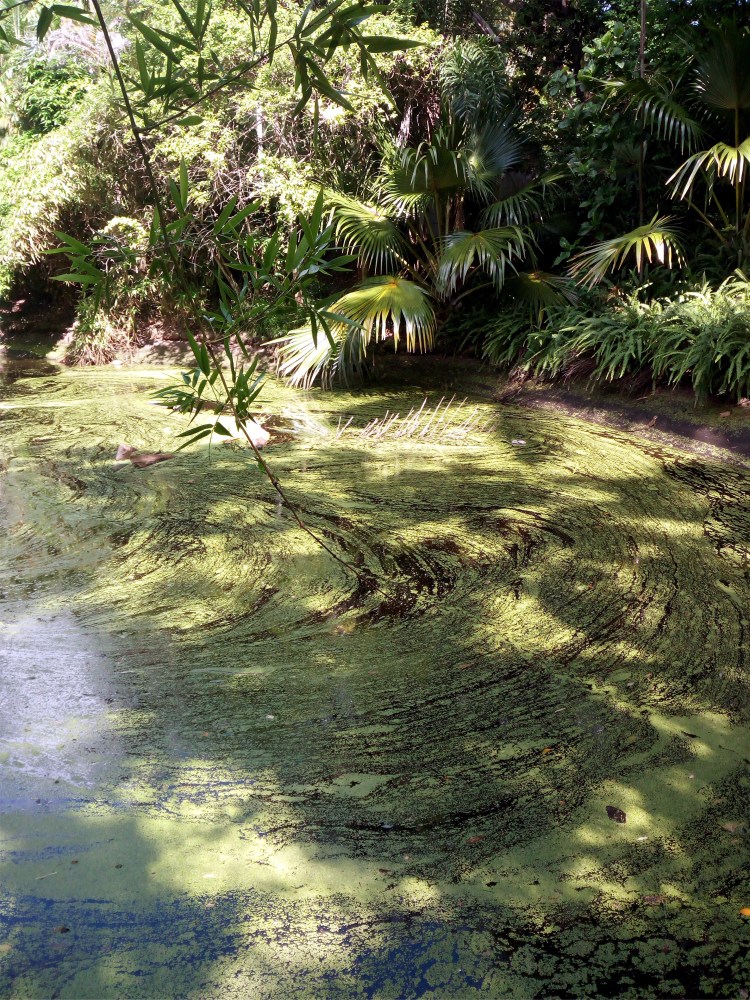
Tropical lagoon and green algae swirls at Mt Coot-tha Botanic Gardens, Brisbane, Australia 2019
The swirls and ripples of the blogosphere will let your post resurface any number of times to an ever-widening pool of readers.
Never underestimate the infinite lifespan of a blog post.
Your post may not make a big splash the first time, nor days later, but it has the potential to be viewed many times into the future.
I know, because I have certain posts which haunt me. In the nicest possible way, of course, but it is still rather disconcerting when an old post gets a sudden flurry of views. It’s like they tread water waiting to bob up.
The reason behind my floating posts remains unclear to me.
Where, or why, my original blog story becomes resuscitated could be caused by any number of factors from reblogging to tweeting or—
linked on someone’s page
kindly mentioned in a comment
family members on Facebook
topic of interest and my tags swum into view
tumbled into the lake of eternal blogs…
I’m sure the tech pond at WordPress is teeming with answers but that’s too factual for me, I prefer the serendipitous, the happenstance of it all.
Overall, I am always pleased and still thrill to see those stats wade across the WordPressmap!
♥Gretchen Bernet-Ward
Tropical lagoon ebb and flow of green algae at Mt Coot-tha Botanic Gardens, Brisbane, Australia 2019




















 Thoughts Become Words