Mary Poppins and Five Years of Blogging

I never thought I would last this long and still be interested in blogging the miscellaneous bits and pieces which make up my literary life.

Over the last five years I have written, read, liked, followed, commented and corresponded with many other bloggers around the world. It is such informative fun, thanks everybody, and I look forward to continuing.

This is me formatting a new blog post © Gretchen Bernet-Ward 2022

What have I got to show for it? To answer that question, a look through my Archive List is required. Select a category from the drop-down menu.

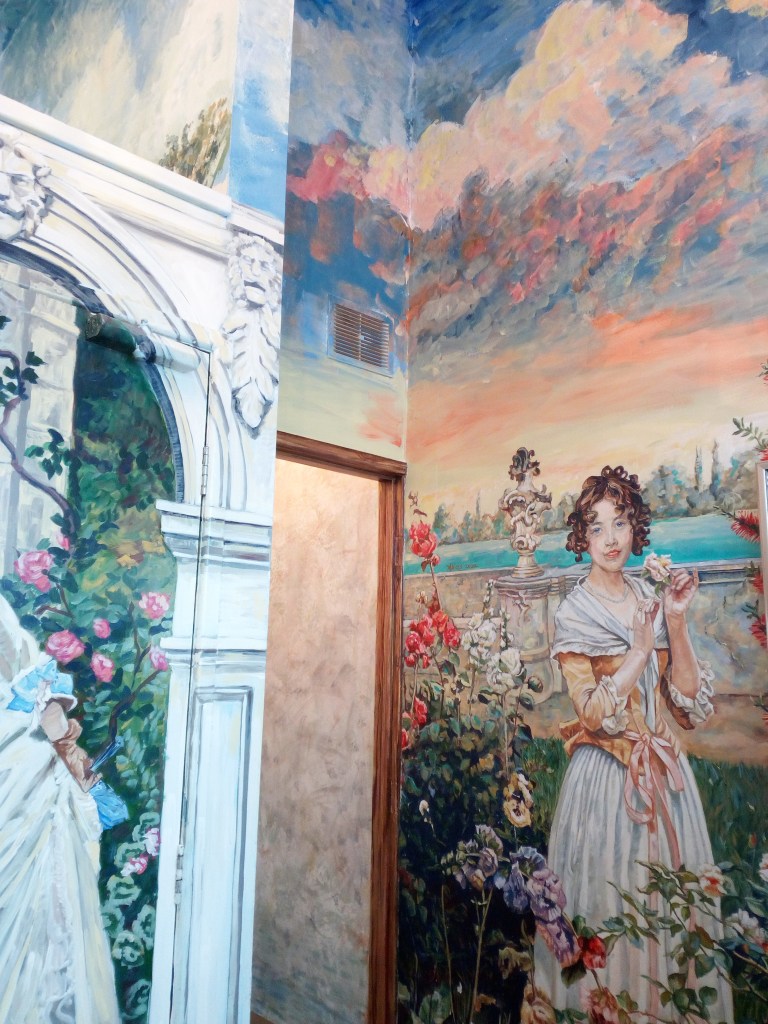
Meanwhile, I have just returned from a holiday in Maryborough (an historic Queensland town – actually the whole region is pretty special) and one of the highlights was attending the Mary Poppins Festival in the birthplace of her creator, author P L Travers. Many will remember the Disney version of her famous book.

Naturally I did heaps of things and took heaps of photos, so once they are curated I will be posting a travel pictorial. “Chim chiminey, chim chiminey, chim chim cher-ee” there is more to see.
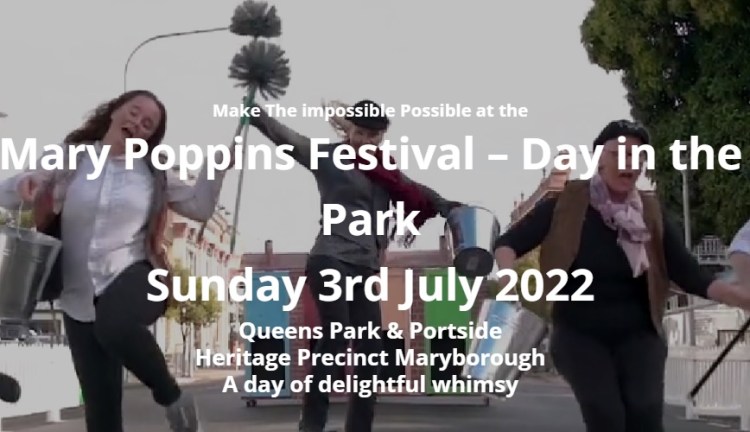
Mary Poppins in Maryborough where it all started https://www.marypoppinsfestival.com.au/

Unfortunately it had been raining for several days when we left Brisbane and headed north with no sign of letting up. The journey to Maryborough, situated inland from the Fraser Coast region, is about 250km and it rained the whole way; it was still raining when we arrived.

The next day was the Mary Poppins Festival and a huge amount of outdoor activities with most people in costume. Lo and behold, the rain stopped! The whole day was fine and sunny. You guessed it, the next day it bucketed down again!

WordPress 5 Year Anniversary July 2022

If I go prepared, rain is a novelty for me. I took an old family umbrella with frills around it. But when the wind blows cold (it is winter here in Australia) it’s not much fun hanging onto a brolly unless you are Mary Poppins. Her classic silhouette, in glowing red then bright green, blinks and beeps as pedestrians cross at traffic lights.

Anyway, the itinerary held good. We achieved our goals, seeing interesting sights (the Mary River curves around the town and there were a number of yachts moored), strolled through art galleries and parks, antique shops, City Hall, the library, the historic Story Bank museum, and ate local produce including pizza in the skate park after dark. We met friendly, welcoming and relaxed people, and waved vigorously at the Mary Ann steam locomotive as it huffed and puffed down the tracks. A different way of life…

Enjoy more pictorial highlights of my Maryborough visit:

https://thoughtsbecomewords.com/2022/07/26/mary-poppins-and-folks-boppin-at-maryborough-festival/

Gretchen Bernet-Ward

Author Overview: Helen Lyndon Goff (author P L Travers) was born and grew up in Maryborough, Queensland, before being sent to boarding school in Sydney NSW. Her writing was first published when she was a teenager. Later she worked briefly as a journalist and a professional Shakespearean actress. As author P L Travers, Goff wrote many children’s stories, non-fiction and collections, and lived a varied yet personal life. Wikipedia entry reads “In a 1977 interview on the BBC radio programme Desert Island Discs, Travers remarked about the Disney film, “I’ve seen it once or twice, and I’ve learned to live with it. It’s glamorous and it’s a good film on its own level, but I don’t think it is very like my books.”

HRH Queen Elizabeth II Platinum Jubilee

In honour of the Queen’s Platinum Jubilee (and because I like umbrellas!) I have reblogged my enthusiastic post from 21st April 2018 to add to the 70th celebrations in 2022 – it’s all about the umbrellas!

_______________________________

In UK, Her Royal Highness has two birthdays each year: her actual birthday on 21st April and her official birthday usually the second Saturday in June.  Born in 1926, at the time of writing, she is 92 years-old and still going strong.  Happy birthday, Your Majesty!

The birthday of reigning monarch Queen Elizabeth II is celebrated at different times of the year throughout the Commonwealth countries and usually accompanied by a public holiday.  In Australia, each State and Territory has decreed a different day.

In Queensland (named after Queen Victoria) we have a Monday holiday in honour of the Queen’s birthday and enjoy a long weekend.  This year it falls on Monday 1st October 2018 and Brisbane residents will head to official celebrations, BBQs, coastal regions, rainforest walks or just laze around at home and read a book.

Gretchen Bernet-Ward

“God Save Our Gracious Queen”

View my blog post about my own umbrella
https://thoughtsbecomewords.com/2018/03/02/childhood-status-symbol/

TV Viewer Report

Queen Elizabeth’s Platinum Jubilee concert in London 2022 was an over-the-top extravaganza of real people, digital wonders, popular songs, personal tributes and Paddington Bear served tea. The music swelled while famous folk talked, superstars sang and everyone swished up and down the huge stage. At night, Buckingham Palace was an ever-changing canvas of celebration showing special moments from over 70 years. High above, fireworks shimmered, creating magical icons for smiling members of the Royal family and the ecstatic crowd of well-wishers, literally millions of cheering flag-waving people spread out as far as the eye could see. What a night!

The Kookaburra and The Crustacean Claw

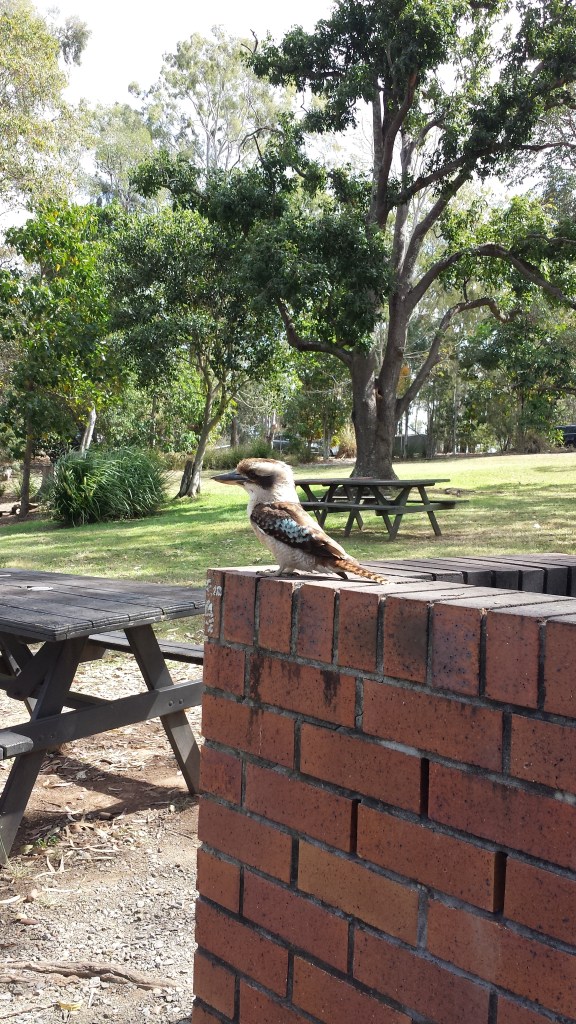
Kookaburra with yabby crayfish claw, Crows Nest, Queensland 2022

The Laughing Kookaburra can be identified immediately by both plumage and call. The cackling laugh is often used in scary jungle movies.

Laughing Kookaburras are found throughout eastern Australia. They feed mostly on insects, worms and crustaceans (like the yabby crayfish above) although small snakes, mammals, frogs and birds may also be eaten. Prey is seized by pouncing from a convenient perch. The meal is eaten whole, but larger prey is killed by bashing it against the ground or tree branch.

The kookaburra photograph (above) was taken at Crows Nest, located 44km north-east of Toowoomba on the Great Dividing Range, Queensland. It is one of the larger members of the kingfisher family with a wingspan 64cm-66cm (25in-26in).

This kookaburra swooped down and kept a watchful eye on our lunch but it’s best not to feed human food to native wildlife © Gretchen Bernet-Ward 2018

I have always loved keen-eyed, stocky little kookaburras. Suburban kookaburras living in parkland sometimes loiter around barbecue cooking areas. They are not dangerous birds and rather stand-offish but I would not encourage them with human food. That powerful beak is better suited to nature’s diet.

Laughing Kookaburra feathers are generally off-white below, faintly barred with dark brown, and brown on the back and wings. The tail is more rufous, broadly barred with black. There is a conspicuous dark brown eye-stripe through the face, like an old-fashioned burglar mask.

Original 1960s artwork F.C. Bernet – Image © Gretchen Bernet-Ward 2022

My grandfather was an artist, woodcarver and bespoke furniture maker, and he designed and cast this laughing kookaburra (above) in a plaster mould. After hand-painting the kookaburra, he framed it in the minimalist style of 1960s. Both he and my grandmother (a needleworker extraordinaire) created Australian designs when many things were influenced by British and European artisans.

The kookaburra’s scientific name is Dacelo novaeguineae but the name ‘kookaburra’ is generally believed to be derived from the original term ‘grab a stick’ or ‘gougou garrdga’ in Kamilaroi/Euhlayi language.

Group kookaburra calls are best heard in early morning and at dusk, and are crazy loud if you are standing under their tree.

A group of kookaburras is called ‘a riot of kookaburras’ because of the raucous noise.

Studies have shown that kookaburras pair for life. The nest is usually a bare chamber in a naturally occurring tree hollow. The breeding season is August to January and every bird in the family group shares parenting duties. The ideal set-up really.

My words, with kookaburra information courtesy of Sea World and Australian Museum.

Gretchen Bernet-Ward

Nominate your Favourite Old Fossil

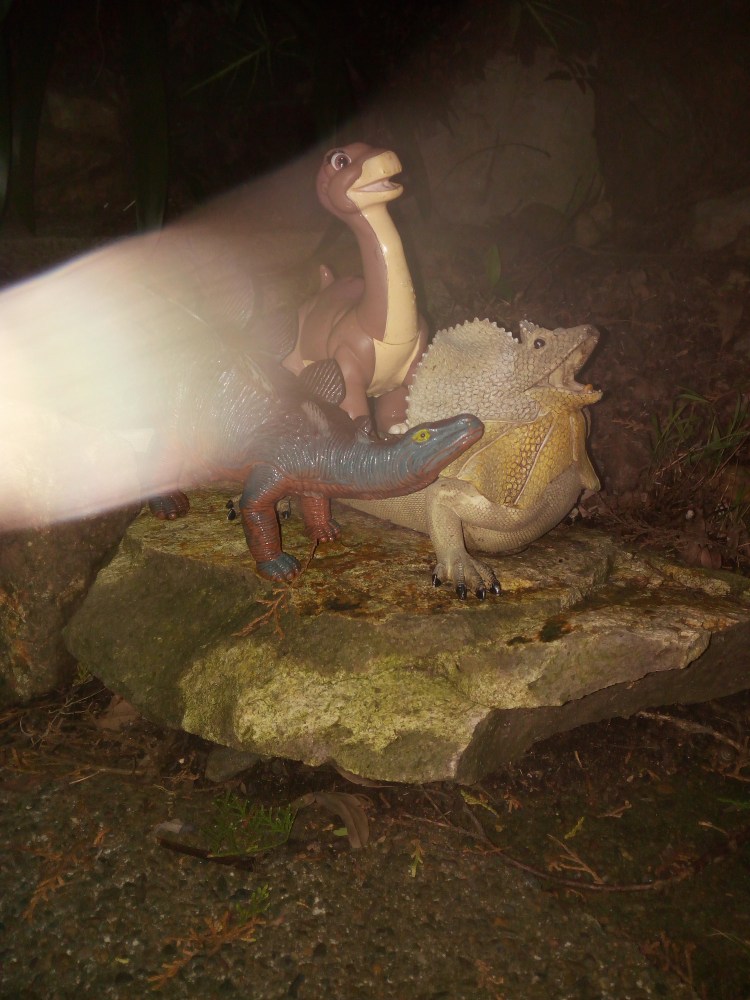
Dinosaur fantasy sequence taken in garden © Gretchen Bernet-Ward 2022

That doesn’t mean your grandfather!

Some of the nominees are dinosaurs. My family has always been fascinated by dinosaurs. From books, movies, kids series to figurines, they have loomed large in our home for many years. Now Queenslanders of all ages have the opportunity to help choose the 10th official State emblem, a fossil—it doesn’t have to be a dinosaur.

Choosing a Fossil Emblem

There are 12 fossil candidates lined up for the honour of being our State’s newest emblem. “Did you know in the Early Cretaceous Period, inland seas covered much of Outback Queensland? This means that Queensland has some of the most exciting fossil museums, dinosaur trails and discovery centres in the world, including the internationally renowned fossil sites of the Riversleigh World Heritage Area.

“Outback Queensland towns like Hughenden, Richmond and Winton are on Australia’s Dinosaur Trail, and many other Outback areas such as Eromanga, Eulo and Quilpie regularly attract fossil hunters and dinosaur lovers.”

All Shapes and Sizes

I am surprised that as well as featuring large prehistoric creatures, the endearing platypus is on the list, and Lovellea wintonensis, the oldest known permineralised fossil flower (which dinosaurs munched on).

Select your preference for Queensland’s newest fossil emblem—

Visit the website
View the illustrations
Read the history
Click a million years in the making!

Nominations close Sunday 10 July 2022

https://campaigns.premiers.qld.gov.au/fossilemblem/

Gretchen Bernet-Ward

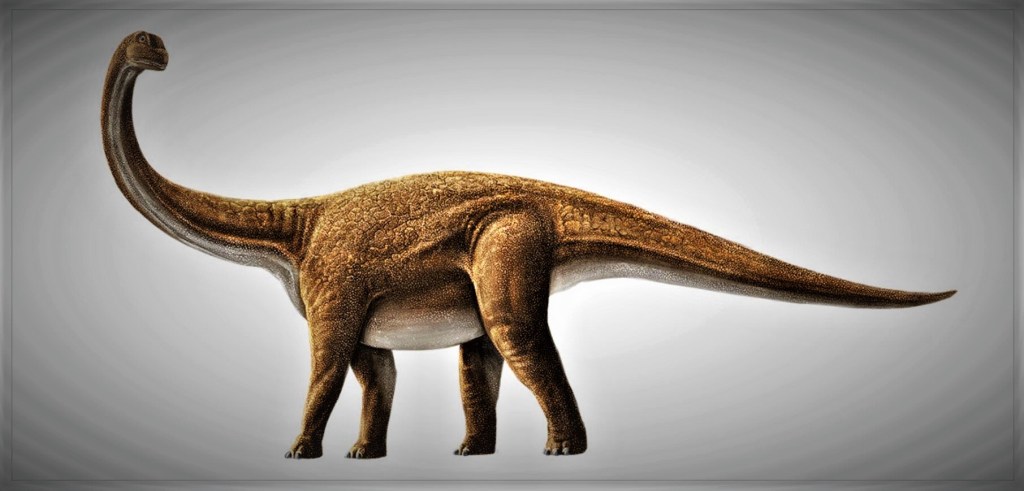
Fossil Diamantinasaurus matildae – Sauropod bones from a billabong https://campaigns.premiers.qld.gov.au/fossilemblem/

Postscript: I m-i-g-h-t have voted for a dinosaur…

NEWS FLASH

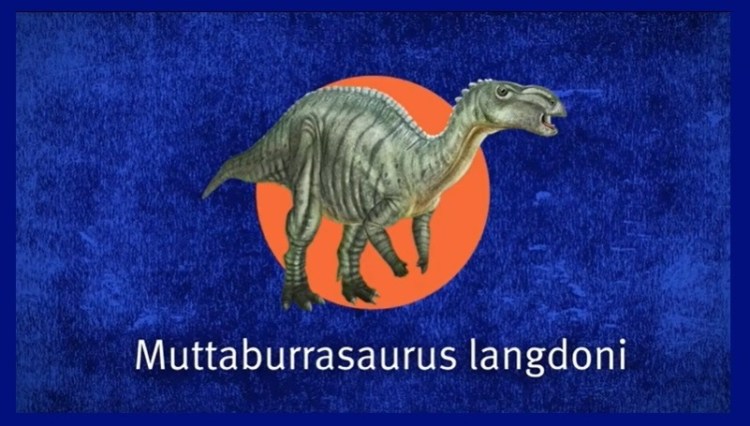
19th January 2023 – Queensland’s State Fossil Emblem is the Muttaburrasaurus langdoni. The Muttaburrasaurus has been chosen by Queenslanders as the State’s fossil emblem. The intact dinosaur fossil was found in Muttaburra, Central Queensland, by a local cattle grazier in 1963.

Queensland’s Newest State Fossil Emblem is the Muttaburrasaurus langdoni

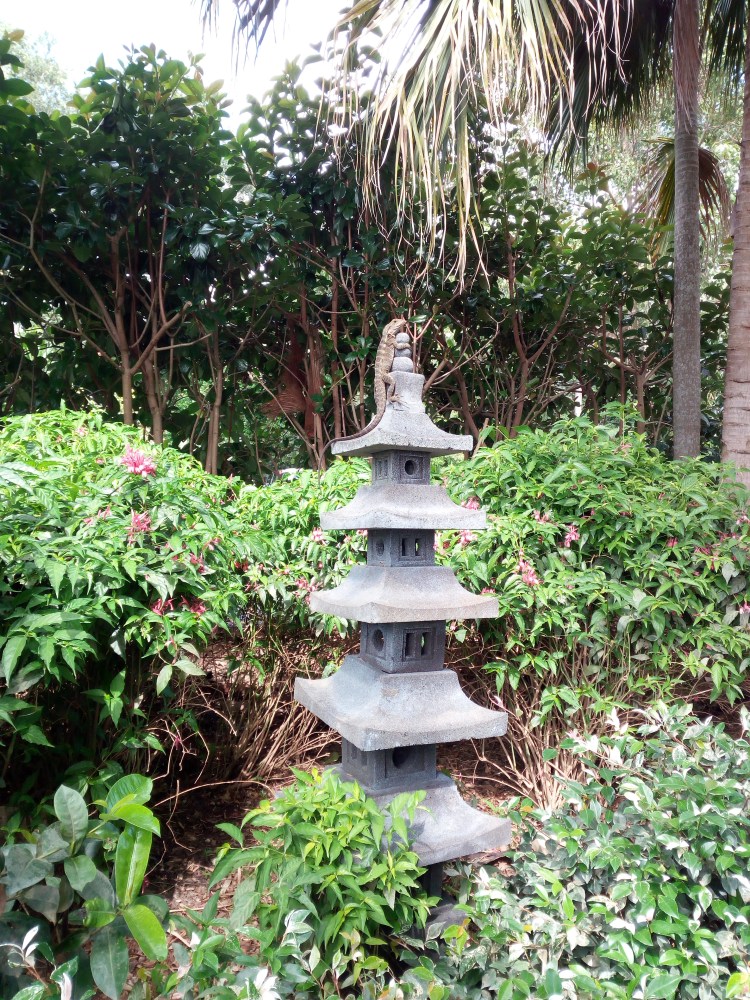
What is that Thing?

What do you see? © Gretchen Bernet-Ward 2022

My photograph was taken in a restaurant garden.

Harmless
Common species
Grows to 45cm

Eastern Water Dragon

“Water Dragons are one of our most frequently encountered lizard species here in South East Queensland. They thrive just about anywhere, particularly around water sources of varied descriptions where they usually can be found in good numbers and they don’t mind the presence of people.”
They feed primarily on small spiders and insects but will take other small vertebrates on occasion.” 
Source https://southeastsnakecatcher.com.au/lizard-identification-gold-coast/

This lizard stayed in position for over an hour and I was unsure if it was waiting for insects or it liked the warmth of the stone pagoda.

Gretchen Bernet-Ward


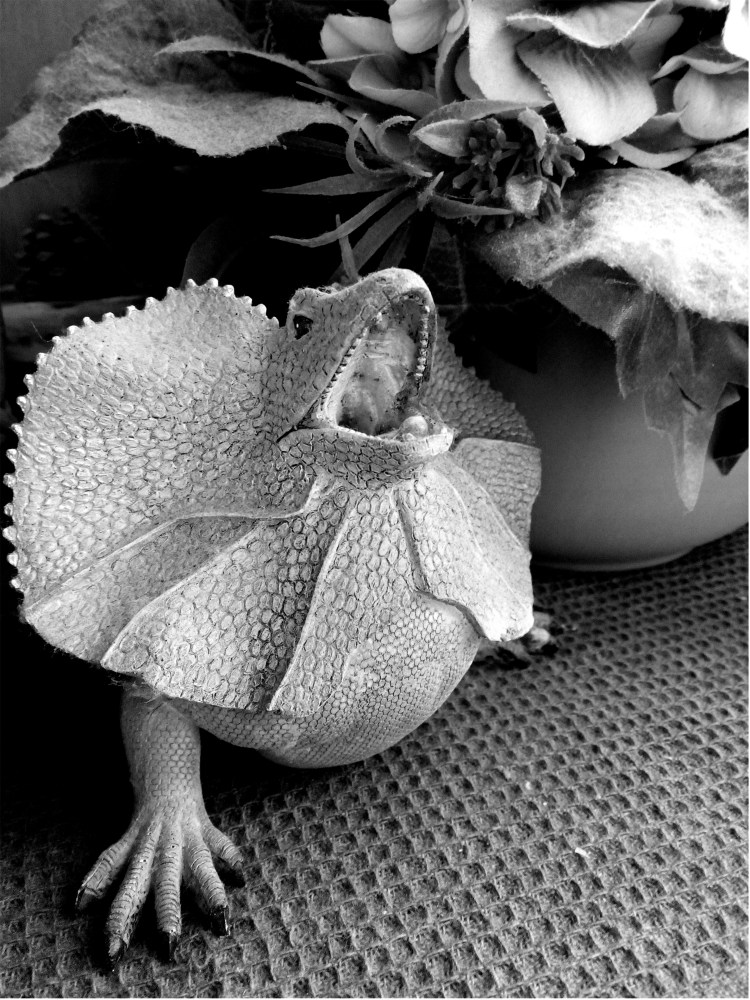
MODEL OF FRILLED NECK LIZARD © Gretchen Bernet-Ward 2022—Scientific name Chlamydosaurus kingii—Frilled Lizards inhabit dry woodland, usually with open shrubbery or grass understorey. Most of their time is spent off the ground in trees, often at a substantial height. They are well adapted to life in the hot tropics of north-western and northern Australia and the species also occurs in Papua New Guinea. The term ‘frilly lizard’ is often mistakenly applied to the common bearded dragon in the southern states of Australia. The Frilled Lizard eats mainly insects, spiders and other invertebrates. Their colour can be brown or grey with the frill being lighter and often tinged with orange or reddish-brown, and they can grow to around 45-90cm in length, about two-thirds of which is tail. It has a vivid yellow mouth and a large extendable frill gathered about the neck and under throat. The combination of the gaping mouth and the wide, brightly coloured frill provide an intimidating sight to any potential predator. It frequently runs at speed on two legs to escape danger, quickly climbing the nearest tree to safety. The image shows a clay model—https://reptilepark.com.au/animals/reptiles/dragons/frilled-neck-lizard/

Lifeguards Ready for Action

Yeppoon Beach, Queensland – Photograph © Dot Bernet 2021

LIFEGUARDS ON DUTY at Yeppoon situated 38 kilometres north east of Rockhampton, Queensland, the gateway to Great Keppel Island and the wonders of the Southern Great Barrier Reef.

From Yeppoon, across beautiful blue water, you can see Great Keppel Island. It has been years since I visited this coastal region and much has changed but the beaches and islands are far more accessible.

Meander down Yeppoon’s main street or stroll along the esplanade to browse beach-chic boutiques and surf stores and keep an eye out for one of the many new street art murals adorning local walls.

Kakadu stud bull

The Capricorn Coast (on the Tropic of Capricorn, the circle of latitude around the world which contains the subsolar point at the December solstice) also delivers when it comes to sourcing fine food with specialty produce like premium, export quality beef (nearby Rockhampton is the beef capital of Australia) seafood, and tropical produce. There is a wide range of restaurants, cafés and clubs catering to all tastes and budgets.

Families are well catered for in Yeppoon, with the foreshore also boasting the fantastic ‘Keppel Kraken’ zero-depth water park, open daily with fun and free activities for the kids on hot sunny days. The new lagoon pool at the southern end of Yeppoon Main Beach also has a children’s play area and dining areas.

I’d say Yeppoon is unspoiled, a relaxed and friendly little coastal town.

Gretchen Bernet-Ward

Information courtesy of https://www.queensland.com/au/en/places-to-see/destination-information/p-56b25db42cbcbe7073ad7126-yeppoon.html

. . . . .

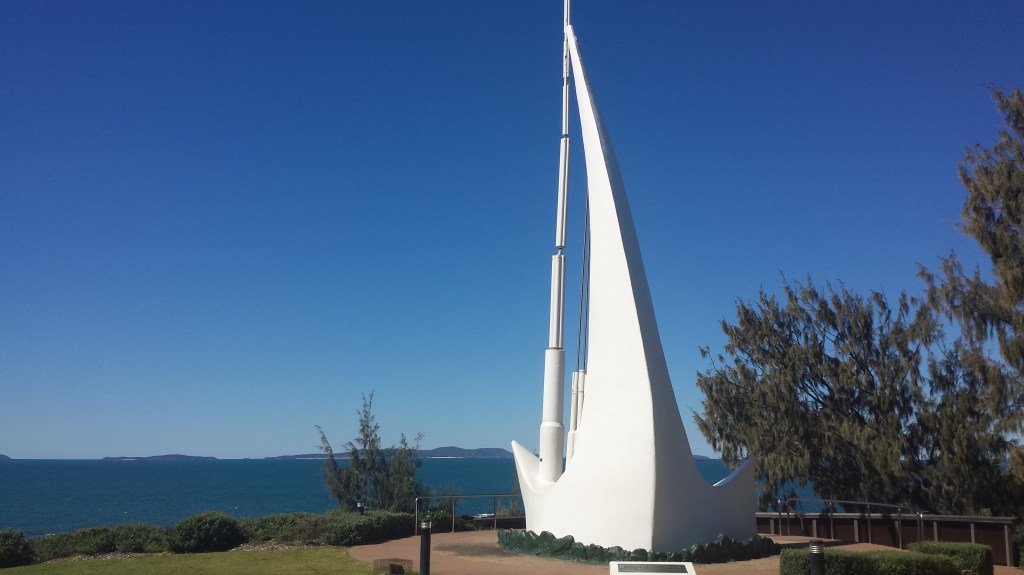
Set against a spectacular coastal vista of blue seas and Great Keppel Island in the distance, the Singing Ship at Emu Park is a majestic monument that commemorates the area’s legacy of the historical explorations of Captain James Cook, who discovered this bay in May 1770.  The unique design represents the billowing sail, mast and rigging of his ship Endeavour. Concealed organ pipes use the sea breezes to create haunting musical sounds.

Old Masterpieces from New York to Brisbane

Finally reached the end of the queue © Gretchen Bernet-Ward 2021

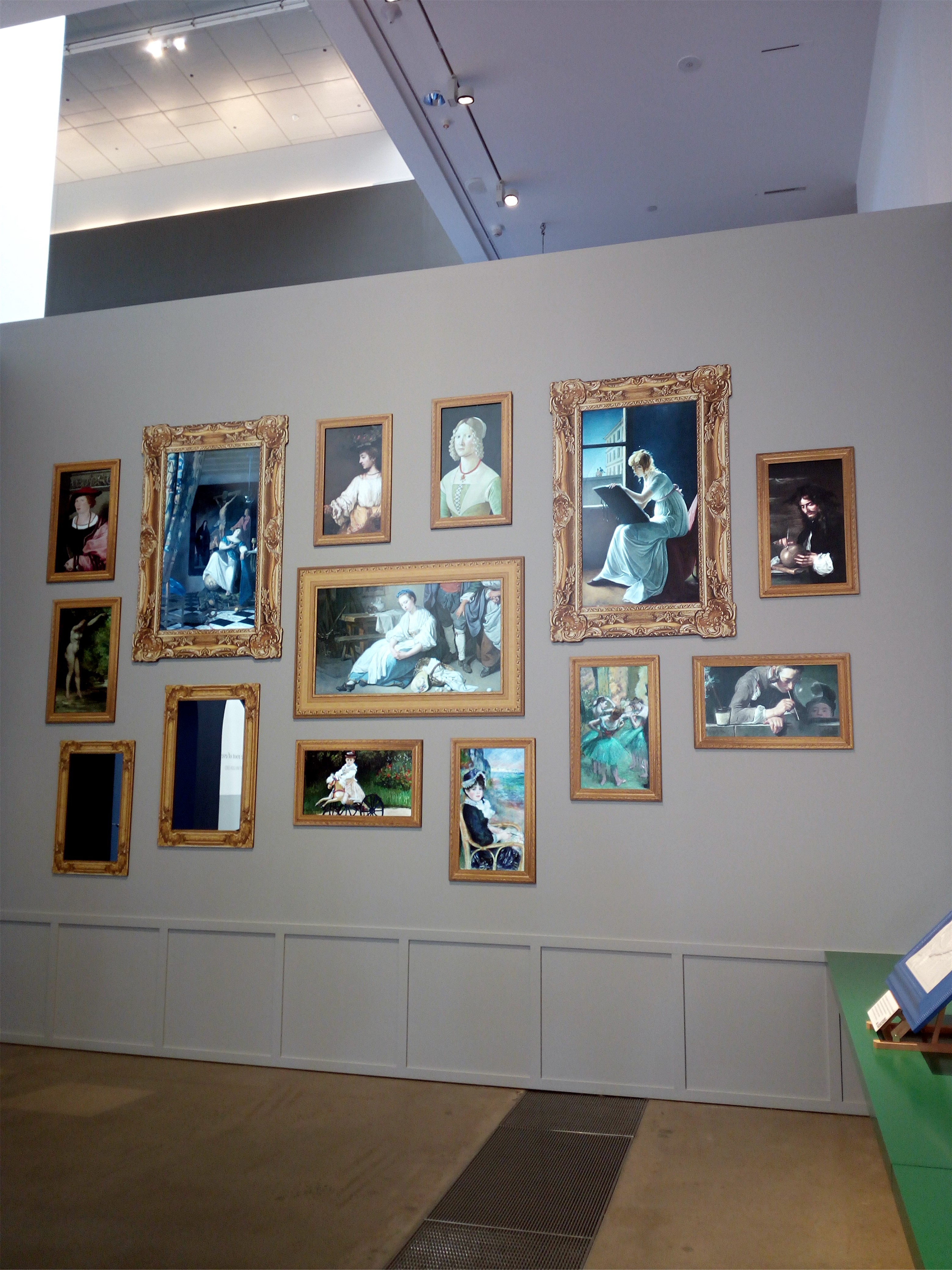
On a sunny Friday morning, waiting to enter GOMA Queensland’s Gallery of Modern Art, I did not photograph the great long queue of people. However, there were no privacy issues, every single person was wearing a mask. Patiently observing restrictions, we were all determined to view the European Masterpieces exhibition on loan from The Met, Metropolitan Museum of Art, New York.

Once inside, after a quick squirt of lavender hand-sanitiser, directions from the highly organised gallery staff were followed, and metered groups were ushered through the necessary sign-in to enter a specially designed viewing area. I say ‘area’ but it was more like roaming around inside someone’s home. Admittedly a large home with muted lighting and grey walls but it was what hung on those walls that definitely became awe-inspiring.

The galleries were split into three groups:

1. Devotion and Renaissance

2. Absolutism and Enlightenment

3. Revolution and Art for the People

From Giovanni di Paolo (Paradise, 1445) to Claude Monet (Water Lilies, 1916) I have written a quick overview of my visit—and I only took a handful of photographs. There are 65 works of art on display, and so famous they do not need my documentation.

Deep down I have to confess that the age and history of many of the paintings captured my attention more than the artwork itself. Scary moments frozen in time, dramatic posturing, gloomy scenes were not the order of the day for me. I loved the works with life and action and, let’s face it, realism.

French painter Georges de La Tour’s work ‘The Fortune Teller’ (see main entrance photo above) finally made sense to me when I saw it for real. It’s not about the old fortune teller at aLL.

GBW 2021

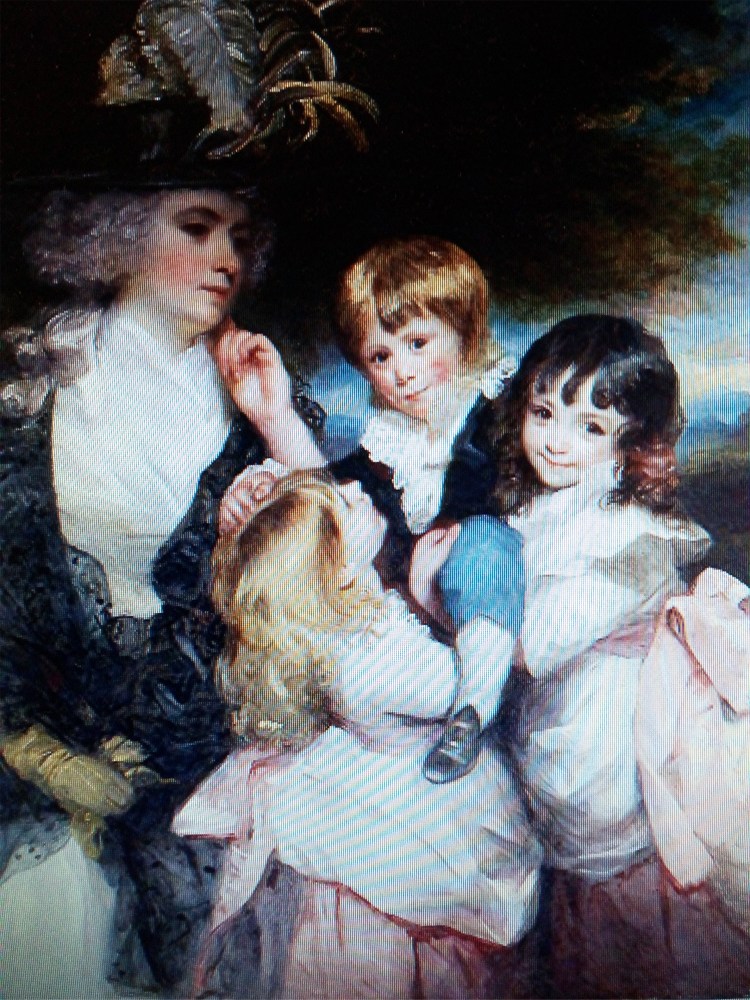
I liked the ‘essence’ of Lady Smith (Charlotte Delaval) and her children George, Louisa and Charlotte, in this family portrait where she appears lost in thought while her children tussle beside her, glancing at the viewer. The portrait by Sir Joshua Reynolds (England) was commissioned by Lady Smith’s husband, a baronet and member of Parliament. Expressing cultural ideals of femininity and upper-class childhood, this work was a popular exhibit at the Royal Academy in 1787 the year it was painted.

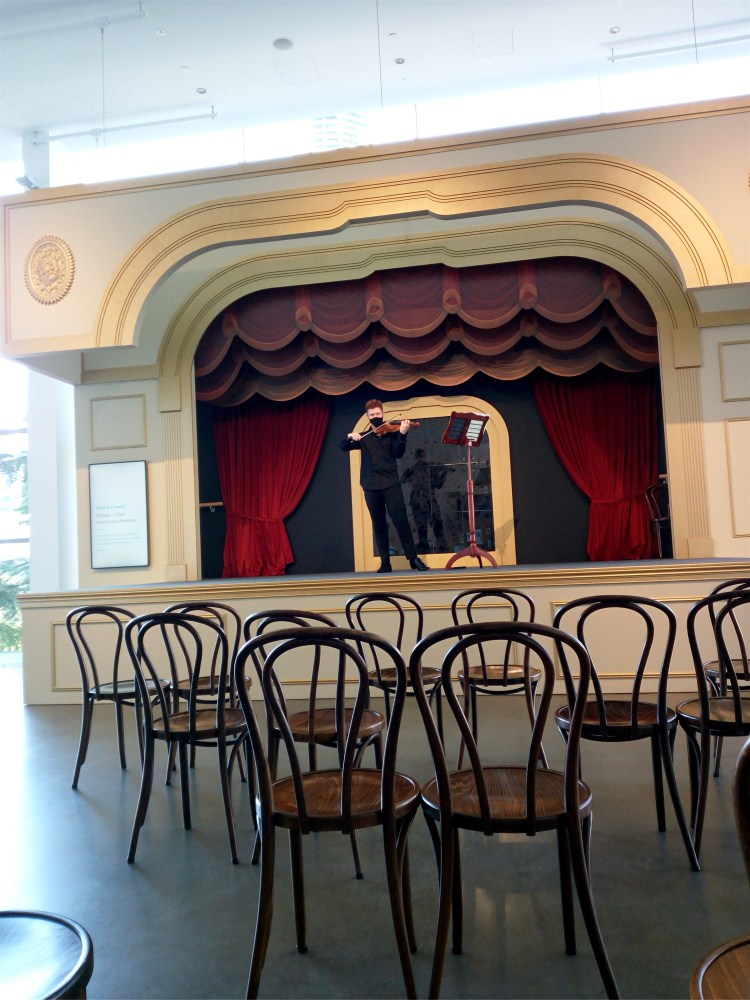
I wandered past El Greco, Rubens, Caravaggio, Vermeer, Goya, Rembrandt, Renoir, et al, and was drawn towards the sound of violin music. I left the dimmed rooms and walked into a brightly lit area where a lone violinist was playing. He finished with a flourish and an elderly gentleman and myself clapped enthusiastically but he appeared a tad embarrassed, nodded his thanks and exited the stage.

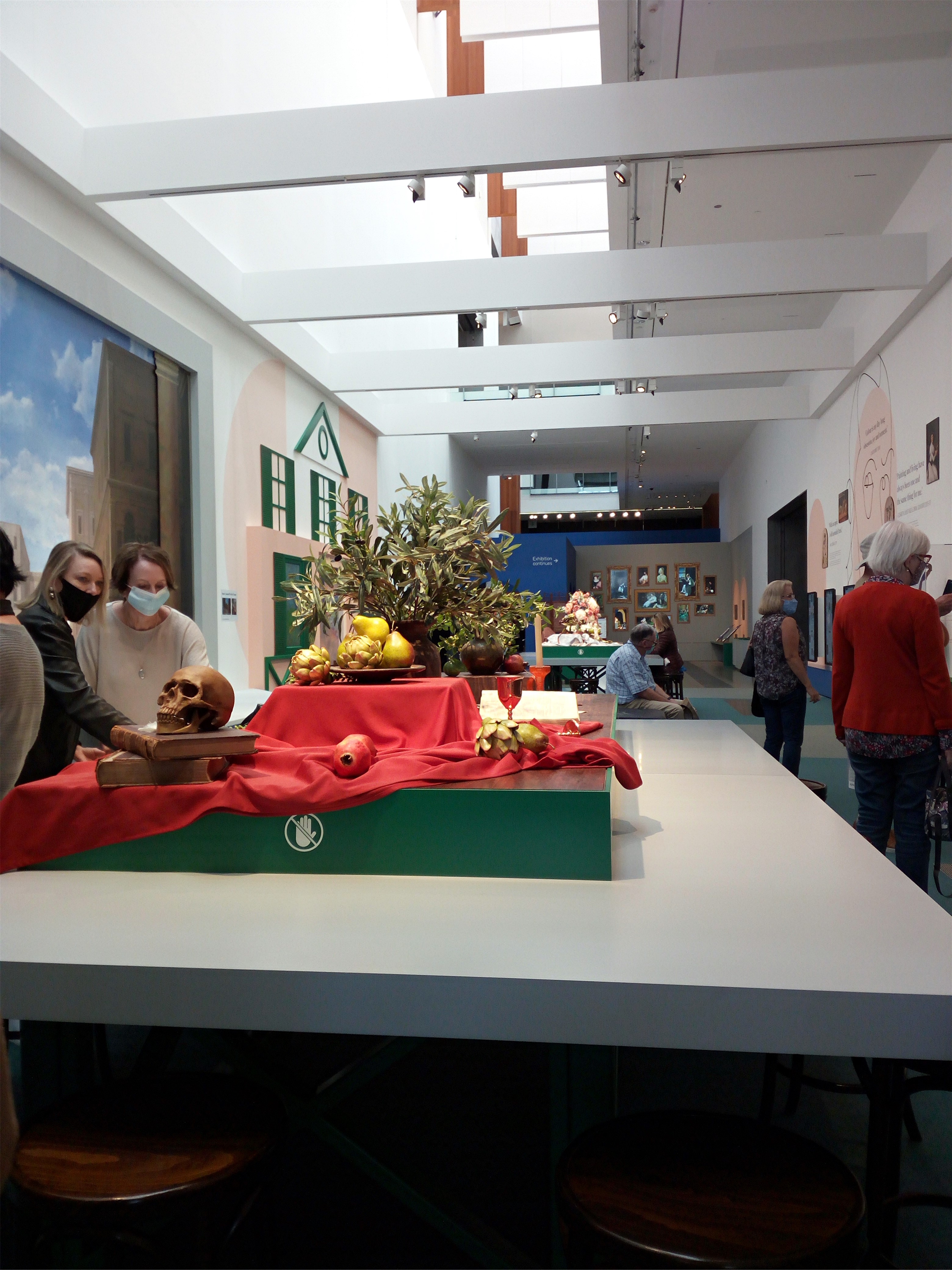
Directly behind me was The Studio, a long gallery set out with still life objects for the budding artist to create a modern masterpiece. There is a Renaissance backdrop for live models at special times. My eyes were drawn to the interactive displays and ‘paintings’ which brought the original art to life. Shades of Harry Potter, both clever and spooky!

The theatrette was not heavily patronised and after hearing the big bosses talk, I decided to seek out one of my favourite colourful artists and that is Paul Gauguin (France 1848-1903). His ‘Tahitian Landscape, 1892’ is smaller and less vibrant than I expected. A pleasant rural scene (below left) but not his usual tropical effervescence.

Claude Monet (France 1840-1926) and his sombre ‘Water Lilies’ wished me bon voyage and I was back into the real world.

As any person who frequents an exhibition knows, the exit is via the gift shop. This low-key store had some nice items but I wasn’t feeling it. The Library Café was looking inviting.

When I thought about the great works of art I had just seen, I pondered which one I could single out, which one I thought was the cream of the crop. The pleb in me rather enjoyed a large 1670 work by Jan Steen (Netherlands) ‘Merry Company on a Terrace’ for its rich vibes and domestic disorder. The original is bigger and brighter than the image (above right) shown here.

I think perhaps Covid-19 had something to do with the way I responded to the Met Masterpieces… and it was interesting to see how each century lightened the mood.

GBW 2021

To quote architect and designer Frank Lloyd Wright (1867 – 1959) “Respect the masterpiece, it is true reverence to man. There is no quality so great, none so much needed now.”

Gretchen Bernet-Ward

—–European Masterpieces—–

12 June 2021 – 17 October 2021
GOMA | Gallery 1.1 The Fairfax Gallery, Gallery 1.2, Gallery 1.3 Eric & Marion Taylor Gallery | Ticketed

https://www.qagoma.qld.gov.au/whats-on/exhibitions/european-masterpieces

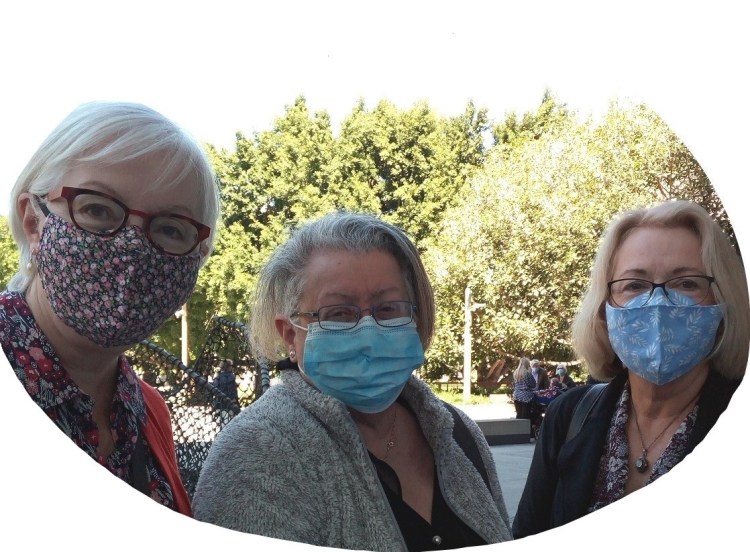
Happy galley visitors © Gretchen Bernet-Ward 2021

Stanthorpe Autumn Insights Part Two

Brooding rain clouds hang over the Stanthorpe Historical Museum gate.

Out the back is the blacksmith’s workshop mentioned in Part One. A guided tour of Stanthorpe Regional Art Gallery was an eye-opener (costumes next) and the Stanthorpe Post Office 1901 was the first in Queensland. Its style is informal with Edwardian Baroque Revival elements and Royal coat-of-arms, but inside it’s 21st century business as usual.

Napoleon, Ferdinand and The Alchemist.

Both Ferdinand and The Alchemist have elaborate tail coats trailing behind their heavily detailed jackets. Dr Denise Rall used a variety of mediums but my photos don’t capture the sumptuousness of the bling-covered fabric. There were two prints of the Rooster and I almost took the cheeky fellow home! The Gallery has an array of art techniques including landscapes by local artists and thought-provoking ceramics.

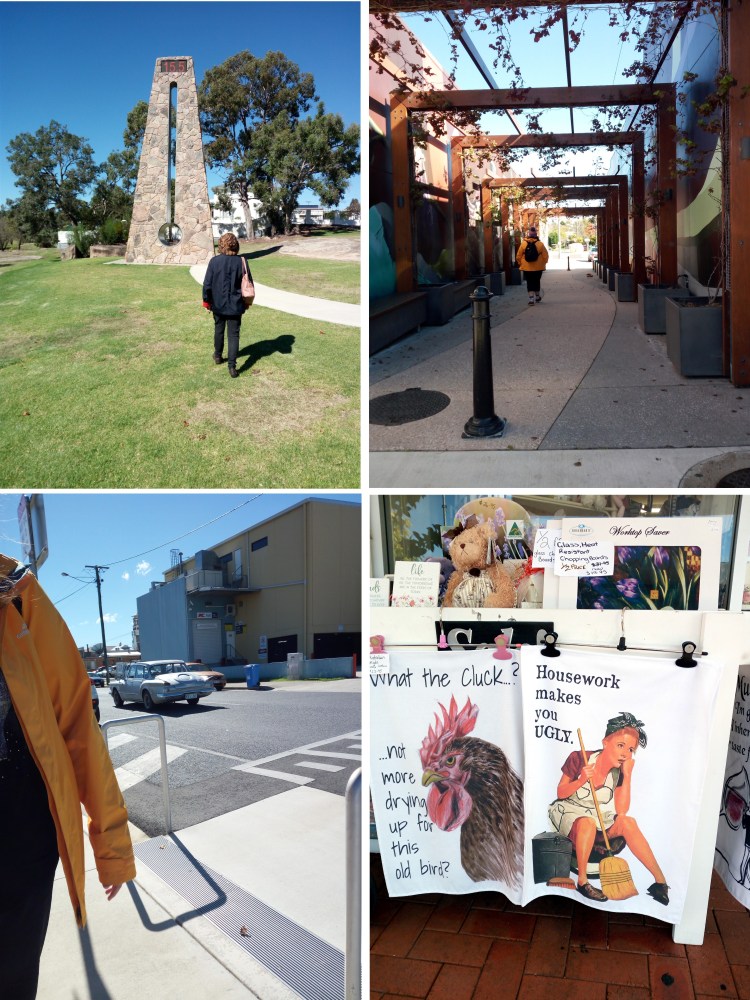
Took a stroll through town.

This must be the biggest stone thermometer in Australia. A detour between buildings lead to a sculpture with an ibis taking flight (used in my ‘Exercise Makes You More Attractive’ post). During lunch I read the local newspaper Stanthorpe Today and discovered the old white 1960s Valiant sedan I had photographed cruising the streets was taking part in a Classic Car Rally. Just love those teatowels!

A pyramid in a paddock.

This one is made of local stone and called The Ballandean Pyramid. It was originally built for the Henty Vineyards former owner, Stuart Moreland.

Storm King Dam on a suitably overcast day.

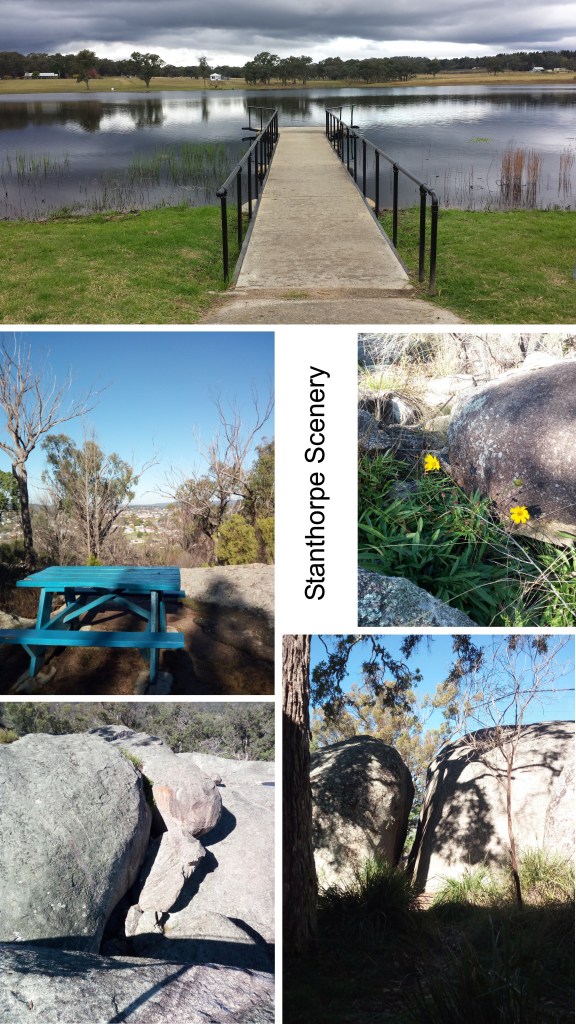
Although not as cold as I was lead to believe. The lake has bungalows to cater for fishing enthusiasts. The view from Top of the Town Tourist Park down to the centre of town with a blue picnic table for contrast. Daisies amongst granite rocks, and more granite rocks and boulders at Donnelly’s Castle, almost impossible to photograph their size—but not teetering like giant hard-boiled eggs in some parts of the region. Captain Thunderbolt, an expert horseman and highway robber, used to hide in these geological wonders.

The U3A Conference 2021 in Stanthorpe.

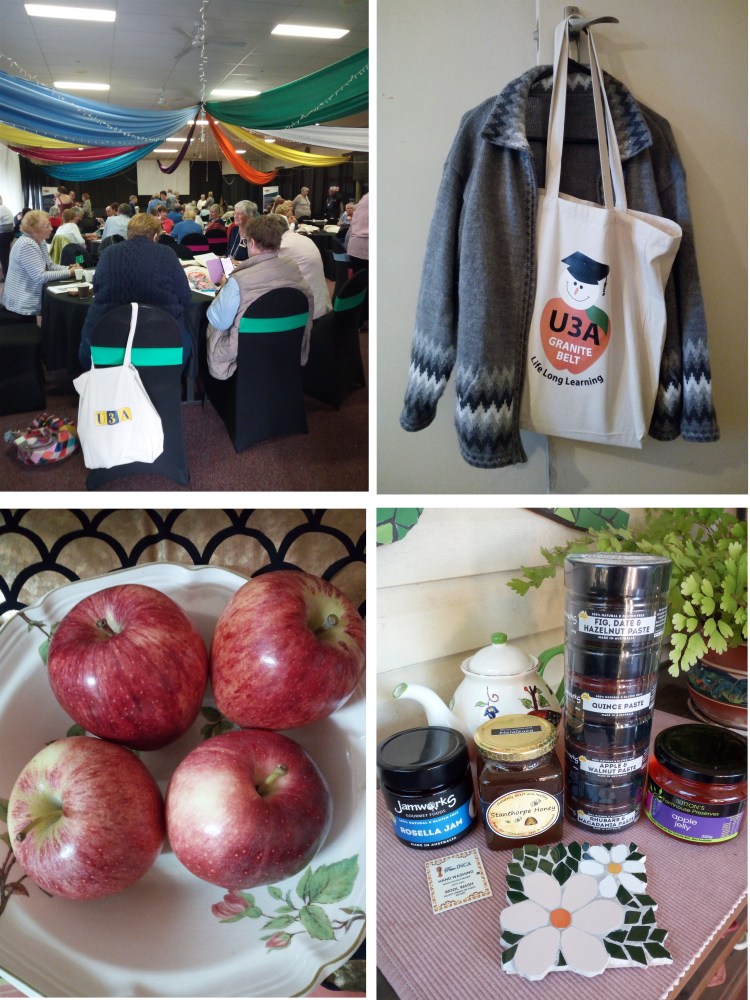
A packed 2-day Program of informative U3A events with eloquent guest speakers, living up to the title of ‘Coolest’ Conference. A highlight for me was Copyright with Irene Sachs, a straight-forward look at Australian copyright laws. Everyone got a goodies bag and the Daisy mosaic tile was hand-made specially, a different one in each bag. There’s my grey Alpaca cardigan from Pure Inca. Fresh-picked fruit abounded, Stanthorpe apples were prominent—I love them! Local food take-home’s included Jamworks Rosella Jam, Sutton’s Apple Jelly, Stanthorpe Honey, Jersey Girls cheese, minus bakery delights consumed on route.

The evenings were misty and quiet…

… except for a heifer escaping after dark and running around mooing at midnight! The daytime sky changed colour often but mostly May sunlight shone on country Stanthorpe and the whispering eucalypt leaves. A return visit is inevitable.

Here’s to life-long learning!

Gretchen Bernet-Ward

At an altitude of 811 metres (2,661 ft), Stanthorpe holds the record for the lowest temperature recorded in Queensland at −10.6 °C (12.9 °F) on 23 June 1961. My blog post compiled on Queensland Day 6 June 2021.

Visitors Guide https://southerndownsandgranitebelt.com.au/

Stanthorpe Autumn Insights Part One

The views change dramatically driving along the highway from Brisbane to Stanthorpe.

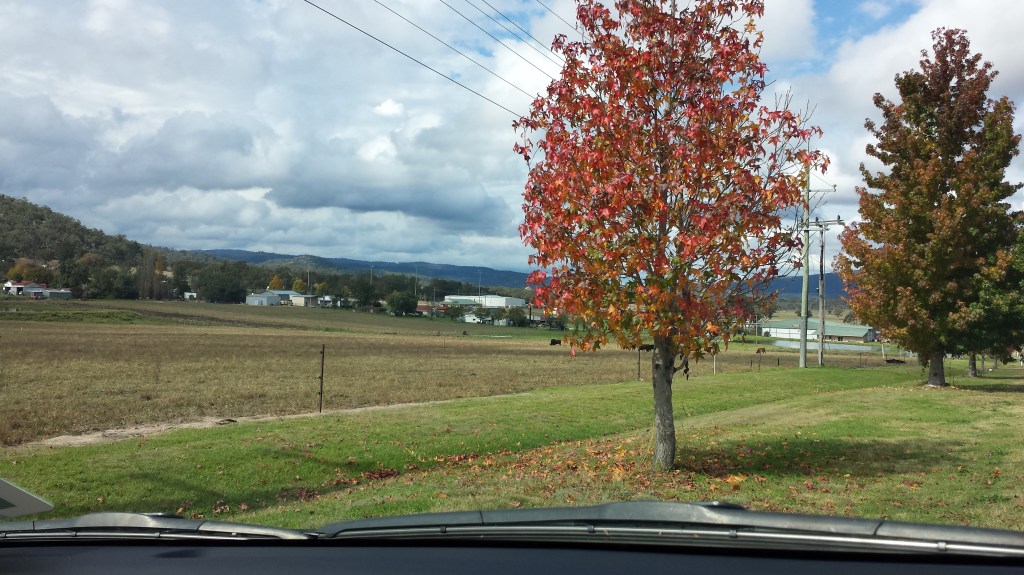
Through farmland, over Cunninghams Gap and the Great Dividing Range (Eastern Highlands) Australia’s most substantial mountain range and the third longest land-based range in the world. Through ‘Rose and Rodeo Capital’ Warwick then into the Granite Belt region renowned for fruit-growing and wine-making. The air becomes cooler, the May autumn leaves turn russet and the landscape is littered with huge granite boulders.

Stanthorpe is a pretty little town with a lot of history as I found out when I attended my first U3A conference.

Actually the 2021 conference was a good reason to visit this fabulous part of Queensland! On arrival, after traversing the town, the next stop was Top Of The Town Tourist Park’s well-appointed accommodation in The Cottage. A modern cottage, small and cute and separate from the other cabins and campers. That didn’t stop me talking to the locals for a good chinwag. The historical museum is nextdoor and that warranted a visit on the last day, so much to see inside! Anyway, it was a quick drive into town and a visit to the supermarket, and a Peruvian Alpaca wool shop just in case there was a cold snap. I did buy a handwoven cardigan which is very warm and snuggly. My photo shows the walk down to Quart Pot Creek. The sky was a clear blue and the water reflections sparkled.

Looking across Quart Pot Creek on the path to the Tourist Information Centre.

A huge stone thermometer read 15 degrees Celsius (59 Fahrenheit) and a tourist bus had just arrived so there were a lot of people milling about inside looking a handmade souvenirs and ordering morning tea. I picked up several leaflets and information on local sites of interest plus must-do events, like wineries, Girraween National Park, Wallangarra Railway Station Museum & Cafe (sadly not managed this trip) Truffle tour with Truffle dog hunts, Jersey Girls Cheese factory (what an experience!) and Donnelly’s Castle which are a jumble of prehistoric granite boulders at the end of a winding gravel road. After climbing these huge mystical boulders, the view was fantastic. Then it was time to head back for a delicious lunch at Lily’s Cafe in the High Street.

My next post will feature another side of Stanthorpe. The diversity surprised me.

A visitor to Stanthorpe would need a couple of weeks to visit all the internationally renowned wineries and local attractions, both natural and man-made like The Pyramid out in a paddock! And I loved the individuality of farm produce and accommodation. Top Of The Town had a trail up the hillside where you can stand on a granite rock and look out over the town in the company of native birds and pretty wildflowers. Brisbane doesn’t get much in the way of autumn leaves (although the weather does cool down) so this blog post features red, yellow, golden leaves.

In Part Two, I will post more photographs and write briefly about the U3A Conference. The conference ran over two days and the first guest speaker was Mike Hayes, Director of Viticulture and Chief Winemaker from Sirromet Wines, Ballandean, located in the Southern Downs near the Queensland/New South Wales border.

These two ducks were not very happy that I was walking past their pond.

The Stanthorpe Regional Art Gallery pond had rainwater in it from a storm the night before but otherwise water is very precious in southern Queensland. I doubt the centre fountain is ever full although it does add to the feel of the season. The U3A Conference organised a guided tour of the Art Gallery and in my second post I will show two of the local artists creations. I was particularly taken by the work of costumier Denise N Rall; landscapes beautifully rendered in different mediums; an illuminated-style book of art.

Grape vine leaves, not in a vineyard but the Stanthorpe Historical Museum.

These leaves caught my eye outside the blacksmith’s workshop. Inside was a blackened fireplace, anvil and countless tongs, pliers, buckets and metal utensils, hung around the slab bark hut. I don’t remember seeing the leather bellows to fan the flames but there must have been. The blacksmithy had a physically demanding yet highly necessary job in every town in days gone by. I found it difficult to even lift the hammer which would have been used to shape the red hot iron. And I have no doubt countless horseshoes and metal implements were forged in sheds like this with its corrugated iron roof, dirt floor and rough log seating.

Bye from sweet, sunny Stanthorpe until my next post Part Two also compiled on Queensland Day 6 June 2021.

Gretchen Bernet-Ward

Bush Stone-Curlew Capers

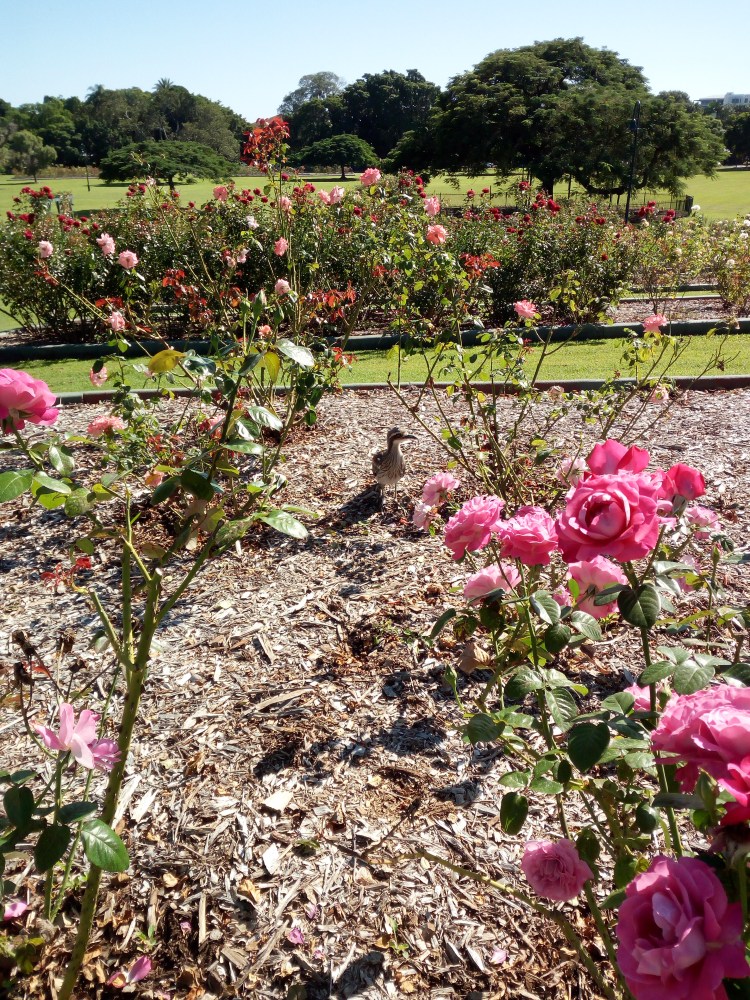
Bush Stone-curlew poised amongst the roses in New Farm Park, Brisbane © Gretchen Bernet-Ward 2021

The Bush Stone-curlew or Bush Thick-knee (Burhinus grallarius) is a large ground-dwelling bird with a life span of up to 20 years.  The bush curlew is endemic to Australia and found in Brisbane, usually in parkland.  The curlew will adopt a rigid posture when it becomes aware of an observer, as this one did, poised amongst the roses in New Farm Park.

Curlews are terrestrial predators adapted to stalking slowly at night.  Their preferred habitat is open landscapes which give them good visibility at ground level where they search for invertebrates such as insects.  The grey-brown coloration is distinguished by dark streaks, its eyes are large and legs are long.  Both male and female care for two eggs laid on the bare ground, usually sited in a shaded position near a bush, stone wall or fallen branch.

Queensland Bush Stone-curlews are capable of flight but rely on the camouflage of their plumage to evade detection during the day. Domestic animals are their biggest threat. At night their call is an evocative and unforgettable sound, a sort of wailing cry which echoes across open ground.

The curlew candid camera (below) is memorable!

Gretchen Bernet-Ward

Video by FAME 2019, Mt Rothwell in Victoria, Australia