Quick Crime Read ‘Building On Past Events’

Highrise © image Gretchen Bernet-Ward 2024

The construction company boss has an accident or is it something more sinister? A ten minute read, dialogue driven, no chapters, no indents or page breaks (courtesy of unwieldy formatting) and I originally wrote it for writing group. Certainly an interesting result.

Erica Brook of Brook Constructions looked across the messy building site and was not happy. Work progress was slow, money was tight. And she’d been doing some thinking. She parked the Tesla and fastened the velcro on her hi-vis jacket. Time to ditch the altruistic ideals and read the riot act to the tradies, most of whom she’d known for years.
As Erica crossed the site, the right boot of her R.M. Williams caught on unfinished paving and she sprawled sideways across half-finished brickwork which crumbled under her weight and sent her down onto an exposed foundation spike.
“Erica!” shouted bricklayer Joan Campbell. “You all right, boss?”
Erica’s stricken look betrayed her pain. Blood was leaking through the leg of her jeans, white bone jutting through the fabric. She passed out and came back to reality in the ambulance.
“Don’t worry,” Joan’s face mirrored the white of her hard-hat. “Things’ll be okay.”
Erica rasped through the oxygen mask. “Not likely, Joanie.”
She grabbed Joan’s hand firmly. “Want to become a partner in the business?”
Joan winced. “I think you’re a bit delirious.”
As the ambulance swung into the Emergency bay, Joan made a quick decision.
“Okay, I’m in.”
Outside the hospital ward, Joan diligently phoned everyone to advise of Erica’s impending leg operation.
Post surgery, she returned and sat beside Erica’s bed in a screened off cubicle, nervously twisting her hard-hat in her hands. Opposite her sat Erica’s wafer-thin wife Michelle who trilled “Trieste needs the vet for a nail clip.”
Erica managed a groan through her swollen jaw.
A light-footed nurse in a blue Covid mask entered holding a glass of water and medication. The charged glance the nurse shot Joan took her breath away.
Michelle sat stiffly, gazing out the window, while the nurse neatly administered pills to Erica then left the cubicle.
“Erica,” Joan asked, “Want anything to eat? Chiko Roll from the cafeteria?”
Erica’s glazed eyes managed to look hopeful.
“No,” snapped Michelle, “she’s on a diet.” 
Disconcerted, Joan muttered “Okay, the site manager should phone soon, I’ll be off then.”
She scrambled to leave ahead of Michelle. At the nurses station she leaned over the counter towards Erica’s nurse and read her name tag. “Annalise”.
Keeping a blank face she asked Annalise if Erica was going to be okay.
Annalise replied in a low voice “She’s suffering from external symptoms.”
Realisation dawned on Joan. “Oh, her wife, I get it…”
Annalise put a finger to her lips to shush Joan and pointed towards the lift doors.
Already wearing sunglasses, Michelle prodded furiously at the buttons, saw a plaque on the wall, and almost tripped through the opening doors.
Joan broke the silence “I’m going down to the cafeteria, want anything?”
“No thanks.” Annalise grimaced. Joan wondered if that was directed at her or the food.
Over lunch Joan checked the news reports and came back thirty minutes later to ask Annalise if she’d seen her hard-hat. “Under the chair where you sat, silly.”
Joan walked the squeaky linoleum floor, entered the ward and stopped at the wrong cubical. “Sorry,” she said, backing out.
She found her hard-hat and bid poor Erica’s taped and tubed body a sombre goodbye.
At home, Joan Campbell was detained by police and told that she and nurse Annalise would be taken to Central police headquarters to be interviewed separately regarding the unexpected death of construction billionaire Erica Brook.
Their second interview was together, without legal representation, in a windowless room at a police detention centre. Joan wanted answers but the only response from a tall uniformed constable was a paper cup of water and his advice to wait patiently.
Drumming her fingers, Annalise stared blankly at the pockmarked white wall until finally it was confirmed that Erica had been murdered.
“Murdered!” Joan stared at Patricia Ruben, the incumbent Senior Detective with small yet stunning earrings no doubt frowned upon by her boss.
“How?” asked Annalise.
Detective Ruben sat down and glanced at her papers. “Death from suffocation.”
She turned to Joan. “Ms Campbell, tell me your movements from when you arrived to when you left the hospital.”
“Well, there was the site accident, an ambulance ride, a chat around Erica’s bedside, I spoke to Annalise, had lunch, went back to get my hard-hat, and left.”
Annalise shrugged. “Standard treatment. The patient was stable and resting.”
Ruben turned again to Joan. “Ms Campbell, I must warn you that building on past events, your return to the cubicle makes you a suspect.
Joan flared up. “No way.”
“And,” Ruben held up a long straight finger, “you inherit the Brook Constructions company.”
“Totally not right.” Joan felt weak and slouched back in the chair.
Ruben passed her the water cup. “You had a discussion in the ambulance.”
“Erica was emotional with pain. It wasn’t some high-powered business transaction.”
“From her hospital bed Ms Brook had informed her wife Michelle of company changes, best to check with her.” Ruben shuffled documents. “Meanwhile did you notice anything odd?”
Joan sighed.
Annalise gazed at the ceiling, arms folded across her pale blue uniform.
“The whole day was screwed,” she said and continued when the detective tilted her head. “There were patients, visitors, couriers, cleaners, florists and maybe small Paul.”
At that name, Ruben frowned. “Elaborate.”
“He’s short and gets mistaken for a child.”
Joan straightened up. “Just remembered! I went to the wrong cubicle, there was a youngster in the bed.”
“Nobody was in there all day,” snapped Annalise dismissively.
“There was, I saw him.” Joan was adamant.  
Detective Ruben scribbled furiously. “Is he likely to still be there?”
“Check the discharge papers at the hospital,” drawled Annalise.
Overlooking this remark, Ruben asked if anything else had occurred.
“Michelle, er, Mrs Brook certainly left in a hurry,” said Joan.
Annalise jabbed her finger in recollection. “She was pushing the lift buttons as if her life depended on it.”
Ruben made another quick file notation.
“I went back for my hard-hat,” Joan mused. “My work clothes had left dust on the chair seat. I noticed a shoe print.”
“Describe the imprint.” The expensive midnight blue pen scrawled across the page.
“Smallish, not a boot, more casual.”
“I’ll be right back.” Ruben left the solid door ajar.
The constable closed the door and blocked it with his looming presence.
Joan crushed the empty paper cup without thinking. The warm interview room thrummed, making her sweat uncomfortably. She missed her phone and became mesmerised by Annalise finger-grooming her balayage hair but the seductive gestures were spoiled by a what-are-you-looking-at scowl.
Joan leaned forward when a paper-rustling Ruben and the constable regrouped.
“Forensics are still checking,” Ruben advised, “but nobody had seen or heard a youngster.”
She opened a spiral bound notepad, wrote quickly, ripped out the page and showed it to Annalise and then Joan.
Turning it around, she read “One of you is lying.” She scrunched the paper. “And what are you going to do about it?”
Annalise stood up. “I’m not speaking any further.”
Joan felt a stab of despair. How could she have been so blind? She launched herself out of the chair and grabbed Annalise by the shoulders.
The alert constable stepped forward but Detective Ruben raised her palm. 
“Why?” shouted Joan, shaking Annalise who flinched and twisted away.
“Enjoy your broken building company.”
“You killed a good friend!” shrieked Joan.
“She used you like she used everyone,” mocked Annalise.
Ruben checked that she had left the audio recorder running. She gestured Joan to sit and pinned Annalise with a glare.
“Tell me how you knew Ms Brook?”
“By her lousy reputation. Brook and brainless here never cleaned up their work place, never fixed broken equipment or fences or filled deep holes even though council specified it.”
“That’s not right.” Joan squirmed at her lie. “What harm did she cause you?”
Annalise clenched her fists, eyes glazed. “It was a case of sooner or later. I waited until she eventually came into Emergency.”
She refocussed. “Remember the child who got run over by one of your site vehicles?”
“Y-yes,” Joan hesitated. “I had just started, but I did see a plaque near the hospital lift.”
Detective Ruben obviously knew where this was going. She wrote quickly, documenting a nightmare as Annalise marked off items on her fingers.
“No security, no hazard warning signs, no site training, no first aid post.”
Joan’s stomach lurched again. “That plaque. Your child.”
Raising her folder, Ruben read “Legal wrangles dragged on. Erica offered no settlement or financial assistance although she was the mother of Annalise’s adopted son.”  
“Her workplace negligence killed my boy Paul,” Annalise screamed. “She blamed me but I got even.”
Joan’s thoughts were spinning as Detective Ruben read out the arresting procedure. Another uniformed officer arrived and Annalise was steered out of the interview room.
She was held by both arms and lead down the corridor, her piercing shrieks echoing back to them. “Erica Brook was easy to smother, I’m glad the bitch is dead!”
A heavy door slammed shut.
“Off to be processed.” Ruben stacked paperwork and glanced at her phone before noticing Joan’s stunned expression. “Forensics already had a match on the shoe print. Maybe she checked for witnesses.”
“There was a child in the next bed.” Joan was quite sure of that.
“Hospital staff didn’t see anyone.” Ruben slowly capped her pen. “That memorial plaque isn’t detailed but allegedly her son used to detour through the worksite on his way to visit the hospital.”
“Poor kid,” thought Joan feeling light-headed, “he saw her retribution.”
Guilt gnawed at her stomach. Instead of confronting Erica about the construction site mess, her obstacle course prank had backfired and caused another deadly outcome.

© Gretchen Bernet-Ward 2024
© GBW2024

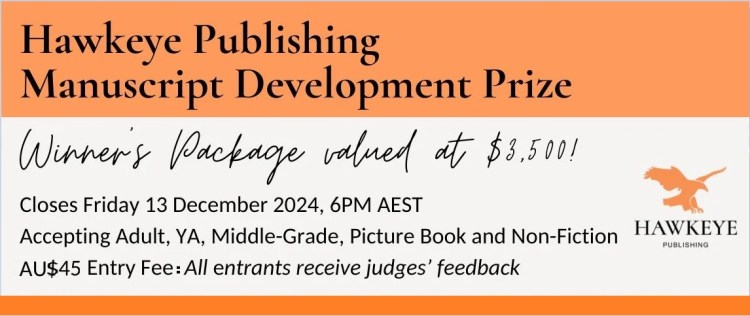
https://hawkeyebooks.com.au/pages/hawkeye-publishing-manuscript-development-publication-prize
Start building your story and cement your character in readers minds.

https://www.facebook.com/groups/writersgroupslisting

New Girl and The Boss

Messy Business © image Gretchen Bernet-Ward 2024

Linda wasn’t quite sure if she should go.
After all she had never been invited into the manager’s office upstairs.

Viv the senior receptionist snapped “Please put this envelope on his desk,” then added ominously “and come straight back.”

Possibly seeing the shock and hesitancy in the young girl’s eyes, Viv softened her voice. “Go on, love, he won’t bite and you’ll be back in time for the fire drill.”

It wasn’t biting or fire drill that Linda was worried about. His temper was known throughout the industry, voices were lowered in his presence, the accountant scampered around, flapping papers for signatures when a meeting was due, and shareholders routinely refused tea and biscuits on the pretext of another urgent meeting.

There was no staff interaction and she had the feeling that the boss did not know their names, or did not care, because they came and went on a regular basis. What if he shouted at her? What if she fainted? But Linda enjoyed her reception work, the customers were nice, although edgy, constantly looking over their shoulders.

The small flat switchboard was new and easy to use and the company name was not hard to pronounce when she answered in that singsong voice of all new receptionists.

Plus she had an intercom and a proper ergonomic faux leather desk chair which swivelled.

The other employees were mildly friendly as if to keep her at arms length because she could be gone by the end of the month. She needed this job, she was going to stick it out, and the gloss had not yet worn off. However, she did not want to have anything to do with the notorious Mr. Arthur Roberts of Roberts & Co Pty Ltd.

Linda whispered to one of the office girls “Maybe it would be better if you popped it on his desk, Joanne.” The reply was quick. “Too busy minding your switchboard.”

“Get hopping,” instructed Viv, “and put it in the middle of the sheet of blotting paper on his desk.” Apparently Mr. Roberts still used a fountain pen. Occasionally it leaked Quink and he often requested a document be retyped due to a spreading stain.

Linda thought it was all too quaint and old-fashioned compared to what she was taught in business college but she went along with it. Until he started shouting at someone.

One of her duties was typing invoices on the new IBM Golf Ball typewriter. It made a satisfying clatter. And for the time being she was the envy of her friends, many of whom had left school to work in the public service or one of the lesser banks in town. Linda had her sights set on the travel industry and the glamour of free flights. Leaving Roberts & Company far behind.

Ignoring the office boy’s wink, she stood up and tucked a strand of hair behind her ear before smoothing her dress, always grateful she did not have to wear a skirt and blouse emblazoned with the company name. An airline hostess uniform would be far more elegant.

Stairwell in Paris France (Photo © Josh Harbort 2024)

The shaky old lift in the foyer stank of cigarettes and Linda had taken an instant dislike to it. Fortunately it only took a few minutes to go up the back stairs where she emerged onto the luxurious deep blue carpet of the fifth floor. Then realisation hit her.

The envelope was still on her desk.

With a huff of annoyance, she was turning back to the stairwell when she heard raised voices. One, of course, was Mr. Roberts and the other was a very angry woman. Moving a bit closer she saw that Mr. Roberts office door was ajar so she stood listening. It was obviously an argument over money. She had heard enough of those from her parents when her father handed over his weekly pay packet.

Linda sucked in a deep breath then slowly, inexorably, found herself drawn towards the heavily panelled door. There was a gasp, the sound of a pained groan and something fell. A spurt of adrenaline coursed through her body before her brain caught up. She turned back to the stairwell door but was too late to stop a fast moving woman reaching it first.

This wild-eyed woman sported a nasty red stain across her chest but had no difficulty in pushing Linda aside. Just as the woman entered the fire door, Linda went into her brother’s favourite soccer slide. She tripped the woman who staggered down several metal steps before falling flat on her face on the next level. There was a metallic clang as a knife fell from her grasp.

“Hey, what’s going on up there?” shouted Viv from below.

A wet cough behind Linda made her turn around, slowly, slowly.

There was Mr. Roberts. He stood with his face the same shade as the blotting paper pressed against his left shoulder. “I’ve buzzed security,” he said. “Best if you ring for an ambulance.” He swayed then sank to the plush carpet and passed out.

“Viv,” screamed Linda, “get the first aid kit!”

At home next day, after several telephone calls from police and workmates, Linda was told different versions of what must have transpired but the knife wound was definitely inflicted by Mr. Robert’s estranged wife Eileen.

“The person you sent catapulting down the back stairs,” Viv observed dryly, “that’s one way to miss fire drill.” The envelope remained undelivered.

Mr. Roberts was recovering in hospital and probably shouting at the nurses. Eileen was held in another wing under police guard pending investigation. Linda, on the other hand, was ensconced at home in her favourite lounge chair, feet up and a big bowl of mixed lollies beside her on the TV tray.

What if I had not gone up those stairs?” Linda mused, then shrugged it off.

“It was the shock really,” she explained to everyone who called to asked how she was feeling. “My legs just went all wobbly.”
That was her story and she was sticking to it.

🧡 © Gretchen Bernet-Ward 2024

NOTE: Originally titled “What If” a Short Story for U3A Writing Class read at end-of-term.
Fictional events but some elements are retro autobiographical.
First draft Wednesday 4th September 2024. GBW.

Brisbane telephone books © image Gretchen Bernet-Ward 2024

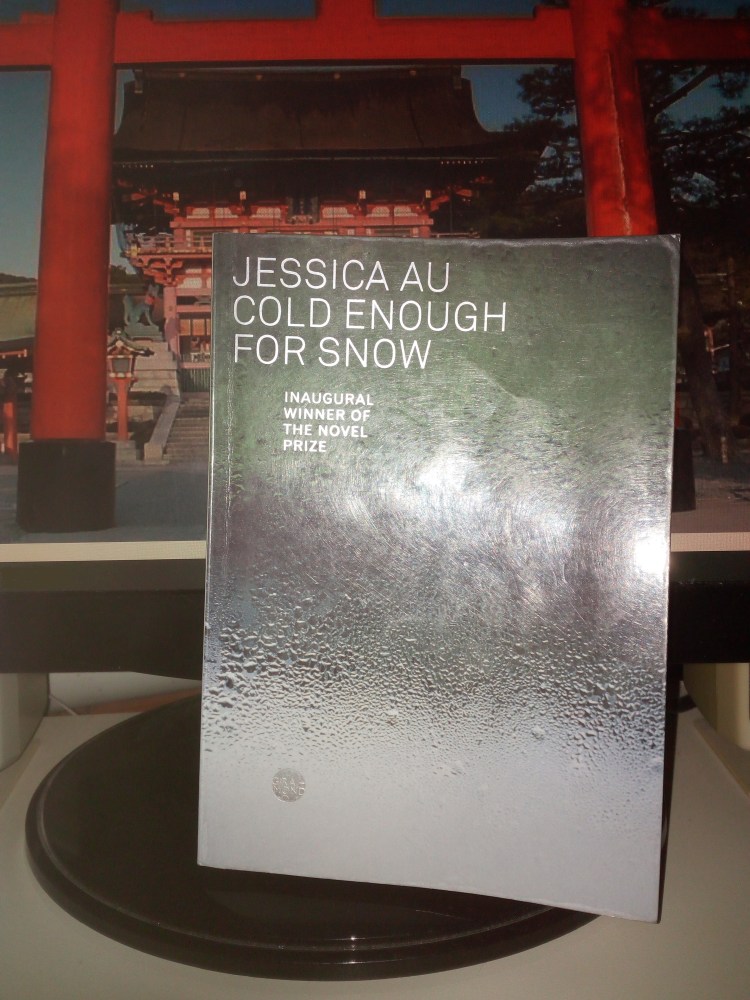
Review ‘Cold Enough For Snow’ Novella by Jessica Au

Jessica Au ‘Cold Enough For Snow’ Novella 2022

A gently flowing story of the tenuous relationship between an adult daughter, the narrator, and her ageing mother during a tourist trip to Japan. The memories, flashbacks and every day minutia come from the daughter. At times the dialogue between the two is fragile, hesitant, and the occasional polite conversation is a description of scenery or food, never their emotions, never connecting on a personal level, but still caring. The daughter remembers her studies and her then boyfriend Laurie. I thought it was surreal when she went kayaking with Laurie and crossed an ancient meteor crater full of deep dark water. Not something I could do but this is not an adventure book, it exposes us to thoughts.

Our memories shift and bend. The grey bookcover perhaps represents the hazy way we walk through life and remember. There’s a mystifying love birds recollection and the daughter even imagines clearing out her mother’s flat, sorting through a lifetime of possessions. Not for gain, just practical, like planning to visit Japan and her mother asking if it was “cold enough for snow”. The story, like the gentle and seemingly never-ending raindrops, carried me through galleries, museums, shopping, rural landscapes and train stations where gifts are carefully chosen for the family. There comes thoughtful gestures from the daughter, always aware of her mother’s pace, watching if she tires, suggesting places to visit and taking care of their meals and travel plans. I enjoyed the calm, methodical pace of this story.

I think you can have memories to talk about, worry about, analyse or just carry close. A meaningful picture of this quiet couple is compiled in my mind without any great realisation on my part until towards the end of the book. “It had been cold outside and warm in the train.” and I felt subtext; is the daughter really with her mother on this journey? Or is she remembering it? Seemingly disconnected, everything does connect to make the daughter an interesting character. Snippets like her restaurant work and her student days were easily imagined. I loved the couple of pages describing her time in Hong Kong and her reluctance to tell her future husband Laurie that she had once lived there.

Wearing puffer jackets, reliving old memories and making new ones, the mother and daughter’s last stopping point is to Inari gates Shinto shrine in southern Kyoto. (The Inari shrine complex is comprised of worship halls at the base of the mountain connected via astounding vermilion torii gate-lined paths). Situated in the mountains, this walk shows their stamina and unspoken mother/daughter bond, each perhaps recalling what they had seen and experienced together. At the end of this novella, the thought conveyed to me is that their journey is not quite over yet.

Gretchen Bernet-Ward 2024

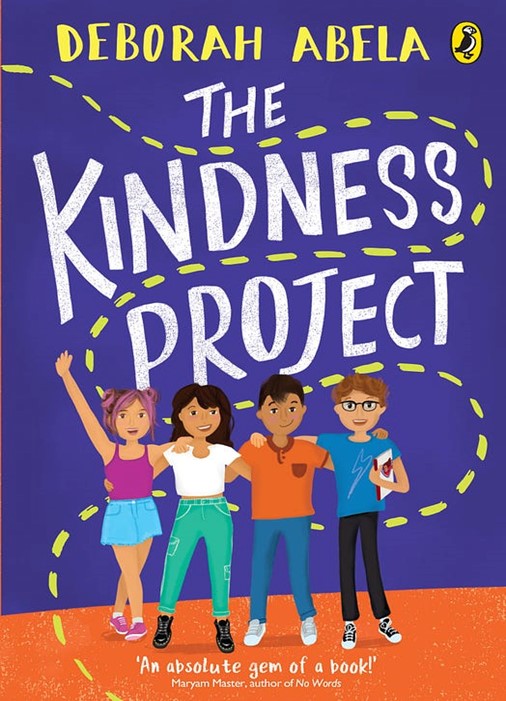
Review ‘The Kindness Project’ by Deborah Abela

A text layout which will appeal to young readers and older readers reading the book to younger readers. A gem of a story from author Deborah Abela who wrote inside ‘I hope you enjoy this little dose of kindness!’ For me it’s more than a dose, it’s a great big generous helping, with thanks to Zanni Louise for my copy.

Of course things don’t start off all sweetness and light, oh no, there’s shy Nicolette, DJ a bully and various obstacles to conquer. Along comes Leaf, a kid you will recognise (and hope in hindsight that you were nice to him). He deserves niceness and big bunches of kindness. Where is his mother?

Both Leaf and Nicolette have troubled backgrounds. They become friends but not before Nicolette imagines all sorts of disasters. Her mind goes off on fearful tangents, she tends to think worst-case scenario and moments do go awry. Ideally ‘You tell someone your worries and they don’t laugh or tease you or call you names, they just listen’ although it does seem like her Nanna is getting a raw deal in the aged care system. The drama is heightened and Nicolette and Nanna make daring plans. What could go wrong?

Event sold out!

I think the type-setting and font changes for this book are brilliant and I haven’t had this much fun since Oliver Jeffers ‘The Incredible Book Eating Boy’. Parents are distracted and teacher Ms Skye, doesn’t seem to notice classroom dynamics but she gives the class a school project. ‘The Kindness Project’ and anyone who has ever done this type of school assignment will groan in sympathy. Coming up with ideas is hard but when you have an obstructive, rude classmate like DJ throwing nasty comments around, the task becomes a hundred times harder.

Naturally Nicolette and Leaf team up but will their combined ideas be enough? Can they create understanding and kindness throughout their school and beyond? Honesty is the best policy but it’s a big ask for young kids with family problems weighing them down.

My heart and mind collide and I shed a happy tear towards the end – mushy I know. While I would like a stronger sense-of-place, the characters do make up for it and Deborah Abela (Ambassador for Room to Read.org) writes young realism in a way which makes reading this story both meaningful and enjoyable.

Gretchen Bernet-Ward 2024

You are never alone in the world, there is always someone out there waiting to say hello © image Gretchen Bernet-Ward 2024

‘Shooting at Strangers’ New Novel from Graham Wright

My Review:

The opening chapters immediately grabbed my attention. The story is initially set at the Corn Exchange in Manchester UK, a gastronomic and entertainment hub, where a mass shooting takes place. Amber Jennings witnesses the horror unfold as two men converge from her past; one on a killing spree and the other a hero. What lead to this massacre, what is their connection?

Amber excels with her own secrets and subterfuge and aside from friends Jameel and Naz there is another man in her life, her unsuspecting husband Steve. I wondered what past role Amber played in this event as a city reels in shock and the press howl for answers from a mystery woman.

As the story unfolds, I found out the background of Amber’s relationships prior to marriage and how these past events dramatically impacted the current situation. The shock and confusion surrounding her is intense, and the continual battle inside her own head is well done as she persistently questions everything and everyone. There are teenage flashbacks, her family, wealthy homes and past friends.

FAVOURITE QUOTE
“Rational thought is a beautiful thing,
but at heart we’re all instinctively superstitious.”

Shooting at Strangers – Graham Wright 2024

When Amber, a mother of two children, finds her marriage faltering she has clandestine meetings with MI5, encounters a ruthless journalist, and meets with the Imam in a local Mosque as she tries to stabilise her life and resolve her seemingly unwitting part in the mass tragedy. 

A timely look behind the headlines, this book will interest crime readers who enjoy a sense of place and good characters with a psychological twist. Indirectly I learned a bit about Manchester, its parks and gardens, not forgetting the Corn Exchange building and its shattering role in the story.

Author Graham Wright thinks deeply about human nature and our foibles and fears. He has written a companion poem titled ‘The Gun’ which echoes the narrative from a different viewpoint – read here.

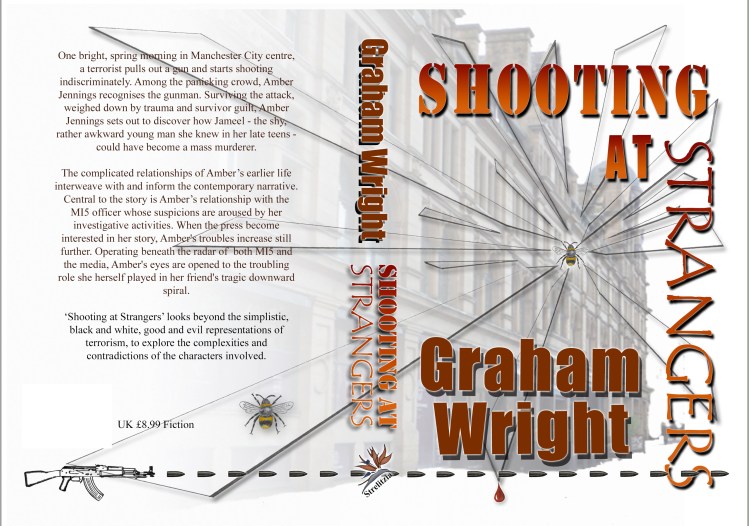
Book available HERE! With thanks to Graham who offered me the chance to read a draft manuscript prior to publication. He says ‘I hope you like the cover design.’ Yes, I do like it.

📚 Gretchen Bernet-Ward

Author Bio: GRAHAM WRIGHT
Website: LiteraryLad

Graham Wright is an author of two previous fiction novels and writes under the general description of literary fiction. His writing is about people and ideas. His aim is to write in a style that is relatively easy to understand, but at the same time creative, imaginative and engaging – literary but not pretentious. Graham works hard to create plots that will leave readers wanting to know what will happen next, but he’s particularly interested in communicating what his characters are thinking and how they’re feeling, in communicating their emotions and the motivation for their actions, rather than simply describing a series of events.

Graham Wright’s first novel, Single Point Perspective, is set in and around the city of Manchester, where he lived and worked for more than fifteen years. His second novel, Moojara, is set in and around the world, but mostly centres on Perth, Western Australia. Both are works of dramatic literary fiction – imaginative, serious and thoughtful, but with a sense of humour. Graham is currently living in north Shropshire UK, where he’s busy working on a fourth novel.

Product details for readers who like stats:
‘Shooting at Stranger’ author Graham Wright
ASIN ‏ : ‎ B0CZ16QWND
Publisher ‏ : ‎ Strelitzia (24 March, 2024)
Publication date ‏ : ‎ 24 March, 2024
Language ‏ : ‎ English
File size ‏ : ‎ 3567 KB
Text-to-Speech ‏ : ‎ Enabled
Screen Reader ‏ : ‎ Supported
Enhanced typesetting ‏ : ‎ Enabled
X-Ray ‏ : ‎ Not Enabled
Word Wise ‏ : ‎ Enabled
Sticky notes ‏ : ‎ On Kindle Scribe
Print length ‏ : ‎ 345 pages

The Strength of Nine Words

This Stephen Benét quote struck a cord with me and I wish it would reverberate around the world to governments, politicians, leaders, teachers, legal and law enforcers, armed forces, researchers in medicine and electronics, mass media, writers, local companies, every citizen, parents and caregivers. Just because we can wield great power, building and destroying in equal measure, from bombing cities to decimating rainforests, I believe we should stop and cultivate the wisdom of Consequence. Bigger, stronger is rarely better. Be wise enough to know it can be done but is it necessary for a healthy future? Wisdom to think, assess, and speak clearly. Wisdom to be unafraid to give your opinion, which unfortunately is denied in many countries. Less power, more universal wisdom to make things better not worse. GBW.

❤ Gretchen Bernet-Ward 2024

Review ‘Gunflower’ Laura Jean McKay

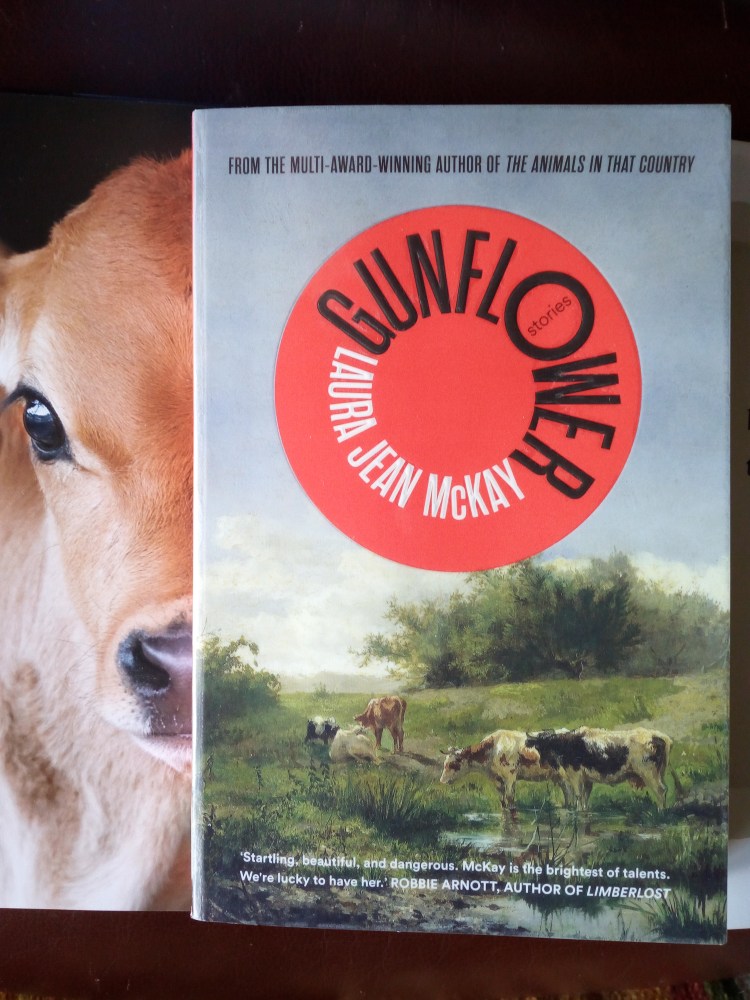
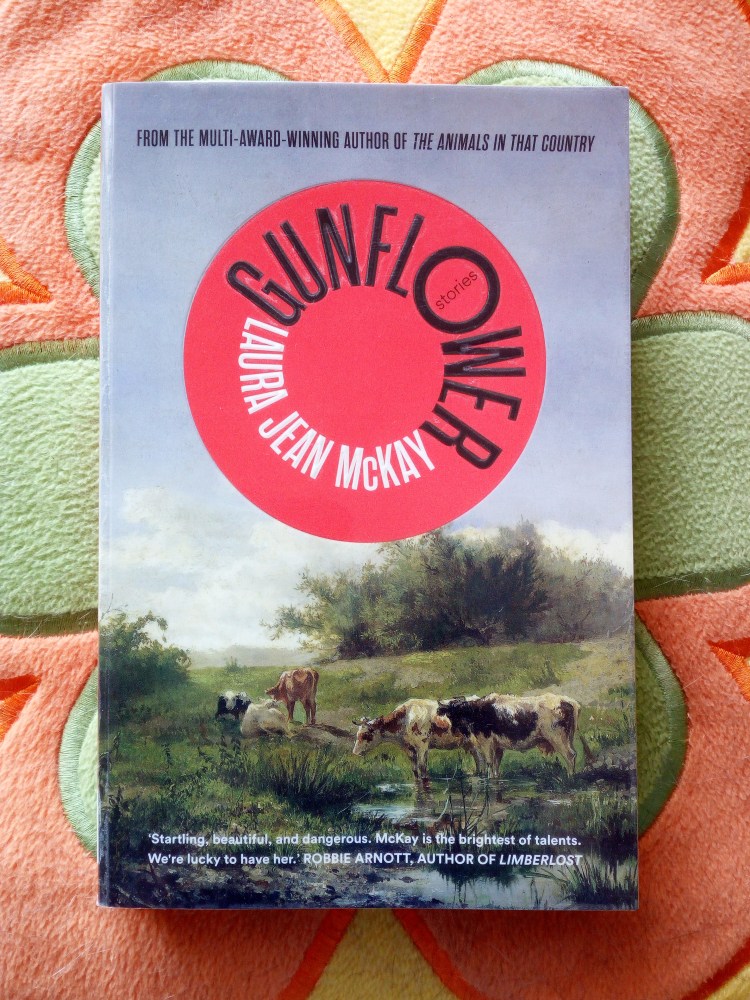
Image styling © Gretchen Bernet-Ward 2024

Award-winning author Laura Jean McKay writes on another level of unusual. Clever, jolting and altogether quite unique.

A certain maturity is needed to feel the strength and hypnotic power of the ‘Gunflower’ short stories. It’s not what’s written which holds the key. It’s the unsettling subtext and intertextuality which means there is more here than meets the reader’s eye.

These short stories transcend the written words so that my own reminiscences began to colour the pages. I squirmed, I laughed, I cried and most of all I realised where the author was coming from with each character or creature, for better or worse.

Grouped under three headings Birth / Life / Death, don’t let the idyllic pastoral bookcover fool you. Written with a keen eye, read ‘Last Days of Summer’ or ‘What We Do’ and try not to shiver with guilt. Some tales are one page length, memorably short and punchy. Perhaps the longest story is ‘Gunflower’ a powerful premise on abortion.

https://scribepublications.com.au/books-authors/books/gunflower-9781922585943

There is loss as well as survivor moments. As I read I remembered a person I knew just like one of the deli characters Joni in ‘Smoko’ but then grasped that I didn’t know the real person at all until the character showed me their inner tenacity. As did all the women in these stories; Felicity and Barb are particularly liberated in ‘Ranging’ 😉

This book may not appeal to the mass market and I bet readers will have different opinions on what ‘Site’ is all about. First Fleet? Booklovers often have a conservative bent when it comes to the patriarchy and also communicating with pets and animals. We tend to shy away like skittish horses at difficult chapters, but I think the subjects earned their hard-won place.

Brace yourself, this is a wild ride and McKay’s novel ‘The Animals In That Country’ seems restrained in comparison. I do wonder if short story collections are the ones which never flourish into fully fledged books. But, hey, these are thought-provoking gems and many Australian authors never get this far.

Keep it different, Laura, keep shaking it up.

Gretchen Bernet-Ward

Laura Jean McKay is the author of Gunflower, and The Animals in That Country (Scribe) was winner of the prestigious Arthur C. Clarke Award, The Victorian Prize for Literature, the ABIA Small Publishers Adult Book of the Year and co-winner of the Aurealis Award for Best Science Fiction Novel 2021. The Animals in That Country has been shortlisted for The Kitschies, The Stella Prize, The Readings Prize and the ASL Gold Medal and longlisted for the Miles Franklin Award.

Adult Content. Australian native animals not include with book © Gretchen Bernet-Ward 2021 | https://scribepublications.com.au/books-authors/books/the-animals-in-that-country-9781925849530

I Hate Poetry or Poetry Hates Me

Poetry is insidious
Subtle words weaving
Verse so perfidious
Cunning and teasing

It twines like string
Snagging each thought
And every cruel thing
twisted and wrought

Sad tales retold
Children cry animals die
Love lost to the bold
And partners who lie

Past battles fought
A punishing word said
Harsh lessons taught
Buzzing in my head

Nightmares surface in bed
He loves me not
He chose her instead
Let them both rot

Poetry churns sentiment
I’d rather forget
So I prefer contentment
Over bitter regret

Kudos to all composers
And each poetry writer
Life ain’t sweet roses
But it will get brighter

Poem © Gretchen Bernet-Ward 2023

Visit palpable poetry
The Lighthouse poems by Tom Alexander

 Gretchen Bernet-Ward

‘The Sun Walks Down’ by Fiona McFarlane

Absolutely love this book! Although I am not a clever reader of literary fiction, Fiona McFarlane got me hooked. It is sometimes a demanding read but so alive and full of richly portrayed characters.

Of course, the South Australian landscape is the main protagonist, tortured and decimated as it is, ruined by European settlers who did not see beauty or learn bush secrets nor had the ability to properly sustain the land; they just saw desert to be conquered. And they did it badly.

September 1883, in the South Australian outback, young Denny is lost in a dust storm but author McFarlane’s tale spins off into other areas as well; the climate, people showing strength and fear, love, intimacy, unthinking cruelty, making good and bad decisions, and those who trek back and forth across the bone-dry landscape on enduring camels. Colonial Australia was raw and rough; every human emotion is detailed here, channelled into finding a lost boy, coercing the reader into moods of discomfort, dreamlike imaginings, and showing the struggles needed to sustain a viable future.

Although I dislike the non-indigenous trees on the bookcover, I could write copious notes on each character in this story. McFarlane brings to mind earlier Australian authors, superlative Patrick White and inimitable Thea Astley. Here, McFarlane’s character of Mrs Joanna Axam reminds me of my great-aunt, a strong and opinionated woman with natural cunning subdued for polite society and an unerring ability to read people’s personalities, often using it against them.

GBW 2023

Joanna Axam has a whippet named Bolingbroke which shows her sense of humour. Henry, her deceased husband, left behind a biblical garden, not because he was devout but because he liked the idea. Joanna knows it’s thirsty, a waste of water, but cannot let it die even though their land is barren due to cattle over-farming. I found her chapters quite riveting and she is obsessed with the possum cloak worn by Jimmy, one of Sergeant Foster’s trackers. What a schemer! Did she want it taken from the rightful owner to cover her own disfigurement? Did she understand mob and Country significance of a possum cloak?

Although young frightened Denny is the catalyst, over seven long days, there are many people good, bad and indifferent, trying to find the youngster by using their own particular skills. Two people spring to mind, Karl and Bess, penniless itinerant artists wandering in the desert in search of creative inspiration. They are woven through Denny’s story for better or worse, you decide.

GBW 2023

I read this book when I was feeling strong otherwise I may have been overwhelmed by emotion at what Fiona McFarlane has created. As indicated by my first name, I am a descendant of German settlers to South Australia where the story is set. My great-great grandfather was a Lutheran pastor who documented the sad decline of Indigenous populations, caring for them as best he could. His records are in University archives and that’s all I know.

Just like life ‘The Sun Walks Down’ has turmoil then a resolution of sorts.

Set aside a chunk of quiet time to read it.

 Gretchen Bernet-Ward

My Goodreads reviews—
https://www.goodreads.com/gretchenbernetward