‘The Detective Up Late’ By Adrian McKinty – Sean Duffy Series
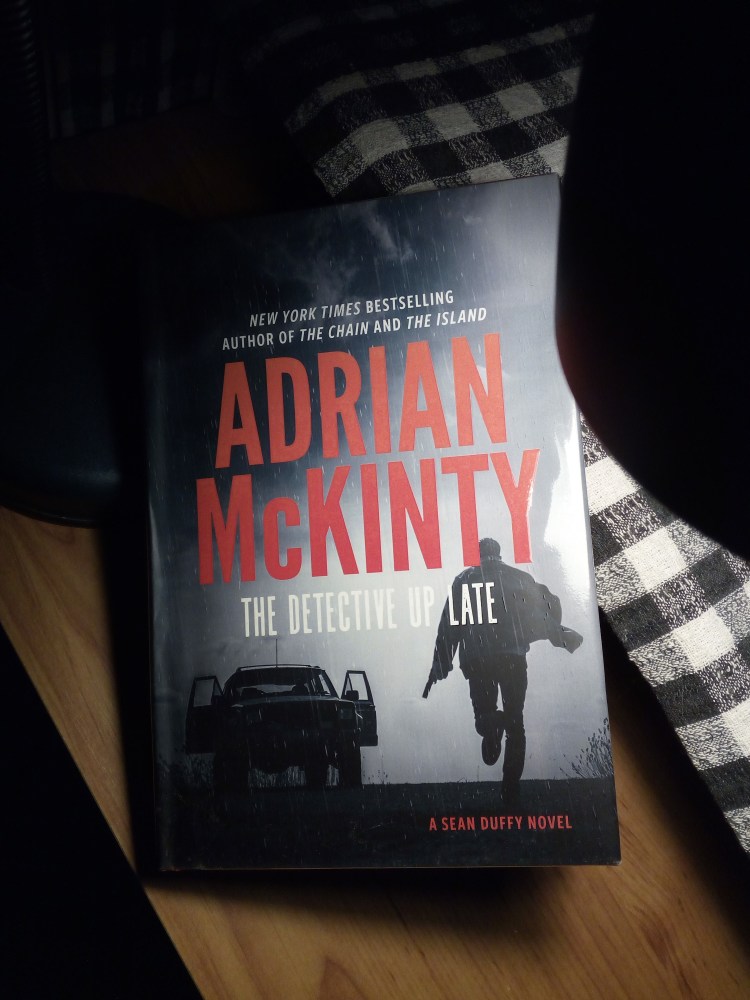
‘The Detective Up Late’ by Adrian McKinty (Book 7 Sean Duffy series 2023)

What a guy, what a book! I am talking about the author as well as the character. Straight to hardcover edition. I have read all Adrian McKinty’s novels but none so brilliant, clever, absorbing and addictive as Detective Inspector Sean Duffy of Belfast, Northern Ireland. Somehow Sean Duffy of Carrickfergus RUC is grounded, he tries to keep his humanity intact and his reality in focus but the halo frequently slips. I read the books in order (hanging out for each new publication) and got a strong sense of personality and practice, of common law and uncommon citizens, e.g. rioting and retaliation, cons, crooks and criminal matters that police deal with on a daily basis. Often a bit of Duffy tongue-in-cheekiness is thrown into the mix “Radio 2 was playing ‘Ebony and Ivory’ over in the Incident Room. I sat up and paid attention. I liked to hate that song” thinks Duffy.

What’s this story about? Well, McKinty’s book titles refer to songs. This title is derived from a Tom Waits song “Bad as Me” and fits well among the irony and dark observations. DI Duffy comes back from an Israel holiday to workplace boredom (nobody wants his bottles of holy water) until a missing Traveller girl Katrina McAtamney tweaks interest. Is she dead or alive? Like real life, Duffy’s work colleague Detective Sergeant “Crabbie” McCrabban is easing himself towards retirement and Detective Sergeant Alexander Lawson is settling in. I got the feeling Lawson’s the token “woman” cop in the story even though WPC Warren is seconded? Characters are diverse and leads are chased; suspects interviewed and statements are fully dissected. A big piece of evidence is discovered. Plenty of lead-chasing work back-and-forth from the cop shop but nothing brings the teenage girl’s whereabouts any nearer or clues any clearer.

During the 1980s I watched Irish TV news bulletins covering The Troubles but was removed from the IRA Belfast horrors. All I remember is the nightly updates “more bombings”. Now, thanks to McKinty and Duffy, a literary picture has been painted and it’s thought-provoking. Yeah, time moves on, now 1990, but Duffy still checks under his car for tilt bombs. Beware, Sean Duffy is not a squeaky clean cop. Although he now has a more “normal” homelife with Beth and little Emma, involving ferry crossings back and forth, he still gets righteously angry. This is tempered by his deep knowledge of music and literature and his strong sense of justice, even as he tweaks the rules and infers dire consequences on hapless suspects. Probably couldn’t get away with it now. And be prepared for swearing at appropriate times, although surprisingly none when they got lost in Coventry’s one-way street system enroute to an interview.

Author Adrian McKinty’s literary identifier, e.g. intertextuality and breaking the fourth wall, does not detract from this compelling story. They drew me through the story. See Chapter 18 “The Fourth Floor” for an excellent example. Apart from Sean’s unsubtle quotations, look for what I think are appropriate genre nods. A nice balance exists between high action, soft moments, cops-and-criminals, scenery and settings, using quick screenplay-scripted dialogue which at times can be philosophical or a tad predictable like the syrupy ending. You may never see me write it again but Sean Duffy could make a great character in a prime time Éire/UK television series. This is reflected in varying locations and grim humour. A strong actor could follow the threads, face the slog of interviewing, the hope of a confession, the tension of a life-and-death encounter.

You know how some crime books just click, you are absorbed into the story? Well, that’s what I find when I read Adrian McKinty’s work. Overall, the clues are there to identify the killer. Enjoy reading this investigative tale for yourself—and take a guess if it will really be the final book.

Gretchen Bernet-Ward

Sean Duffy
   1. The Cold, Cold Ground (2012)
   2. I Hear the Sirens in the Street (2013)
   3. In the Morning I’ll be Gone (2014)
   4. Gun Street Girl (2015)
   5. Rain Dogs (2015)
   6. Police at the Station And They Don’t Look Friendly (2017)
   7. The Detective Up Late (2023)

Adrian McKinty—Author
Adrian McKinty was born and grew up in Carrickfergus, Northern Ireland. After studying philosophy at Oxford University he emigrated to New York City where he lived in Harlem for six years working in bars, bookstores, building sites and finally the basement stacks of the Columbia University Medical School Library in Washington Heights. In 2000 he moved to Denver, Colorado where he taught high school English and started writing fiction in earnest. In 2008 he moved to St. Kilda, Melbourne Australia with his wife and two children. In 2023 he is currently residing in New York City with his family. He has written numerous other books and won numerous literary awards.
Visit his official website for more details:
https://officialadrianmckinty.com/

‘The Tide Rises, the Tide Falls’ Longfellow

Tidal flats of Wynnum Manly foreshore Moreton Bay, Queensland © Dot Bernet 2021

The Tide Rises, the Tide Falls

By Henry Wadsworth Longfellow

The tide rises, the tide falls,

The twilight darkens, the curlew calls;

Along the sea-sands damp and brown

The traveller hastens toward the town,

      And the tide rises, the tide falls.

Darkness settles on roofs and walls,

But the sea, the sea in the darkness calls;

The little waves, with their soft, white hands,

Efface the footprints in the sands,

      And the tide rises, the tide falls.

The morning breaks; the steeds in their stalls

Stamp and neigh, as the hostler calls;

The day returns, but nevermore

Returns the traveller to the shore,

      And the tide rises, the tide falls.

* * * * *

Henry Wadsworth Longfellow, American poet (1807-1882)

https://www.poetryfoundation.org/poems/44651/the-tide-rises-the-tide-falls

Gretchen Bernet-Ward

Twilight falls on Wynnum Manly foreshore Moreton Bay, Queensland © Dot Bernet 2021

Take A Detour…

IMG_20201118_123239
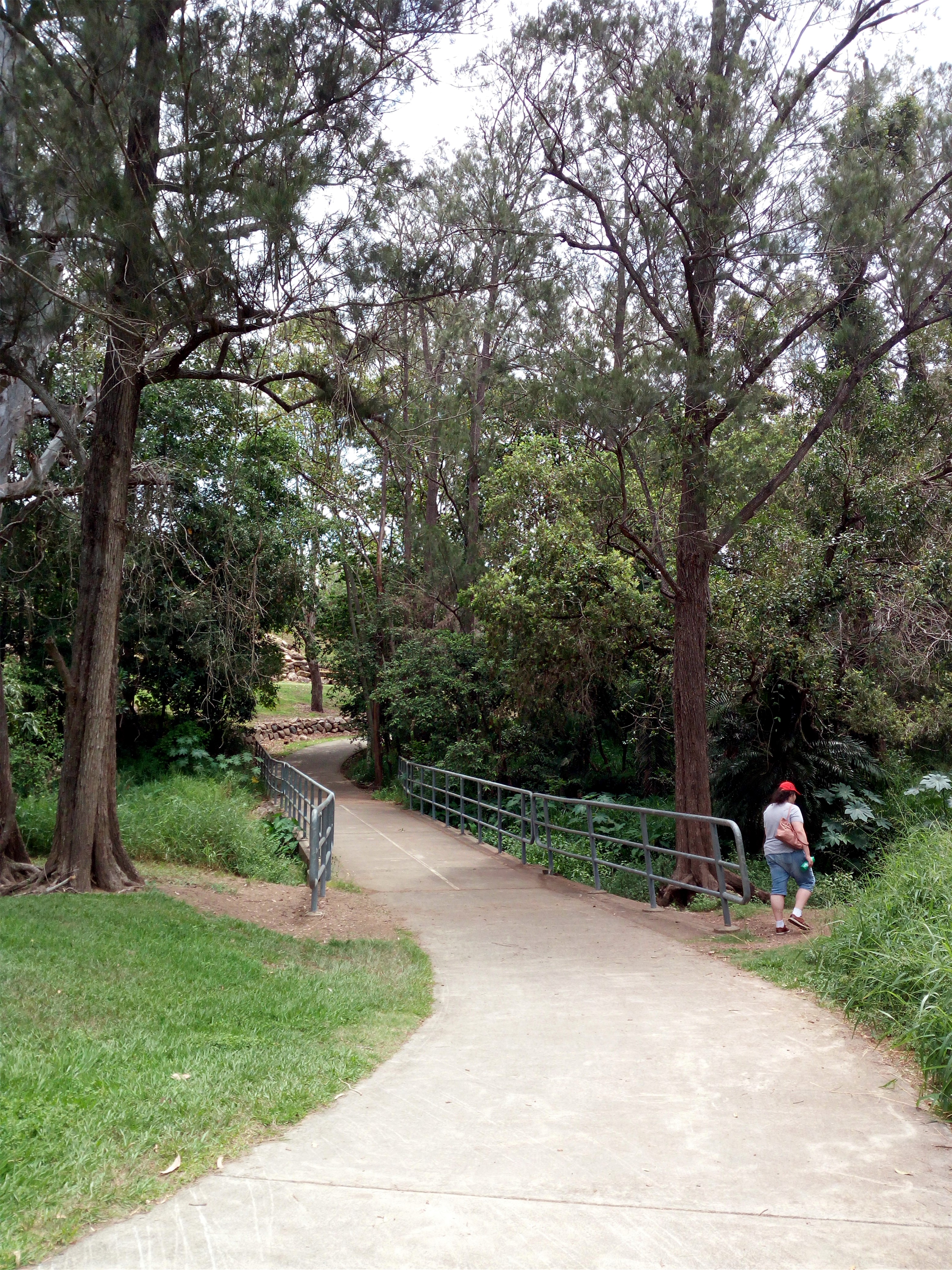
Take a detour © Gretchen Bernet-Ward 2021

“The Road Not Taken” is a narrative poem by Robert Frost, published in 1916 as the first poem in the collection Mountain Interval.

The Road Not Taken

Two roads diverged in a yellow wood,
And sorry I could not travel both
And be one traveller, long I stood
And looked down one as far as I could
To where it bent in the undergrowth;

Then took the other, just as fair,
And having perhaps the better claim,
Because it was grassy and wanted wear;
Though as for that the passing there
Had worn them really about the same,

And both that morning equally lay
In leaves, no step had trodden black.
Oh, I kept the first for another day!
Yet knowing how way leads on to way,
I doubted if I should ever come back.

I shall be telling this with a sigh
Somewhere ages and ages hence:
Two roads diverged in a wood, and—
I took the one less travelled by,
And that has made all the difference.

By American poet Robert Lee Frost (March 1874 – January 1963)

Condamine River Sheep Shearers on the Track

Condamine River sheep shearers on the Track 1800s Queensland Australia

Coach Departing Now, Folks

IMG_20190729_162917
Made in England – china dessert bowl – date and manufacturer unknown.

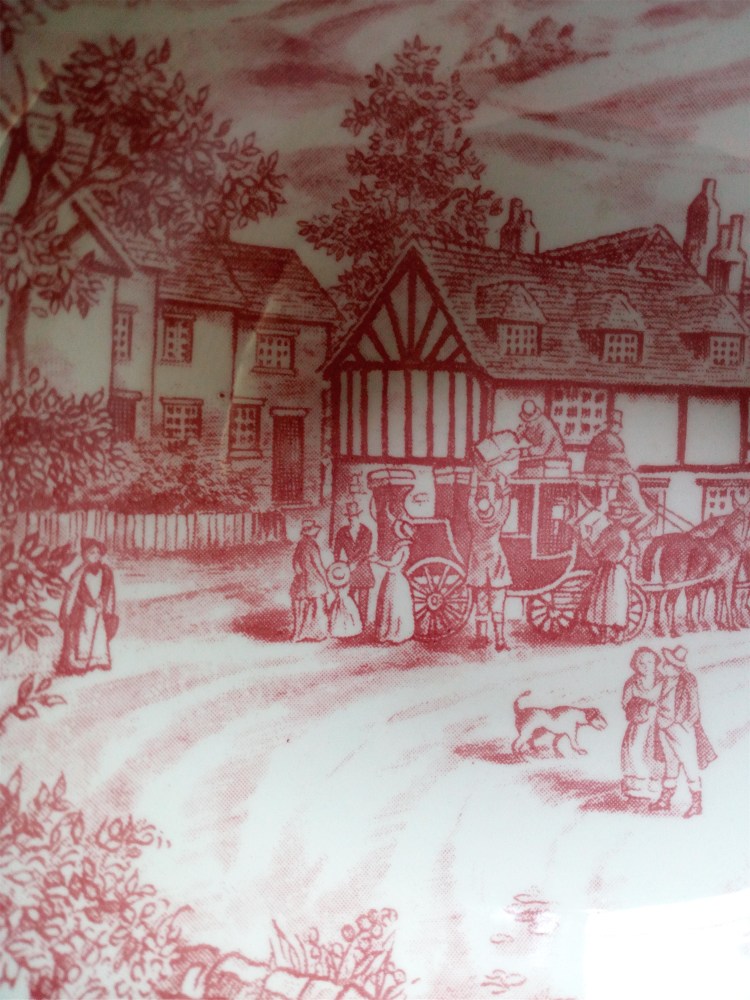
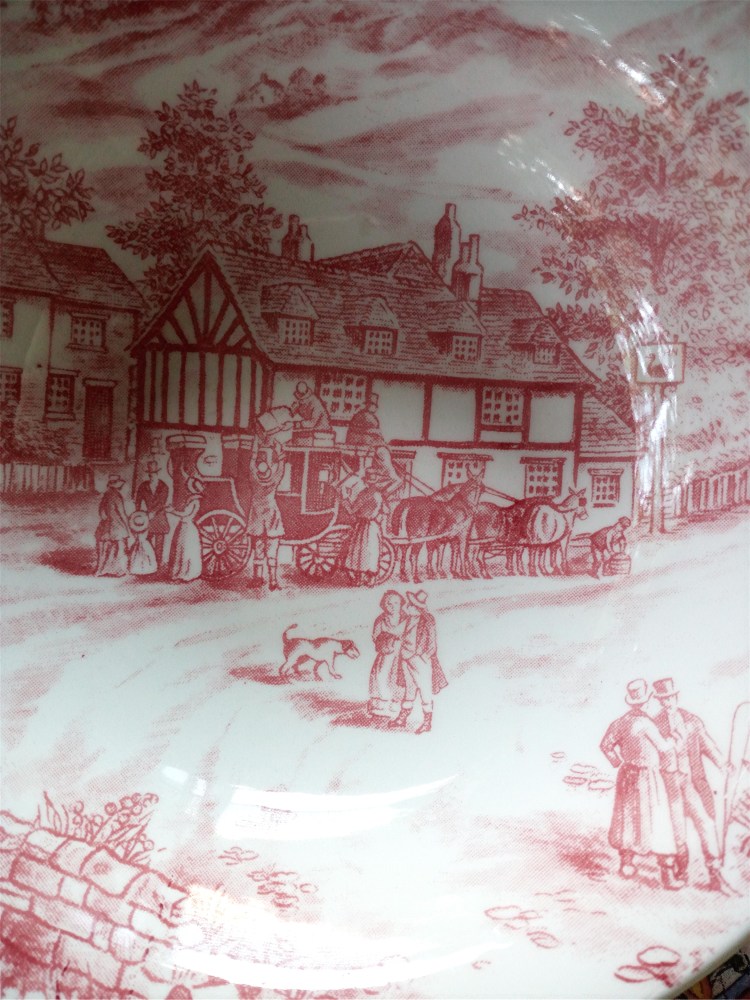
A rather dramatic story is unfolding in my breakfast bowl.

Cereals and desserts have been eaten from this bowl for over thirty years and yet I have never properly looked at the picture on it.

A few days ago I had a shock when I scooped up the last spoonful of my Weet-Bix (similar to the UK Weetabix, both invented by Bennison Osborne, an Australian) and saw there was a castle on the hill.  I kid you not, I had never seen that castle before!

Allow me to acquaint you with some backstory.  Originally there was a set of six china bowls (15 centimetres or 6 inches across) and originally my parents owned them.  Unfortunately porridge, domestic accidents, and heating leftovers in the microwave have whittled them down.  Of the surviving two, one has a nasty looking fault line appearing.  Therefore, the bowl I have photographed may be the end of the ceramic line.  Or the end of the beginning of a coach trip.

So far, so boring—but wait.  Although this bowl is old, I have to be honest and say it is not an antique.  In fact the picture may have been embossed on like a transfer and glazed over.  Never mind, I’m getting to the point, well, ten points actually—

  First there is the brooding castle on the hill; quite a substantial pile.  A name doesn’t immediately spring to mind but I’m working on it.

  Nestled halfway down the hill is a gamekeeper or crofter’s cottage.

  In the valley at the base of the hill is a small village.  An unaccompanied lady is standing on the side of the unpaved road which runs past the Duck Inn.  She isn’t over-dressed and uses a walking cane.  Her gaze is towards the two gentlemen opposite, chatting beside the milestone.  Perhaps this marker reads “London 100 miles” but I can’t decipher it.

  One of the toffs (lord of the manor) is holding a buggy whip.  He would not have ridden a horse down from the castle in a top hat.  He could be the lady’s son and heir up to no-good, he spends too much time in the tavern.  Or she may be his old faithful nanny, instructed to keep an eye on him.  Or yet again, she could be the wife of the man canoodling in the middle of the road.

  We see two lovers canoodling in the middle of the road.  The man is keener than the woman, and a dog is either giving them a wide berth or coming around behind the man to nip him on the ankle.

  Unbeknown to the busily occupied people, a cat slinks into the rear footwell of the coach.  Earlier he had been shooed away but being a feline named Nosey…

  Outside the Duck Inn (a duck is painted on the sign) the coach boy is making final preparations for the horses’ feedbags.  He loves them ‘orses.

  The coach driver is ready and waiting.  He’s heard rumours that Dick Turpin is lurking in the vicinity (if I’m in the right century) and wants to get going well before nightfall.  The innkeeper loaned him a pistol and it digs into the small of his back.

  Seven people are milling about.  At least four are passengers judging by the loading of a trunk on the roof, a well-wrapped parcel in somebody’s hands, and a family group perhaps saying goodbye.  The husband could be off to London on business and the daughters are sad but the wife is glad he’s out of her hair for a few days.

  Lastly, a curtain twitches at one of the attic windows of the Duck Inn.

There are leafy details in the background and in the foreground the stone wall appears to be crumbling.  I have looked for birds but only managed to spy a tiny number 9 in the garden beneath the Duck Inn sign.  A maker’s mark?

And that’s it.  There are no hallmarks or stamps on base of the bowl except the words “Made in England”.  I have no idea if the picture is fake-aged or has been copied from an earlier (original) tableware design.

One thing is for sure, it has given me a good idea for an historical short story.  Visual prompts are another way to overcome writer’s slump.  Look hard at any image and you will find a story to tell.

Check your kitchen cupboards, your own crockery may have a narrative in the making!

Gretchen Bernet-Ward