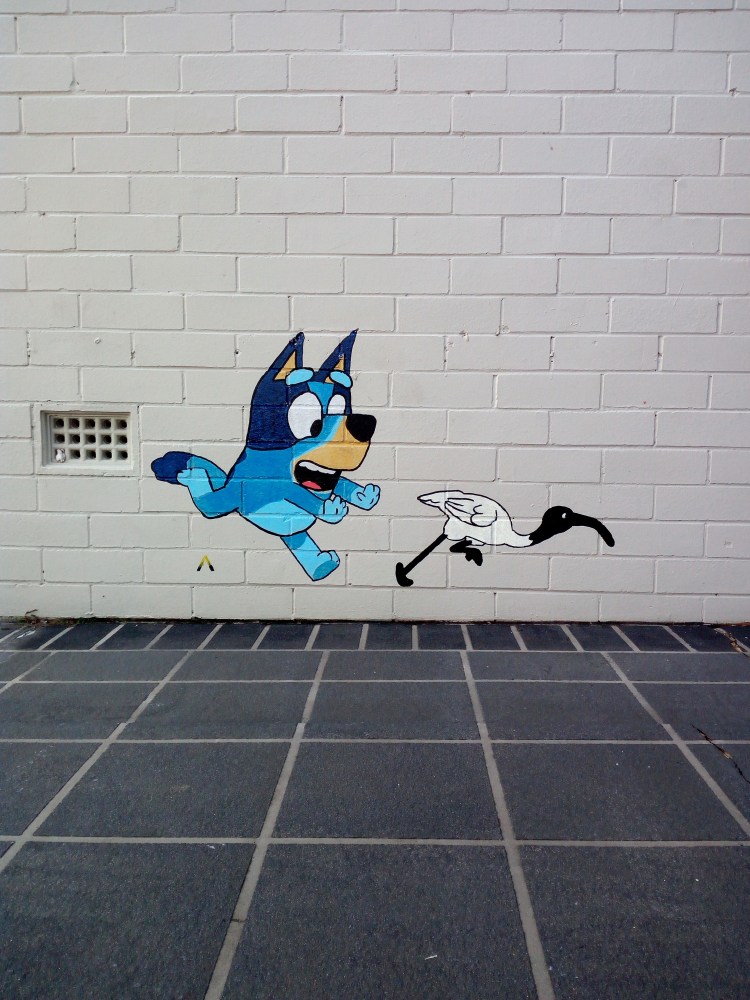
Is our cartoon star Bluey from Brisbane (seen here in the suburb of Sherwood) living up to the Blue Heeler herding tag, or did the Ibis shout “Chasey! Bet I can beat you!” My money is on the Ibis because, unlike an Emu, the Ibis can fly.
The Australian White Ibis was once known as the Sacred Ibis but is sadly now often referred to as a “bin chicken, tip turkey or dumpster diver”. They tend to be opportunistic scavengers and can often be spotted at rubbish tips and in city parks. However, they are harmless to humans.
But first some facts on Bluey:
Info https://www.bluey.tv/
Bluey is an Australian animated television series for school children which premiered on ABC Kids. The cartoon program was created by Joe Brumm and is produced by Queensland-based company Ludo Studio. The stories follow Bluey, an anthropomorphic six-year-old (later seven-year-old) Blue Heeler puppy who is characterised by her abundance of energy, imagination and curiosity about the world. The young dog lives with her father, Bandit, mother, Chilli, and her younger sister Bingo who regularly joins Bluey on adventures through imaginative play. Other characters featured each represent a different dog breed. Overarching themes include focus on family, growing up and Australian culture. Ostensibly for children, the program is watched by all age groups. Bluey was created and produced in Queensland and the capital city Brisbane inspires the show’s settings.
The Australian Museum website has White Ibis details but here’s some further reading—
The Australian white ibis (Threskiornis molucca) is a wading bird of the ibis family, Threskiornithidae. It is widespread across much of Australia. It has a predominantly white plumage with a bare, black head, long downcurved bill, and black legs. While it is closely related to the African sacred ibis, the Australian white ibis is a native Australian bird. Contrary to urban myth, it is not a feral species introduced to Australia by people, and it does not come from Egypt.
Historically rare in urban areas, populations have disappeared from natural breeding areas such as the Macquarie Marshes in northern New South Wales and urban populations in Sydney. However, the Australian white ibis has established in urban areas of the east coast in increasing numbers since the late 1970s; it is now commonly seen in and around Wollongong, Sydney, Melbourne, Adelaide, Darwin, the Gold Coast, Brisbane and Townsville. In recent years, the bird has also become increasingly common in Perth, Western Australia and surrounding towns. As yet it has not been sighted in Tasmania.

Aussies love a good nickname and, as mentioned, due to the Ibis increasing presence in the urban environment and its habit of rummaging in garbage, this protected species has acquired a variety of colloquial names such as “bin chicken”. In recent years these birds have become an icon of Australia’s popular culture, regarded with glee by some and passionate dislike by others. I don’t hinder their Ibis lunch in the park and they (so far) don’t disrupt mine.
❤ Gretchen Bernet-Ward 2024
 Thoughts Become Words