“What if young women around the world were encouraged to be more, rather than less? What if the focus shifted from how we appear, to the possibilities of what we can do?”
Quote from Jade Hameister – world record-breaking polar skier.
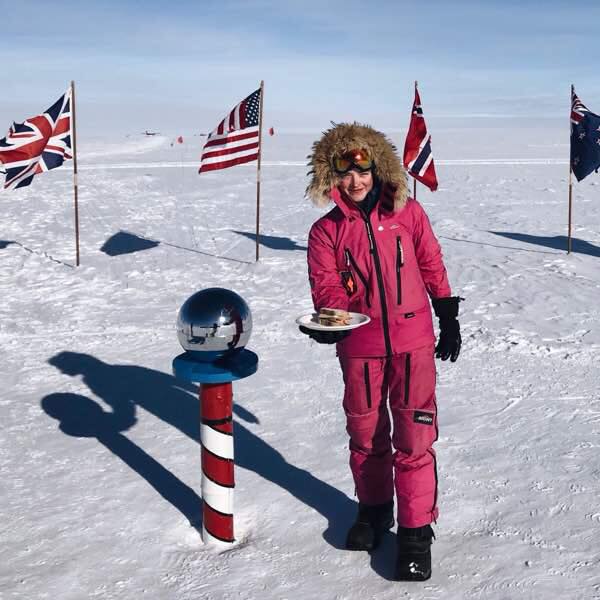
When told to “make me a sandwich” by a number of male internet trolls in response to her TED talk, Hameister made one, posted a picture of herself with the sandwich at the South Pole and captioned the photo:
“I made you a sandwich (ham & cheese), now ski 37 days and 600 kilometres to the South Pole and you can eat it.”
Jade Hameister OAM (born 5 June 2001) is an Australian woman who, age 16, became the youngest person in history to pull off the “polar hat-trick”, ski to the North and South Poles, and cross the second largest polar icecap on the planet: Greenland. Wikipedia.
Multi-talented storyteller, author and freelancer Chris Hall of luna’s on line says “Basically, I love writing in all its forms. I tell stories – short fiction pieces, even poetry – maybe from a writing prompt or a piece of artwork I’ve seen, or maybe something topical which I’ve read. For the past few months I’ve been writing serials on my blog e.g. Sinead’s Final Quest and Alys and Sparky.”
I wasn’t ready for this book. I wanted to enjoy it as much as I enjoyed Catherine Jinks other books but it didn’t work for me right from the start. The setting was vivid but the raw, brutish behaviour and sheer masculinity of the story overwhelmed me. Does that make me a sexist, a bigot, a wimp when it comes to macho bravado? I don’t know. I turned the pages with trepidation, not interest. Maybe the colonial frontier loneliness affected me and I didn’t want to go on.
On my second reading
the story felt less crushing. I concentrated on young English convict Tom Clay, a former poacher transported in chains to Australia, and now a shepherd. I willed him to be okay, to learn and survive intact. His country assignment in New South Wales works well, he didn’t steal from landowner Mr Barrett so he was never flogged and he works hard. Through his eyes, I saw the strangeness of a harsh new land, the vast differences, and the cruel pitiless men he is forced to live and work with guarding sheep against theft and wild dogs.
Tom has a jaundiced eye
when it comes to things like Australian native wildlife and his comment on first seeing kangaroos is less than flattering. I was disappointed with the header on the bookcover which reads “The wolf is not the only hunter”. There are no wolves in Australia, there are dingoes (wild dogs) and that should have been apparent.
and Tom’s fight for life against his arch nemesis Dan Carver is harsher still. These chapters are tightly written. The knock down drag ‘em out battles are horrific, the ghastly metal trap, the shootings, the human and animal deaths… but Tom dearly loves his sheep dogs.
I am not a fan
of an undefined location nor overused nonlinear narrative. Tom’s past comes out in this way. Flashback to eight year old Tom at his mother’s funeral, his former life almost as bad as his current one. He learns “No matter what a convict’s situation might be, he’ll never persuade a trooper that he’s telling the truth.” Flashback to when Tom first met convict Rowdy Cavanagh, a con man who joked, laughed and teased his way to success until he was caught “A single misstep and it ruined me life.”
The age rating
for this tense, chilling, thrilling story eludes me, but it is a tale I did not fully enjoy. I do respect it wholeheartedly for the screenplay fear and fascination it instilled in me regarding the rough and thoroughly inhumane life early convicts were forced to endure.
A sequel?
Tom’s situation could lead to listening and learning from the Indigenous custodians of this ancient land, and perhaps encourage a new phase in his life.
Catherine Jinks(Australia b.1963) is a four-time winner of the Children’s Book Council of Australia Book of the Year award, and has also won a Victorian Premier’s Literature Award, the Adelaide Festival Award for Literature, the Ena Noel Award for Children’s Literature and an Aurealis Award for Science Fiction. In 2001 she was presented with a Centenary Medal for her contribution to Australian Children’s Literature.
Catherine Jinks, author of over thirty books for children and adults, including the award-winning Pagan Chronicles series, was born in Brisbane and grew up in Sydney where she studied medieval history at the University of Sydney.

She became a writer because she loves reading, as well as history, films and television. Catherine gets ideas for her novels from everywhere, particularly good science fiction films. She lives in the Blue Mountains NSW with her Canadian husband and daughter Hannah.
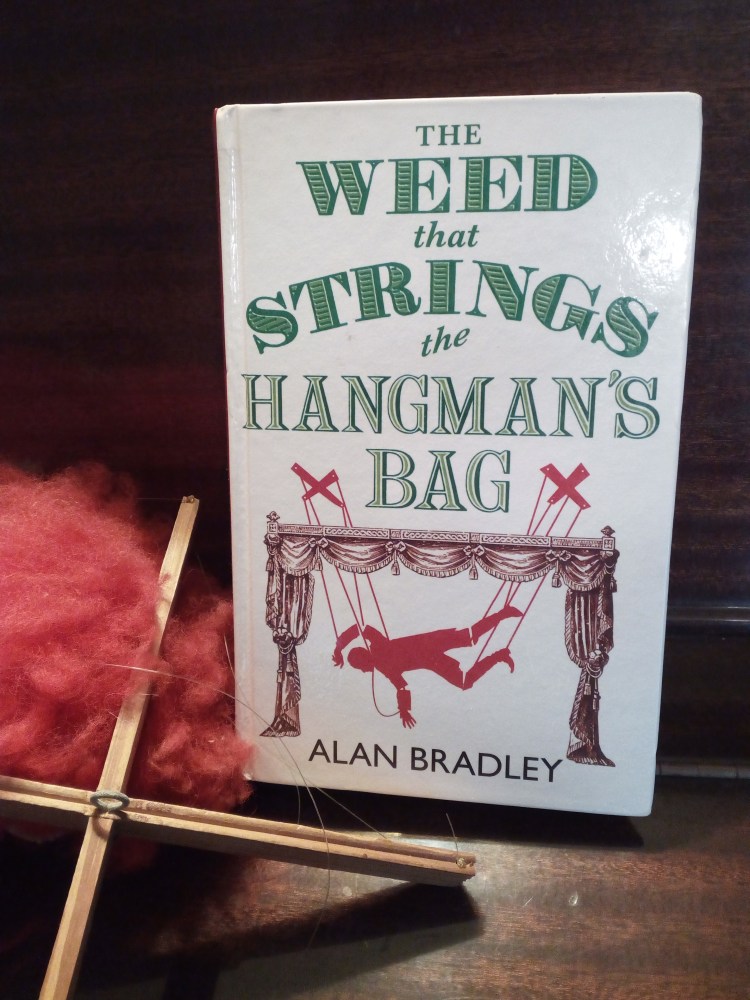
This Alan Bradley story is deserving of 10 stars. The irony, the wit and the revealing portrayal of 1950s English village life, is both hilarious and horrible. Events are seen through the eyes of young Flavia de Luce, an implausibly precocious 11 year old girl who lives with her family in genteel decline.
Young Flavia’s encounters turn into forensic investigations and she has an inherent love of chemistry, brewing dangerous concoctions in her late grandfather’s lab.
The village of Bishop’s Lacey appears to be close-knit, yet even gossipy Mrs Mullet didn’t seem to know who or what killed young Robin Ingleby at Gibbet Hill. The story really kicks off when well-known BBC puppeteer and bully Rupert Porson gives his last performance. The scene-setting is brilliantly done and I felt immersed in the story from the beginning right through to the end.
Perhaps not a book for younger readers because they may get tired of the mid-20th century writing style. Mature readers who like a quirky character will enjoy this tale. I have never encountered the likes of Flavia de Luce, a strange mixture of Wednesday Addams and Bones.
But she certainly knows how to snoop or turn on the charm when necessary.
Generally the main players are conventional but it’s what I expected, having been raised on a diet of British books, magazines and television series. Their dialogue and the descriptions of village society in post-war Britain were familiar to me – at least fictionally – and it’s clever how the tension and Flavia’s ‘fluctuations’ from girl to grown-up and back again is established.
Question: Apart from the shock value, what is the significance of Jack’s puppet face? And I don’t mean who it represents.
‘The Weed that Strings the Hangman’s Bag’ is book 2 in the current 10 book Flavia de Luce mystery series, and takes its title from Sir Walter Raleigh. With my thanks to Goodreads friend and writer Chris Hall for recommending this delightfully different book.
♥Gretchen Bernet-Ward
Author profile
Alan Bradley is a mystery writer known for his Flavia de Luce series featuring this pre-teen sleuth with a passion for chemistry. The series began with the acclaimed ‘The Sweetness at the Bottom of the Pie’. See more books in the series at Penguin Random House. Bradley is also a New York Times bestselling author of many short stories, children’s stories, newspaper columns, and the memoir ‘The Shoebox Bible’. More about Alan Bradley
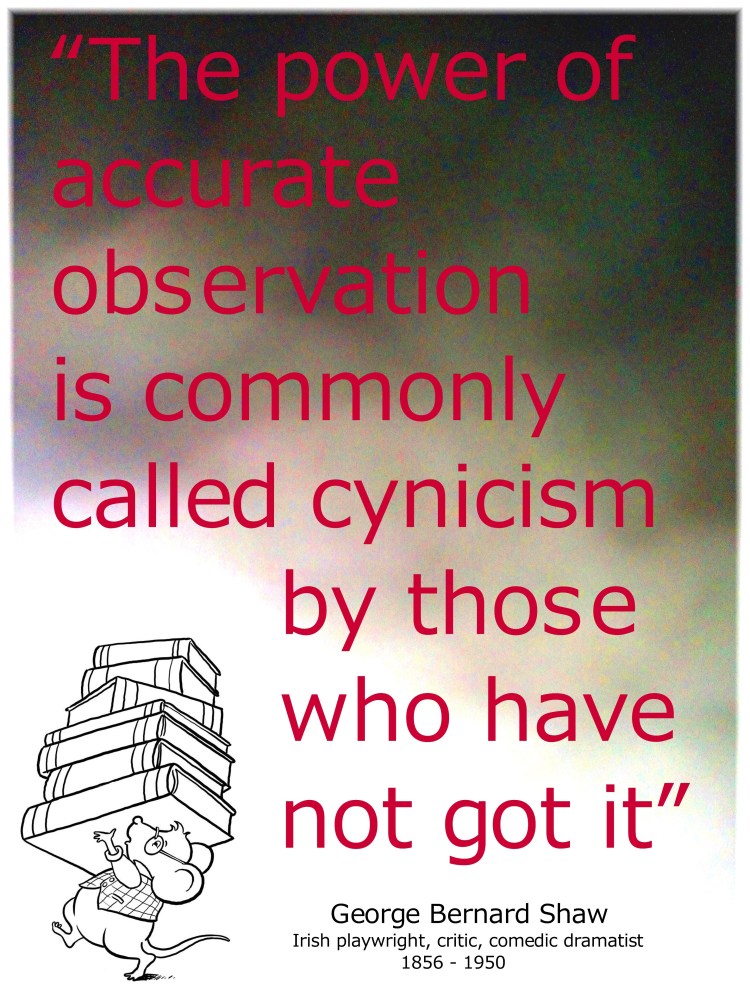
Bernard Shaw (he disliked his first name George) was not a good scholar but developed a wide knowledge of music, art, and literature from his mother’s influence and his visits to the National Gallery of Ireland.
In 1876 Shaw resolved to become a writer and he joined his mother and elder sister, by then living in London. Like most creatives in their 20s, Shaw suffered continuous frustration and poverty. He depended upon his mother’s pound a week from her husband and her earnings as a music teacher.
I love a good rags-to-riches story
Shaw’s early days were spent in the British Museum reading room, writing novels and reading what he had missed at school… eventually he became an internationally known and celebrated playwright, producing more than sixty plays. His work is still performed today, the most well-known from 1912 is ‘Pygmalion’ aka ‘My Fair Lady’, and in 1925 he was awarded the Nobel Prize for Literature.
NOTE: Britannica shows a film clip of Bernard Shaw (in his 70s) speaking on the marvels of Movietone and the novelty of technology; excerpt from a Hearst Metrotone newsreel (c. 1930), (29 sec; 2.6 MB) J. Fred MacDonald & Associates.
Back when the century had ticked over into another millennium, I was given seven canisters of China Tea. These dragon-covered tins languished on a high kitchen shelf, unopened and forgotten in favour of Queensland-grown black tea from the Russell family.
Eventually it was decided that the pantry shelves had to be Covid Cleaned, e.g. needing a serious going-over. Various items were inspected and sorted into good and bad piles but the tea, packed in Hong Kong and imported to Australia, remained in a different category.
The dragon artwork proved a lure and inquisitiveness won.
Although the tin lids were dust coated and faded, it was decided to open all seven of them, brew the contents—in cup and pot—and drink regardless of aroma. Flavour was another matter. To add to the excitement, one tin had lost its label and the large tin was Earl Grey teabags.
‘Hmm, not for me thanks’ I said, but the intrepid Dot B was up for it.
The lid seals had perished but once the canisters were ‘prised’ open, the interiors were pristine clean. I only sniffed the contents and did not taste it, nevertheless considering its age the Jasmine Tea was still beautifully aromatic.
Subjective comments as recorded by Dot B, daredevil tea taster.
Luk On: Drying but pleasant after tones, would drink again.
Oolong: Smooth but common. A nice cuppa.
Earl Grey Tea Bags: Tastes like a boring black tea. Smells funny without lemon.
Shou Mei: Bit of nothing taste-wise but smells nice. Slight metal aftertaste.
Jasmine: PHWOAR smells like FLOWERS and tastes like tangy FLOWERS.
Pu Li: Tastes like hot wee, smells like hot wee. Not recommended.
Mystery Tea: Smells like tanbark and tastes … kind of Green?
Pro tip—don’t eat pickles after tea tasting.
Dot B is a part-time tea critic and full-time dragon lover.
Not so much a circus as a train. Or a circus on a train. Not a speeding train, not the Orient Express, not even a suburban train. This book is a fully loaded interstate train heading inexorably towards a broken bridge over a river. Along the way, passengers are jostled around, some jump out the doors, most get drunk in the dining carriage, several are angry and the rest are bemused.
Inspector John Carlyle is the most bemused of them all
This series has an arresting array of bookcovers
I love a criminal book, you can comment hard!
Somewhere along a distant track I had stopped reading James Craig’s Inspector Carlyle series and this fourth book refreshed my memory. It contains such a high level of macho rubbish, female exploitation and smarmy politics that it is well past the read-by date.
It is astounding that the book doesn’t run off the rails with the ludicrous amount of murders
If Inspector Carlyle didn’t have off-sider Joe Szyszkowski and other sensible police personnel to back him up, he would still be floundering for answers at the end of the ill-fated journey. Maybe he’s on the wrong train? He gets cranky and often causes ‘accidents’ to himself and others due to his own dullness. Yes, he gets bashed up but never thinks his nemesis and ugly thug Trevor Miller knows where he lives – operative words ‘never thinks’. Miller is now the Prime Minister’s security adviser and totally out of control.
When it comes to using high-end brand names, from beer to clothes, watches to furniture and a plethora of cafés, this story takes the cake. Or biscuit if you are Carlyle who pays more attention to topping up his blood sugar levels and imbibing strong coffee than policing. The ending will have you spluttering in your coffee, it is beyond contrived.
Published in 2013, the political issues and phone tapping scandal is old. The dialogue is old, most characters give a neutral “Hm” when asked to respond. There are too many hands placed on arms, too many raised eyebrows; and the plentiful white males POV often switches to an omnipotent narrator.
For me, the best character is the City of London
Without alcohol the stratagem would flounder, trim the sexual abuse and the chapters would be less, without repeat paragraphs like Carlyle whining about the declining standards of UK newspapers this book would be blessedly shorter. And without packing in umpteen suspects from the Prime Minister to residents of greater London, this whole book would not have dragged on and could have been more effective.
“When the body of journalist Duncan Brown is found in the back of a rubbish truck, Inspector John Carlyle is thrown into the middle of a scandal that threatens to expose the corrupt links between the police, the political establishment and the hugely powerful Zenger media group.
Hunting down Brown’s killer, Carlyle finds himself going head-to-head with his nemesis, Trevor Miller. A former police officer turned security adviser to the Prime Minister, Miller has dirty money in his pockets and other people’s blood on his hands. Untouchable until now, he is prepared to kill again to protect his position – having failed once already to dispose of Carlyle he is not prepared to slip up again.”
Pablo Neruda (1904–1973) born Parral, Chile.
Attended Chile University and became a poet, politician, activist, diplomat.
National Prize for Literature Chile (1945)
International Peace Prize (1950)
Lenin Peace Prize (1953)
American Academy of Arts and Letters (Foreign Honorary ∙ Literature ∙ 1968)
Nobel Prize in Literature (1971)
Golden Wreath (1972)
He was perhaps the most important Latin American poet of the 20th century and for a deeper look at his intriguing life I recommend https://www.wikiwand.com/en/Pablo_Neruda
‘AS EVERY CAT OWNER KNOWS, NOBODY OWNS A CAT’ — Ellen Perry Berkeley