Author: ThoughtsBecomeWords
Reader Writer Miscellaneous Blogger

Review ‘The Dreamers’ by Karen Thompson Walker
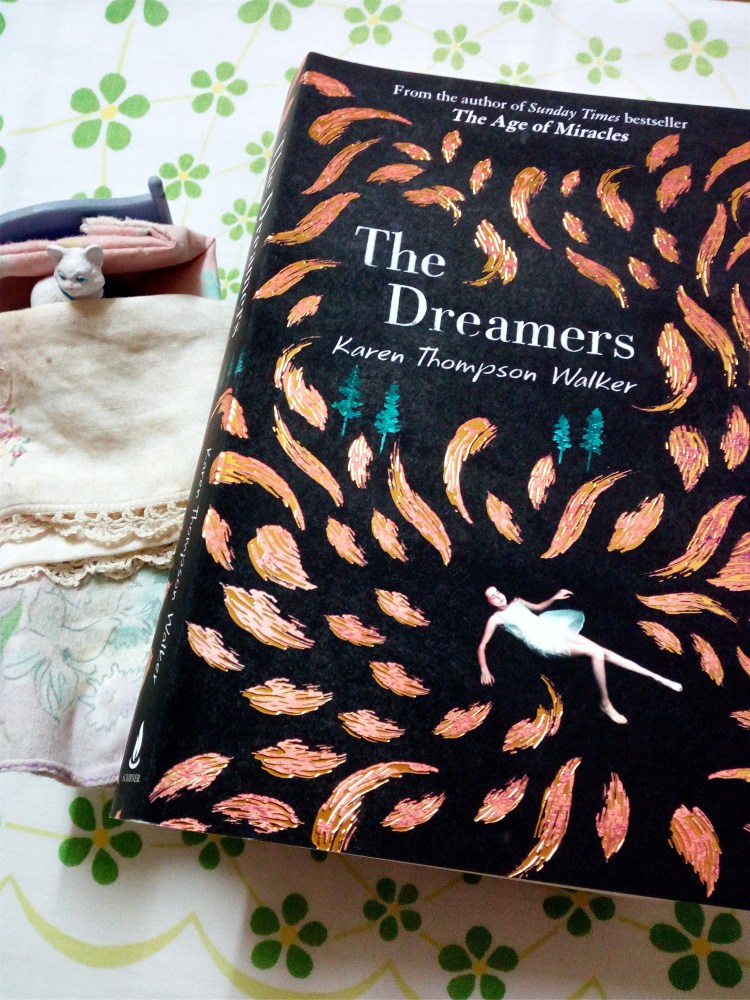
The pretty embossed bookcover hides a dark and disturbing story and I would not recommend it to immature readers, or people I know with sleep disorders.
I think the apocalyptic nature of the book could have a tendency to induce fear and possibly depression in anyone sensitive to a crisis situation with unstoppable consequences.
If I was watching this as a disaster movie about a virus starting in a school dormitory, causing people to fall asleep and may never wake up, I bet most of the theatre-goers around me would be shallow breathing, wondering if it were true.
Lesser books have been known to cause restless sleep, or bad dreams.
Of course, the virulent virus comes from the fertile imagination of Karen Thompson Walker who said in a BWF 2019 panel discussion “Why we dream is unknown” although she puts forward some interesting theories in this story.
‘The Dreamers’ could just as easily die from any airborne disease and here lies the crux of the matter.
The author does an excellent job in researching and creating botched medical care, civil unrest, mass panic, and then bringing it right back down to the most helpless, two young girls and their kittens, alone in an old house.
In a clipped journalistic writing style, there are heroes, references to new life, new love and parental devotion striving against all odds yet feeling strangely hollow and disjointed. For me, the ending is unresolved.
This type of plotting is not my preferred reading, however, I respect the level of apprehension Karen Thompson Walker has created even while I think ‘The Dreamers’ could unsettle vulnerable readers. Or create fear around the new Corona Virus.
Postscript July 2023: My review was written in November 2019 and the world did not fully know what horrors Covid-19 was going to unleash. A global virus, a pandemic nightmare of epic proportions. Karen Thompson Walker was ahead of the curve.
♥ Gretchen Bernet-Ward
AUTHOR PROFILE—Karen Thompson Walker was born and raised in San Diego, California, where her first book ‘The Age of Miracles’ is set. She studied English and creative writing at UCLA, where she wrote for the UCLA Daily Bruin. An assistant professor of creative writing at the University of Oregon, she lives in Portland with her husband, the novelist Casey Walker, and their two daughters.
http://karenthompsonwalker.com/
Strolling Down by the River





♥ Gretchen Bernet-Ward
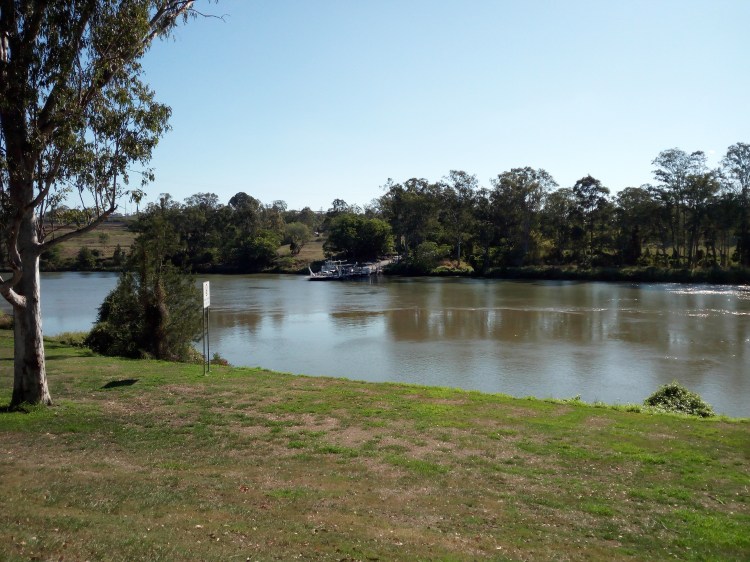
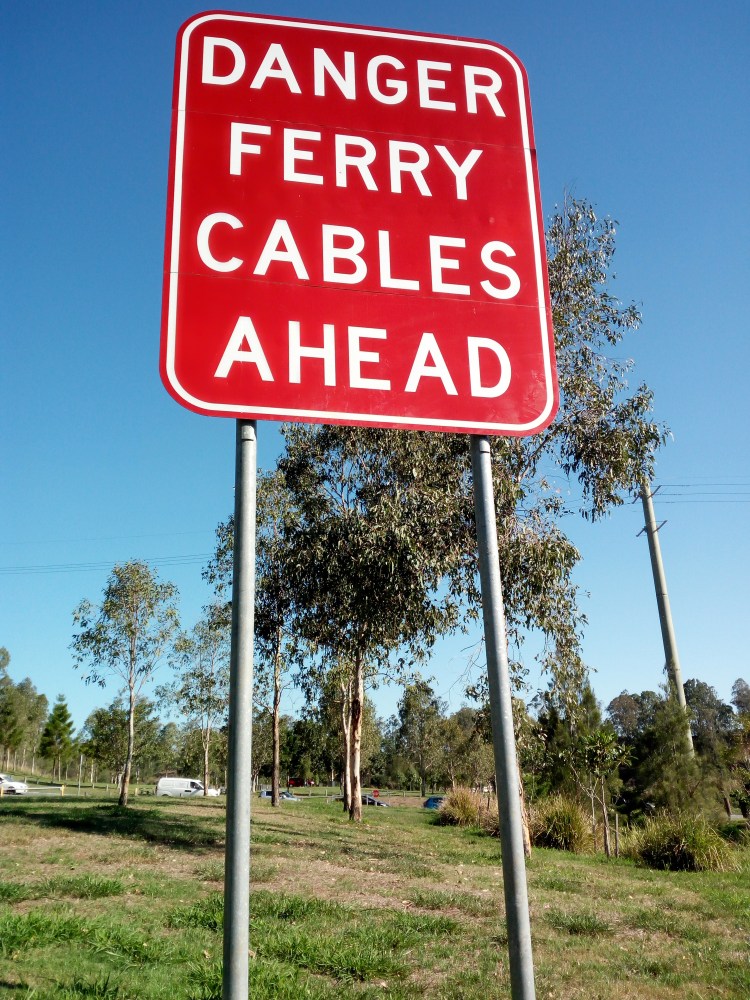
BACKGROUND INFORMATION Moggill Ferry, a tolled vehicular cable ferry, crosses the Brisbane River between Moggill, Brisbane and Riverview, Ipswich, Queensland. It has weathered several floods since 1920s and had various replacements. The ferry was motorised in 1940s under joint control of the Ipswich and Brisbane City Councils. It can carry 20 vehicles (car AU$1.90) GVM vehicle up to 4.5 tonnes (AU$16.30) pedestrians (free) and operates between sunrise and sunset—if you miss the last ferry, you have to take the long way via Ipswich Highway. Services operate daily, except for Good Friday and Christmas Day. The journey takes approximately 4 minutes on the vehicle ferry. I think that depends on the pull of the current. During the floods of 2011, the ferry cables broke and ferry staff lashed it to the riverbank so it would not get washed away. It may look like a bygone era but it is well-used and only 19km (12 miles) from the centre of the city. GBW.
Blog 119: In which I somehow find myself walking the Corridors of Power
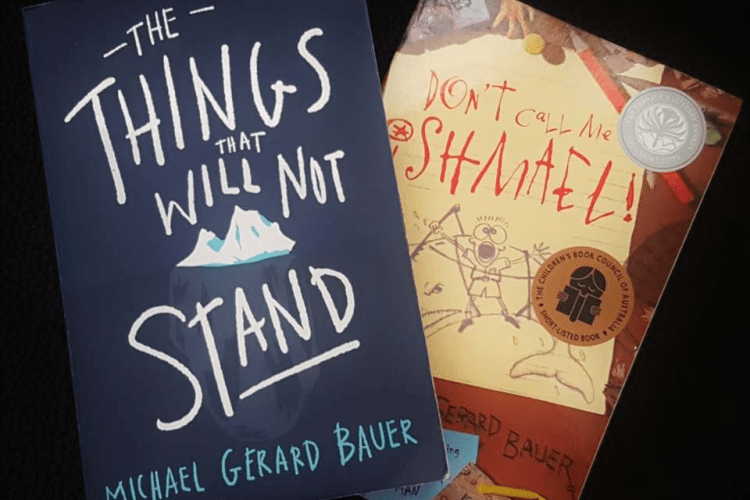
Fantastic win! Congratulations to Michael Gerard Bauer on winning the Prime Minister’s Literary Awards 2019 Young Adult Literature for “The Things That Will Not Stand”. Read his blog and check out the medals! ♥ Gretchen Bernet-Ward.

My YA novel The Things That Will Not Stand had its genesis in two thoughts that came to me one day when I was taking one of my regular walks around the neighbourhood.
One was a memory from my Uni of Queensland days of being in the foyer of the Schonell Picture Theatre and hoping that a particular person I knew might come through a set of doors and join me.
Spoiler alert!!!!!!!
She didn’t.
The second thought was about writing a story which took place over just one day.
That was an idea that immediately appealed to me. I knew it would be a challenge but it would also be a gift because it would free me to focus just on the characters and their immediate interactions without having all the rest of their lives to worry too much about.
In the end I used both thoughts and wrote…
View original post 1,096 more words
Review ‘Wintering’ by Krissy Kneen

This slow burning story crept up on me. I guess you know by now that I don’t write conventional book reviews. For starters I’m not going to give you a synopsis. Let’s jump right in, shall we?

Jenolan Caves are caves in the Blue Mountains, New South Wales, Australia; 175 kilometers west of Sydney. They are the most celebrated of several similar groups in the limestone of the country being the oldest discovered open caves in the world. They include numerous Silurian marine fossils of great interest and the calcite formations, sometimes pure white, are of extraordinary beauty.

The sadness and bewilderment Jessica suffers when her partner Matthew goes missing in the wilds of Tasmania gradually expands until she snaps. The atmosphere changes into an eerie, gothic-like tale of deception and fear. There are disturbing bits, there are gruesome bits and there are strong sex scenes, Krissy Kneen’s trademark.


Jessica lives in a flimsy wooden cottage at the edge of a seawall not far from the township of Southport. As I read on, I was unsure of William, the man who offers to help her, and doubly unsure of the coven of local women who offer strange advice and an even stranger solution. In the end I wanted Jessica to fight back and she did, the result is worth more than the price of admission to the spooky glow-worm caves.

At the time Matthew goes missing, Jessica, a scientist, is just finishing her PhD on glow-worms and works as a tour guide at the local cave complex, helping the tiny creatures to prosper. Winter Cave is her favourite and Winter Cave coldness, the surrounding dense forest, and feral smells pervade this book. Disturbingly, she is a good shot and needs to carry a gun to feel safe.


The character portrayals are well suited to their remote Tasmanian coastal surroundings, in particular old Marijam of Cockle Creek and her outlook on what appears to be a strange isolated life. She goes fishing for her seafood and compares commercial fishermen to the demise of small traders “Pick on a little bookstore, put a big mega-store across the road. Discounts on all the prices till the little fella dies, then corner the market” which she read about on the internet.

I queried some of the ‘things’ in the story and I was dissatisfied, or perhaps had my credulity stretched, with what transpires at the end. Like most animal-lovers, I sincerely hope the thylacine Tasmanian Tiger still exists. I also wondered if Jessica knew those caves as well as she thought.
My pet peeves are:
(1) More showing, less telling.
(2) Proof-reading misses, e.g. license interchanged with licence, rear-view mirror becomes rear-vision mirror. I’d go for Aussie spelling every time.
(3) Parts of the story felt like a filmscript not a literary description. There is a difference.
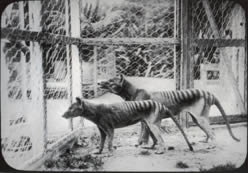
Krissy Kneen’s story reflects the time and effort she put into it, the sense of place is strong and at times overpowering. As a child, my parents and I visited the Jenolan Caves in New South Wales, Australia, and I have been claustrophobic ever since.
♥ Gretchen Bernet-Ward
NOTE Photographs depict general scenes and caves in Australia and Tasmania and are not related to places mentioned in the book. If you want an in-depth analysis I suggest reading ‘Not a Tiger at All: A Review of Krissy Kneen’s “Wintering”’ by Madeleine Laing of The Lifted Brow.
Be An Intelligent Person!

♥ Gretchen Bernet-Ward
Book Perfect – Virago

Virago is an international publisher of books by women for all readers, everywhere. Established in 1973, their mission has been to champion women’s voices and bring them to the widest possible readership around the world. They found me! From fiction and politics to history and classic children’s stories, their writers continue to win acclaim, break new ground and enrich the lives of readers. That’s me! Read on…



My Goodreads Book Review
Superb anthology of the last forty years of Virago Modern Classics with a gorgeous bookcover illustration. Great for readers who appreciate women writers and also for students studying literature. Each contemporary author writes a sincere and thoughtful introduction from their own perspective as a reader. They cover the classics, from fiction and comedy to famous diaries and autobiographies. For example, Margaret Drabble discusses Jane Austen ‘Pride and Prejudice’ and further on Jilly Cooper talks about E. M. Delafield ‘The Diary of a Provincial Lady’. Although I’ve not read ‘Strangers on a Train’ by Patricia Highsmith, I think Claire Messud has convinced me to read it. At the end of Amanda Craig’s introduction on Rebecca West ‘The Fountain Overflows’ she says ‘The novel is one of those rare books that leaves the reader feeling happier and more hopeful than before.” And that’s exactly what this Virago Modern Classics makes me feel ♥ https://www.goodreads.com/gretchenbernetward

Virago celebrated their fortieth anniversary of Virago Modern Classics, Virago Press published the book I so eagerly purchased ‘Writers as Readers’, an anthology of forty introductions from the last four decades…books that deserve once again to be read and loved. Virago also reintroduced the iconic green spines across their whole booklist.
Virago has a huge booklist, I’m sure you’ve read several of their titles, and rather than me listing every book available, you can visit their beautiful website:
https://www.virago.co.uk/
♥ Gretchen Bernet-Ward
Art Deco Delights on Display
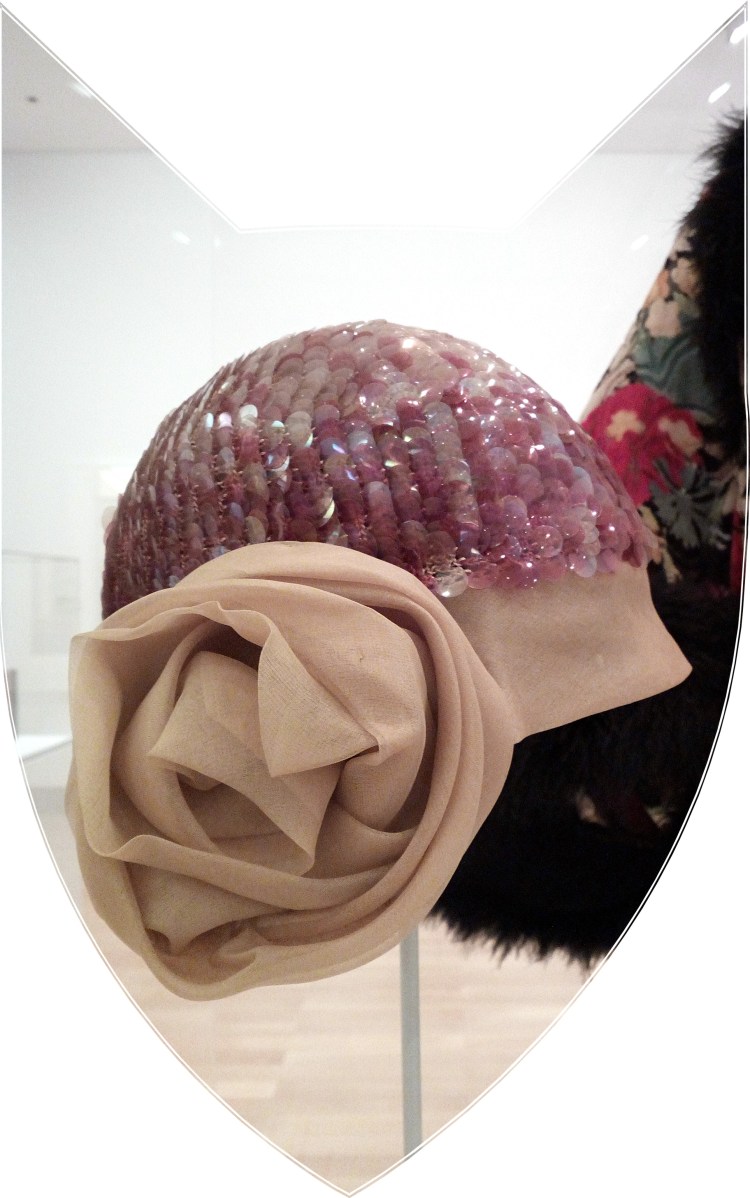
The first photograph shows a Cloche hat (circa 1925) made of rayon, silk organza, sequins and mercerised cotton. The designer is unknown. I saw it displayed in the Ipswich Art Gallery exhibition ‘The World Turns Modern’. It is from the Julian Robinson Collection on loan from National Gallery of Australia.
ART DECO is the predominant decorative art style of the 1920s and 1930s, characterised by precise and boldly delineated geometric shapes and strong colours and used most notably in household objects and in architecture.
Below is my small sample of Art Deco on display.
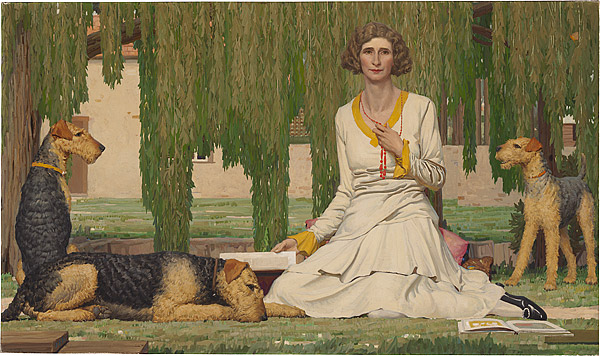
The first painting to draw my eye was Christian Waller in her garden with her dogs.
Artist : Napier Waller (Penshurst, Australia 1893 – Melbourne, Australia 1972)
Title : ‘Christian Waller with Baldur, Undine and Siren at Fairy Hills 1932’
Materials and technique : Oil and tempera on canvas mounted on hardboard.
Dimensions : 121.5 h x 205.5 w cm, overall frame 1315 h x 2165 w x 60 d mm (big!)
Purchased : NGA 1984.
“The frieze-like formality of the painting and its cool, crisp colours underscore the demise of the Waller marriage.” Such a sad note, and I wonder who got the Airedale terriers?
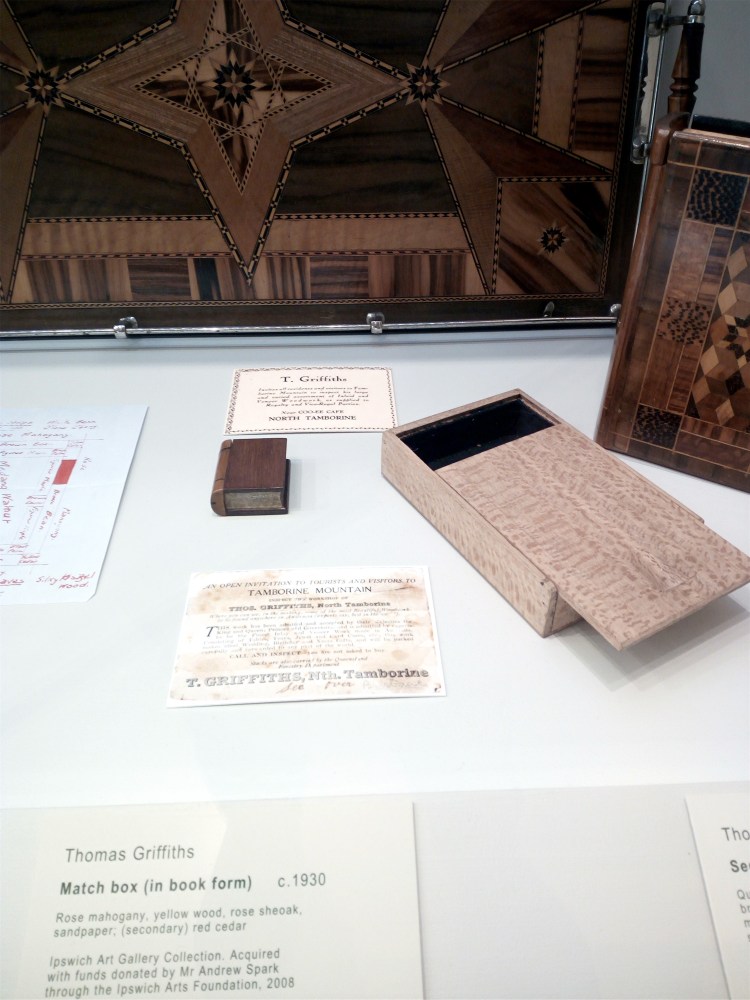
Inlaid wood was all the rage and this match box (in book form) took my fancy. As the information card states, it comprises rose mahogany, yellow wood, rose sheoak, sandpaper and red cedar. Rare commodities nowadays.


This stunning bronze cast (in relief) features a woman wrangling two horses; I liked the strength, energy and symbolism of this piece. Jean Broome-Norton’s renaissance woman is not life-size but the plinth gives it height and power.


The modern front doors of award-winning Ipswich Art Gallery, and inside the original building has been restored and extended. The shipping and travel poster hints at women enjoying greater freedom, the right to vote and travelling unchaperoned. The image of the independent woman became popular in graphic design for posters and portraiture.
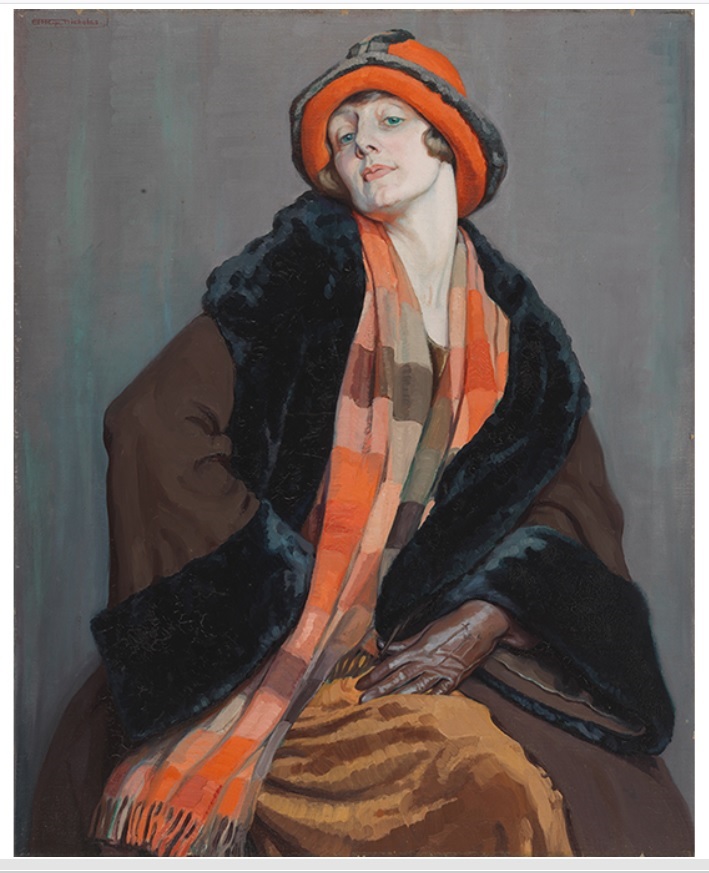
This painting appears on gallery advertising posters and epitomises the era.
IMAGE: Hilda Rix Nicholas ‘Une Australienne’ 1926.
Oil on canvas. National Gallery of Australia, Canberra. Purchased 2014.
© Bronwyn Wright.
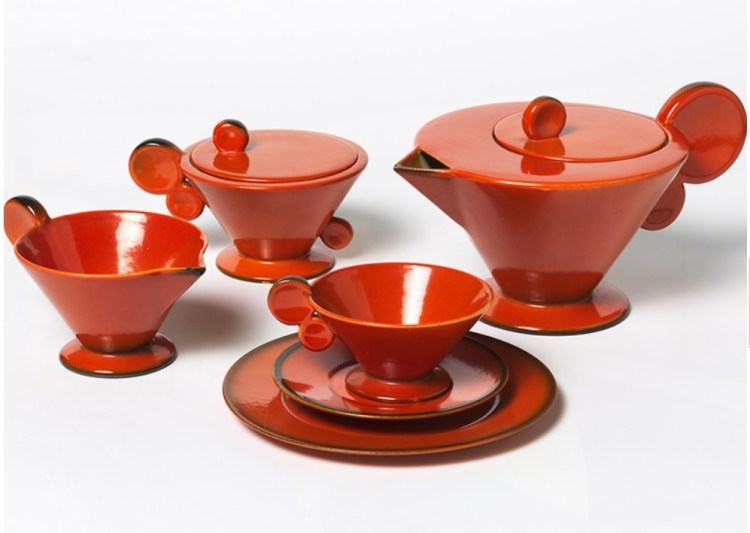
Unfortunately my photographs of etchings, square teapots and Lalique glassware did not work due to the lighting. Pictured above is a red Art Deco tea-set of stunning design, quite petite, which may not have been easy to sip from if you were feeling nervous at a polite society soirée.


Left photo : In a side gallery, I viewed ‘Cover Story: Queensland Arts Council Cover Art and Poster Collection 1981 to 2008’ displaying commissioned work by leading Australian artists and illustrators. From rough sketches to finished art, it was fascinating to see such big names especially in children’s literature, for example Graeme Base, and my favourite Alison Lester and her 1991 on-tour directory cover.
Right Photo : Upstairs in the heritage gallery, I just had to take a photo of this wonderful 1895 miner’s brooch which I presume was designed for a man but it is small and delicate. Made of 15ct gold, it may have been used as a tie pin, and the case is about the size of a snuff box.

Time for a cuppa at the Post Office Café. I was impressed how the colour and table setting matched the Art Deco theme without really trying. The proprietor of the café told us that she was sick of washing the tablecloths and they were being replaced with inlaid lacquered tabletops. Shame, but the sweet treats were delicious.
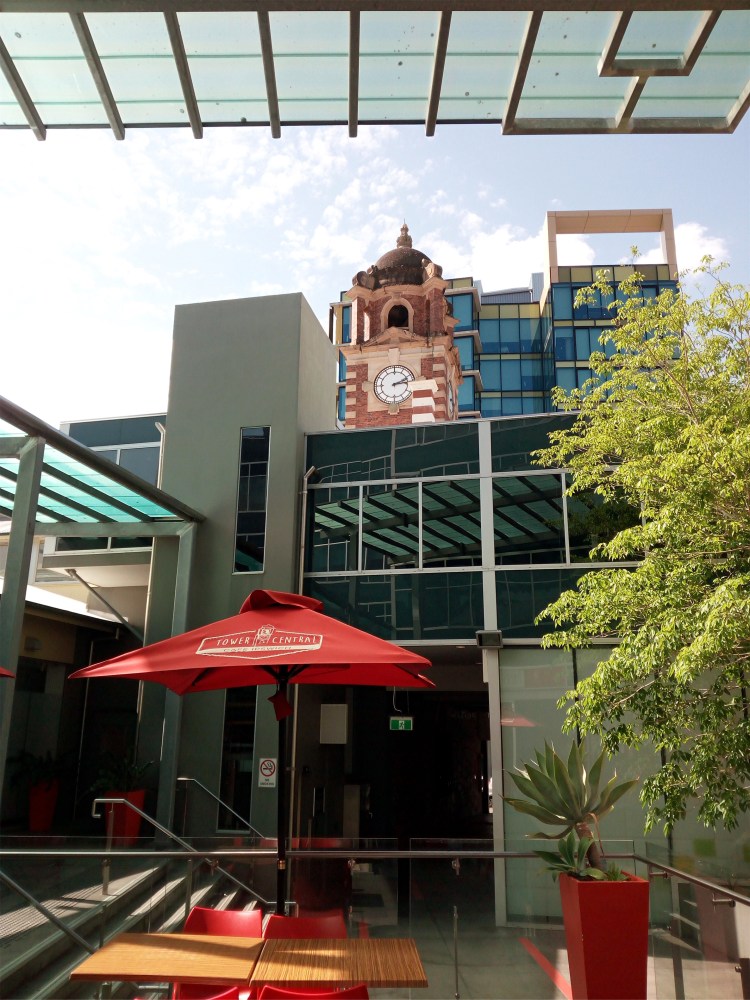
The view outside had interesting angles and contrasts; the Post Office Café courtyard, the umbrella, the modern buildings and above, as if floating, the original Ipswich Post Office clock tower, circa 1890.
If you are interested in the Art Deco exhibition, get in quick, it closes this weekend!
07 Sep 2019 – 27 Oct 2019
“Comprised entirely of works selected from the National Gallery of Australia collection, this exhibition provides superb examples of the diverse expressions of Art Deco.”
♥ Gretchen Bernet-Ward
Review ‘Too Much Lip’ by Melissa Lucashenko
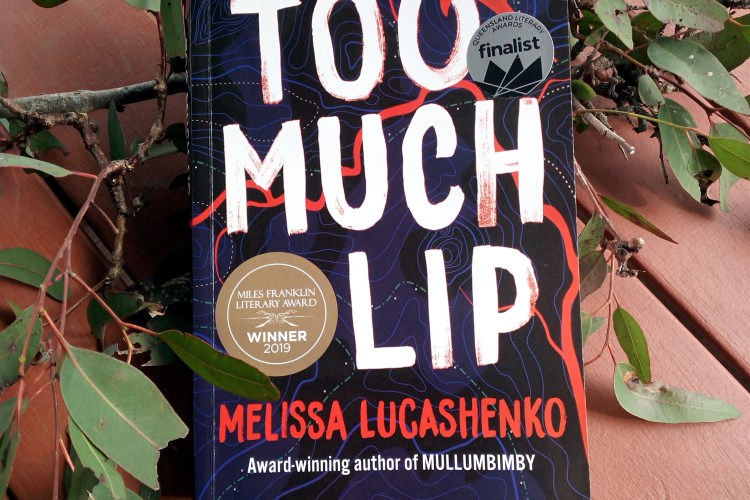
The incessant fights in the Salter family are too real, their plight is real, every word is real and that’s what damaged me the most. I took long walks due to the serious and unrelenting nature of the content. Loaded with the troubles of the Salter family, cruel sarcasm, too much drink, too many smokes, I was getting worn down right along with them. It took me a month to read this book in fits and starts but I’m glad I did.
Abrasive characters are well portrayed which makes them doubly annoying, they need to be accepted warts and all, like ‘mouthy’ Kerry Salter and her unlikable brother Ken who argue every minute of the day. I’m sure I’d have put Ken in hospital at about Chapter Three.
Maybe take the pressure off young Donny.

Early on, Bundjalung woman Kerry has returned to her home town of Durrongo, and grieves the loss of her girlfriend Allie, her Pop and her stolen blue backpack. She does a B&E, part retribution, part spirit world, and the universe turns a notch. Fair move, but repercussions come later. Then there’s romance in the form of her hot eye-candy boyfriend Steve Abarco who’s the flagship for level-headed, rock-solid men.
Kerry’s tarot card-reading mother Pretty Mary celebrates a birthday and those volatile chapters are my favourites. At the party is another brother, gay Black Superman, maybe long-dead sister Donna, plus assorted Aunts (called Mary) Uncles and children who gust through the pages like eucalyptus smoke. But forget about opening old family wounds, I’d say a lump the size of police headquarters sits in the pit of their stomachs, continually irritating their every move.
The battle against a new prison, to be built on sacred ground where Salter ancestors are laid to rest, ramps up with a land rights campaign. Enter cops like Senior Sergeant Trevor Nunne and money-hungry Mayor Jim Buckley. Ken’s flamboyant gesture on a piece of Buckley’s property was not appreciated and leads to disastrous retaliation.
You will have noticed that I am not giving too much away.
Writing style-wise, I did wondered why Kerry wasn’t written in first person. Some events are seeded in advance while others appear to be inserted later to up-the-ante. Every so often the voice changes, doubt creeps in, there’s a lull. Or a change in atmosphere with The Doctor. Occasionally things become omnipotent and POVs jump in and out of people’s heads but that can be overlooked for scary brave writing.
If you are not Australian, you WILL become lost in the slang and cultural references.
Try anyway.
Read this rude, gutsy book if you ARE offended by swearing, truisms close to the bone, and the struggles of Indigenous people. As Ken says in Chapter 15 ‘How to invade other people’s countries and murder ‘em, and call it civilisation’.
It’s a strong insight into the modern world and an ancient culture, one which doesn’t need skyscrapers because Country is a place of belonging and a way of believing.
Good onya, Melissa, for audaciously holding your nerve*
♥ Gretchen Bernet-Ward
* REFERENCE : Sydney Morning Herald interview insights into the writing of ‘Too Much Lip’
https://www.smh.com.au/entertainment/books/melissa-lucashenko-too-much-lip-was-a-frightening-book-to-write-20180724-h1326h.html
AUTHOR PROFILE : Melissa Lucashenko is an acclaimed Aboriginal writer of Goorie and European heritage. Since 1997 Melissa has been widely published as an award-winning novelist, essayist and short story writer.
AUTHOR WEBSITE : https://www.melissa-lucashenko.com/

Shopping – Bombeck and Kinsella say…

♥ Gretchen Bernet-Ward
 Thoughts Become Words