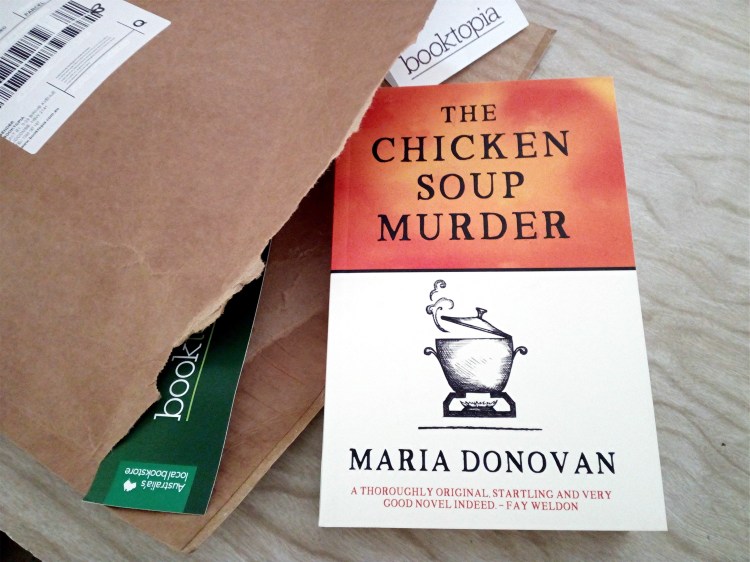
I was waiting for the delivery of a book written by UK author Maria Donovan. The title and synopsis of ‘The Chicken Soup Murder’ hint at a delicious yet deadly coming-of-age mystery.
There was scratching at the front door and our well-trained pet dragon stood there with a grin on his face. He had collected the parcel from the letterbox in anticipation of a treat. I patted him on the head and said ‘Good boy’ then picked up the parcel. He whined. I laughed. ‘Okay, I’ll get a couple of nuts’.
Inside the door, I placed the parcel on the sideboard. Underneath was an old rusty toolkit containing old rusty bits and pieces. I selected a couple of flange nuts and one bolt, gave them a squirt with WD40, and went back outside.
Part of the game was a quick toss-and-gulp and if you weren’t ready you’d miss it. I closed the front door on the slobbering noises and went to find a pair of scissors. The Booktopia cardboard was tough but I wrested it open.
And there was the pristine book I had so eagerly awaited! At the moment, I’ve only read up to Page 20 so I am sorry to disappoint you but my book review will be in another blog post further down the track. As my auntie used to say ‘Keep you in suspenders.’
The personal experiences of poet Kate O’Neil offer a diverse and interesting look into the creative world of poetry.
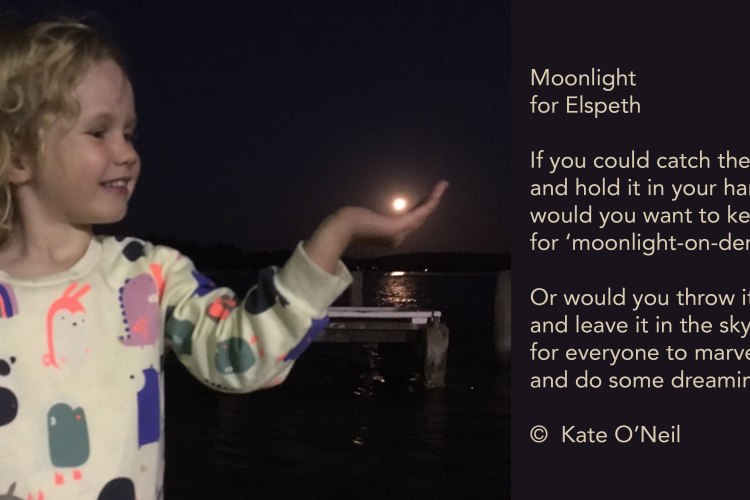
After chatting to Kate over our shared memories of the old poem ‘Wynken, Blynken and Nod’ she kindly showed me her ‘waking up’ version (excerpt below) which fits beautifully with the original. Kate then agreed to answer some tricky questions for me and her responses are both thoughtful and revealing.
Welcome, Kate!
Thank you so much for your time.
My favourite poem of yours is short and sweet; ‘Paragliders Bald Hill Lookout’ invokes in my mind’s eye vivid colour, movement and summer days at the beach.
Talking of short and sweet, I recall asking you which would you choose ‘Lollipop or Cake?’ and you immediately said ‘Cake’, supplying a recipe with almonds smothered on top. I can identify with that! I had read your work on Australian Children’s Poetry under Kate O’Neil and recently discovered your real name is Dianne Cook. You explain why in our Q&A, and give readers a peek behind the scenes of your poetry life.
Okay, let’s get those thoughts into words…
What highlights stand out in your poetry journey?
I’ve been hanging out with poetry for most of my life, so there have been lots of decades for highlights to happen in.
Highlights of poetry reading still happen with amazing frequency. They began when I first realised what magical particles words and sounds are, and what selection, arrangement, combination – even omission, can play in shaping and delivering meaning. There were the ‘greats’ I studied at school – some fantastic stuff there, and I’ve stored many riches from them. But the thing is – poetry keeps on coming. There are poets all over the world publishing collections, submitting to competitions and anthologies and magazines – and sharing a way of seeing. Some poems have knocked me flat, left me breathless. Some have lifted me to heaven; it’s a great ride.
There have been highlights of poetry writing, too. For years the only public airing of my poems was in eisteddfod performances by drama students for whom I had written them (but who did not know this – hence my use of a pen-name). There have been lovely moments hearing something performed well.
A major ‘highlight’ was having my submission to the inaugural (and only)Manchester Writing for Childrenprize short-listed. This competition was set up by Poet Laureate Carol Ann Duffy’s team at Manchester Uni.
There have been some wonderful outcomes from this. These poems were published in‘Let in the Stars’, the competition anthology, and one of them has since been chosen for inclusion by Roger McGough in his anthology‘Happy Poems’. AND I have kept in touch with several other poets in the book. I love the book. I love so many of the poems in it, and the illustrations (by Manchester art students) are wonderful.
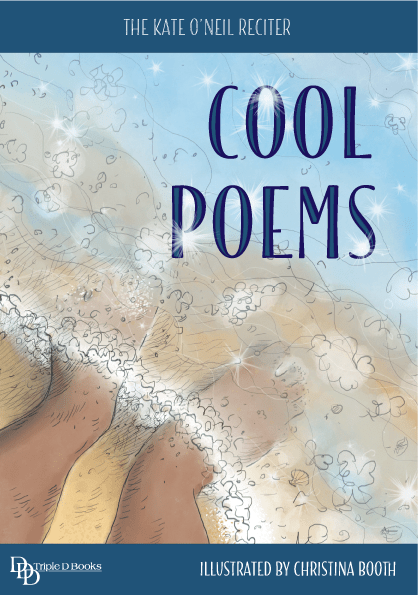
Since then I’ve made successful submissions to several magazines and anthologies – for adults and children. See ‘Cool Poems’ information further down. And I keep on submitting – (loads of rejections, of course).
See OOPS! at the end of Q&A for more book details.
Is there a significant thread through your creativity?
I would say not. If anyone ever notices one I‘d like to be told. At the Manchester Prize event, Mandy Coe (one of the judges) commented that I write in a variety of voices / styles. She suggested it might be the influence of drama teaching. I don’t know if that was praise or not. Aren’t we writers meant to ‘find our voice’?
What challenges do you face when beginning a poem?
Nothing like the challenges of finishing it. If a beginning (or middle) pops into my head at an inconvenient moment, I fear it will vanish if I don’t get it down on paper or in the notes on my phone. This makes my amount of ‘screen time’ look dangerous.
Are you inspired or influenced by another poet?
Inevitably, and I could never know how many. I’ve done some online workshops recently with UK poet Wendy Pratt, whose work I admire. She, and others in the group, have helped me tighten my writing. Lots of deleting went on.
Can you name just one of your favourite poems?
James Carter UK Children’s Poet
You are asking this of someone whose word files are loaded with favourites! If they are in the cloud, it will rain my favourite poems one day. What if I narrow this to ‘favourite poem for children’? Or better still, ‘favourite concrete / shape poem for children’? I can do that. It’s ‘The Moon Speaks!’ by James Carter. It’s on his website:
This is getting difficult. There are so many ways in which a poem can succeed (or fail). I think I’d rate a poem’s success (for me) by the state I’m in after reading it.
How did you feel about poetry when growing up?
I’ve probably answered this in the first question. I had no discrimination, but anything with rhyme, rhythm, sound patterns, imagery caught my attention. Hymns, advertising jingles, greeting cards, bush ballads…
Do you draw on your own childhood memories?
Yes, at times, but much of that grist is still very much in the mill.
Excerpt from Kate O’Neil verse expanding on the traditional children’s poem.
Have you experienced an awkward poetry moment?
Mostly private ones. (‘What? Did I really write that?’)
Are you a day dreamer or do you plan significant goals?
Genetically inclined to dreaming, but I try to impose goals to counter this. (Hence the Wendy Pratt courses which involved writing on a prompt a day for four of the past six months).
Can you give us a hint about your work-in-progress?
‘Progress’ plays tricks on me? I have drafts of picture books, a chapter book, jottings for poems – ALL OVER THE SHOP! Sometimes something gets finished, usually unexpectedly, usually when I think I am working on something else – and I send it somewhere. Results are mixed. This morning, for instance, I learned I have TWO poems long-listed in a comp (adult) and they will be published in an anthology. Last week I sent off a poem I quite liked to The School Magazine just before I left for Sydney. By the time I got there it had been rejected.
Do you have some guiding words for emerging poets?
I think it better to share another poet’s words that have guided me. The main one is READ.
Jo Bell web image credit Lee Allen
Jo Bell quote: “If there is one thing I want you to take from this book, it is this: Nobody writes good poetry without reading good poetry. Those who don’t take this seriously invariably write cliched, derivative and unoriginal work – just what we all want to avoid – because they aren’t aware of the context in which they are writing.”
OOPS! I haven’t mentioned the publication last year of my ‘Cool Poems’. This was a major highlight! The book belongs in a series published by Triple D Press, Wagga Wagga NSW. It was a nail-biting thing to have a book which would sit alongside collections by Australians Bill Scott, Anne Bell, Colin Thiele, Christobel Mattingley and Max Fatchen. Many thanks to Zita Denholm (Triple D) and Christina Booth (illustrator) for helping it happen.
Di Bates, editor of Buzz Words Magazine, wrote a lovely review on 23 December 2018 ‘Buzz Words: Cool Poems’.
It has been delightful making your acquaintance and learning more about the workings behind your poetry. I look forward to reading many more of your beautiful poems. ♥Gretchen Bernet-Ward
Coming out of a hot dry summer, March weather is beginning to soften the sky and offer the cooler, more gentle mornings of autumn. There is no definite change of season, just a calmness, almost a feeling of relief after the insistent tropical heat.
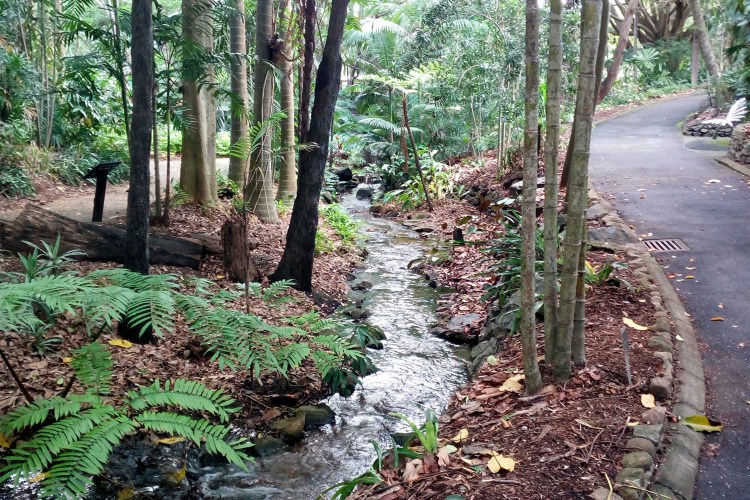
Apart from, whack, an insect, there’s something serene and relaxing about strolling through a garden, touching leaves, sniffing flowers, following a creek and hearing the splash of a small waterfall through the trees.
To quote Rudyard Kipling “The Glory of the Garden it shall never pass away!” so…
Here’s what I experienced one lovely morning…
Arriving early at the Brisbane Mt Coot-tha Botanic Gardens, I strolled through a cool, green gully and thought it was strange to be in a capital city yet hear no traffic sounds. I floated along, enjoying the stillness, until my personal calm was shattered when the garden crew came on duty and the leaf- blowing brigade roared into action. I had to wait until one fellow walked out of shot to photograph Xanthorrhoea australis, the Grass-trees (below; left). The atmosphere shuffled its feathers and tranquility returned.
Wooden bridges and flowing streams…
Leisurely, I followed the meandering paths across bridges and green lawns, enjoying the mild sunshine. Strolling down a slope, I came to a bracken-lined watercourse then walked up a gentle incline towards king ferns, piccabeen palms and towering hoop pines. I’ve never fully traversed the 56 hectare (138 acre) area which displays mainly eastern Australian plants.
You can spot Eastern Water Dragons (lizards) and geckos as they scurry out of sight or get a giggle watching the many varieties of water fowl, ducking and diving in the lake. Feeding wildlife is not allowed and I couldn’t entice them into an appealing photograph.
Sculptural features are ‘casually’ placed throughout the gardens and I think the most alluring is a silver fern seat (below; left) with interesting support.
Beside the pond and beneath the trees…
The Japanese Garden (below; entrance and pond) offers soothing symmetry and a waterlily’s single bloom. Nearby the concert bandstand has grass seating surrounded by trees with foliage of different patterns and colours. Around me, there’s a multitude of subtropical shrubs, cycads and flowers with names I never remember. You will notice that I do not attempted to be horticultural! A bit further along, in the arid zone, resides a sci-fi concoction of exotic cacti. The culinary, fragrant and medicinal herb gardens are pure indulgence. But if herbs aren’t your thing, the pungent eucalypt is my favourite and walking the Aboriginal Plant Trail with its edible food plants.
Biodiversity and water reflections…
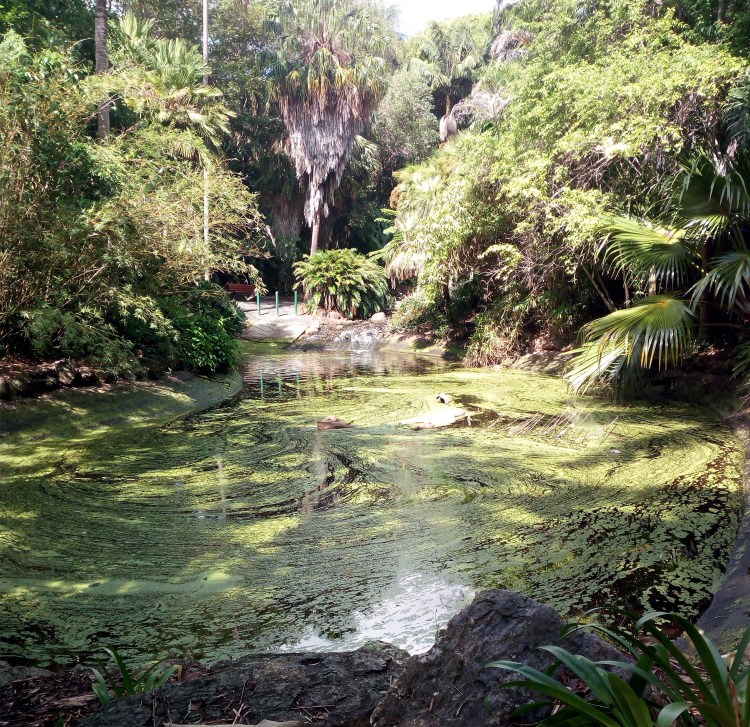
The stillness of the morning created pleasing reflections on the lagoon which is fed by rainwater captured from the hills. You can choose between typical heathland or wetland regions made easily accessible for suburban folk. The Conservation Collection includes rare and endangered species in their natural habitats and I entered the steamy, geodesic hothouse (below; left) where equatorial plants are nurtured. My face beads in sweat, it’s not a place for humans to linger too long. Time for an ice-cream!
Tropical Display Dome at Brisbane Botanic Gardens, Mt Coot-tha, is a large lattice structure (geodesic) displaying plants from the tropics. A pathway winds upwards through the dome building, wrapping around a central pond with water plants.
Look outside the Botanic Gardens…
Outside the entry are several buildings of interest: Sir Thomas Brisbane Planetarium (below; saved from extinction by a vocal community uprising) large carpark, small art studio, specialist library and auditorium providing a variety of events. I have booked a place in a workshop Monoprinting Australian Native Plants, so a blog post may be forthcoming. The new Visitor Information centre offers guided walks and Gardens Café has the ice-cream. The two white-coated fellows outside the café are entomologists, surviving statues from World Expo 88.
Pandas and children have a special treat…
The Mt Coot-tha Botanic Gardens Children’s Trail is a hide-and-seek ramble through the shady rainforest garden with special works of art dotted along the way and I couldn’t resist following it myself. Check out the wacky weathervane! And a log for native stingless Sugarbag bees. Mother and baby Panda bears enjoy the bamboo; they are a special fabrication of laser-cut aluminium by Australian sculptor Mark Andrews.
Parks and gardens change with horticultural trends. The smaller City Botanic Gardens are older and more formal, in keeping with the style of previous centuries, but I prefer the softness of Mt Coot-tha Botanic Gardens. As the world becomes more populated and natural plant life decreases, Brisbane city dwellers like me need our botanical gardens to nourish and refresh our screen-dependant interior lives.
♥Gretchen Bernet-Ward
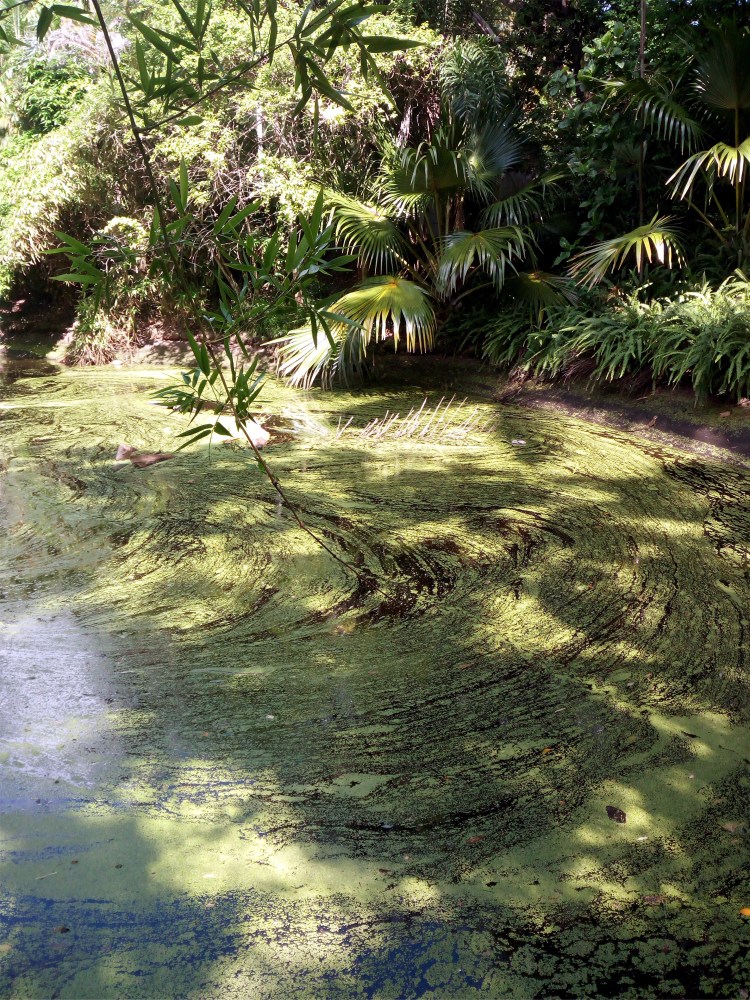
Tropical lagoon and green algae swirls at Mt Coot-tha Botanic Gardens, Brisbane, Australia 2019
Note: Please click or tap an image to enlarge.
You may also like to read about my visit higher up the road atMt Coot-tha Lookout.
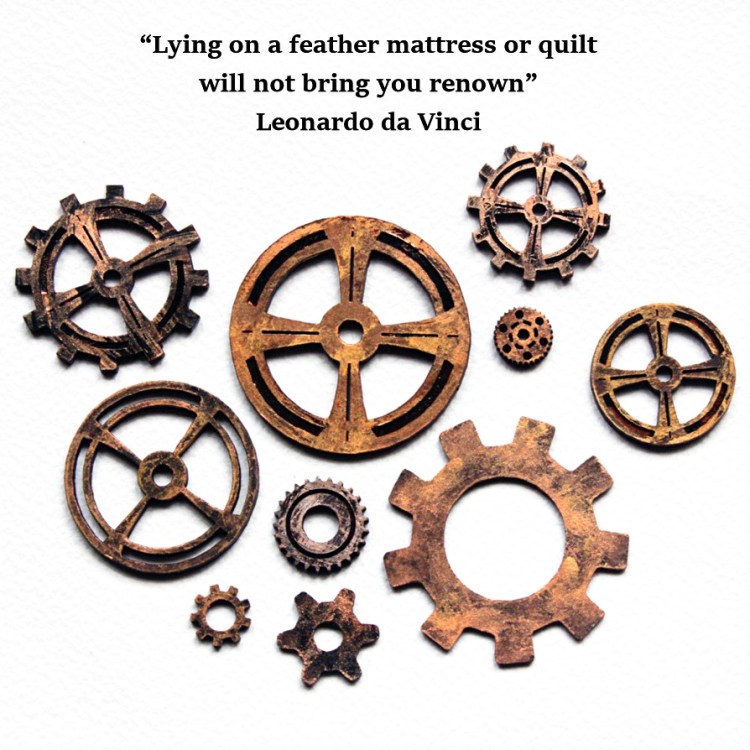
Renaissance genius Leonardo da Vinci (1452-1519) was a painter, sculptor, architect, inventor and student of all things scientific but he had difficulty waking up in the morning. He wrote “Lying on a feather mattress or quilt will not bring you renown”. One of his earlier inventions was a personal alarm clock powered by water. Based on his elementary diagrams, Leonardo’s device would trigger an alarm by the collection of water dropping into a reservoir at brief intervals. I would have thought the drip, dripping of water all night would have kept him awake. Website https://www.leonardodavinci.net/♥ Gretchen Bernet-Ward
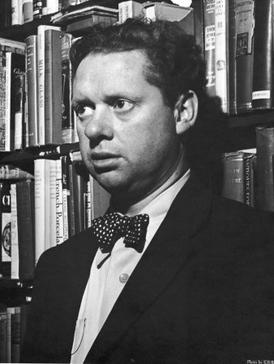
If you’ve never read a Welsh writer’s work, now is your chance! I’ve been to the library and collected my copy of Under Milk Wood, the radio/stage/film drama by Welsh poet Dylan Thomas to get me started. Read all about Dewithon19 on Book Jotter’s blog….Mwynhewch ddarllen! (Enjoy reading!) ♥Gretchen Bernet-Ward
Welcome to the first ever Wales Readathon (aka Dewithon 19), a month-long event beginning on Saint David’s Day, during which book bloggers from all parts of the world are encouraged to read, discuss and review literature by and about writers from Wales.
For more in-depth information on this reading jolly, head over to DHQ (Dewithon Headquarters) – and should you wish to take part in the official readalong, please follow this link. You can also share your thoughts and posts on Twitter by using the hashtags #dewithon19 and/or walesreadathon19.
Here we display your Dewithon-related posts. Please leave your links in the comments below or drop me a line with the URL.
Tropical lagoon and green algae swirls at Mt Coot-tha Botanic Gardens, Brisbane, Australia 2019
The swirls and ripples of the blogosphere will let your post resurface any number of times to an ever-widening pool of readers.
Never underestimate the infinite lifespan of a blog post.
Your post may not make a big splash the first time, nor days later, but it has the potential to be viewed many times into the future.
I know, because I have certain posts which haunt me. In the nicest possible way, of course, but it is still rather disconcerting when an old post gets a sudden flurry of views. It’s like they tread water waiting to bob up.
The reason behind my floating posts remains unclear to me.
Where, or why, my original blog story becomes resuscitated could be caused by any number of factors from reblogging to tweeting or—
linked on someone’s page
kindly mentioned in a comment
family members on Facebook
topic of interest and my tags swum into view
tumbled into the lake of eternal blogs…
I’m sure the tech pond at WordPress is teeming with answers but that’s too factual for me, I prefer the serendipitous, the happenstance of it all.
Overall, I am always pleased and still thrill to see those stats wade across the WordPressmap!
♥Gretchen Bernet-Ward
Tropical lagoon ebb and flow of green algae at Mt Coot-tha Botanic Gardens, Brisbane, Australia 2019
Do you ever throw a literary stink bomb into your book club meetings? Does a particular book annoy you into spewing a non-positive review?
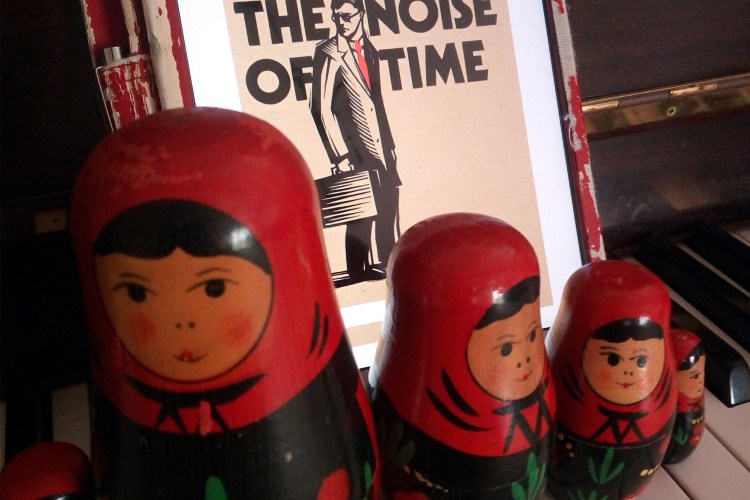
My recent attendance at a book club gathering certainly raised eyebrows (I guess I’m not highbrow) when I panned Julian Barnes 2016 quasi-biography ‘The Noise of Time’ based on Russian composer Dmitri Shostakovich.
I believe book clubs should read a wide variety of books and not just ‘literary stuff’. Out of 12 people, only two of us spoke up and voiced our critical opinions without fear or favour.
Read my review below and make of it what you will – this is not a discussion post but it is my opinion and I totally respect yours –
Book Review – ‘The Noise of Time’ by Julian Barnes
Author Julian Barnes fictionalised biography of Russian composer Dmitri Shostakovich begins in 1930s and is about the man himself, not necessarily about his music which is a disappointment.
Barnes wants to immerse us in the inner world of Shostakovich, therefore most of the story takes place within the previously uncharted waters of the composer’s own mind. The rest appears to be gleaned from conventional sources. There’s a lot of telling and not much showing.
First up, Shostakovich’s opera ‘Lady Macbeth of Mtsensk’ is denounced, and while there is tension and foreboding throughout the story, there’s no significantly dramatic scenes after this point. Shostakovich smokes heavily and is understandably nervous. He has the fear of Soviet Communism hanging over his head all the time (there’s a peculiar phone call from Stalin) and the dread which Shostakovich seems to pile upon himself. Like the bookcover illustration, he’s a man always looking over his shoulder but this doesn’t necessarily make edifying reading.
Politics aside, Shostakovich later wrote his Fifth and Eighth Symphonies yet Barnes glosses over a lot of this, using a series of vignettes without delving into that emotional side, so there’s minimal mention of his creative process or the effects of his wife’s death on his family.
The interior dialogue does not expose Shostakovich as an eccentric creative, nor do I think it makes him a likeable protagonist. Barnes portrays his inner world in an obsessive manner (think clocks, bad luck in a leap year, the elevator scene) and I think he comes across as a bullied child. One who needs encouragement yet gets slapped down at every turn.
My favourite paragraph is when Shostakovich is staying in New York and a woman working at the Soviet consulate jumps out of a window and seeks political asylum. So, every day a man parades up and down outside the Waldorf Astoria with a placard reading “Shostakovich Jump Thru The Window!” but according to Barnes and other writers this gave him great inward shame.
In strides man-about-town composer Nicolas Nabokov who kindles Shostakovich’s shame so that Shostakovich is trapped by his own timidity, unable or unwilling to stand up and be counted, preferring to talk through the medium of music which is later used to punish him.
For me, this partly true reimagining is not very engaging. I did learn a couple of new things but even allowing for Julian Barnes writing style, this book doesn’t add anything special to my reading list.
Childhood can come crashing back when you read something from your past. I saw the words ‘Wynken, Blynken and Nod’ and instantly I was about five years old.
Unwilling to stay in bed, sleep seemingly a million miles away, I knew as soon as my mother recited this magic poem, I would drift off into dreamland.
Eugene Field may not have known the children around the world who fell asleep under the spell of his words, but I’m pretty sure his own kids were good examples. Did they know the entire poem? Every line, every verse, every nuance? I certainly did not.
If you are in the same shoe-boat, read on to discover the complete original while you sip strong coffee…
Wynken, Blynken and Nod
Wynken, Blynken, and Nod one night Sailed off in a wooden shoe — Sailed on a river of crystal light, Into a sea of dew. “Where are you going, and what do you wish?” The old moon asked the three. “We have come to fish for the herring fish That live in this beautiful sea; Nets of silver and gold have we!” Said Wynken, Blynken, and Nod.
The old moon laughed and sang a song, As they rocked in the wooden shoe, And the wind that sped them all night long Ruffled the waves of dew. The little stars were the herring fish That lived in that beautiful sea — “Now cast your nets wherever you wish — Never afraid are we”; So cried the stars to the fishermen three: Wynken, Blynken, and Nod.
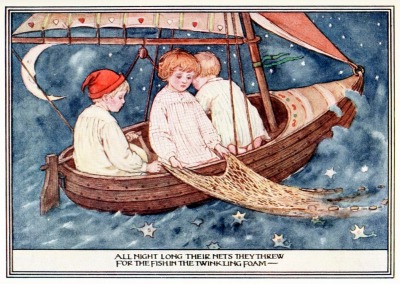
All night long their nets they threw To the stars in the twinkling foam — Then down from the skies came the wooden shoe, Bringing the fishermen home; ‘Twas all so pretty a sail it seemed As if it could not be, And some folks thought ’twas a dream they’d dreamed Of sailing that beautiful sea — But I shall name you the fishermen three: Wynken, Blynken, and Nod.
Wynken and Blynken are two little eyes, And Nod is a little head, And the wooden shoe that sailed the skies Is a wee one’s trundle-bed. So shut your eyes while mother sings Of wonderful sights that be, And you shall see the beautiful things As you rock in the misty sea, Where the old shoe rocked the fishermen three: Wynken, Blynken, and Nod.
By Eugene Field (1850 – 1895) poet and journalist.
Eugene Field was born in St Louis, Missouri, on 2 September 1850 and by all accounts was a great practical joker.
In 1875 he married Julia Comstock and eventually they had eight children. In 1883 he moved to Chicago, Illinois, to write a column for the Chicago Daily News.
His columns occasionally featured light verse for children and he became known as the ‘Poet of Childhood’. These imaginative poems were both happy and sad (‘Little Boy Blue’ is a well-known tearjerker) and later published in collections including ‘The Tribune Primer’ in 1900 and ‘A Little Book of Western Verse’ in 1903. Eugene Field died on 4 November 1895 in Chicago, Illinois.
Maxfield Parrish and other artists illustrated his earlier books, and artwork changed to reflect 20th century styles over the years while the eponymous characters remained constant.
Simon McDonald is a Sydney-based reader, writer and senior bookseller at Potts Point Bookshop. I always enjoy his book reviews. Simon writes perceptive, eloquent and up-to-the-minute appraisals which have helped me discover some great stories and I look forward to reading this book. GBW.
Molly Murn is a South Australian author and poet. She holds a Bachelor of Dance, a Masters of Creative Arts, and is currently a PhD candidate in Creative Writing at Flinders University. ‘Heart of the Grass Tree’ is Molly’s first novel. https://mollymurn.com