Win a Prize by Cheating

Reading Girl 43
Hmm…

Fleur was sick and tired of the competition rules, regulations and conditions which surround the submission of a manuscript.  She decided to cheat the system.  But one of the worst things is to think you are going to get caught, that you are double-dealing the system, that you’ve done something you shouldn’t have done.  Be self-assured?

“Sure, you justify it to yourself that you aren’t going to win a prize in that writers competition anyway so what the heck, give it your best shot, enter four competitions with the same short story under 3,000 words.”  Fleur finds her handbag and house keys.  “And who cares?  First world problems, right?  They can only disqualify me.  They’ll get an entry fee without the hard slog.  What hey, they will do the hard work first.  Judges will find out later that I’ve cheated.  Well, not exactly cheated, more bent the rules.”

Fleur submitted the exact same story to four different organisations in the hope that one would succeed.  Of course, deep down she knows that the story will not succeed.  But there’s that tiny little glimmering hope that one entry will win.  “Ha,” snaps Fleur’s psyche, ‘you’ll win first, second or third place in each competition and cause a furore.”  There will be a lot of huffing and puffing, but Fleur says “I don’t care!  Keep the entry fees, frankly I don’t care!”  There will be tedious emails pointing out her indiscretion and how naughty she’s been – she don’t care!  They can sort it out by themselves.  Go ahead, eliminate her, but questions sneak through before the front door closes.

Fleur’s shoes pound the pavement as her rant continues “At the time I think I said to myself that I had not submitted to another competition, however, by the last entry I had.  And I didn’t change a word.  But here’s two questions for you.  How come books and authors can win the Pulitzer Prize, Nobel Prize, Ned Kelly Award, Prix Goncourt, Man Booker Prize, etc, even though they have already won another prize?  Or magazine articles which have been reprinted elsewhere with author permission?  Like I said, I don’t care!”

“Please, please,” Fleur takes a breath “don’t let me win a place in any more than one competition.  I couldn’t stand the hassle.  As a matter of fact I don’t quite understand why I did it.  Well, in the case of the smaller organisation, I think I did it out of pity to bolster their entry numbers.  And in the case of the larger organisation, I think I did it out of spite to prick their egotistical speech bubbles.”

Fleur is expounding this tirade now because three of the organisations have announced their cut-off date, entries have closed.  The minor one is still struggling on.  “Oh,” she says, her pace slowing “I forgot to mention that I have submitted another manuscript, quite a different story but the same copy to two interstate writing competitions.  Their game plans are miles apart, one laidback and one stiff and starchy.  The story is rather laidback itself so I will be interested to see if it gets anywhere, I do like it.”

On the subject of slightly ignoring their instructions on the grounds of “get over yourselves, bloody gatekeepers” Fleur couldn’t help adding “If they don’t like it then that’s tough.  I don’t care!”  She knows she will have second thoughts after formal announcements are made in a few months’ time, and she voices the unsettling assumption that she may be victimised.  Fleur has heard tales of editors, indeed publishing houses, blacklisting people and the writing fraternity shunning one of their own for not following the guiding principle of “doing it the right way”.

Fleur stops walking.  “Publishers want unusual, they want different, but mostly they are just as rigid as the public service, any spark of individuality snuffed before it ignites.  Death to the formula!”  She hears her bulky envelope fall into the metal post-box and slams the flap shut.  The guidelines stated that all entries must be submitted by email attachment.

Gretchen Bernet-Ward

Reading Girl 42
Rubbish!

Saving Grandpa’s Tree

Tree Without Leaves 09
Tree Rescue

Grey clouds raced across the sky and cold wind ruffled Paul’s hair.
He gazed with sadness at Grandpa’s new tree.
It looked sick.
Its leaves were brown and crispy and some had fallen on the grass.
Paul grabbed the garden hose and watered the earth around the tree.
A large puddle circled the trunk but nothing happened.
Paul thought it needed some food.  “What do trees eat?”
In the garden shed, Paul foraged among lots of interesting containers.
On the bench he saw Grandpa’s half eaten sandwich and took it to the tree.
Crunch!  He picked up the dog’s smelly bone and gave that to the tree.
Cackle!  The hens followed a trail of grain as it trickled along behind him.
Meow!  Paul was sure the cat wouldn’t miss her bowl of fish-flavoured treats.
From the kitchen, vegetable scraps joined a plate of leftover breakfast bits.
Icky!  He pulled a fuzzy lollipop out of his pocket and tossed it on the pile.
Gloop!  He found a jar of honey and poured that around the base.
Woof, cluck, meow, buzz!  Everyone enjoyed the food except the tree.
“You still don’t look right,” said Paul.
A leaf fluttered down, then another and another until the branches were bare.
Paul felt a tiny ache inside.
He walked slowly into the house – then thought of an idea! © GBW

………………..to be continued…………………

AUTHOR NOTE
This children’s picture book story is temporarily withdrawn.
It has been rewritten and submitted to a writing competition.

Gretchen Bernet-Ward

Tree Without Leaves 06

‘Rain Dogs’ by Adrian McKinty

Adrian McKinty 04
Ulster Riot

It’s 1987 and things are still nasty in riot-torn Northern Ireland.  The Troubles in Ulster won’t go away.  A dreaded mercury tilt bomb causes a fatality in the Royal Ulster Constabulary ranks when least expected. In fact, many things happen when least expected.  The old ‘dead body in the locked room’ scenario rears its ugly head again.  The unassailable Carrickfergus Castle location is picturesque but the freaky circumstances are not.  Pretty reporter Lily Bigelow’s body is found sprawled in the snowy courtyard at the base of the castle keep.  The castle is locked.  Nobody went in and nobody came out, so what’s the deal?  The facts don’t add up and it’s a case of did she fall or was she pushed?

Northern Ireland MapWithout much to go on, DI Sean Duffy of Carrickfergus RUC uses dogged police work, video tape footage, and many repeat suspect interviews, until small pieces slowly emerge.  There is an outline to this puzzle but can it be filled in?  Convincing evidence is hard to come by.  Much in all as I love Sean, I do think he took two matters at face value even though I was shouting at him to double check.  And he does appear to be maturing, perhaps a little bit more circumspect, managing to curb his anger when insulted by hostile Larne CID Chief Inspector Kennedy at a horrific crime scene.


We are left to wonder what part Sean’s old friend and ex-cop Tony McIlroy has to play in his role as protector of the visiting Finnish delegation Mr Laakso Mr Ek & Company.  They are on a tight schedule, which involves finding a suitable factory location to manufacture Lennätin mobile phones, so these dignitaries are unhappy when Mr Laakso’s wallet is stolen.  Sean is unhappy too.  More so later when he has to interview them on the ice-road island of Hailuoto near Oulu in Finland.

The series regulars appear, solid unattractive Sergeant McCrabban and intelligent handsome DC Lawson who steals the limelight with a couple of excellent ideas.  Some of my favourite cameos are from vague Chief Inspector McArthur and major irritant Sergeant Dalziel (gotta wonder about that name) and Sean’s lady love Beth plus the ever-delightful Mrs Campbell from nextdoor, married with kids but oh-so-smouldering.  The only thing which grated on me was the dead giveaway of the chapter titles.  I like them a bit more esoteric.

It seemed to be the year for paedophilia in crime fiction; the RUC Sex Crimes Unit at Newtownabbey gets involved and Jimmy Savile puts in an appearance.  On a different note, Belfast has a visit from world heavyweight boxer The Champ, Muhammed Ali.  I do enjoy Adrian McKinty’s diversions, these little re-writings of history.  I wouldn’t class Rain Dogs as a scary thriller but in a gripping scene, Sean knew he ‘was afraid and fear releases power.  Fear is the precursor of action’.  McKinty also writes the dread and tedium of everyday life in succinct wording (without me needing grim online images) and Sean’s days are peppered with music and references.  Which incidentally are where the titles of the books are derived.

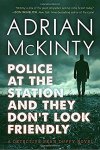
Now living in Australia, Irish-born author Adrian McKinty has again worked his magic with Sean, maybe with a little help from St Michael (or St Francis de Sales) and no doubt book six in the Sean Duffy series Police At The Station And They Don’t Look Friendly is equally as good.  At least I hope so because I don’t think readers are ready to kiss this Carrickfergus detective goodbye just yet.  I can recommend Rain Dogs if you want to sink your canines into a distinctively styled crime novel.

Books in the Sean Duffy series:

  1. The Cold, Cold Ground 2012
  2. I Hear the Sirens in the Street 2013 – my first favourite
  3. In the Morning I’ll be Gone 2014
  4. Gun Street Girl 2015 – my second favourite
  5. Rain Dogs 2016
  6. Police at the Station and They Don’t Look Friendly 2017

Gretchen Bernet-Ward

Adrian McKinty 01
The Troubles
Adrian McKinty 02
More Troubles
Adrian McKinty 03
Big Troubles

Group Interview Trauma


Boardroom 02
Skill Test

Between jobs, I once had the misfortune of attending two group interviews.  Both for a permanent part-time position.  Let me tell you about the first one.  I was pleased to be called in and keen to get the ball rolling until after an hour I realised the whole process was degenerating into tedious insincerity.

Fellow jobseekers and I played mind games with shapes and symbols, wrote clues on butcher’s paper and on each other’s backs (with our finger) and sat down to interview the ‘buddy’ seated next to us.  We then introduced each other to the selection panel which was a trick because what was told to us privately was then asked to be broadcast across the room.  And, most outlandish of all, we formed groups to invent a new company motto and present it.  Then we were gathered into teams to construct a workable bridge from scrap pieces.  During discussion time, one person endeavoured to take control of our group, effectively making it a one-woman show.  Another broke away from his group to talk to me separately so I’m sure that would have been a black mark against him.

Most applicants ‘talked the talk’ although whether they actually meant it or not remains to be seen.  The extroverts did their best to outshine the other applicants with their superior customer service line but when pressed, many hadn’t even checked the company website.  Basically everyone was mouthing the same tired old phrases about equality, fairness, safety, courtesy, teamwork and how good they would perform in the job.  Lines which they had obviously rehearsed at home.  Which in itself is good but it wears everyone down, especially when juniors kept referring to their notes.

By the time my five minute one-on-one interview took place, over three hours later, I was lacklustre.  The questions asked were the same as those I had already addressed in my selection criteria which tended to make me more repetitive than I should have been for such an important occasion.  My past experience and references were scrutinised without a word.

I tried to pull my thoughts together and keep a glazed look out of my eyes but regrettably enthusiasm had started to wane.  It appeared to me that the HR department was trying to justify its own position within the company by orchestrating an overly long interview process and my respect for its staffers dwindled during that period.  It was held at an awkward time of day too, so I left the interview feeling hungry which did not help my mood.  For those nervous yet bored candidates waiting to be called, surely a beverage wouldn’t have been too much to ask?  At the end of this interview process, we were instructed to leave by the side door.  I hoped the other applicants were more upbeat than me, or at least better actors.

Another point which I found interesting was the amount of young first-job attendees who wore jeans and casual tops.  In a job where presentation is important, I failed to understand their choice of clothing.  Especially considering there were 75 applicants, hand-picked from hundreds, for only 25 job vacancies.  Apart from a good resumé, I think your eagerness to get a job should include upping your appearance.

A considerable length of time, and another job, has passed since then and I still have not been informed of the outcome.  I seriously question the usefulness of such a long drawn-out exercise.  ‘You either got it or you aint’ and I think a good personnel department should see that a mile off without all the frills.

Gretchen Bernet-Ward

Boardroom 01
ChitChat

My First Car

My First Car Datsun
Datsun

One hot day in early 1970s, sitting in a crowded bus on my way to business college in Brisbane central, I vowed to myself like most young people at the time, that the first thing I was going to do when I found a job was to buy a car.  And I wanted a new car.

Thanks to my parents’ foresight, I was already taking RACQ driving lessons around the torturous hills of Bardon and Paddington in Brisbane.  I was issued with my driver’s license at Rosalie on the first attempt, secured a secretarial job and started to save for my first car.

Vehicle window-shopping became a regular pastime.  By mid-1975, after reading volumes of the driver’s bible The Road Ahead, and comparing models with my father, I purchased a brand-new white Datsun 120Y four-door sedan from Ira Berk in Fortitude Valley.

My new Datsun sedan cost me $4,000 in cash.  Although I could drive a manual, it was an automatic.  It also sported a thin stripe along either side.  It had a tight turning circle and was economy-plus when it came to petrol consumption, two of its bragging points.  The interior and seats were brown vinyl and the dashboard was black; basic but functional.  It contained a radio player, cigarette lighter and, surprise-surprise, an analogue clock which ticked away the hours for 18 glorious years.

Many happy memories are linked to my first-car ownership which include boyfriends, marriage, having my child’s first car seat fitted, then school runs.  There was no downside to my Datsun.  The only challenge I faced was to keep the metal hubcaps on because they would pop off driving over speed bumps.

It was serviced regularly and the service log book was an historical record in itself.  When my Datsun was sold in 1993, it was in such good condition, amazingly, I was given $2,000 trade-in.  The only reason I sold it was to enjoy the cooling breeze of air-conditioning in my second brand new car.  Another white four-door sedan.

AUTHOR NOTE: This excerpt was written in 2004 and I would like to add the postscript that I am now a big advocate of public transport and catch a bus regularly, particularly into the city centre.

Gretchen Bernet-Ward

Brisbane Bus 1970
BCC Bus 1971

The System

Allora Queensland
Allora Township

Angus shuffled through a pile of bills and sent one fluttering to the floor.  His son Steve stood beside the dining room table, arms folded, watching him.  Every week Angus misplaced an important piece of paperwork.
“Told you it wasn’t far away.”  Angus held up an electricity account.
“You should have a proper filing system, Dad,” Steve said.  “One day the electricity will be cut off and you’ll wonder why you’re in the dark.”
“It’s you who’s in the dark, my lad.”  Angus tapped his nose, an obscure family joke.
Steve gave a brief smile.  “Let me buy you a three-drawer filing cabinet with suspension files and alphabetical tabs.”
“My manila folder is just fine,” said Angus, holding up a battered cream folder with various names crossed out and a succession of dates which finished at 1998.
“You’re damn lucky I haven’t forced you into owning a computer,” said Steve, stacking old invoices, “otherwise I’d make you pay bills online.”
“The only line I like is a fishing one,” said Angus, his mouth twitching at the corners.  He couldn’t resist adding “Just ‘cos you program computers doesn’t mean I have to like ‘em.”
Steve gave a good-natured harrumph and went in search of his mobile phone.  He gave a whistle and his dog Fancy raced in from the garden with her tongue lolling and eyes gleaming.  “Come on, girl, it’s time to take the old bloke shopping.”
Angus knew that Fancy had been foraging in the garden by the dirt clinging to her paws.  “Glad someone likes my little courtyard,” he said.  She placed a paw on his bony knee and he ruffled her ears.  “No treats yet.”
Before they left, Angus surreptitiously swallowed a blood pressure tablet.
They took Steve’s car and drove into town, parking on a broken two-hour meter.  At the shopping centre, Angus went straight to the rawhide-smelling pet store and bought a packet of dog treats.
“One hundred percent pure beef,” he read.
“You spoil the dog,” said Steve.
Angus jutted his jaw but said nothing.
At the next stop, Angus purchased postage stamps and talked with the postmaster.
“Steve’s going to make me a grandfather in a couple of week’s time.”  His thoughts strayed and he said quietly, “That will certainly change things.”
Steve tapped his watch and mouthed the word “Coffee”.  Angus knew he had just two minutes to pay the electricity bill.  He said to the postmaster, “Can’t miss out on my Café Bijou treat.”
Leaving the post office, they walked a short distance to the café, pausing once for Angus to catch his breath.
“When can we eat at a healthy place?”  Steve sounded like a five year old child.
“When I’m gone,” said Angus, taking off his sweaty Akubra and fanning himself.  The steps going into the café were uneven and he tripped.
“Steady.”  Steve offered his arm but Angus shook his head.
Café Bijou served a wide range of high fat, carb-loaded meals and well sweetened desserts.   Angus enjoyed the never-ending cups of coffee served by the eighty year old waitress Dita.  Her hands had started to shake but she didn’t spill their coffees.
“Dita, you’re a living treasure,” said Angus.  He took a swipe at her apron bow as she ambled away.
“Ah, ha,” Dita crowed, “you never could hit me backside.”
“Don’t know why––it’s broad enough,” said Angus in an aside to Steve, who hung his head and started tapping on his phone.  Angus handed the menu to him.  “I bet you’ll check which sandwiches have the least amount of red meat.”
“Do you have the slightest idea what cholesterol is?” asked Steve.
Angus ignored him and leaned over to take a newspaper off the top of a bundle.  “Same stories, just a different way of writing ‘em.  If sporting heroes stopped screwing up their lives, the media would be stumped for ideas.  Look, one of them died from a health-nut overdose.”  Steve rolled his eyes.
As they were leaving, the treasurer of the bowls club halted Angus in the doorway, asking for a donation for their sponsored charity.  Angus obliged but the chitchat got to him.  Shifting his weight from foot to foot, he said “I’m going shopping with my boy Steve.  He’s pretty busy these days.  Every moment counts.”  With apologies, he pursued Steve’s figure down the street, heading in the direction of the supermarket, his least favourite place.
Fancy had been asleep in the car but woke when she heard their voices returning.  They loaded the grocery bags into the boot.
“We’ve got time to look at a new filing system,” said Steve.
“Let’s do it another time.”
“It would help keep your records more organised, Dad.”
“It’s just how I like it,” said Angus and slipped a dried treat to Fancy.
Once on the road, they travelled in silence until Angus saw Steve glance at him in a melancholy way.
“The doc said my new pills are working just fine,” said Angus, aware that his illness hung between them, an unseen yet active enemy.  “I don’t have another appointment until next month.”
Steve nodded. “Good.”
Angus didn’t add that the surgeon had said he may not be allowed to drive again.
He watched Steve negotiate a corner.  “You’re a good driver, Steve.  Shame I never taught you how to drive a ute across a furrowed paddock.”
“I was too young.  Then the farm was sold.”  Steve toyed with the digital controls on the dashboard.  “You did more for me in other ways.”
After awhile, Angus said, “Can we take a different route home?”
“That sounds ominous,” said Steve but obliged by turning off the main highway.
The rural landscape was sparsely treed with very few farm buildings.
Without warning, Angus said “Stop!”  He asked Steve to pull over outside an old barn-like warehouse with an adjoining timber yard.
“I reckon we could make our own filing cabinet, don’t you?” said Angus.

Gretchen Bernet-Ward

Bright Cherry Walk Cafe 01
Cosy

Council Meeting


IMG_0078
Happy
Lightning Bolt
Sad

REPORT

It is going to be an uncomfortable meeting.  The aluminum-lined tin roof of the old scout hut has Christmas lights still hanging from the beams but no ceiling fans.  In the slowly increasing heat, city council employees stand around fanning themselves with official paperwork, sweat running into the collars of their creased jackets.

A gathering of various ages and nationalities, husbands, wives, old friends milling about, young children already fidgeting, and teenagers comparing notes about being awake so early on a Saturday.  And me, taking notes for a writing class.

My brief:  Go to an unusual place and observe people and surroundings then write about it.

I tread the worn linoleum flooring, past bare walls, seeking a vacant chair.  Instead being lured by chilled water jugs, beaded with droplets.  The moisture runs onto trestle tables covered with plastic cloths and neatly stacked glassware.  On a corner table, ignored, a tea urn, china cups and sugar.  “Too hot for a cuppa,” hisses a woman “but a biscuit would be nice.”  No such luck, it looks like it will be all business.

I chose this council meeting, billed as a Community Centre Public Consultation, hoping for a good cross-section of individuals.  The focus is an old disused council depot just up the street from the scout hall which is ripe for redevelopment.  Possibly a venue for arts and crafts, retired folk or out-of-work men with carpentry skills.  Doesn’t sound too threatening but you never know with hot tempers and hotter weather.

There are not enough white plastic chairs so a frantic search gets underway to find more seats for late arrivals.  By now, attendance hovers around 45 humidity-affected people.  Craggy old veterans, highly-perfumed women, groups in casual shirts and shorts, retired types perhaps looking forward to the proposed construction.  One woman commands attention with a loud voice, passionate about protecting her home from noise and extra traffic.  A male voice tells her “It hasn’t started yet so shut up.”

Registration sheets are handed around and duly completed, information leaflets handed out, a welcome speech, introductions all round and the meeting starts.  The Councillor and various council departments take turns talking about the proposed community centre site and how it will benefit the general public.  A white board and black pens are used to draw proposed plans, stressing that existing trees will remain and more planted.

I put my reading glasses on as a slide presentation illuminates but some gruff local residents butt in with irrelevant queries.  A young, flushed council assistant is hassled by senior homeowners out to protect their land values, citing added burdens on the already strained infrastructure.  “Traffic is bad enough now, this street can’t cope with extra cars.”  And “If an event was on, numbers would treble and we couldn’t get out of our driveways!”  There is a smattering of applause and a red-faced toddler starts to cry.

The Councillor is getting agitated, stern faced and unhappy about these interruptions to her pet project.  She rises, retorts in a firm, concise manner “Questions and answers will be held at the end of this session.  Please refrain from interrupting” then she sits down and furiously scribbles a note.

Feeling overheated and drowsy as the meeting drags on, I’m shaken from my lethargy by an unusual break in the proceedings.  Oh dear.  A plus-size young lady on a wobbly plastic chair is starting to slip.  Slowly, her chair sinks as the legs buckle and she gracefully slides to the floor.  Plop!  The Council officials gasp as one.  Embarrassed, she rolls over and stands up.  Everyone is fussing, offering her sympathy and cold water.  The weakened chair is quickly replaced and a sturdier one supplied.

More words, blurring in, old ground is covered then comes audience input time.  An outpouring of emotion from local residents, more fervent than factual, practical comments are overruled by zealous objections.  Limp council staff organise the tables and chairs into groups and hand out sheets of butcher’s paper and pens for the audience to scrawl down comments about traffic, parking issues and the type of structure they would like to see near their homes.  I don’t attempt a drawing, unlike the person next to me who is lavishly embellishing a castle-like structure.  Hardly acceptable but she is about six years old.  My hand melts the thin paper and the felt-tip pen smudges as I write a couple of comments.

The Councillor stands, looking strained, and addresses the gathering with a formal thank-you.  Her politeness is wasted.  It’s time to go and already people are moving towards the rear doors.  Outside the air is heavy with the smell of eucalyptus.  I fold my notes, not looking forward to my hot car and a long drive home.

AFTERWORD:  Jump ahead in time, eight years to be precise, and the derelict sheds are revitalised and re-purposed into a community centre, a thriving hub for group activities.  Men’s Shed displays are held yearly, artisans can be commissioned for special projects.  The perceived threat to peace and tranquility did not materialise due to sensible planning and a carpark.  Feathers were hardly ruffled … unlike the storm brewing over old homes being demolished and their sites redeveloped for high density box-like dwellings.  Now that really will affect their suburban infrastructure …

Gretchen Bernet-Ward

Community Connection
People Power

Do You Doodle?

Snail
Snail

Do you still doodle on a notepad or scrap of paper?  When telephones were fixed items, every office had a blotter with notepad and pen handy.  Home phones had a dedicated area littered with paper and old envelopes for note-taking or scribbling a quick message with a stubby pencil.  Doodling came into its own while listening to your boss rant or your mother dispense advice.  It is quite possible that fifty percent of paper used in the world prior to computers and internet access was used for doodling while on the telephone.

It seems we only used half our brain when talking on the phone and, as evidenced today, we had to be occupied with something else at the same time.  Lo, mobile phones were born!  Or in other countries, lo, cell phones were born! With access to a myriad of mind-occupying pastimes.  And you can personalise any device; doodling without pen or paper.  I don’t think it’s necessary to launch into the historic progress of communications over the centuries but I can guarantee it will get more and more streamline, more and more accessible and more and more invasive.  Computer art is not really doodling…

I love curlicues and my featured doodle was penned while I was listening to a podcast so perhaps there is still a time and place for doodling.  I don’t know where that snail came from but I can use any number of tech devices, themes and programs to jazz him up.  Do I want to? Nah, think I’ll just leave him on an old piece of recycled A4 paper.

Happy indeedydoodling!

Gretchen Bernet-Ward


‘Breakfast With The Borgias’ by DBC Pierre

Bookcover DBC Pierre 03
Author interview March 2011 http://www.thewhitereview.org/feature/interview-with-dbc-pierre/

Correct thinking and clear vision are applied to wunderkind Ariel Panek, a computer scientist and associate professor but he is powerless when heavy fog sees him stranded overnight in the rambling, dilapidated Cliffs Hotel on the Suffolk coast.  Without connectivity, Ariel is tormented by the “no network” signal because he is overdue to talk at a conference in Geneva where he will meet his undergraduate girlfriend Zeva Neely.

Meanwhile the odd hotel staff and weird guests are making Ariel feel uncomfortable.  A bizarre set of circumstances conspire to prevent him leaving the hotel.  He must fend off unwanted attention, cut through the Borgia family secrets and subterfuge, and try to battle his way back to normality.

Reclusive, modernist Booker prize-winning author DBC Pierre has loaded this eerie Hammer Films-inspired novella with his trademark blend of social, scientific and spiritual matters.  Gradually the layers are peeled back to reveal the chilling truth behind this unsettling tale.

Gretchen Bernet-Ward

Reviewer Notes:
1.  The woman in the story who shares my first name is definitely not me!
2.  If you are reading this, Peter, I’d love you to autograph my copy of the above.
3.  My review of “Release the Bats: Writing Your Way Out Of It” by DBC Pierre.
4.  Synopsis quotation: “You can be insecure and be a writer.  You can be unsuccessful and be a writer.  You can be a bad person and be a writer … You just have to write.  That’s where it gets tricky”.

Bookcover DBC Pierre 02
Writer’s Guide

Kelburn Castle Scotland

Castle Kelburn Scotland 01
Fairytale

This photograph intrigued me for two reasons.  First, I thought perhaps the laird is a children’s storybook lover, and second, perhaps National Trust Scotland has relaxed their heritage rules.  The illustrations certainly capture the essence of fairytales, well-worked and colourful.  No doubt this eye-catching display attracts the attention of the viewing public.  For better or worse!

Now, for those who like the facts, here they are:

The Graffiti Project
Most people know Kelburn for its innovative street art projects, or perhaps it is better described as ‘castle art project’, which brought together four leading graffiti artists from Brazil. The artists were asked to transform the rendered exterior of the castle’s south walls and tower into a gigantic work of art, blending Scottish architecture with vibrant and colourful urban art on a giant scale. The Kelburn Castle ‘canvas’ has been named one of the Top 10 examples of street art in the world.

There are lots of other attractions at Kelburn Estate, well worth a visit!

Gretchen Bernet-Ward

Castle Kelburn Scotland 03
Magical https://www.kelburnestate.com/