Book Backlog and Being ‘Beswitched’

Every reader has book backlog.  If we didn’t, there would be no such thing as the TBR, or stacks of unread ARCs, neither shelves groaning with books nor e-readers crammed with downloads.  My bedside table is piled high with enticing yet unread novels and, well, you get the idea.  You have book backlog, too.

There are so many excellent books in the world that I know I will never catch up—so I’m being choosy and will read what I want, when I want.  And taking the sinful route of skipping pages if it’s not up to scratch.

My reading material may not be literary, it may not be controversial, it may not be popular, it may not be the latest or greatest, however, it will be a book I’m interested in from cover-to-cover.  An occasional blog post is sure to come out of it, no matter how fluffy or deep the content.

‘Okay, okay, enough!’ I hear you cry.  ‘When does time travel come into this?’


Beswitched by Kate Saunders 01“A ripping English boarding-school story with a perceptive heroine and time-travel twist guaranteed to appeal to modern schoolgirls.”—Kirkus Reviews


BESWITCHED BY KATE SAUNDERS
is the kind of story which I would have loved when I was a girl.  Well paced and absorbing, it is eerily accurate of all those Famous Five and Girls Own Annual stories I read yonks ago.  Saunders tight writing style easily pulled me into the dilemma which rather spoilt young schoolgirl Flora Fox finds herself, viz, she gets fobbed off to boarding school and never arrives.

Actually she does arrive, but she’s zapped back in time.  Instead of luxurious Penrice Hall, she arrives at St Winifred’s in pre-war 1935 where all the ‘gels’ are ever-so-British-upper-class, the underwear is scratchy and the food is awful.

As you can imagine this is a personal growth tale, cut through with humorous chronological comparisons, nightmare teachers, ripping seaside hols, scary bonding adventures and a neat twist to the enlightening finale.  Jolly. Good. Fun.

I won’t go into the logistics of time travel but suffice to say the elements meld together well.  Recommended for 8 to 12 year olds, although anybody can read it for a look at life when steely friendships were forged by facing boarding school adversity together.

My kidlit rating soars above five stars!

Gretchen Bernet-Ward

Kate Saunders Author
Kate Saunders won the Costa Children’s Book Award for ‘Five Children on the Western Front’ published 2014. Photo by Clara Molden. Review https://www.kirkusreviews.com/book-reviews/kate-saunders/beswitched/

Indrani Ganguly ‘The Rose and The Thorn’ Book Review

Author Indrani Ganguly based her historical novel in Lucknow, India, a city renowned as the most refined of the Muslim kingdoms where she, her mother and grandmother were born.  In 1857 the Siege of Lucknow was also the scene of some of the most brutal fighting during the country’s uprisings.

Lucknow India 002

Indrani Ganguly’s novel is an illuminating blend of fact and fiction.  Twins Mukti and Lila Chatterjee—the eponymous rose and thorn compared to a black rose in their garden—are the heart and soul of the story.  Ganguly’s research is comprehensive thanks to an academic background, and her foreword mentions some family memories.  She explains the book is not a personal history of her family, although I think there are insights which add to the charm of the narrative.

Two parallel movements emerged in India in the 19th and 20th centuries, the national movement of Independence and the social reform to uplift the most vulnerable sections of society.  During this time of national and social upheaval, the role of Indian women makes enlightening reading.

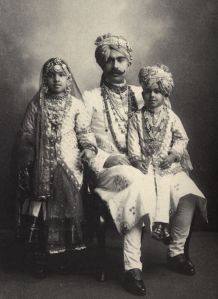
India Father and Children 1930sLucknow Rose and Thorn

There are six families in “The Rose and The Thorn”.  The main characters are Jai Chatterjee, history professor, his wife Shanti and their twin daughters Mukti and Lila.  Then follows The Mukherjees, The Alis, The Johnsons, The Banerjees, and The Maharajas.  It is easy to keep track as the years unfold, events develop in clear progression and the tension builds.

Young Mukti innocently reads the signs of civil unrest in a 1922 pamphlet calling for a boycott on foreign clothing, and the event is witnessed by her British friend Elizabeth and father Alan when riding in a tanga (horse-drawn transport).  Protesters burn clothes on a huge bonfire, quickly followed by police aggression.  One of the police inspectors, Anil, is a Chatterjee family member.

India horse-drawn Tanga

India Mahatma GandhiAround this time, non-violent resistance advocate Mahatma Gandhi is arrested and imprisoned for two years for publishing seditious material.

The twins Lila and Mukti grow up, marriages are arranged and their resilient personalities emerge to deal with life; the loss of loved ones, writing for radical newspaper Chandpur Barta, social work at a women’s centre, and an eventful protest march for women’s rights.

As a young woman in 1970s I was woven into the women’s liberation movement but did not realise how long Indian women had faced their own battles.  They were invisible, they survived as long as they had a man, otherwise they were classed as nothing.  From a 21st century stance, I find it difficult to comprehend the household dictates of that time and the shocking treatment of widows.

The character portrayals of the men and women in the story are strong, and they have firm opinions on the subjects of politics and political activism—handsome Rashid Ali spices things up!  His mother Ruksana is also a driving force.  Mosquito-hating Krishna Banerjee and the Maharaja are men not to be underestimated.  Societal revolutions are brewing but the big question is ‘Will Congress win?’  If women had the vote things may have been different.

Lucknow India 001

I was interested in the chapters dated March 1923 because that was the year my mother was born.  As my mother grew up, I wonder how much she and her Australian contemporaries knew of the Partition turmoil in India?  I knew India was part of the British Commonwealth but certainly didn’t learn about their struggles.  To quote the prologue “There are no martyrs’ monuments or eternal burning flames…” for the ordinary women who led extraordinary lives.

On a lighter note, Chapter 25, March 1923 “The Governor’s Ball” has an outrageous encounter with the Governor’s wife.  And during a family visit to the Taj Mahal, a wandering minstrel strolls by, strumming his ektara (traditional one-stringed musical instrument) singing a saucy song:

There was a rose and a thorn in my life
One was my lover and one was my wife.
Which was which I could not tell
It changed day-by-day and as night fell . . .

. . . I don’t want to give too much away, dear reader, but I will say there is a secret.

Author Ganguly explains that representing the dialogue in English was a challenge.  The two languages used in the book are Hindi and Bengali which have very different grammar syntax.  She overcame this and the result is flowing dialogue containing a smattering of Indian words which enhance the story.

India Food Luchi Eggplant 01The woven cloth khadi, and sweet and savoury food references enticed me to look for translations.  I found a recipe for Mukti’s favourite dish, freshly fried luchi and eggplant.

My curiosity was piqued by the influential roles of India’s royals, the Maharaja and Maharani, in the story.  I read a quote from modern-day Princess Shivranjani of Jodhpur who doesn’t have a problem with only male heirs inheriting but aptly retorts “If you say a boy is everything and a girl is nothing, well, I have a problem with that!”

Indian Goddess Maa Durga Devi 03Powerful Goddess Durga, whose name is spoken several times in the book, also got me researching.  “Durga” in Sanskrit means “invincible” and numerous Mantras are chanted for her throughout the year.

The era of Indian history from 1916 to 1947 is brought alive by Indrani Ganguly through the eyes of Mukti and Lila, and the wise and courageous women who supported them.  While I did not choose a favourite between the rose and the thorn, I enjoyed their journey and learned a lot about the faith and endurance of families in India during those turbulent times.

The epilogue narrator says “I myself travelled many different paths till I joined my father in Delhi but that is another story.”  I look forward to reading it!

Gretchen Bernet-Ward


AUTHOR PROFILE

IMG_20190802_140349
Author Indrani Ganguly

Indrani Ganguly was born of Bengali parents in Lucknow, India.  Her parents imbued her with a strong sense of Indian and world history and culture, and a great appreciation of  diversity in all its forms.  Indrani studied English Honours and sociology in India and did her PhD on the impact of British occupation on revolution and reform in West Bengal from the Australian National University.  In 1990, Indrani married an Australian with whom she now lives in Brisbane, Queensland.  They have a son, daughter and grandson.
Indrani’s website: https://indraniganguly139.wordpress.com/blog/

Published by Boolarong Press
https://www.boolarongpress.com.au/product/the-rose-and-the-thorn/
NOTE General photographs (above) are for illustration purposes only.

Here is the YouTube link to BBC’s Great Indian Railway Journeys video which documents the history and scenes of Lucknow, and shows the buildings which Indrani Ganguly writes about in her book.
https://www.youtube.com/watch?v=CckjZafH0vI

Louise Candlish ‘Our House’ Book Review

Quote “Don’t get me wrong, I’m not saying he was psychopathically charismatic or anything like that.  He didn’t set out to use his powers for evil.  More likely his powers were no match for the evil he chanced upon.” Chapter 34, Fi’s Story >1:59:07

That quotation from Bram Lawson’s wife Fiona appears to be a fair assessment of her husband’s character but is it accurate?  Bram made one faulty decision which started the ball rolling over and over until it rolled into a brick wall, and the wall started to topple.

The unforced yet headlong pace of this novel has to be read to be understood.  It is full-on right from the opening line: “London, 12.30 p.m. She must be mistaken, but it looks exactly as if someone is moving into her house.”

London Terrace Houses 03
Author Louise Candlish has the knack of subverting expectations, making her characters do things I hadn’t anticipated, and making them believable.  Everything that could go wrong, did go wrong in a progression of events at 91 Trinity Avenue in the London suburb of Alder Rise where property values are in the millions.

In this transfixing drama of house fraud and so much more, the main players are Bram and Fiona; their two young sons; would-be homeowners David and Lucy Vaughan; neighbour Merle; Mike and Wendy; the website of crime podcast The Victim.

London Terrace Houses 05

Told by Fiona (Fi) and Bram, their retrospective sides of the story nearly overlap yet never quite converge, building a strong sense of unease.  With foreboding I followed their newly separated, and prickly, domestic rituals with bird’s nest custody arrangements.  I almost shouted at the book a couple of times—I can’t reveal why—as deception and indiscretion insinuated themselves into the story.

Woven through the redolent London background are family moments, some more heart-wrenching than others, before a nasty turn of events and the final dénouement.  While the catastrophic narrative honour goes to Bram, the overarching theme is home ownership and who legally owns the house.  Apparently it is, or was, a possibility that this kind of deed transfer could happen.

“Our House” is the best crime book I’ve read this year, well crafted and written with an ending which sends out shock waves.  If you like incomparable award-winning psychological thrillers, I urge you to read this one.

Five Star Rating Star Fish 02Star Fish 02Star Fish 02Star Fish 02Star Fish 02

Gretchen Bernet-Ward


About the Author:

Louise Candlish UK Author 2019Louise Candlish is the author of eleven previous novels, including “The Sudden Departure of the Frasers”, “The Swimming Pool” and the international bestseller “Since I Don’t Have You”.  Louise studied English at University College London and worked as an advertising copywriter and art book editor before writing fiction.  She lives in South London with her husband and teenage daughter.  “Those People” is her next book.
Author website http://www.louisecandlish.com/

I also recommend author and WordPress reviewer Rachel McLean
https://rachelmclean.com/book-review-our-house-by-louise-candlish-a-gripping-psychological-thriller/

There are perceptive book club questions in a Reader’s Guide at the end of “Our House”.

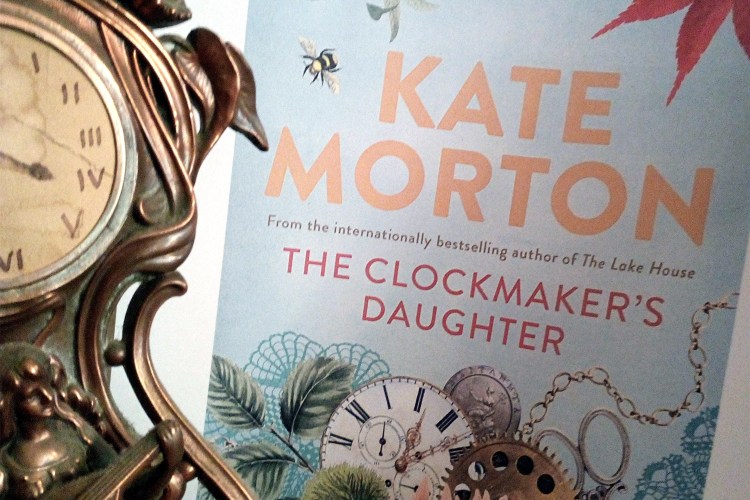
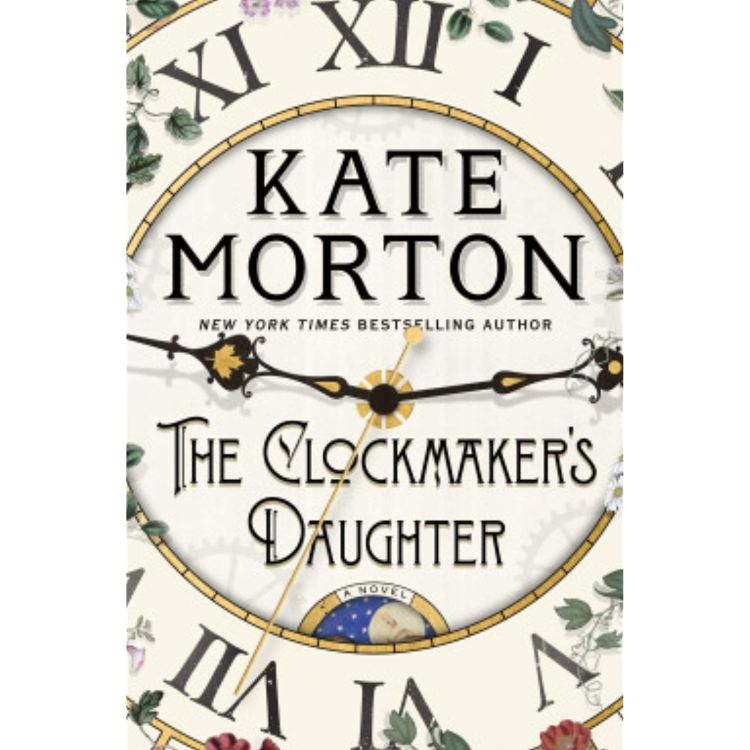
‘The Clockmaker’s Daughter’ by Kate Morton

Not my usual genre

but I love and respect this book. It deserves the status of a 21st century classic.  Narrated by numerous voices from Birdie Bell to Elodie Winslow, I was immersed in a mystery with twists and ghostly turns, fine art and emotional lives of several families over two centuries of turmoil and heartbreak.

The fluid nature of ‘The Clockmaker’s Daughter’ is similar

to the ebb and flow of a river.  In this case the Thames, and the reader should move with the tide, not fight against it.  Accept each individual character and enjoy their allotted time in the book, otherwise an undercurrent could pull you down into reader malaise which may cause you to miss the best bits.

Human emotions are the core of this novel

but some criticism seems to be there are too many characters.  Why?  The classics and modern historical fiction have loads of characters.  I think Kate Morton truly loved her cast of players and couldn’t bear to trim them to fit a mere trifle like a word limit.  Each person has a purpose!

Perhaps the 21st century reader has difficulty due to

a shorter attention span?
less retentive memory?
poorer concentration?
reading skills only suitable for glancing at a small screen?
Tick all of the above
(Sorry, just had to lecture…)

My friends know that rarely, if ever, do I reread a book

The Clockmakers Daughter by Kate Morton 03

because once read, never forgotten – well, almost – but ‘The Clockmaker’s Daughter’ is the first book in years which I have felt compelled to reread.  It touched on many threads in my own familial life and exposed feelings and understandings.  In one chapter, I had to stop because the emotion became too much as I recalled several elements of my own family’s journey through life and death.  My grandfather was an early 20th century artist, talented and struggling to make a living, perhaps similar to Edward Radcliffe.

Triggered by outstanding writing, we pour our own sentiments into a story

and Kate Morton succeeded in cracking my heart just enough to make the sadness bearable.  Then the atmosphere lightens, a scene change like a stroll in springtime.

Synopsis from publishers Simon and Schuster

https://www.simonandschuster.com/books/The-Clockmakers-Daughter/Kate-Morton/9781451649413

“In the depths of a 19th-century winter, a little girl is abandoned on the streets of Victorian London.  She grows up to become in turn a thief, an artist’s muse, and a lover.  In the summer of 1862, shortly after her eighteenth birthday, she travels with a group of artists to a beautiful house on a bend of the Upper Thames.  Tensions simmer and one hot afternoon a gunshot rings out.  A woman is killed, another disappears, and the truth of what happened slips through the cracks of time.  It is not until over a century later, when another young woman is drawn to Birchwood Manor, that its secrets are finally revealed.”

Oh, secrets revealed

but there are a couple of unanswered questions.  This is where a keen reader sees the clever intertextuality and works it out for themselves from the vignettes Kate Morton has polished and refined for us.   Even down to the defining chapter headings—or didn’t anyone notice that.  This story is a puzzle, it appeared to be disparate people until I followed the signposts, keeping observations tucked away for future reference.  Gradually events join up, different eras are linked, a genealogical timeline exposed.

Here’s my incomplete list of characters…

Elodie Winslow, modern archivist
Tip, her great-uncle
Handmade leather satchel
Birdie Bell, young pickpocket
Lily Millington, pickpocket and artist’s muse
Mrs Mack, purveyor of crime
Martin Mack, thug
Pale Joe, sickly boy
Birchwood Manor
Fairy folk tale
Edward Radcliffe, artist and portrait painter
Frances Brown, his fiancée
Lucy Radcliffe, his sister
Thurston Holmes, unpleasant friend
Ada Lovegrove, sad student
Juliet, newspaper columnist
Jack, ex-policeman
Radcliffe Blue, diamond

There are beautiful paragraphs

which I would love to reproduce, although being taken out of context would ruin the impact.  There’s grimy poverty stricken London, the joy of wildflowers, the thunder in a storm, a fascinating country manor, the love between Edward Radcliffe and Lily Millington, the dubious behaviour of their friends and family culminating in a shocking moment followed by the ultimate conclusion.

I won’t divulge crucial plot points and

my recommendation is to read ‘The Clockmaker’s Daughter’ without preconceived notions.  Unlike reviewer Caroline E. Tew, Crimson Staff Writer of The Harvard Crimson, I did not expect a resolution that is literal, practical or easy to digest.  Have a pinch of romance in your soul.

There’s a 12-Minute PDF Blog summary out there which should have a Spoiler Alert.  It reports inaccurately on a clue, and pretty much gives the game away.  I am glad I did NOT read it prior to reading the novel.  It exposes the plot in a clinical fashion, ruining the atmosphere and skimming across Kate Morton’s beautiful prose and depth of feeling.

On the other hand

an exceptionally good review of ‘The Clockmaker’s Daughter’ by Jo Casebourne of The Reading Project will give you well-rounded insights into the story and characters in chronological order from 1860s to present day.

Naturally author Kate Morton’s website is an absolute must
https://www.katemorton.com/behind-the-clockmakers-daughter/

I have reproduced a chapter vignette (below) to show a scene of top-notch character writing.  But first, let me ask you to ponder this key question, answerable after reading the book.  Out of the four woman, mother, sister, lover, fiancée, who do you think loved Edward Radcliffe the most?

Gretchen Bernet-Ward


Chapter Sixteen ‘The Clockmaker’s Daughter’ Extract

Leonard Gilbert, ex-soldier, researching the Radcliffe family.
Lucy Radcliffe, now elderly yet still sharp.

“The cottage was pleasantly dark inside, and it took a moment for his gaze to arrive at Lucy Radcliffe in the midst of all her treasures.  She had been expecting him only a minute before, but clearly had more important things to do than sit in readiness.  She was engrossed in her reading, posed as still as marble in a mustard-coloured armchair, a tiny figure in profile to him, a journal in her hand, her back curved as she peered through a magnifying glass at the folded paper.  A lamp was positioned on a small half-moon table beside her and the light it cast was yellow and diffuse.  Underneath it, a teapot sat beside two cups.
‘Miss Radcliffe,’ he said.
‘Whatever do you think, Mr Gilbert?’  She did not look up from her journal.  ‘It appears that the universe is expanding.’
‘Is it?’ Leonard took off his hat.  He couldn’t see a hook on which to hang it, so he held it in two hands before him.”

Kate Morton 09

Five Star Ratingstar twinkle twinkle 03star twinkle twinkle 03star twinkle twinkle 03star twinkle twinkle 03star twinkle twinkle 03

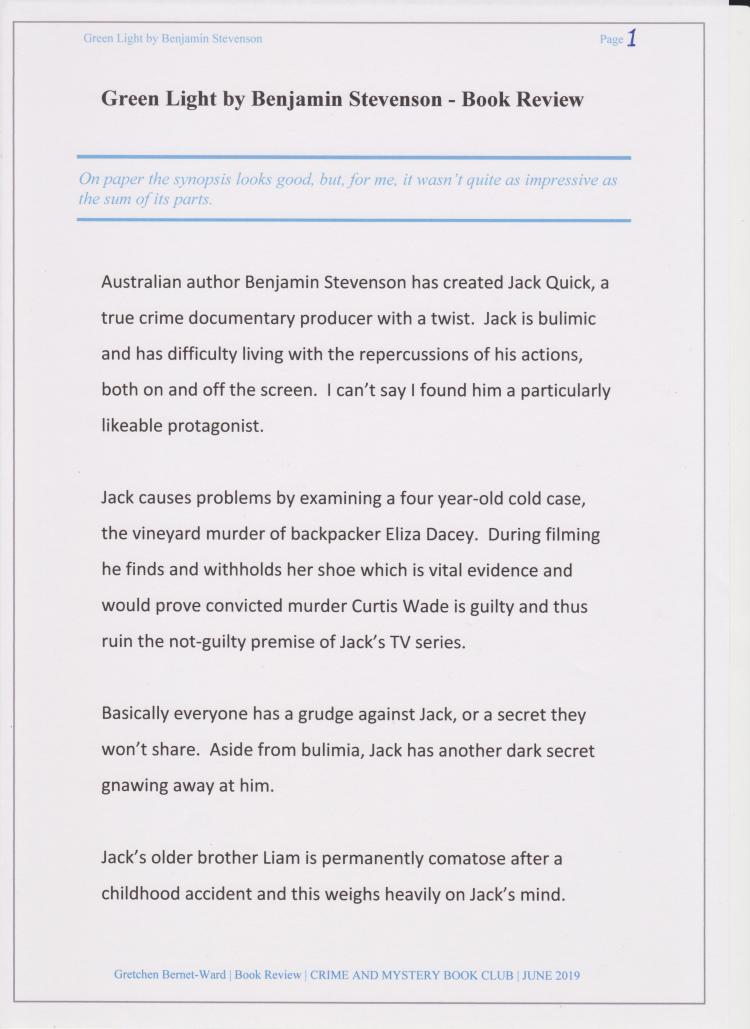
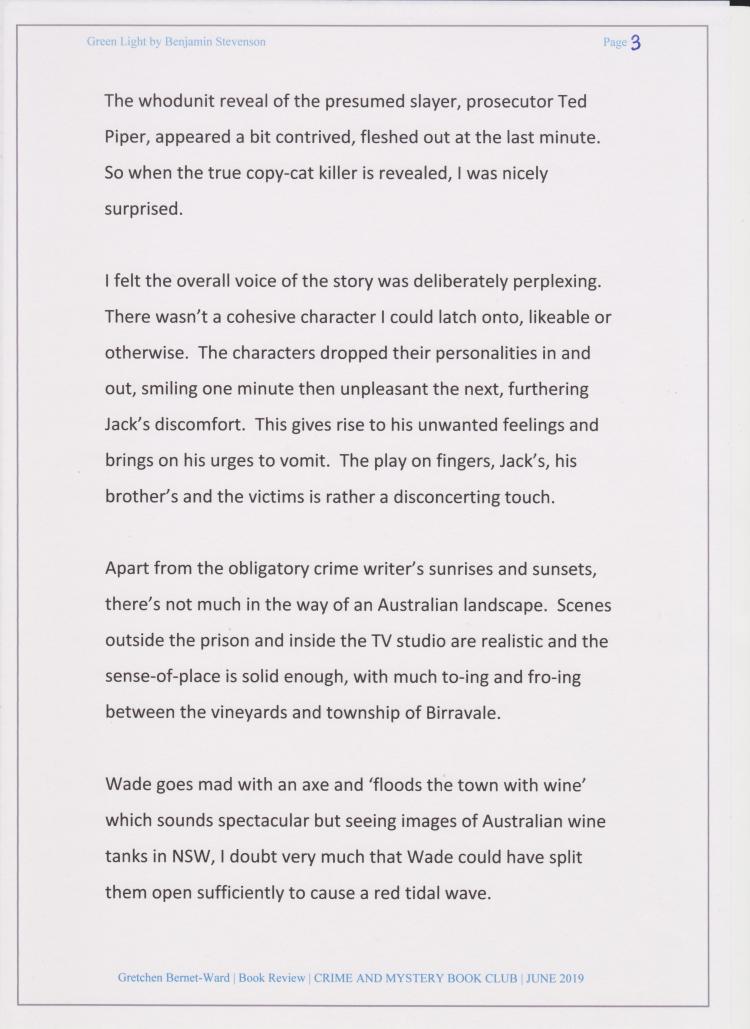
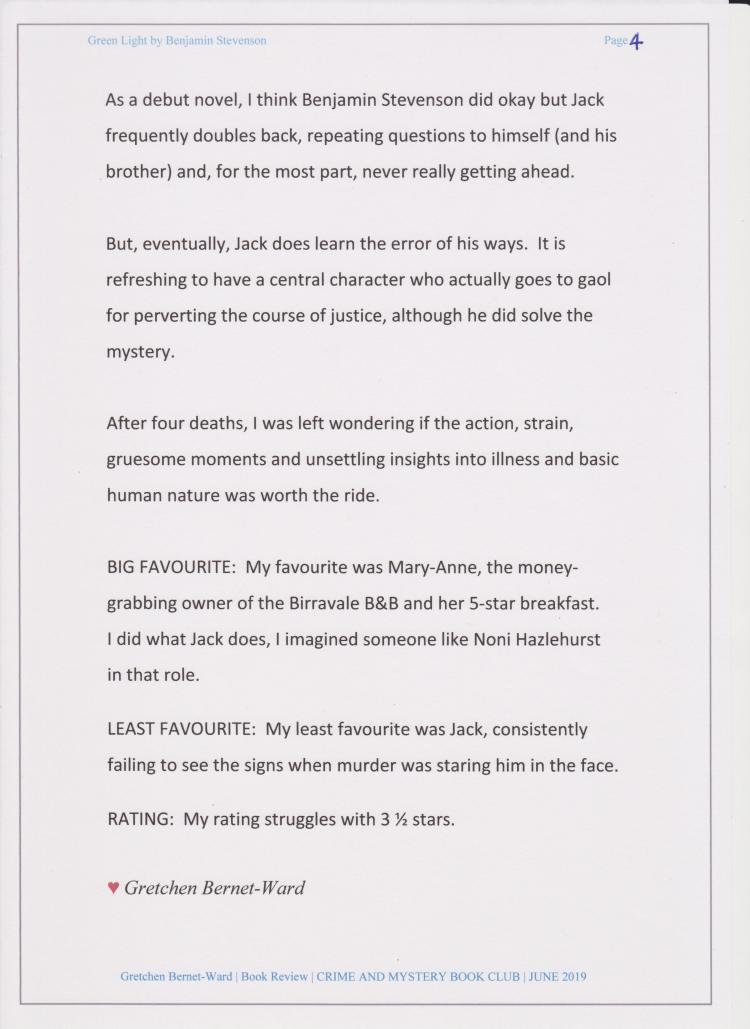
‘Green Light’ by Benjamin Stevenson Book Review

Here are my notes from the book review I presented at my local Crime And Mystery Book Club which meets once a month in our local library.  Most of the participants had similar reviews. Gretchen Bernet-Ward.


Crime and Mystery Book Club Review 01

Crime and Mystery Book Club Review 02

Crime and Mystery Book Club Review 03

Crime and Mystery Book Club Review 04

Jimmy Barnes Working Class Rock Star Book Review

It is said Jimmy Barnes is the heart and soul of Australian rock and roll…if you like his style.  His rasping voice was the sound of the Eighties and everyone knew his song lyrics.  Four decades later and he’s still going strong. 

James Dixon ‘Jimmy’ Barnes (né Swan) was born in Glasgow, Scotland on 28 April 1956 and raised in Elizabeth, South Australia.  His career as the lead vocalist with the rock band Cold Chisel, and later as a solo performer, has made him one of the most popular and best-selling Australian music artists of all time.

From 1973–present, Barnes career has spanned singer-songwriter-musician with vocals, guitar, harmonica and flute and he has received tonnes of music awards (and two Australian Book Industry awards) been inducted twice into the ARIA Hall of Fame and presented with the Order Of Australia medal.

Jimmy Barnes 08

Underneath the gravelly vocals and rough exterior, Jimmy Barnes struggled with an inferiority complex which manifested itself in alcohol and drug addiction for many years.  The question on everyone’s lips was ‘How did he survive?’  Barnes wrote two autobiographies ‘Working Class Boy’ and ‘Working Class Man’ to answer this question.

I doubt his first book ‘Working Class Boy’ (published 2016) was fully edited.  Raw and basic, it is a litany of hope, fear, addiction and the search for acceptance.  Acceptance from his violent father, his mates and his audience.  He writes about childhood abuse, how he ran amok through the towns of Elizabeth and Adelaide and later the Australian east coast, singing, drinking, finding a dealer, finding a girl and not sleeping for 24 hours or more.  A son, performer David Campbell, is the result of a fling in his teenage years.  Barnes’ second father, the man whose name he adopted, was a mentor of sorts until rock music became the epicentre of his life.

Jimmy Barnes 01
Jimmy Barnes ‘My Criminal Record’ collectors edition in vinyl

Barnes second book, a sequel titled ‘Working Class Man’ (published 2017) chronicles his thoughts of suicide and his continuous drug-taking and excessive alcohol consumption to the point of tedium.  A horrible thing to say when I think of the mental and physical torment he was trying to escape.  Still, it didn’t stop him singing—albeit clutching a Vodka bottle on stage every night—nor did it stop him gaining more and more success and greater financial stability as his music career took off.  He began to live the life of a rock star.

Then Jimmy Barnes body let him down.  After surgery, he tried to calm down and write his life story.  It’s not a pretty read, examining old memories, but it’s honest.  There are plenty of photographs and name-dropping, and Barnes talks about his wife Jane Mahoney, their children and extended family.  He is now a grandfather and this shocked me the most!

“If you want to write a memoir, you’ve got to be ready to bare your soul” Jimmy Barnes

No rating because of the ‘chicken and egg’ situation, did his fame boost the books or did the books boost his fame?

Gretchen Bernet-Ward

Website https://www.jimmybarnes.com/
Biography https://www.jimmybarnes.com/biography/
Books https://www.jimmybarnes.com/books/
Press Interview and Movie Clip  https://www.smh.com.au/entertainment/music/for-hyperactive-jimmy-barnes-new-album-and-tour-is-just-the-beginning-20190528-p51s26.html

Jimmy Barnes 02
https://www.jimmybarnes.com/news/tour-announcement-jimmy-barnes-is-shutting-down-your-town/

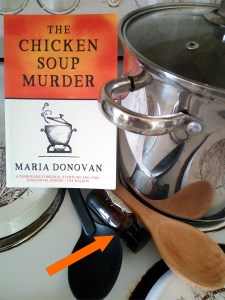
Review ‘The Chicken Soup Murder’ by Maria Donovan

The plot twists and turns over many months as I follow the lives of three families jolted sideways after two untimely deaths.

Michael’s friend Janey has lost her dad to cancer and Michael understands this, but the other person who died?  Nextdoor neighbour and dear friend Irma.  Was it a heart condition, an accident or murder?

The safe, cosy world of young Michael and his Nan changes dramatically.  Michael also has to cope with George, a bully, who moves into Irma’s house with his father Shawn prior to her death.

IMG_20190427_151647The sudden loss of Irma is deeply felt by Michael.  As the saying goes he has “an old head on young shoulders” but is confused over what actually happened and gets no real help from the adults.  Advice is conflicting.

Deep down Michael believes Irma was murdered and is determined to convince Nan and the gatekeepers.  There are complexities to face and he over-reaches in the hope of finding justice.  Anxiety joins his grief, he challenges his homelife and raises old questions.  Why does he live with his grandmother?  Where are his parents?

During a bad night, Michael’s old teddy bear comes down off the shelf for support as he works on his theory of Irma’s demise.  He thinks she may have been poisoned.  The chicken soup in question was homemade by Irma and well loved by Michael, his favourite panacea for cold symptoms.

At one stage, Michael suspects his Nan – she’s my favourite character! – and while out walking he dashes away and hides.  Quote “Michael?” calls Nan.  I don’t move.  “Michael”.  “He’s fallen in the bloody moat,” says the man who isn’t Grandad.  “Good job there’s no water in it.”  “Feeder canal,” says Nan.  “This is no time to be right about everything,” he growls.  I’ve never heard anyone tell Nan off like that before. Unquote.

IMG_20190427_131423
Real clue? Fake clue?

Author Maria Donovan portrays well-rounded, believable characters and each brings small yet highly significant details to the story.  Bully and his father are thorns in Michael’s side but nothing distracts him from the hunt for clues.  Janey has her own family problems.  To relieve her frustration she gets a box of golf balls and stands in The Middle, a green opposite the houses…

Being of a nosey disposition myself, I empathise with Michael’s underlying emotions and the need for resolution.  Tension escalates and stoic Nan marches towards a showdown.  Maria Donovan’s tightly written finale comes at a penultimate time of year for everyone.

IMG_20190427_152828Skillfully woven through the story are school holidays, the seaside, and events on telly like Wimbledon.  Occasionally the zeitgeist side-tracks Michael’s quest yet adds a kaleidoscope of nostalgia for me.

Michael’s journey isn’t for children although young adult readers would identify with the youthful side.  Part mystery, part coming-of-age, I think adults will enjoy the unique elements of the plot, and appreciate less gore than currently found in mystery novels.

Maria Donovan’s book walks a fine line between innocence and adult behaviour and succeeds in capturing the mood beautifully.  It demands to be read again.  Seek out those clever clues!

My star rating star twinkle twinkle 03star twinkle twinkle 03star twinkle twinkle 03star twinkle twinkle 03star twinkle twinkle 03

Gretchen Bernet-Ward


AUTHOR BIOGRAPHY:

Maria Donovan Book Launch

‘The Chicken Soup Murder’ is Maria Donovan’s debut novel and was a finalist for the Dundee International Book Prize.  Apart from this book, Maria has many literary credits to her name including her flash fiction story ‘Chess’ which won the Dorset Award in the Bridport Prize 2015.

Maria is a native of Dorset UK and has strong connections with Wales (also in the book) and Holland.  Her past careers include training as a nurse in the Netherlands, busking with music and fire around Europe and nine years lecturing in Creative Writing at the University of Glamorgan, South Wales.

Visit Maria Donovan online www.mariadonovan.com
Twitter https://twitter.com/mariadonovanwri
Facebook http://facebook.com/mariadonovanauthor

I can highly recommend the informative Chicken Soup Murder Q&A with Maria Donovan and Shauna Gilligan.

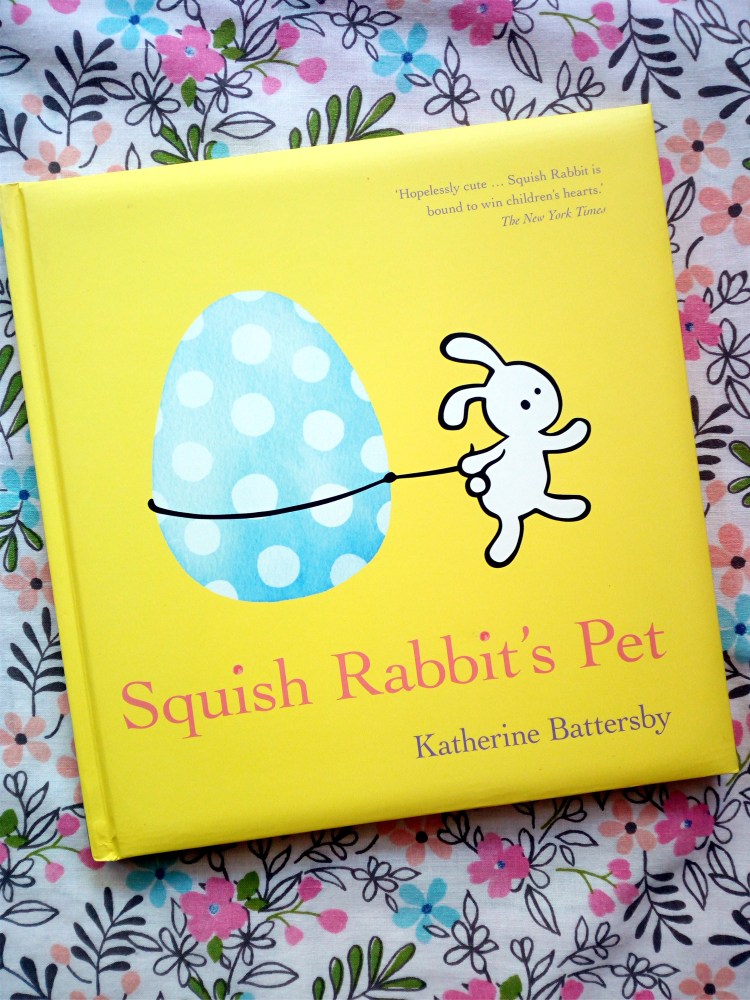
Review ‘Squish Rabbit’s Pet’ by Katherine Battersby

IMG_20190407_133200
The New York Times says ‘Hopelessly cute…’ and they are right.

Squish is just a small rabbit, but he dreams big.

IMG_20190407_134318
Two friends read their favourite book ‘Squish Rabbit’s Pet’.

Squish dreams of many things including having a pet.

IMG_20190407_133317
Squish Rabbit is a lively little character.

Squish makes a long list—a puppy would be perfect.

IMG_20190407_135424
Squish Rabbit makes a list of many things.

Squish’s best friend Twitch helps him along the way.

IMG_20190407_134919
Squish Rabbit’s best friend Twitch helps make an ‘almost’ pet.

Squish thinks important thoughts about friendship and his future pet.

IMG_20190407_133708
Squish Rabbit has two other adventures you can read.

Squish waits and waits to meet his new pet—who is more wonderful than he ever dreamed.


REVIEW:  There is an art to creating good children’s books and with her clear illustrations and succinct text, Katherine Battersby has shaped a beautiful story.  ‘Squish Rabbit’s Pet’ is a picture book which combines thoughtfulness, fun and friendship with an eggciting ending.

COMMENT:  I saw this third Squish Rabbit book at a UQP publishing event prior to its release and had to buy it.  I am familiar with Katherine Battersby’s work and have met her professionally when she journeyed from Canada to Queensland.  Happy reading!  🐨 🍁

Gretchen Bernet-Ward


Category: Children’s Picture Book, Children’s + Young Adult
Release Date: 3 April 2019
Pages: 32
Publisher: The University Of Queensland Press
ISBN: 978 0 7022 6046 9
Teacher Notes: http://www.uqp.uq.edu.au/store/images/Hi-RES/teachersnotes/1501/4157.pdf
Online: https://www.readings.com.au/products/26387171/squish-rabbits-pet

Printed with a squishy cover perfect for little hands!

IMG_20190410_071422
Just gift-wrapped Squish for a new baby, never too young for books!

Dylan Thomas ‘Under Milk Wood’ Wales Readathon 2019

#dewithon19 logo

I found myself drawn to ‘Under Milk Wood’ by Dylan Thomas after accepting an open invitation from Book Jotter to participate in Wales Readathon by reading a book or two from any Welsh writer during March.

Because I wanted to read a physical book, my search had its ups and down until I visited my local library.  Ah, libraries, magical places!

Wales Readathon Dewithon (1)

I now have in my possession (for a limited time) an updated paperback edition of ‘Under Milk Wood’ published 2000 and based on the definitive 1995 edition.  The original was first published in Great Britain in 1954.  The cover art above is taken from ‘Abstract With Woman’s Head’ an oil painting by Evan Walters.  The paperback has been well-read, with yellowing pages, and the print is small.  Initially glancing through it, I thought it had longer introductions and more explanatory notes than the play length!

First, the book blurb to get you started—

Synopsis is taken directly from the back of the book, written when people read longer paragraphs:

“In 1951, two years before his death at the age of thirty-nine, Dylan Thomas wrote of his plan to complete a radio play, ‘an impression for voices, an entertainment out of the darkness, of the town I live in, and to write it simply and warmly and comically with lots of movement and varieties of moods, so that, at many levels . . . you come to know the town as an inhabitant of it’.

The work was Under Milk Wood – an orchestration of voices, sights and sounds that conjure up the dreams and waking hours of an imagined Welsh seaside village within the cycle of one day.  Thomas’s flawed villagers reveal a world of delight, gossip and regret, of varied and vivid humanity; a world that his classic ‘play for voices’ celebrates as ‘this place of love’.”

And, I might add, a snapshot of history, a way of life changed forever.  The VOICE OF A GUIDE-BOOK on page 19 hints at Llareggub being a backwater.  In Dylan Thomas’ time the part where Mog Edwards boasts that he will take Myfanwy Price away to his Emporium on the hill ‘where the change hums on wires’ was already a dying era.  But Thomas shows us that basic personalities never really change.
Wales Readathon Dewithon 2019 05

Now some background information—

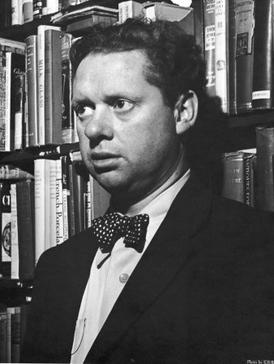
Dylan Thomas (1914 – 1953) is a poetry icon, he even has his own day on 14th May.  No doubt ‘Under Milk Wood’ has been analysed within an inch of its life, so it will be difficult to choose a path not already well-trodden.  For starters, I am not going to tell you Dylan Thomas’ life story – his granddaughter Hannah handles that beautifully.

I will say that Dylan Thomas finished polishing his play for voices ‘Under Milk Wood’ in 1953 and performed it in New York.  It went on to become a BBC radio drama, stage plays, films and produced in several other formats in Wales and around the world.  Australian pianist and composer Tony Gould‘s 1997 ‘Under Milk Wood’ adaptation (written for narrator and chamber orchestra) was performed by actor John Stanton and the Queensland Philharmonic Orchestra.

Several Australian versions followed, including a one-woman production of the text performed at the Sidetrack Theatre in Sydney, New South Wales.  Actress Zoe Norton Lodge performed all 64 characters in the play – and I like to think at least one was based on her father, a proud Welshman.

And finally my book review—

Got a coffee handy?  I may have bitten off more than I can chew with this classic.

Spoken by an omniscient narrator, the opening paragraph of ‘Under Milk Wood’ gave me chills.  If you’ve got the time, I’d like you to read it.

[Silence]
FIRST VOICE [Very softly]

‘To begin at the beginning:
It is spring, moonless night in the small town, starless and bible-black, the cobblestreets silent and the hunched, courters-and-rabbits wood limping invisible down to the sloeblack, slow, black crowblack, fishingboat bobbing sea.  The houses are blind as moles (though moles see fine tonight in the snouting, velvet dingles) or blind as Captain Cat there in the muffled middle by the pump and the town clock, the shops in mourning, the Welfare Hall in widows’ weeds.  And all the people of the lulled and dumbfound town are sleeping now.’

He goes on to describe the people and the animals, the town and household items until we arrive at ‘ . . . the big seas of their dreams.  From where you are, you can hear their dreams.’  Then we learn about Captain Cat, the retired blind sea captain.

FIRST DROWNED
Remember me, Captain?
CAPTAIN CAT
You’re Dancing Williams!
FIRST DROWNED
I lost my step in Nantucket.

And just like that, you know you’re in for a rollicking time!

Make no mistake, it contains dark adult concepts.  Fear, foibles and funny thoughts are exposed, things which the villagers would prefer hidden from view.  At the same time, it doesn’t matter because whatever country or town you live in, I think Dylan Thomas’ characters are universal and show us that love, lust, greed, spite and skullduggery can lurk inside every home.  The odd behaviour of Lord Cut-Glass and his clocks, Mr Pugh’s poisonous ideas, Mrs Dai Bread One and Two; the good, bad and temperamental folk are laid bare in the most lyrical of terms but at the same time asking us to accept and forgive.

As for individual characteristics, I consider Nogood Boyo has the right idea.  He goes out in a dinghy, ships the oars and drifts in the bay, lying in the hull among the tangled fishing lines.  NOGOOD BOYO [Softly, lazily] ‘I don’t know who’s up there (on Llareggub Hill) and I don’t care.’  Page 29.  But inquisitive readers do.  On page 55 Reverend Eli Jenkins muses about his deceased father Esau who fell sleep in a corn field and had his leg scythed off.  Reverend Eli thinks ‘Poor Dad, to die of drink and agriculture.’

Listicle 06Rhymes are chanted and there are various words unknown to me so I appreciated the Textual Notes at the back of the book.  The editors, Messrs Walford Davies and Ralph Maud, took exception to BBC copywriters dropping commas, changing spelling or capitalising/italicising words which were not in Thomas’ original manuscript.  So ‘take that BBC!’ from pages 81 to 104 they have been painstakingly corrected.

But, I say (holding up my pointer finger like a school teacher), while Mr Thomas was said to be an excellent speller, I think I spy with my little eye, a possible hiccup on page 37 and I quote ‘ . . . the drugged, bedraggled hens at the back door whimper and snivel for the lickerish bog-black tea.’  Could that word be ‘licorice’?  No, this man rocks poetic license and knows exactly what he’s doing.

Just for the record, I’m not entering the ‘Under Milk Wood’ book title debate.  The name of the fictional fishing village of Llareggub, where the entire dawn-to-dusk scene takes place, appears to be Welsh but if you read it backwards, it says something quite different.

There are several evocative paragraphs I could elaborate on with great relish, however, since I did not study Dylan Thomas at school, this blog post could be in danger of turning into a starstruck student essay.  I will close with one of the milder pieces:

Wales Readathon Dewithon 2019 06

‘From Beynon Butchers in Coronation Street, the smell of fried liver sidles out with onions on its breath.  And listen!  In the dark breakfast-room behind the shop, Mr and Mrs Beynon, waited upon by their treasure, enjoy, between bites, their every-morning hullabaloo, and Mrs Beynon slips the gristly bits under the tasselled tablecloth to her fat cat.’ Page 27.

An excerpt from the final paragraph reads:  ‘The thin night darkens.  A breeze from the creased water sighs the streets close under Milk waking Wood.  The Wood, whose every tree-foot’s cloven in the black glad sight of the hunters of lovers . . . the suddenly wind-shaken wood springs awake for the second dark time this one Spring Day.’  That makes my mind reel – in a good way.

Grab a copy and read it out aloud—Rated Five Daffodils!

Wales Readathon Dewithon 2019 08Wales Readathon Dewithon 2019 08Wales Readathon Dewithon 2019 08Wales Readathon Dewithon 2019 08Wales Readathon Dewithon 2019 08

Diolch yn fawr, mwynhewch ddarllen!  Gretchen Bernet-Ward

Dewithon Logo Daffs


Twitter #dewithon19

Wales Readathon https://bookjotter.com/category/wales-readathon/

DHQ: Dewithon 2019 https://bookjotter.com/2018/03/26/dhq-dewithon19/

Suggested http://readingwales.org.uk/en/

Rattling the Book Club Cage ‘The Noise of Time’

Do you ever throw a literary stink bomb into your book club meetings?  Does a particular book annoy you into spewing a non-positive review?

My recent attendance at a book club gathering certainly raised eyebrows (I guess I’m not highbrow) when I panned Julian Barnes 2016 quasi-biography ‘The Noise of Time’ based on Russian composer Dmitri Shostakovich.

I believe book clubs should read a wide variety of books and not just ‘literary stuff’.  Out of 12 people, only two of us spoke up and voiced our critical opinions without fear or favour.

Read my review below and make of it what you will – this is not a discussion post but it is my opinion and I totally respect yours –


Book Review – ‘The Noise of Time’ by Julian Barnes

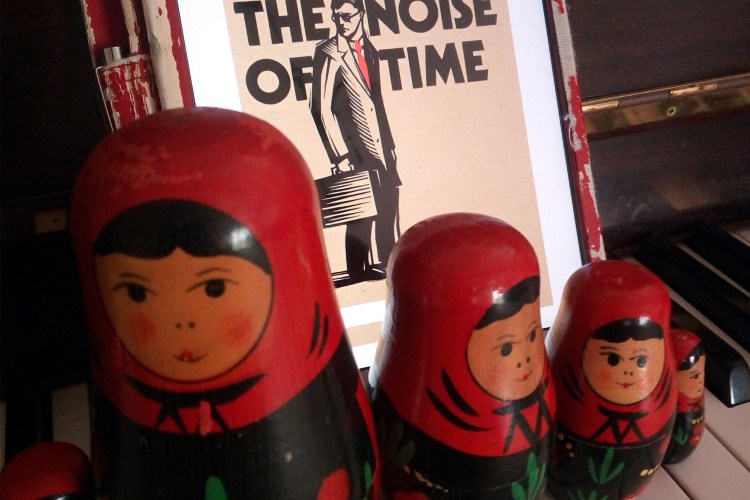
The Noise of Time by Julian Barnes

Author Julian Barnes fictionalised biography of Russian composer Dmitri Shostakovich begins in 1930s and is about the man himself, not necessarily about his music which is a disappointment.

Barnes wants to immerse us in the inner world of Shostakovich, therefore most of the story takes place within the previously uncharted waters of the composer’s own mind.  The rest appears to be gleaned from conventional sources.  There’s a lot of telling and not much showing.

Russian Composer Dmitri ShostakovichFirst up, Shostakovich’s opera ‘Lady Macbeth of Mtsensk’ is denounced, and while there is tension and foreboding throughout the story, there’s no significantly dramatic scenes after this point.  Shostakovich smokes heavily and is understandably nervous.  He has the fear of Soviet Communism hanging over his head all the time (there’s a peculiar phone call from Stalin) and the dread which Shostakovich seems to pile upon himself.  Like the bookcover illustration, he’s a man always looking over his shoulder but this doesn’t necessarily make edifying reading.

Politics aside, Shostakovich later wrote his Fifth and Eighth Symphonies yet Barnes glosses over a lot of this, using a series of vignettes without delving into that emotional side, so there’s minimal mention of his creative process or the effects of his wife’s death on his family.

The interior dialogue does not expose Shostakovich as an eccentric creative, nor do I think it makes him a likeable protagonist.  Barnes portrays his inner world in an obsessive manner (think clocks, bad luck in a leap year, the elevator scene) and I think he comes across as a bullied child.  One who needs encouragement yet gets slapped down at every turn.

British Author Julian BarnesMy favourite paragraph is when Shostakovich is staying in New York and a woman working at the Soviet consulate jumps out of a window and seeks political asylum.  So, every day a man parades up and down outside the Waldorf Astoria with a placard reading “Shostakovich Jump Thru The Window!” but according to Barnes and other writers this gave him great inward shame.

In strides man-about-town composer Nicolas Nabokov who kindles Shostakovich’s shame so that Shostakovich is trapped by his own timidity, unable or unwilling to stand up and be counted, preferring to talk through the medium of music which is later used to punish him.

For me, this partly true reimagining is not very engaging.  I did learn a couple of new things but even allowing for Julian Barnes writing style, this book doesn’t add anything special to my reading list.

Gretchen Bernet-Ward


Publisher Penguin Books
https://www.penguin.com.au/books/the-noise-of-time-9781784703332
Author Julian Barnes
http://www.julianbarnes.com/
Composer Dmitri Shostakovich
https://en.wikipedia.org/wiki/Dmitri_Shostakovich