‘Don’t Keep History A Mystery’

Read a story which is thousands of years old.  I’d like to share the email I received from Mr Miller on National Sorry Day and to commemorate National Reconciliation Week––

“My name is Glen Miller, I am a Board Director of the Indigenous Literacy Foundation and a descendant of the Butchulla people of the Fraser coast (Queensland). Today we acknowledge the 10th anniversary of National Sorry Day, a milestone in Australia’s history. This National Day of Healing is at the heart of our steps towards reconciliation. Tomorrow marks the beginning of National Reconciliation Week and we reflect on this year’s theme: ‘LEARN, SHARE, GROW – DON’T KEEP HISTORY A MYSTERY’. Here, we are invited to explore our past as a country; learn, share and acknowledge the rich histories and cultures of the First Australians; and develop a deeper understanding of our national story.

“Today I would like to share a story that is thousands of years old, that has been passed on from one generation to the next, and nearly came to be lost…

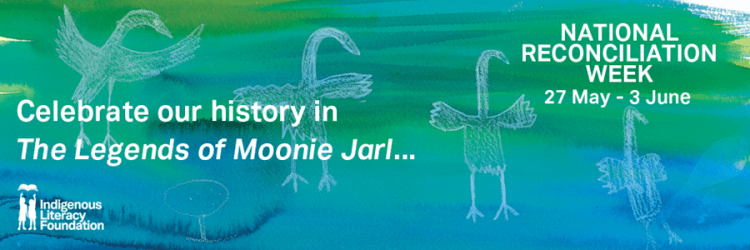
ILF Legends of Moonie Jarl Banner

“For many thousands of years the Butchulla people have been travelling between Queensland’s K’Gari (Fraser Island) and the mainland; catching winter mullet in stone fish traps set along Hervey Bay and trading with the mob up around the Bunya mountains. There are three laws that the Butchulla people live by: 1) What’s best for the land comes first, 2) If you have plenty, you must share, and 3) Do not touch or take anything that does not belong to you.

“While these were the laws that were taught to the children, they were also told stories that describe the origin of the land: The Legends of Moonie Jarl. These stories tell how the wallaby got its pouch, how the boomerang was invented, and how the little firebird came to have that bright scarlet spot on its back. These stories were told to me as a boy by my uncle Wilfy in the The Legends of Moonie Jarl. The year was 1964 and it was the first Aboriginal children’s book published and authored by Aboriginal people.

“Three years after its publication, Indigenous people were finally recognised as Australian citizens and 50 years on the stories continue to be shared among the Butchulla people. In 2014, our Foundation re-published The Legends of Moonie Jarl so now the stories are available to share with all Australian children.

Indigenous Literacy Foundation“A book isn’t just for reading; it’s more powerful than the information it provides. Reconciliation Week is an opportunity to look at the truths that need to be told and  celebrate our stories. This National Reconciliation Week I invite you to learn and share these rich histories and cultures of Indigenous people, and develop a deeper understanding of our national story. Please support the work of our Foundation by purchasing a copy of The Legends of Moonie Jarl or making a donation.”

Glen Miller
ILF Board Director
May 2018

“It was written by Uncle Wilf Reeves and illustrated by my mother Olga Miller” – Glen Miller.

Indigenous Literacy Foundation
PO Box 663 Broadway NSW 2007
Australia
info@ilf.org.au

Gretchen Bernet-Ward

HRH Queen Elizabeth II Birthday

In UK, Her Royal Highness has two birthdays each year: her actual birthday on 21st April and her official birthday usually the second Saturday in June.  Born in 1926, at the time of writing, she is 92 years-old and still going strong.  Happy birthday, Your Majesty!

The birthday of reigning monarch Queen Elizabeth II is celebrated at different times of the year throughout the world and usually accompanied by a public holiday.  In Australia, each State and Territory has decreed a different day.

In Queensland (named after Queen Victoria) we have a Monday holiday in honour of the Queen’s birthday and enjoy a long weekend.  This year it falls on Monday 1st October 2018 and Brisbane residents will head to official celebrations, BBQs, coastal regions, rainforest walks or just laze around at home and read a book.

Gretchen Bernet-Ward

“God Save Our Gracious Queen”

View my blog post about my own umbrella
https://thoughtsbecomewords.com/2018/03/02/childhood-status-symbol/

Jasper Fforde 2018-2019 Author Events

Excited beyond belief when I found out Jasper Fforde, my all-time favourite post-modern author, has some cool events coming up!  Including another book.  And the eponymous Fforde Ffiesta rolls around again next year.

If any reader attended a US event, or may be attending a future UK event, I’m jealous but hoping I will read your WordPress review.  Of course, I will be writing about Jasper Fforde’s Brisbane Writers Festival 2019 special guest appearances in September!  See itinerary below—

Gretchen Bernet-Ward

Photos by Mari Fforde (hover to see date)
Information from Jasper Fforde website (see below)


APPEARANCES

 Jasper Fforde says:  As usual, please call the venue to check times and dates before you set out just in case I am kidnapped by badgers, eager to promote their dangerous monochrome agenda.
Gretchen says: New book “Early Riser” is now available.  Read my review here
https://thoughtsbecomewords.com/2018/12/14/early-riser-jasper-fforde-book-review/\


2018


Feb 21st-22nd, Casper, Wyoming:
Wyoming Humanities Festival 2018

Book signing and lectures. I’ve never been to Wyoming, and the frightfully pleasant people at Casper have been asking me for a while. Talk and Book Signing Courtesy of Windy City Books, and a lecture plus Q&A the following day. Full details at the Humanities Festival website.


1-2nd March 2018, Cardiff Library:
Crime & Coffee Festival, Cardiff

First Crime and Coffee Festival at Cardiff Library. More details to follow, but I am assured the coffee is the crime, and there will be no actual murders of crimes taking place. Either days, or both, details to follow. Cardiff Library Website.


24th May-3rd June 2018
Hay Festival, Hay-on-Wye, Wales:
May or may not be attending this year––One of the UK’s most imaginative and entertaining authors creates hilarious, often absurd but always compelling adventures within bizarre and zany worlds.  Jasper Fforde’s hugely popular The Last Dragonslayer series is packed with trademark magic and invention.”
Information brochure Hay Festival, Wales.
Gretchen’s book review The Last Dragonslayer.


August 2018
Launch of Early Riser in the UK:

About bloody time too, say I.  Likely 1st to 12th August.  More details to follow.


August 13th – 18th, 2018, Wales:
Ty Newydd writing retreat, Wales

With Belinda Bauer, the course is called: Crime Fiction: A Twist in the Tale and from their website: “This course is designed for those who would like to write best-selling crime fiction – with a twist. Whether you’re writing your first novel, are switching from another genre, or have only dreamed of being a published author, we hope you’ll enjoy this down-to-earth, fun, and practical course. In workshops and one-to-one mentoring sessions, we will be sharing our tried and tested methods of creating character, plot and tension, while helping you to avoid some common pitfalls. We’ll offer advice on a range of issues, from writer’s block and the art of pitching, to how to cope with bad reviews!”
For more details, please mouse you way to the Ty Newydd Website.


2019


Early Riser Tour Jasper Fforde


25th-26th May 2019, Swindon, UK:
Fforde Ffiesta VIII, Swindon, UK

These Festivals are held biannually and oh, what ffun we have – and hopefully a lot more to talk about this year as I will have at least one more book published… Their website is here.


NEWS FLASH !!

THURS 5 SEPTEMBER TO SUN 8 SEPTEMBER 2019, BRISBANE, AUSTRALIA

VENUE: BRISBANE WRITERS FESTIVAL, SOUTH BANK, QUEENSLAND
https://bwf.org.au/2019/brisbane-writers-festival/artists/jasper-fforde-1

Jasper Fforde itinerary will be:

Event 1 – Workshop ‘Writing Futures’ with Jasper Fforde at QWC: Learning Centre, State Library of Queensland.

Event 2 – Panel ‘Dream Worlds’ at Cinema B, Gallery of Modern Art, South Bank.

Event 3 – Conversation ‘Early Riser’ at The Edge, State Library of Queensland.

Event 4 –  Book Club ‘Meet Jasper Fforde’ River Decks, State Library of Queensland.

Event 5 –  Lecture / Special Closing Address by Jasper Fforde, The Edge, State Library of Queensland.

Jasper Fforde at Brisbane Writers Festival Sept 2019


FUTURE ENGAGEMENTS


March 02031:   Asteroid belt and Saturn (technology permitting) More details TBA.

October 02042:   81-year-old Fforde talks to other members of old people’s home: “I used to be a novelist, no really, I did. Is it lunchtime?” More details TBA.

July 02175:   Semi-lifelike cloned Ffordesque replicant to tour Gamma Quadrant in the Cygnus Cluster. More details TBA.

Setember 03431:   Much improved Fforde cloned back to life to face execution for sedition; all works consigned to erasure.

Janfebry 008910:   Last evidence of Fforde’s books vanish forever with the removal of the ‘Formerly Thursday Street’ plaque from what is now W23-61 Rd in the conurbation known as EuroWest-79.

00012972:    Visiting archaeologists from Thraal-7 discover incomplete copy of Well of Lost Plots from excavation in landfill. Deciphering takes seven hundred years and a further four hundred years of academic scrutiny before being accepted as historical fact.


More ffun, books, merchandising, photos  Jasper Fforde Grand Central
For those who like a bit of backstory  Wikipedia – Author Jasper Fforde
Twitter  @jasperfforde
Instagram  Jasper Fforde
Facebook   Jasper Fforde Writer

NEWS FLASH 2020

JASPER FFORDE HAS CONFIRMED FORTHCOMING BOOKS!

“Dark Reading Matter”  Bookworld and Thursday Next – adult
“Dragonslayer IV”           Ununited Kingdom and Jennifer Strange – young adult
“Shades of Grey II”         Colours and Eddie Russett – adult
“The Constant Rabbit”   Racism and Mrs Constance Rabbit – adult – available now


Book Covers Tell Too Much

Books Bookshelf Old Volumes

Can you tell a book by its cover?  Sure you can!  Just the same as an individual’s personality and clothing can tell something about them, a book lures the reader with an enticing cover image.  That visual reveal, a hint of what’s hidden within the book is a very important marketing tool.

A contemporary bookcover, no matter what the genre or category, has to be identifiable.  It has to look good on publicity material, it has to create a mood and it has to appeal to its target audience.  The font style, back cover blurb and all-important artwork join together to get you interested enough to part with your money.  Unless you are borrowing the book from your local library.  Nevertheless, you will still be interested in that lurid hardback in your hand because it promises so much…just look at that out-of-context quote from a famous author who said “chilling depth” and “sizzling romance” from a “writer with imagination”.

Millions of modern eye-catching bookcovers are perfectly serviceable and practicable and sensible and don’t mislead the intended reader.  It can be argued that bookcover images only hint at a small portion of the entire book.  But, as a person who reads books very closely, I disagree.  I like to make my own assumptions and not be misled by skewed artistry.

Thus I start my LONG bookcover show-and-tell, documenting that which has annoyed me for some time – the all-to-obvious artwork on bookcovers, those illustrations which give the game away.

  • The reveal: I loathe it when the crime bookcover shows the pivotal moment in the book. A dead giveaway!  Is that the graphic artist’s fault for reading the front and back page?  Is it the publisher’s fault for handing out the last chapter?
  • Bookcover clue giveaway: I have just finished a police procedural and the creepy black-and-white cover photo with a rundown house on the hill encircled by barbed wire is actually where the bodies are buried. No kidding, I knew every time the detective went up that hill, he was darn stupid.  Or the one with the sketch of a child on a rocking horse holding a scythe over her shoulder – storyline crumbles before it starts.  Worth mentioning that a rocking horse was not even in the story.
  • Vignettes snipped from a chapter: Like historical fiction “Golden Hill”, where a sketch of the hero is seen on the bookcover leaping across a roof top in true Hollywood style, no doubt aimed at action-loving readers, when the bulk of the story revolves around cruel social hierarchy.
  • A mystery novel: Well, murder actually because several people end up getting killed. This illustration managed to ruin the first three punchlines in the first three chapters.  Not to mention the good guy is seen working in the downstairs office window when his office is upstairs.  Plus the red motorbike heading up the road outside is meant to be him, at the same time.  Lovely drawing but couldn’t they have chosen something more accurate?
  • Overcooked Clones:  There’s the hand frozen in ice (guess how the victim dies) there’s the bridge across the river (guess how the victim dies) there’s the threat (a big dark old building) there’s a corrupt political serial killer millionaire mowing his way through rich widowed neurotic socialites on board his yacht (guess how the victims die) or bones poking out of the earth…black crow…wolf in snow…lonely highway…stark tree…dropped gun…body part…the train racing through the underground station…all overdone crime tropes.
  • To quote Tim Kreider, essayist: “The main principles of design—in books…is your product must be bold and eye-catching and conspicuously different from everyone else’s, but not too much! Which is why the covers of most contemporary books all look disturbingly the same, as if inbred.”  Which leads into––
  • Dark silhouette: I, for one, thoroughly dislike the brooding male or female silhouette in a heavy coat, head down, walking toward a menacing city skyline/bridge on a rain-soaked evening. Boring!  The stock standard photo silhouette has been on countless bookcovers for years.  Think of Lee Child.
  • Expected bookcovers or Clone II:  Why does (1) Romance have the obligatory well-developed over-muscled man and well-developed bust-overflowing woman, and (2) Literary fiction has a sedate, toned, almost elegant layout with a design which purrs good taste?  (3) Non-fiction is so varied it usually has just a colour photo with a word overlay.  (4) Historical fiction will have a woman in period costume gazing at house or hillside.  (5) Children’s books, fantasy and science fiction have a place all their own.  Renegades breaking up the predictable.
  • Flip side: An irrelevant illustration. There are obscure bookcovers like “The Midnight Promise” with two hands shaking as though in agreement when the Promise is nothing like that image.  At least it gave me something to ponder.
  • World-wide: I’m commenting on English language publications and referring to p-books and e-books. I’ve mentioned arbitrary books I have read and tried not to name them.  However, the same book published in different countries gets a different bookcover.  This is where designers and image stock can become tricksy.  I have seen translated children’s books looking very adult, young adult books looking too adult, and adult books looking sugary sweet, e.g. cosy mystery covers with blood-thirsty content between the pages.

Book Sliced Up on Plate with Knife

BONUS:  Terry Pratchett’s bookcovers by artists Josh Kirby and Paul Kidby tell a detailed story.  With fiction, decide how closely you should look.  Decide if you want to undermine the plot.  You may not even notice pictorial clues!  Ask yourself if you are exercising your own freewill, or are you conditioned by a generic bookcover image.

Link to superb 20th century bookcovers from The Paris Review:
https://www.theparisreview.org/blog/2018/02/22/twelve-illustrated-dust-jackets/

Today, the mass market book illustrators, the image makers, appear to acquire design inspiration from their clinical, perfectly sculptured computer programs.  Perhaps they should visit an art gallery, or see what’s shakin’ in the real world, then tell that miserable silhouette model to get lost.

Never stop reading!

Gretchen Bernet-Ward


Postscript : A Tiny Bit of History : Literature has changed in more ways than one over the centuries.  Illuminated manuscripts gave way to smaller volumes with dust covers/jackets in 1820s Regency, then refined in 1920s to make hardback books more attractive.  Before this the majority of bookcovers were a plain single colour with gold embossed wording and little adornment.  Swanky ones did have lithographs or a portrait frontispiece.  It is considered that 1930s paperback printing changed the course of bookcover art.

Lorna Doone by R D Blackmore

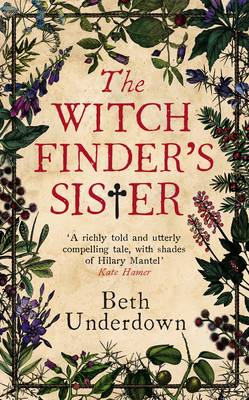
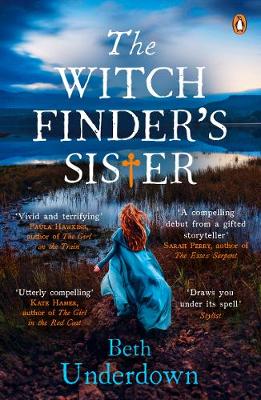
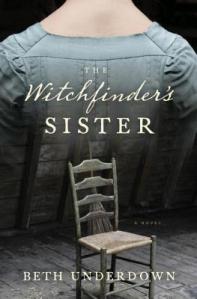
‘The Witch Finder’s Sister’ by Beth Underdown

A witch-finder compiles his list … To me, prologues are an unnecessary extension of the backcover blurb and I often don’t read them.  Resistance is futile when it comes to Beth Underdown’s deep dark 17th century historical novel based on the real witch-finder Matthew Hopkins.

When I read the prologue to The Witch Finder’s Sister I tried not to become smitten with the words, tried not to be intrigued by the premise nor overcome with a desire to read what sister Alice has to say, but I am already into Chapter 8 even though historical fiction is not my preferred genre.

As absorbing as I’m finding this tale, this is not a proper book review and “no correspondence will be entered into”.  But I will say Chapter 1 is claustrophobic and tension-filled, a classic example of how thoughts become words to become other people’s thoughts.  There is an epilogue under the guise of Author’s Note which I can live without reading.  If you wish to pursue the Prologue & Epilogue debate, check out  WordPress Blogger theryanlanz A Writer’s Path

The Witchfinder's Sister Bookcover 03

I will leave the review to Suzi Feay of esteemed The Guardian newspaper:

The Witch Finder’s Sister by Beth Underdown review – puritan or serial killer?
The Guardian Review of The Witch Finder’s Sister by Beth Underdown


The Witchfinder's Sister Bookcover 01

Gretchen Bernet-Ward

Here is the prologue to The Witch Finder’s Sister by Beth Underdown––
“1645, and the Civil War in England has begun its fourth year.  It is a war about God, and how best we should worship Him.  It is a war about who should govern, and why; whether the Parliament should rule, or whether the ousted King.  It is a war of thoughts, of words printed or hurled in anger: but this is also a war of guns.  Last year, at Marston Moor, more than four thousand men were killed.  Before this, women have seldom been hanged for witchcraft – one or two, every five years, or ten.  Eight were sentenced in Pendle, thirty years ago, when the land still knew peace.  But now this country is falling apart at the seams.  Now, all England is looking the other way: so there is nothing to stop Matthew Hopkins stepping forward.  Starting to make his list of names.”

Proof-reading Style Errors

IMG_20171225_204232
Breaking the proof-reading rules?

The style guide reads: Below are errors in style due to inappropriate or poor choices of language which can lead to boring, imprecise and inaccurate writing. In some situations, they may be relevant and suitable, but they are usually best avoided––

  • Clichés, over-used phrases, e.g. bed of roses, pretty as a picture.
  • Vogue words and trendy expressions, e.g. proactive, meaningful dialogue.
  • Colloquialisms in formal writing.
  • Parochialism in documents intended for a wide audience.
  • Jargon in documents intended for a general audience.
  • Euphemisms, e.g. pass away, upwardly mobile.
  • Overstatements, e.g. fabulous, incredible, fantastic, amazing.
  • Archaic words, e.g. herewith, thereby, hereinafter.
  • Sexist terms, e.g. man-made, nurseryman, waitress.
  • Tautologies, e.g. totally unique, completely empty.
  • Ambiguity, e.g. maybe I would if I could.
  • Unnecessary use of foreign words and phrases.

This information was retrieved from my older Word.doc files with no acknowledgements attached.  As a touch of humour, I wrote the short profile of Aunt Belinda.  I can only suppose such formal advice is for non-fiction writers.

Gretchen Bernet-Ward

Let Your Heart Be Light

Jen Storer is an established Australian children’s author brimming with imagination and inspiration. This post encapsulates her talent, personality and future plans. Jump into The Duck Pond and start paddling with emerging writers and illustrators!
Gretchen Bernet-Ward

girlandduck's avatarGirl and Duck

Hello!

I like writing blog posts at Christmas. No one expects much. Do they?

IMG_3967Writing: I finally finished Truly Tan: Baffled! (book seven) and delivered it to my publisher on time (working right up until December 15, the day it was due). Phew! Next year I’ll be waaaay more organised. Ahem.

Finalising: We signed off on Danny Best: Me First! Check out the full cover. Talk about The Best! 😉 Due out in Feb 2018.

DB_MEFIRST_FC2Receiving: I received a Christmas card from a Tan reader. The letter attached said, I know you like wolves. So here’s a card with a fox on it. God, I love my readers.

IMG_3984 2

Planning and: pondering 2018. I have some lovely plans for girl and duck, including a Scribbles Boot Camp in Feb, and an IRL (in real life) Scribbles master class in Melbourne in May. We will also be launching the Girl and Duck…

View original post 518 more words

Can Listicles Rot Your Brain?

Listicle List 04

Is a listicle clickbait, fun facts written for readers with short attention spans, or an orderly way to write information?

First of all, the word listicle is comprised of two words, list and article, and features numbered sentences.  The salient content is brief, frequently light on facts, often humorous and has an almost hypnotic quality.  There is a compulsion to read a listicle to the end but this can leave a feeling of dissatisfaction.  Yet, as time and the internet marches on, readers can’t get enough of them.  Accordingly, listicles have transcended dot points and editorial shortcuts to become the layout of choice for everyday writers and bloggers needing a quick and easy-to-read solution.

Listicle List 01

You know what to expect by the heading of a listicle, usually important nonsense, so opinions are divided on their usefulness.  Are they ever meant to be taken seriously?  Many people think so, but that’s probably because they are writing a how-to manual.

Back when a listicle in a magazine was called a Guide or Questionnaire, and had titles like “Ten Ways To Find Out If Your Boyfriend Really Loves You”, the format was short, numbered sentences and had ten boxes to tick ‘yes’ or ‘no’ and ended with your score.  Listicles have morphed into a more sophisticated version of this ‘filler’ yet still pretend to be useful data, advice or handy hints to enhance your lifestyle.

Listicle List 02

So, does this glossary format, this amusing fad with the cute name, continue on or can it be classed as nouveau 21st century literacy?

It doesn’t affect my reading ability (heck, I’ve re-blogged them myself) and I tend to treat a listicle as an expurgation, a beguiling and abridged version of real reading.  Just type in ‘listicle websites’ and have a look at the content.  Hardly literature at its finest even allowing for sentences stripped bare.

There are as many ‘for’ and ‘against’ stories as there are listicles.  Here are 3 of my favourite takes on listicles with apologies for not making it 10––

Listicle List 03

(1)  Excerpt from “What Is A Listicle?”
https://www.thoughtco.com/what-is-a-listicle-1691130
From Richard Nordquist comes this Garrison Keillor slice of the Darker Side Of Listicles, an interview with the writer who popularised listicles (or did he?) and asks him––

Q: Do you have any idea what damage you’ve done, Jim? You’ve made people more stupid. Some of your readers now find it hard to read paragraphs that aren’t numbered.
A: How many? A lot?

Listicle List 08

(2)  Excerpt from Mark O’Connell “Ten Paragraphs About Lists You Need in Your Life Right Now” The New Yorker, August 29, 2013
https://www.newyorker.com/books/page-turner/10-paragraphs-about-lists-you-need-in-your-life-right-now
“The rise of the listicle obviously connects with the internet’s much-discussed effect on our ability (or desire) to sit still and concentrate on one thing for longer than ninety seconds. Contemporary media culture prioritises the smart take, the sound bite, the takeaway––and the list is the takeaway in its most convenient form. But even when the list, or the listicle, has nothing really to do with useful information, it still exerts an occult force on our attention––or on my attention, at any rate. (’34 Things That Will Make ’90s Girls Feel Old.’ ’19 Facts Only a Greek in the U.K. Can Understand.’ ’21 Kinds of Offal, Ranked By How Gross They Look.’) Like many of you, I am more inclined to click on links to articles that don’t reflect my interests if they happen to be in the form of countdowns. And I suspect my sheep-like behaviour has something to do with the passive construction of that last sentence. The list is an oddly submissive reading experience. You are, initially, sucked in by the promise of a neatly quantified serving of information or diversion….Once you’ve begun reading, a strange magnetism of the pointless asserts itself.”
Note how Mark O’Connell has numbered all his paragraphs.

Listicle 06

(3)  On the flip side, here is an excerpt from pro-listicle website “Five Reasons Listicles Are Here to Stay and Why That’s OK”
https://www.wired.com/2014/01/defense-listicle-list-article/
Rachel Edidin talks about ‘active progression’ and ‘lane-markers’ and her opening comment launches straight into battle “Lists are everywhere. They’re the bread and butter of sites like Cracked and BuzzFeed, and regular content or sporadic filler at dozens more. (Yes, even WIRED). From the multimedia gallery to the humble Top 10, list-format articles – listicles – are rapidly becoming the lingua franca of new-media journalism…” and later says “… listicles are just another tool in the box.”

Listicle

Listicle List 06

Listicle List 07

If you are a listicle fan, you won’t be reading this blog post.
For those who have struggled this far, here is a bonus extra:

On a scrap of paper, I’ve just written my higgledy piggledy shopping list––or is it?

1.     Bread, flour.
2.     Milk, butter, cheese.
3.     Coffee, green tea.
4.     Apples, oranges, pears.
5.     Potatoes, carrots.
6.     Basil, thyme, rosemary.
7.     Eggs, chicken.
8.     Gnocchi, penne, ravioli.
9.     Tuna, salmon.
10.   Basmati, paella.

Did you read to the end?

Gretchen Bernet-Ward

Postcards Postcrossing the World

Postcards are alive and well and received by countless friends, family and complete strangers around the world.  Complete strangers?  This is where Postcrossing comes into the picture.

I first learned about Postcrossing, a postcard exchange group, from a quarterly Stamp Bulletin and joined free-of-charge.  The five-step guidelines are easy to follow, the website makes it simple to set up a profile and tweak your settings.  Navigate around and check out the stunning and prolific cards received and uploaded by Postcrossing members.  Everyone abides by the rules so things flow smoothly between more than 69,000 members in over 200 countries.

Postcard 017SEND: There’s pleasure in finding and choosing suitable postcards and stamps uniquely representative of your own location.  Clever members can match a postcard to followers hobbies.  It took a couple of weeks for the first postcard to hit my letterbox but I could start mailing out straight away.

RECEIVE: The beauty, variety and quantity I received, often from places I’d never heard of, was impressive.  English is universal although you can specify countries and language.  Handwritten, never laser printed, it takes a certain skill to describe something about yourself and your town on the back of a small piece of cardboard!

Postcrossing Logo

The Postcrossing project was created in 2005 by Postcrossing Founder Paulo Magalhães as a side project when he was a student in Portugal.  From 2008 to 2017, 40 million postcards have been sent.  Naturally Paulo loves to receive postcards and finding one in his mailbox always makes his day!

Postcard 007Right down to the different shapes of the stamps, and in some cases, distinctly long addresses, I was hooked on the fun.

The Postcrossing website has stats and charts to follow the progress of your postcards and I only had one go missing in action.  I think the British postcards were the quickest to arrive and I’ll be diplomatic and not say which was the slowest.  Larger countries sometimes lagged, perhaps because of sheer volume – or misguided postal cuts.  In Australia, there’s an infinite variety of unique postage stamps and supply doesn’t look like declining any time soon.

This world-wide concept stands strong, despite the challenges of internet and social media.  Stamps are still stuck on postcards, timeless messages are still written on the back, and they are still physically mailed to a real address.

Postcard 016Postcrossing friendships are possible via their blog, forum and meet-ups.  Due to work commitments, I closed my Postcrossing account and gave many of my postcards to a collector.  I kept a few colourful ones to wistfully gaze at on a quiet day.

Post a postcard!

Gretchen Bernet-Ward


Want more? The Snail Mail mega toons postcard edition

Positive and Confident

Confident Cat
Confidence

It would seem natural to present your writing in a positive manner but it’s often hard to do.  Sometimes it can be easier to shrink away, to be shy or introverted, and other times quite difficult not to be self-effacing, apologetic or too polite.  Regardless of what you’re offering, present a positive attitude to the world.  I don’t mean a pushy pitch or aggressive behaviour, and it’s usually of no benefit to be bold to the point of belligerence, but tell yourself to be positive and you will be met with a greater degree of interest.

Just as my Grandma used to say “Don’t hide your light under a bushel”, and school teachers cajoled us to “smarten that attitude”, the following example of loss-and-gain is what I observed one Saturday morning at my local shopping centre.

It was Fundraising Week for a local youth group and they were selling sweet biscuits.  Their traditional biscuits are round, flat and stamped with an insignia.  This time they were also offering chocolate chip, shortbread, gluten free, etc, and the stall outside the supermarket was groaning with packets of enticing treats.  The girls were in their uniforms, with neat hair and shiny faces.  They proudly showed me the products on sale, offered me a sample and told me the pricing.  It was such a pleasant encounter that I purchased several packets.

As I walked back to my car, I turned a corner and nearly bumped into more members of the group selling the same biscuits.  They had the packets of biscuits on the flagstones and were standing with arms by their sides, eyes down, embarrassed by the shoppers walking past.  No display, no smiles, no attempt to present themselves or their product in a good light.  I think one shopper took pity and bought a packet, telling the girls to keep the change.  The response was mumbled.  Too late, a group leader came along as I was leaving.

Naturally I don’t expect everyone to be a salesperson, I understand those girls were daunted by the prospect, finding themselves in a situation outside their comfort zone.  Nevertheless, they needed a positive-outlook boost because they represented an organisation, whereas writing is a personal extension of you – but surely it’s the same?  You write for a reason, get it out there, let it go!

In my experience, being positive about your work brings confidence along for the ride.

Gretchen Bernet-Ward