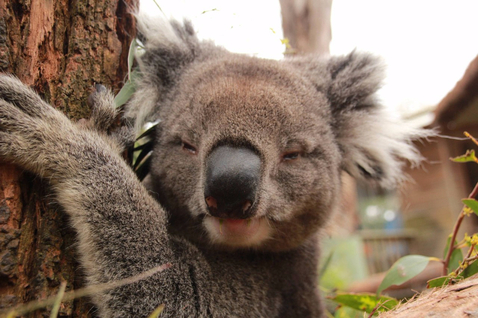
The Koala is a laidback leaf-muncher who gets hassled by the bad boys of the Aussie bush. Not by other native animals but tree-lopping developers and domestic pets. Koalas are a unique marsupial which needs human protection to survive. And eucalyptus trees, of course.
At Lone Pine Koala Sanctuary, an 18-hectare Koala conservation park in the Brisbane suburb of Fig Tree Pocket, Queensland, there is a new facility dedicated to Koala health and well-being. I paid them a visit to learn more…
Greeted by mother and baby on arrival at Lone Pine Koala Sanctuary, Brisbane. On this visit I didn’t hug a real Koala but you can!
The Koala (Phascolarctos cinereus, not a bear) is an arboreal herbivorous marsupial native to Australia. It is the only extant representative of the family Phascolarctidae and its closest living relatives are the wombats.
To quote the KOALA SCIENCE COMMUNITY dedicated to Research, Connect, Protect:
“United by a common purpose to conserve koalas across their range, Lone Pine Koala Sanctuary and Brisbane City Council worked together to build and establish the Brisbane Koala Science Institute, located at the sanctuary in Brisbane, Queensland. The Institute and this online community are further supported by Lone Pine’s not-for-profit organisation, the Research for Nature Foundation, which will help fund various South-East Queensland koala projects, in partnership with local scientists, researchers, and industry professionals.
At the unique Brisbane Koala Science Institute at leafy Lone Pine, I was pleasantly surprised at how much Koala information I absorbed in a short space of time. There are interactive (and multilingual) displays, research labs with public viewing areas and a koala observation area.
♥ Koalas have special teeth for grinding down eucalyptus leaves which ferment creating sleeping patterns which mean they can sleep more than 18 hours a day. ♥ Koalas have large, strong claws to help them climb smooth-barked eucalyptus trees. ♥ A Koala baby, joey, lives in the mother’s pouch for six months then grows up to become a big eater, consuming about one kilogram of eucalyptus leaves per day. ♥ Koalas front paws can grip small branches as they reach for the juiciest leaves. ♥ Koala lifespan is between 10 to 16 years which naturally depends on environmental conditions.
This Blue-Winged Kookaburra swooped down and kept a watchful eye on our lunch, however, it’s best not to feed human food to native wildlife.Afternoon tea, two coffees and two muffins, one caramel and the other blueberry, both with edible chocolate circles iced on top.The wishing well outside the front entrance to Lone Pine Koala Sanctuary with plenty of coins and “I Love Australia” badge.
Although I focused on the Koala, there are many more unique Australian species to see here, from kangaroos to cockatoos, eagles to emus in a beautiful bushland setting. I recommend the following link and video highlights featuring all the wildlife residents of Lone Pine Koala Sanctuary:
A quick guide to the wild birds around Long Pine Koala Sanctuary. Behind the sign, an Eastern Water Dragon lizard came out to sunbathe on the brickwork.
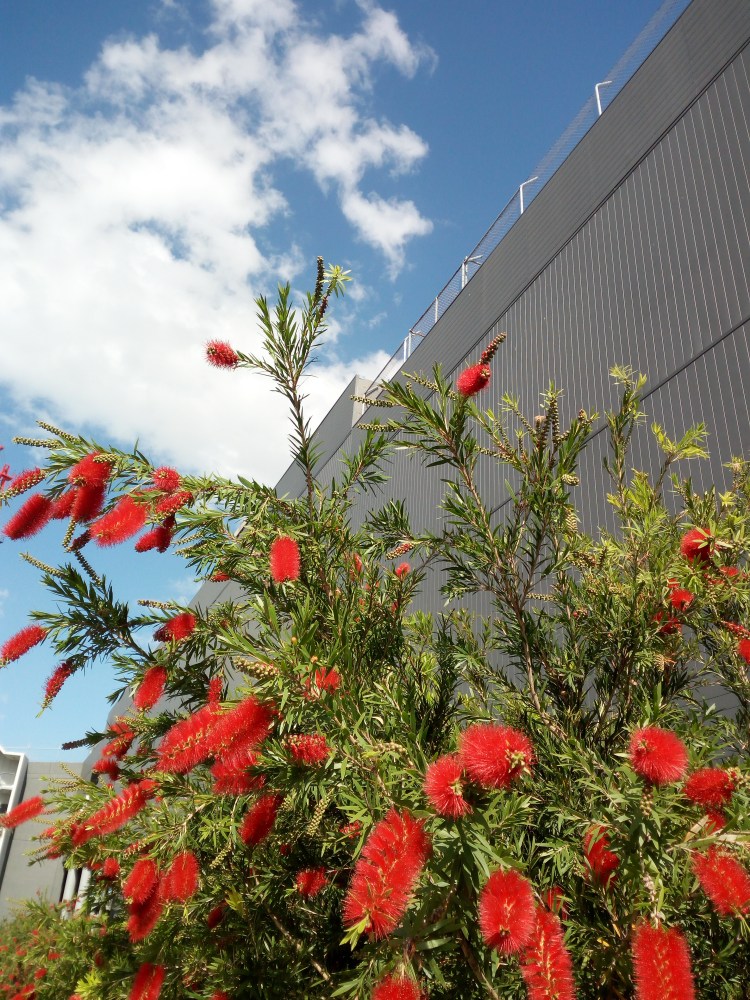
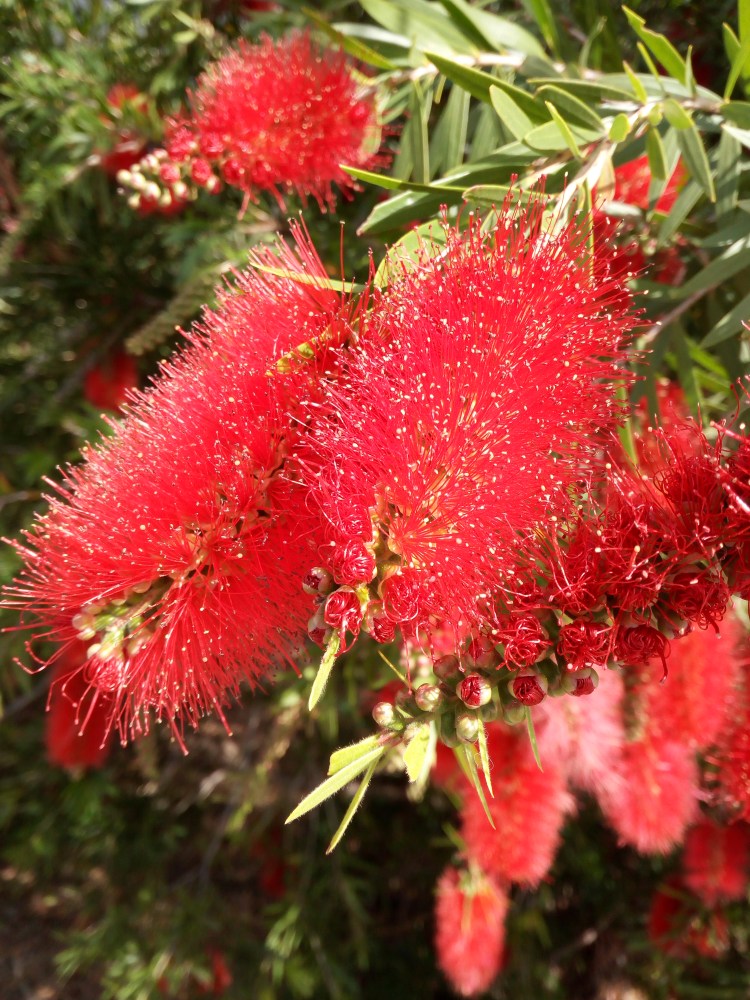
These vivid flowers would be perfect at Christmas time. But, no, this spectacular red Callistemon, an Australian native Bottlebrush, flowers in springtime and early summer.It has long fluffy tubular flowers that look beautiful in gardens and taste delicious to all kinds of native birds, insects and other wildlife. The flower 'brushes' are so soft, not spiky at all.There were two Rainbow Lorikeets hiding in the branches, eating the nectar and chatting away, but they wouldn’t keep still for a snapshot.I saw this long row of flowering plants in an industrial-type setting in Brisbane yet Callistemon grows in every location, tall shady trees to knee-high potted shrubs and used as groundcover.Information from this website Australian Plants Online Flowering Callistemon indicates that I’ve photographed 'Hannah Ray' which is 4 metres high and suitable for streetscapes.It brightened my September day!♥Gretchen Bernet-Ward
An enlightening literary look at events on the Victorian/New South Wales border; interesting books and even more interesting authors, and a bookshop with the perfect name.
You have the month of September to sign up to the new Indigenous Literacy Day fundraising campaign and fill your virtual shelf with books for children in remote communities. Participate in the launch on Wednesday 5 September and discover how to fill a bookshelf for children in the remote Australian outback.
It’s something new, something a little different, something the Indigenous Literacy Foundation believes you’ll enjoy sharing with your friends and family, and something that gives you the opportunity of ensuring kids in remote communities have access to quality, new books.
Commencing on Indigenous Literacy Day (5 September 2018) the new ‘Fill a Bookshelf’ fundraising campaign aims to raise $300,000 to help ILF gift 30,000 new books to schools and service organisations in remote communities where books are scarce.
How does it work? The idea is simple…
Sign up online to create a fundraising page and receive an empty virtual bookshelf.
Ask family, friends, colleagues to donate a virtual book to your page (in the form of a donation)
Fill your virtual bookshelf!
Change the lives of Indigenous children.
Your donations will help buy new, carefully selected books for children who have none. To put it quite simply – without your support, in a very real sense – bookshelves in remote Indigenous communities are empty.
All children in Australia deserve the same opportunities – in education, employment, health and wellbeing. Evidence shows that literacy is the pathway to CHOICE for these opportunities, and BOOKS are the building blocks for literacy. If you believe this too, sign up today!
The Indigenous Literacy Foundation
PO Box 663 Broadway NSW 2007
Australia
Indigenous Literacy Day is a national celebration of Indigenous culture, stories, language and literacy. Indigenous Literacy Day aims to raise awareness of the need to support literacy in remote and isolated Indigenous communities of Australia.
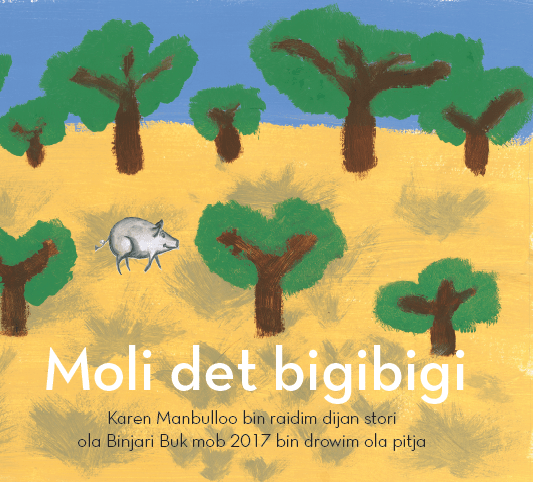
‘Moli det bigibigi’ (Molly the Pig) a new children’s picture book written by Karen Manbulloo, from the remote Binjari community near Katherine in the Northern Territory. Written in Kriol and English, ‘Moli det bigibigi’ is a story based on a real-life pet pig of the Binjari community, found in the bush by Karen’s brother.
This fun tag was brought to my attention by productive book blogger Paula Bardell-Hedley of BookJotter fame. Originally created by Beth of Bibliobeth the idea is to share a picture (aka ‘shelfie’) of your favourite bookshelf and then answer ten questions related to the titles displayed.
Visit Beth’sblog to see more info, the logo and tag and view posts by participating bloggers. Then launch your own unique Q&A Shelfie by Shelfie.
I think many readers will find these titles unfamiliar…
Part of Gretchen’s book shelves.
1. Is there any reason for this shelf being organised the way it is or is it purely random?
Short answer is ‘subliminally shelved’. Long answer is there are many bookshelves in our home and until I decided to participate in Shelfie by Shelfie I didn’t realise that most of my books are grouped. Either when they arrived or over a period of time, I’m not sure. There are clumps like non-fiction, poetry, humour, crime, fantasy and (not all shown) Australian content.
2. Tell us a story about one of the books on this shelf that is special to you, i.e. how you got it / a memory associated with it, etc.
Hard to pick just one. I know some of the authors (or received uncorrected bound proofs to review prior to publication) but my all-time special one would have to be ‘My Beachcombing Days: Ninety Sea Sonnets’ by Brisbane poet John Blight. His daughter, a family friend, gave it to me as a birthday gift in the same year as disastrous flooding hit the city. The flood waters also coincided with me securing a glam job in a travel agency which had 12 inches of river mud throughout the ground floor office.
3. Which book from this shelf would you ditch if you were forced to and why?
No contest! It would be Tom Keneally’s ‘Shame and the Captives’ a semi-factual diatribe about World War II prisoners-of-war from Italy and Japan who are held in a compound in Gawell, New South Wales, but allowed to work on a local farm. It does have its altruistic moments but there’s bloodshed aplenty and the ‘uncertainty and chaos’ never worked for me.
4. Which book from this shelf would you save in an emergency and why?
‘Withering-by-Sea’ written by children’s author and illustrator Judith Rossell. Young heroine Stella Montgomery is the epitome of someone I would have loved to have known when I was a child. I did read a lot of British kids books! Set in Victorian England, the story is both adventurous and creepy. Apart from dressing up as a mature-age Stella Montgomery for library Book Week, two years ago I had my copy of the book signed by Judith Rossell when I attended her writers workshop in historic Abbotsford Convent, Melbourne.
5. Which book has been on this shelf for the longest time?
Hmm, that would be a toss-up between Nobel Prize for Literature winner Patrick White ‘The Cockatoos’ and Miles Franklin ‘My Brilliant Career’ both yellowing reprints dated 1974 and 1979 respectively. I guess Mr White wins.
6. Which book is the newest addition to this shelf?
Another toss of the coin. ‘Truly Tan Hoodwinked!’ (Book 5) kids chapter book written by Jen Storer, and ‘Care of Australian Wildlife: For Gardeners, Landholders and Wildlife Carers’ by Erna Walraven, a 2004 revised edition but in mint condition and recently purchased in a second-hand bookshop. The most adorable teeny tiny Koala baby is on the front cover. The Koala wins by a nose.
7. Which book from this shelf are you most excited to read (or re-read if this is a favourites shelf?)
I have a ‘thing’ for DBC Pierre, expat Aussie writer, and admire his off-kilter books. I own two of his novels (the rest were loans) and love ‘Breakfast with the Borgias’ which I willingly re-read; and I’m usually not a re-reader. Perhaps the fact that one of the characters is named Gretchen has something to do with it.
8. If there is an object on this shelf apart from books, tell us the story behind it.
There is a small cardboard cut-out figure of Lisa Simpson from TV series The Simpsons which probably came with a McDonalds meal deal. Lisa is holding an armload of books and in the show she is the lone advocate of literacy and learning. I always like to think she influenced a generation of TV viewers to read. And that she’s happy on this shelf.
9. What does this shelf tell us about you as a reader?
It doesn’t tell you that I borrow hugely from my local library; or that I read too many e-books; nor that my current audio book is, ironically, ‘The Book Case’ by Dave Shelton narrated by Colleen Prendergast. It does shout that I’m an Australian reader.
I read most genres and most writers regardless of nationality (translated helps!) but I keep coming back to Australian authors. In an online book forum, I recall an American reader saying he only read American books because he understood them. He didn’t mean the language, he meant emotional ties, recognition, connection. That’s what I get from Australian books, nevertheless, I do think we have to step outside our comfort zone.
10. Choose other bloggers to tag or choose a free question you make up yourself.
A free question I can make up sounds good. NOTE I do not activate Comments, you will have to answer it in your own Shelfie by Shelfie blog post.
BONUS QUESTION: Do you discuss the books you read in a face-to-face situation, online book reviews, or clutch your latest read to your chest saying ‘my precious, my precious’?
Happy reading, blog stars!
♥Gretchen Bernet-Ward
For modern Australian book reviews I can recommend blogger and bookseller Simon McDonald https://writtenbysime.com/ while this list contains notably mature Australian authors: Thea Astley
Bruce Beaver
Geoffrey Blainey
Martin Boyd
Christopher Brennan
David Campbell
Peter Carey
Marcus Clarke
James Clavell
Bryce Courtenay
Geoffrey Dutton
Len Evans
John Farrow
R.D. FitzGerald
Miles Franklin
Joseph Furphy
Helen Garner
Germaine Greer
Kate Grenville
Charles Harpur
Alexander Harris
Shirley Hazzard
Xavier Herbert
Dorothy Hewett
A.D. Hope
Janette Turner Hospital
Robert Hughes
Joseph Jacobs
Colin Johnson
Elizabeth Jolley
Henry Kendall
Thomas Keneally
Jill Ker Conway
Henry Kingsley
C.J. Koch
Leonie Judith Kramer
John Dunmore Lang
Ray Lawler
Henry Lawson
Norman Lindsay
Ern Malley
David Malouf
Furnley Maurice
James Phillip McAuley
Hugh McCrae
Colleen McCullough
Les Murray
Oodgeroo Noonuccal
Bernard Patrick O’Dowd
Vance Palmer
Eric Partridge
Hal Porter
Peter Porter
Katherine Susannah Prichard
Henry Handel Richardson
Steele Rudd
Nevil Shute
Peter Singer
Kenneth Slessor
Christina Stead
Alfred George Stephens
Douglas Stewart
Kylie Tennant
P.L. Travers
Ethel Turner
Arthur William Upfield
Morris West
Patrick White
David Williamson
Tim Winton
Judith Wright
Markus Zusak
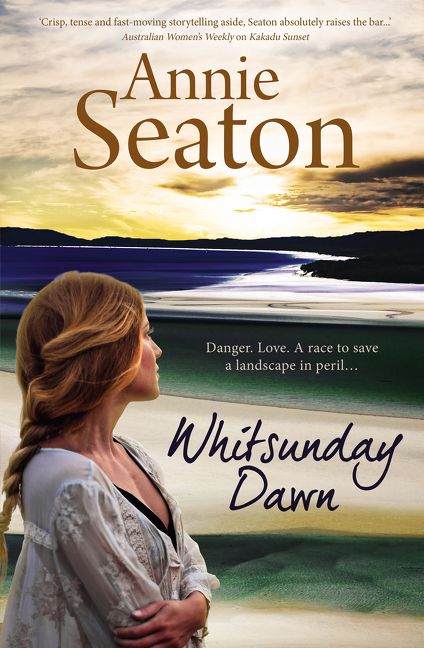
Don’t you love being on the verge of discovering a new author, that feeling of anticipating! Look at the beautiful location where romance writer Annie Seaton is holding the book launch for her latest release Whitsunday Dawn––in the Whitsunday Islands at beautiful Coral Sea Resort.
“Ecological impact, divided loyalties and the pristine beauty of the Whitsundays under threat, can mining spokesperson Olivia Sheridan expose the truth in time?” Author Annie Seaton brings to life a new era of romance and eco-adventure. Perfect for fans of Di Morrissey and a sun-kissed tropical lifestyle.
As WP readers will know, I’m not usually a romance reader but I’m rather taken by the beautiful location of this all-Australian story. Watch out for my review.
On her website Annie says “I am truly blessed to live by the beach on the east coast of Australia. I am following my lifelong dream of writing, and discovering that readers love reading my stories as much as I love writing them is awesome. It’s what keeps me at my desk each day when the garden and the beach are calling to me!
“You can read of the topical human and social issues I explore in Kakadu Sunset, Daintree and Diamond Sky. My latest release with Harlequin Mira WHITSUNDAY DAWN (August 2018) is an historical/contemporary story set in the Whitsunday Islands in 1943 and 2017.
“My inspiration comes from the natural beauty of our Australian landscapes and I’m passionate about raising awareness of the need to preserve the pristine areas that surround us.”
Will you be in the vicinity of the wonderful Whitsundays? Visit the launch of Annie Seaton’s newest book WHITSUNDAY DAWN being held on Friday 7 September 2018 at Coral Sea Resort Jetty, Airlie Beach, Queensland. A welcome drink then cash bar will be available with complimentary gourmet nibbles and canapes from the Coral Sea Resort kitchen. RSVP via Facebook https://www.facebook.com/AnnieSeatonAuthor/
Did you see them pass today, Billy, Kate and Robin,
All astride upon the back of old grey Dobbin?
Jigging, jogging off to school, down the dusty track––
What must Dobbin think of it––three upon his back?
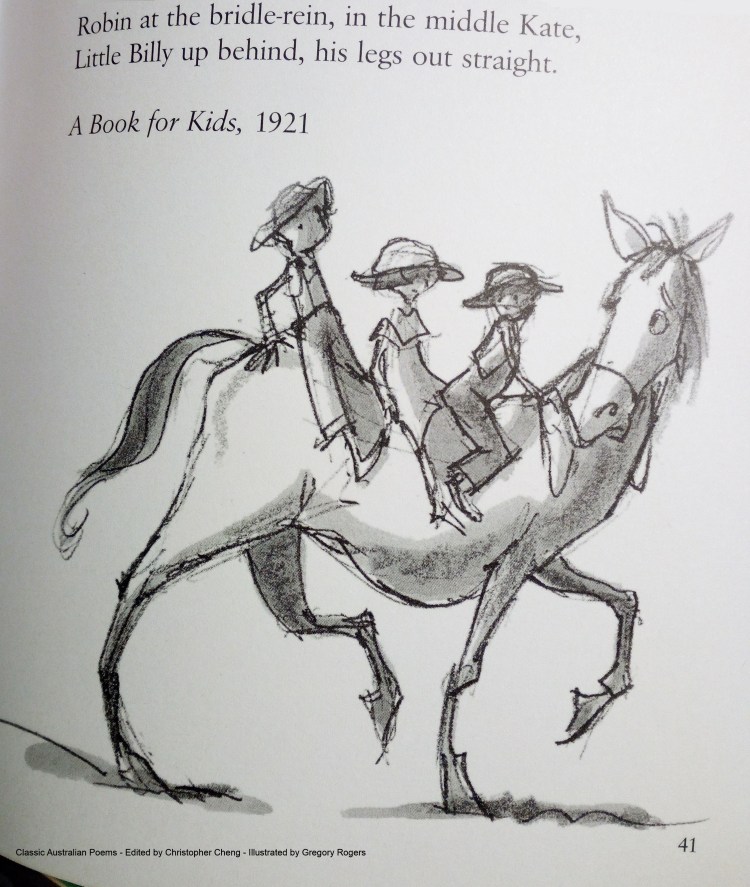
Robin at the bridle-rein, in the middle Kate,
Billy holding on behind, his legs out straight.
Now they’re coming back from school, jig, jog, jig.
See them at the corner where the gums grow big;
Dobbin flicking off the flies and blinking at the sun––
Having three upon his back he thinks is splendid fun:
Robin at the bridle-rein, in the middle Kate,
Little Billy up behind, his legs out straight.
Poem originally published in ‘A Book for Kids’ 1921
Poem by Clarence Michael James Dennis, better known as Australian poet C J Dennis (Sept 1876 – June 1938) who had a variety of jobs, from bar tender, secretary to a senator, to publisher and editor. He is fondly remembered for the humorous stories and verse he wrote for big city newspapers and was dubbed ‘laureate of the larrikin’ which means he penned prose about boisterous, unruly people. GBW.
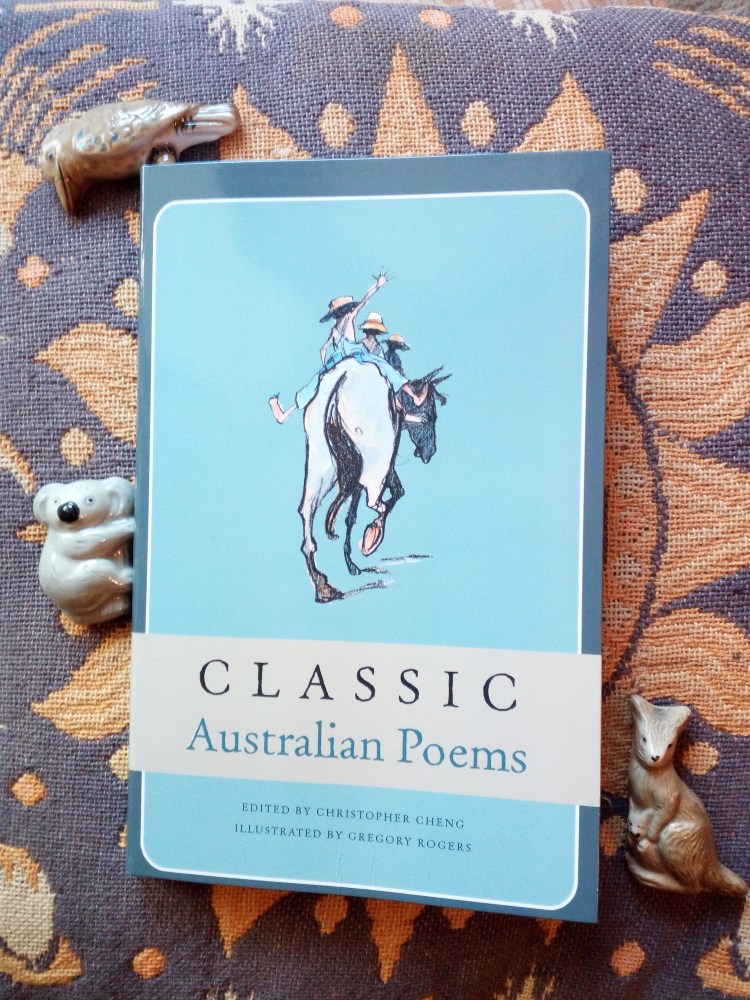
Ever get poetry nostalgia? Australian school children learn poems by C J Dennis, Henry Lawson, Banjo Paterson and many more. Often a particular poet’s verse follows them through life, even though their lives are nothing like the rough and tumble era in which these pioneer poets wrote.
Changes were afoot in Australia in late nineteenth/early twentieth century and were reflected in the country’s poetry. In the evening, after dinner, someone would recite a poem or two. Years later, I grew up with Banjo Paterson’s ‘The Man From Snowy River’, a rollicking ode to bush men, stock riders, the dangerously rugged land and the great value of horses.
Slow Clothing reflects author and refashion advocate Jane Milburn’s own unique style, independent of “fast fashion” trends. Upcycled from denim jeans, the dress Jane wore during her talk at a local BCC library had the potential to look strange but was distinctive and quite beguiling.
Jane, sustainability consultant and founder of Textile Beat, touched on several key elements during her talk––environmentally unfriendly fabrics and dyes; sweat shop labour; landfill; passive fashion; synthetic vs natural fibre; signature style and minimal wardrobe. Hot topics included recycle by exchange, shopping tips, Sew It Again mending and creating new from old. Jane tends to hoard fabric offcuts and used buttons, and has a passion for real cotton thread.
Rethinking clothing culture doesn’t mean wearing your clothes until they fall apart at the seams, it means mindful immersion, repairing and refashioning your garments.
An attentive audience, Jane encouraged us to make thoughtful, ethical, informed choices to reduce our clothing footprint on the world. Until recently, she regularly visited charity shops for secondhand garments but is currently resisting the temptation and working with what she’s got. “We believe secondhand is the new organic and mending is good for the soul. In return, we are liberated and satisfied.”
In her book Slow Clothing: finding meaning in what we wear Jane shares insights and upcycling advice. She has created templates like Upcycled Collar and History Skirt, guiding home sewing conversion of a beloved garment to reflect the changes in our lives.
To provide meaning and story to her own favourite pieces, Jane Milburn restyles and sews her clothing by hand. Currently testing t-shirt cotton drawstrings as an alternative to underwear elastic (elastic is made from synthetics) Jane stitches everything by hand.
Help! I can hear you say, nobody has hand-sewn an outfit since the mid-twentieth century––except maybe Vivienne Westwood––but don’t panic, Jane’s book provides testimonials, illustrations and clear instructions for eco-dyes and upside-down jumper skirts through to sewing on a button. Eco-fashionistas unite!
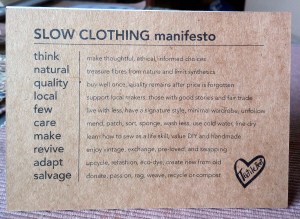
Although Slow Clothing is a multifaceted, easy-to-read book with positive chapter headings (Purpose, Authenticity, Creativity, Action, Autonomy, Reflection) amid the ingenious apparel, I am missing a frivolous note, perhaps a ball gown? On a serious mission, Jane has created a Slow Clothing Manifesto with ten tags to keep in mind when out shopping: think, natural, quality, local, few, care, make, revive, adapt, salvage.
Quotes from Jane embody the Slow Clothing philosophy “Slow Clothing brings wholeness through living simply, creatively and fairly” and “We buy thoughtfully, gain skills, and care for what we wear as an embodiment of ourselves.” Personally I am hoping to see people clutching their Slow Clothing Manifesto cards at an op shop near me.
The current trail Jane Milburn is blazing makes fascinating reading. Arts Queensland, meeting VIPs, War on Waste ABCTV, visiting 103-year-old Misao Jo in Osaka, hosting a Clothing Repair Café, conducting workshops and championing natural-fibre, Jane says “It has been personally satisfying to see the uptake of upcycling as a conscious practice with many young people interested in its potential for customising their clothes.”
Unfortunately I didn’t get to ask Jane Milburn how we go about combating the greed of designer labels. But the clear message is––help reduce landfill by upcycling your clothes to reflect your own unique style.
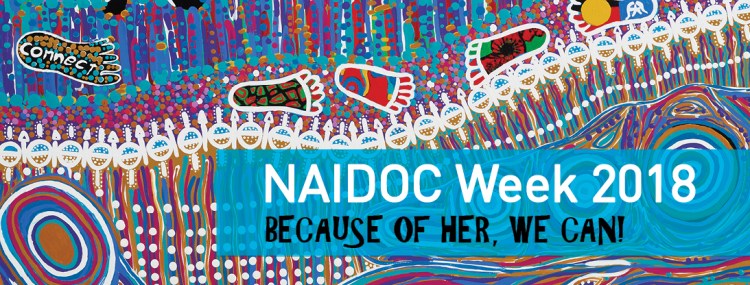
The 2018 National NAIDOC Poster was designed by Cheryl Moggs, a Bigambul woman from Goondiwindi, Queensland. Cheryl drew on the history, courage and resilience of Aboriginal and Torres Strait Islander women to educate others. The artwork (tarmunggie – woman) has three overlaying images, connecting dreamtime, culture and knowledge.
BECAUSE OF HER, WE CAN!
Theme: NAIDOC Week 2018 celebrates the invaluable contributions that Aboriginal and Torres Strait Islander women have made – and continue to make – to our communities, our families, our rich history and to our nation.
“This artwork portrays the courage and resilience of Aboriginal and Torres Strait Islander women. From the ripples of fresh water and salt water, across the travel pathways and song lines of our traditional lands and skies”.
NAIDOC WEEK 8-15 JULY 2018
Background: NAIDOC Week celebrations are held across Australia each July to celebrate the history, culture and achievements of Aboriginal and Torres Strait Islander peoples. NAIDOC is celebrated not only in Indigenous communities, but by Australians from all walks of life. The week is a great opportunity to participate in a range of activities and to support your local Aboriginal and Torres Strait Islander community.
Origin: NAIDOC originally stood for ‘National Aborigines and Islanders Day Observance Committee’. This committee was once responsible for organising national activities during NAIDOC Week and its acronym has since become the name of the week itself. Find out more about the origins and timeline history of NAIDOC Week. Find out the history of the Australian Aboriginal flag and the Torres Strait Islander flag under Australian Flags.
This year the focus city of Sydney will start NAIDOC Week with the 2018 National NAIDOC Awards announced at a black tie ceremony and ball. National NAIDOC Poster Competition and the NAIDOC Awards recipients are selected by the National NAIDOC Committee.
Here’s a map of Queensland and video of Brisbane City which makes me think I live in a pretty good place. Nomad Girl of The Jasmine Edit films short, interesting videos around the world. She makes it look like fun; maybe I could make a video, too?
Oops, just noticed a spelling error near the Great Barrier Reef.
If you are interested in early Queensland architecture from Victorian, Federation and inter-war era, please click here to view Wikipedia Queensland Architecture


 There were two Rainbow Lorikeets hiding in the branches, eating the nectar and chatting away, but they wouldn’t keep still for a snapshot.
I saw this long row of flowering plants in an industrial-type setting in Brisbane yet Callistemon grows in every location, tall shady trees to knee-high potted shrubs and used as groundcover.
There were two Rainbow Lorikeets hiding in the branches, eating the nectar and chatting away, but they wouldn’t keep still for a snapshot.
I saw this long row of flowering plants in an industrial-type setting in Brisbane yet Callistemon grows in every location, tall shady trees to knee-high potted shrubs and used as groundcover.
 Information from this website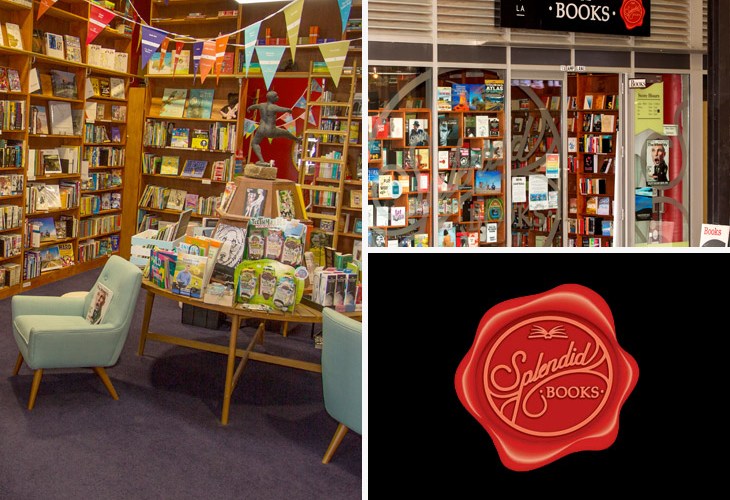










 Thoughts Become Words