‘Behind the Sun’ Convict Girl Series by Deborah Challinor

In a dread-laden atmosphere of shocking sights and smells, the transportation of four convicts to the women’s gaol Parramatta Female Factory is as grim as their backstory.  Although hiding a terrible secret between them, these young women are resilient and struggle against the harsh conditions.

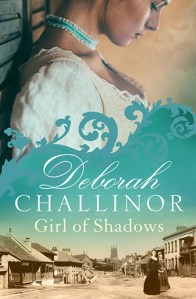
The Convict Girls four-book series written by Deborah Challinor follows four bonded female convicts Friday Woolfe, Rachel Winter, Sarah Morgan and Harriet Clarke who are shipped from London’s infamous Newgate Prison to the penal colony of Sydney Town, New South Wales, to work off their sentences.  The penalties for petty crime, like the strange new land, are unforgiving.

Set in 1832, the travails of Friday, Rachel, Sarah and Harrie jump off the page as each book tells the story from each woman’s perspective while moving the narrative forward.  Titles are Behind the Sun, Girl of Shadows, The Silk Thief, A Tattooed Heart.  As they work through their bond in different forms of servitude, the reader follows their friendship, the physical and mental strain, and their all-important futures.

Author Deborah Challinor skilfully expands and elaborates on their new lives (the homebody, the thief, the seamstress, the prostitute) while keeping the voice true.  She gets the more risqué messages across without unnecessary crudeness.  Her well researched, well written plots and strong supporting characters, like cruel Bella Jackson and handsome Dr James Downey, blend together to spin a gripping yarn, spiced with highs, lows, loves, laughs, drama and murder.

I love good historical fiction, this quartet is superb (look beyond the chick-lit cover art) and Deborah Challinor knows how to lure her readers.  The outstanding imagery, ripe for screen adaptation, kept me reading long after I should have turned off the light.  I strongly recommend this 5-star series and suggest reading the stories in sequence so they unfold in all their splendour.

♥ Gretchen Bernet-Ward


AUTHOR BIO:  Deborah Challinor Author PhotoDeborah Challinor is a writer and PhD historian from Waikato in New Zealand.  She lived in Australia while researching the stories for her Convict Girls series.  The books follow four young woman transported to New South Wales for petty crimes. The character of Friday Woolfe is loosely based on her great-great-great-great-great-grandmother Mary Ann Anstey who was caught stealing a silk handkerchief and sent out to Sydney Town on Lady Juliana, a convict ship dispatched in 1789 from England to Australia.  Deborah Challinor has written over 16 books, historical fiction and non-fiction titles. Website https://www.read-nz.org/writer/challinor-deborah/

XXI Commonwealth Games – Gold Coast

Find out interesting things like events, history, medal tally, for the Commonwealth Games . . .

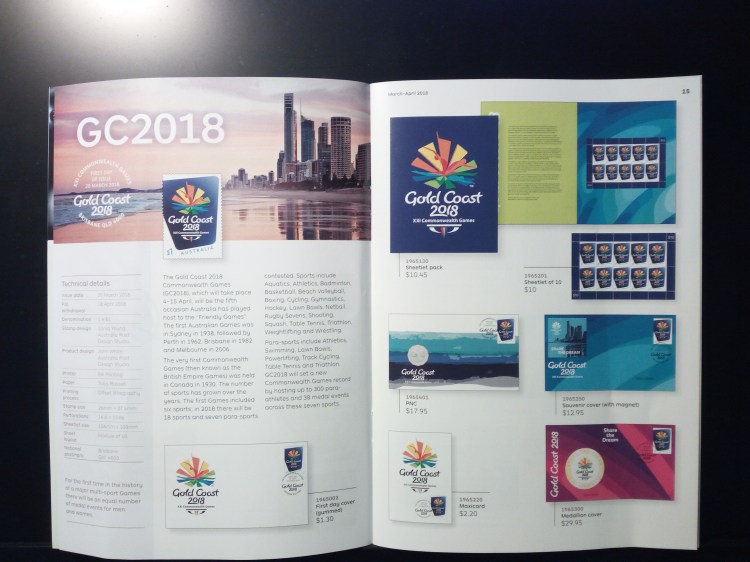
First, browsing through my Australian Stamp Bulletin, I saw that commemorative issue postage stamps will coincide with the start of XXI Commonwealth Games on the Gold Coast, Queensland, Australia.  The Games sporting competitions commence 4 April 2018 and continue over 12 days until closing ceremony 15 April 2018.

I am more into literature than sporting pursuits but it’s going to be quite an event!  It appears that the blue surfing koala mascot Borobi (which means ‘koala’ in the indigenous language) is on postcards but not included on the stamps so I’ve added him further down the page.

Commonwealth Games Stamp Issue 2018 01 (1)

Game on!  This is the second time Queensland has hosted The Games.  The 1982 Commonwealth Games were held in Brisbane City from 30 September to 9 October 1982 and I actually attended.  Below, I have written a little bit of Games history to bore you with facts and figures.

A brief history of the Commonwealth Games

In 1891, John Astley Cooper first wrote about a sporting competition that would bring together members of the British Empire, but it wasn’t until 1911, at the coronation of King George V, that an ‘Inter-Empire Championships’ was held.  This event included teams from Australasia, Canada, South Africa and the United Kingdom.

Commonwealth Games Gold Coast 2018 Logo

The first official Commonwealth Games (called the British Empire Games) were held in 1930 in Hamilton, Canada.  Four hundred athletes from 11 countries competed in 59 events across 6 Core sports.  The Core sports have increased: athletics, boxing, lawn bowls, rowing, hockey, badminton, squash, weightlifting, rugby, aquatics (swimming and diving) and wrestling.  In the past women only competed in swimming events.  That’s all changed and now there’s something for everyone.  Gold Coast 21st Commonwealth Games will include 18 events.

In addition to the 10 Core sports there will be:

  • Basketball
  • Beach volleyball
  • Cycling (road, mountain bike and track)
  • Gymnastics (rhythmic and artistic)
  • Para power lifting
  • Shooting
  • Table tennis
  • Triathlon

Commonwealth Games Stats Graphics Medals

Since 1930, the Games have taken place every four years, except in 1942 and 1946 (due to World War II), and had a few name changes.  Although there are 53 members of the Commonwealth of Nations, 71 teams participate in the Commonwealth Games, as a number of dependent territories compete under their own flags.  The four Home Nations of the United Kingdom—England, Scotland, Wales, and Northern Ireland—also send separate teams.

Australia is the overall champion of the Commonwealth, having won 2218 medals in total, 852 in Gold.  England is second with 2008 and Canada is third with 1473.
(See below for new figures 2018)

Commonwealth Games Australia Map

The 2018 host city – Gold Coast

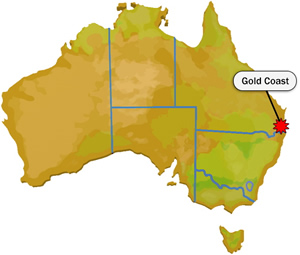
The host city for the 2018 Commonwealth Games is Gold Coast, Queensland, located just north of the Queensland/New South Wales border, and about 66 kilometres south of Brisbane.  The Gold Coast is a coastal city on the Pacific Ocean with a population of around 640,000 people.  It is the sixth-largest city in Australia (the largest non-capital city) and the second largest in Queensland (after Brisbane).

The Gold Coast is one of Australia’s major tourist destinations with its sunny sub-tropical climate, beautiful surfing beaches, theme parks and rainforest hinterland.  More than 10 million people visit the Gold Coast every year, including around one million international visitors.  It is also a film production hub with movies such as Pirates of the Caribbean: Dead Men Tell No Tales and Thor: Ragnarok being filmed there.

The official XXI Commonwealth Games stamps have yet to be issued but, in the meantime, collectors may be interested in visiting superb WordPress stamp blogger The Snail Mail:
https://thesnailmail.wordpress.com/2018/03/02/my-favorite-is-the-fruity-stamp-from-malaysia-received-from-china-england-india-indonesia-malaysia-taiwan-the-u-s/

Here’s Borobi and souvenir merchandise https://shop.gc2018.com/collections/mascot-1

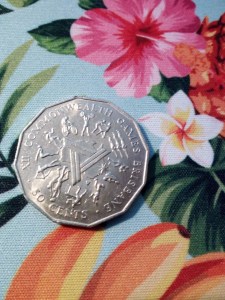
IMG_20180409_165348
Original 50cent coin from XII Commonwealth Games 1982 Brisbane Australia.
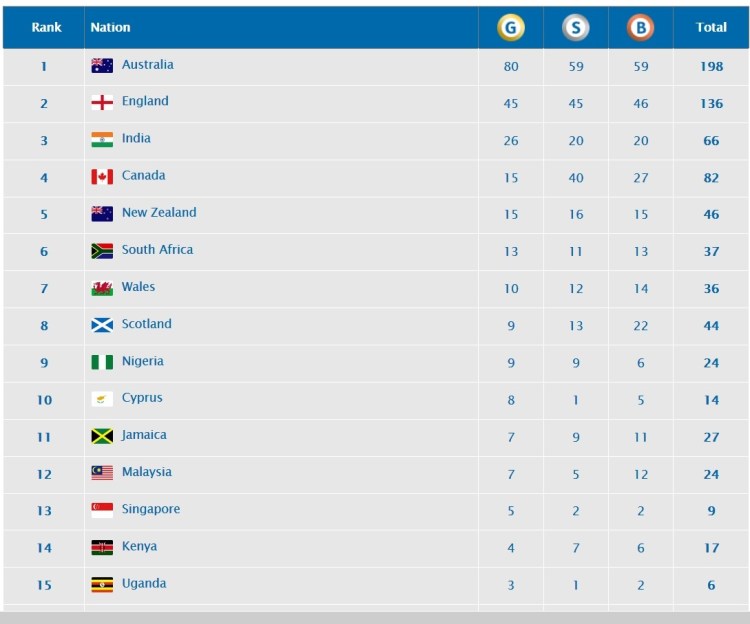
Commonwealth Games Stats 2018
XXI Commonwealth Games Medal Tally 2018

♥ Gretchen Bernet-Ward

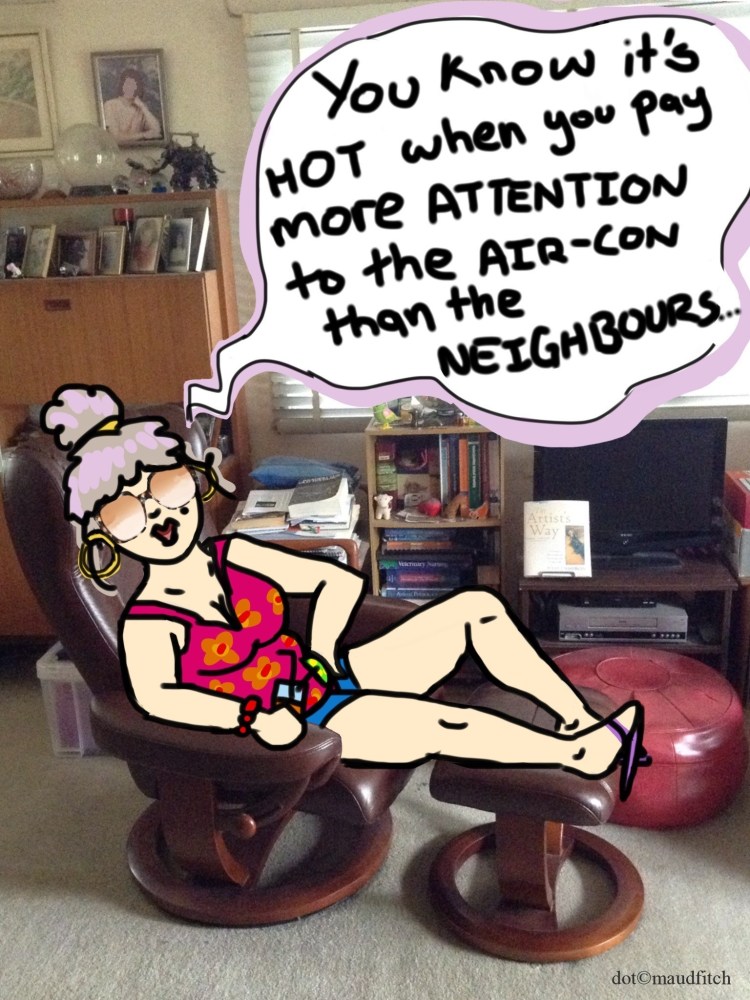
Burning Cauldron of Summer

Maud Fitch 05
Maud Fitch lives in a subtropical climate and 2018 summer has been extremely hot.

Hot nights, boiling days
Anger bites, temper frays.

Clothes stick, sweat drips
Fans click, weekend trips.

Seaside splashes, kids squeal
Sand rashes, sunburn peel.

Straw hats, ice-cream soothes
Cricket bats, sluggish moves.

Lush green, drooping leaves
Magpies preen, beetle weaves.

Shimmering heat, mown grass
Barbecued meat, chilled glass.

Family spats, neighbour snoops
Buzzing gnats, endless loops.

Afternoon heat, swaying palm
Tired feet, wanting calm.

Soft breeze, cooler places
Air-con freeze, calmer faces.

Car toots, dog greets
Unlace boots, cotton sheets.

Dissolving day, warm rain
Moonlight ray, night again.

♥ Maud Fitch – Guest blogger

Australian Editors and Publishers Set Bar Too High

I have come to the conclusion that the Australian publishing industry and its associated editors and reviewers have set the bar way too high for Australian writers.  Emerging authors have a pretty slim chance of being published with huge odds against hitting the big time.

Strong-willed literature-controlling gurus rule our domestic market like school teachers from the 1950s.  They seek perfection, the best book of the year, often cerebral stuff ignored by half the population, and they disregard perfectly serviceable down-to-earth Aussie authors.  Also, when did parochialism creep in, e.g. Melbourne is the hub of all things literary?  Let’s focus on inclusive Australian content.  Oh, and stop changing words to suit international readers, they’re cool, they can work it out.

Publishing houses receive thousands of unsolicited manuscripts each year and the selection process is fierce.  Only a handful of authors are chosen, gather a following, write more books and hopefully make money.  The untried crime writer, for example, may not appeal to the literati judges, but, hey, there’s always that coterie of readers who will love them.  The way it is now, their work may never see the light of day.  Dive deep into that slush pile!

Book Publishing 04
Sure, there’s always the internet, WordPress, e-books, self-publishing, writing competitions (see below) and a gazillion non-traditional ways to be seen but nirvana is a publishing deal with a real-deal publishing house.


“Relax,” I say to publishers from my seat of ignorance.  “The shock of ebooks has faded, so forget micro-niche and churn out those books, get those names in print.”  What?  Too much of a risk, not financially viable?  Yeah, I guess that’s right.  Nobody wants risk in business.  I say “Lighten up, people, offer a broader spectrum of books to the general public”.  Stop book snobbery because, meanwhile, mediocre books with typos are flooding in from overseas and I’m getting a bit sick of it.

Did I hear our aspiring authors cannot compete with the overseas calibre?  Our readers are not savvy, interested or sincere enough to try a reasonably good newbie?  Come off it!  Peel back those layers.  An Australian author or reader is as good as the next person but needs the exposure, the push, the shove, the necessary connections and circumstances to make it work.

Chips on shoulders, the need to prove we Australians are well-read, has past. Forget the Cultural Cringe, dismiss ‘benchmark’ literary awards and too perfect prose and embrace the mass production of typically Australian-written and illustrated books and be proud of them.

♥ Gretchen Bernet-Ward

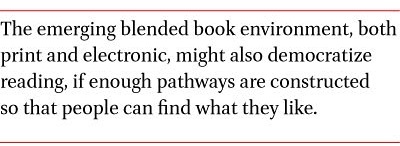
FURTHER READING:  https://journals.uic.edu/ojs/index.php/fm/article/view/3353/3030  with quote taken from “Non-Traditional Book Publishing” by Jana Bradley, Bruce Fulton,  Marlene Helm, Katherine A Pittner in “First Monday” Journal and, although somewhat passé, it shows foresight.  EVEN FURTHER READING:  https://www.theliftedbrow.com/liftedbrow/2017/11/22/keep-your-eyes-on-the-prize-unpublished-manuscript-competitions-and-you  The Lifted Brow is a not-for-profit literary publishing organisation based in Melbourne, Australia, and Martin Shaw’s article explains an awful lot about the hidden terms and conditions of competition entry.

{NB. Gretchen has reviewed books, worked in the library industry and reads extensively.  As an aspiring writer, she may have shot herself in the foot}

Indigenous Astronomy

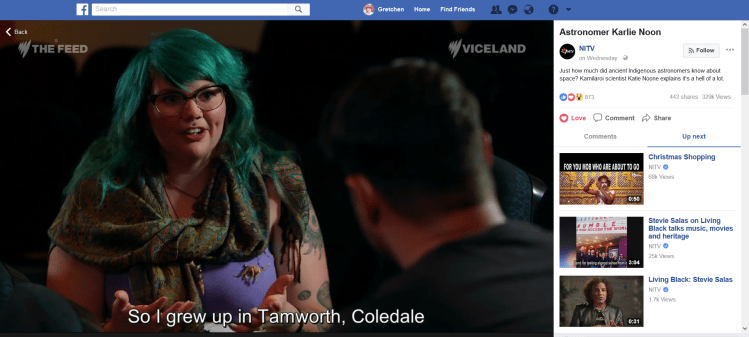
Indigenous Astronomy Moon Halo Karlie Noon 02

When I discovered this link to Karlie Noon and her life as an Indigenous scientist, I also learned about predicting the weather from a moon halo.

Karlie Noon, interviewed by Marc Fennell on NITV Australia/SBS The Feed, was the first Indigenous woman in NSW to graduate with a double degree in mathematics and physics… but Indigenous Australians have been practicing science long before universities were teaching it.  There is evidence in the form of rock art depicting Indigenous knowledge before Galileo, Newton or Kepler made their discoveries.

This video delves into Karlie’s early life, visits the instrumentation building for space exploration and explains the reading of a moon halo.


♥ Gretchen Bernet-Ward

Garden Notes on a Warm Winter Day

Dear Diary, it’s a calm, warm July day, almost like an early Spring, but there are no butterflies or buzzing insects.  The crows call to each other across the back garden and noisy miners flit back and forth like feathered investigators on an important assignment.  The children in the house behind my suburban block are jumping on a netted trampoline and soon there will be a cry and a parent will take them off.  The towels have been on the Hills Hoist clothes line for two days.  A dried-out agapanthus head is sticking straight up out of the perennial foliage, a reminder that I am not a conscientious gardener.

IMG_3643
Tomatoes
Rosella Flower 01
Rosella
Pointsettia 002
Poinsettia
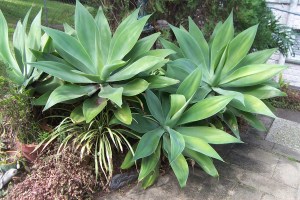
Agave 03
Agave


So saying, in a green square pot I have grown a very tall tomato plant with fat green tomatoes (above) emerging every day.  The old mandarin tree has a yearly crop of pale orange-coloured mandarins, and my rosella plants are flowering (above) while the spring onions and ginger roots carry on regardless.  There are non-native plants like a small pomegranate, poinsettia bright red and blooming (above) and our huge native gum tree towers over all of us; blossom for the parrots and fruit bats.  Special mention goes to our agave family.  These Mexican beauties (above) love our subtropical climate and we’ve given away more young plants than I can remember.

IMG_0517
Hoya


IMG_0451
Coffee Flower
Bird Nest 02
Nest


Of course, there’s the herbs, for better or worse, always trying so hard … The trailing hoya (above) was a joy with its pink waxy flowers but recently it decided it had had enough and shrivelled up.  The ancient mulberry tree went the same way, dying in the drought a few years back, followed by the peach and avocado trees.  The coffee bean tree (above) survives anything.  We live on a sloping hill with poor soil which is interesting because many years ago cows grazed on the lush hillsides around us.  My father once said “All your good top soil has been washed downhill”.  Not so long ago the rich alluvial earth along the creek at the bottom of our street was plundered and no doubt sold for landscaping.

When I first lived here, the suburb was casual with a leafy roughness about it which made for a relaxed, friendly vibe.  Indeed, every home was owner/builder and most residents chose not to erect fences nor were there any footpaths.  Trees were planted to shade homes from the fierce western afternoon sun and if you were lucky you had a ceiling fan.  Ah, the 70s, a time of emerging from the past and forging ahead with little regard for past cultural or community identity but, in so doing, it created a unique city.  Strangely, if not surprisingly, it has taken about 40 years for the people of Brisbane, Queensland, to appreciate our subtropical city.  The past is now nostalgically and fondly remembered as the concrete is poured for yet another highrise apartment block.

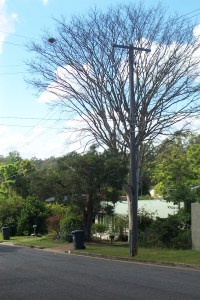
If real estate developers would let us, we would return to our friendly, informal way of life instead of building cement block homes and painting them grey like every other capital city in Australia.  To take my mind off the screeching of chainsaws as they hack down another leopard tree (above) I will write a little bit about our front garden.

Palm Blossom 001
Date Palm
Alkina Flame Tree (6)
Flame Tree
Orchid on Flame Tree
Orchid
Jacaranda in Afternoon
Jacaranda


Maiden Hair Fern
Fern


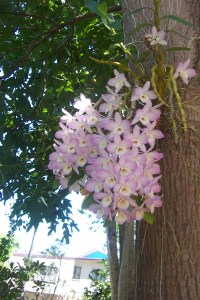
In the front garden, and I use the term loosely, there is structure and visions of edging and all, but I have let that slip.  Two tall palm trees (above) on either side of the house echo early Queensland-style seen in rural areas.  Tough-as-old-boots golden cane palms dot the area while I think our camellia is a Melbourne throwback.  The stocky Illawarra flame tree with its pink orchids (above) was planted to complement the purple jacaranda nextdoor (viewed from balcony).  I will not describe the weeds like camphor laurel, monstera or umbrella trees always springing up between the lemon scented tea-trees and more civilised shrubs.   Does anyone still grow ‘mother-in-law tongue’ and ‘cast-iron’ plants?  Cast iron is an unkillable broad leafed low-growing plant and I think it was beloved of early Victorians as either a hothouse or indoor plant in brass pots on wooden stands.

In the back garden, what there is left of our lawn is covered in bindii prickles thanks to lawn mowing contractors who disperse them willy-nilly via their lawn mower tyres.  You can read my screed on Lawn Mower Men.  There is a shallow bird bath under the eucalyptus tree for the enjoyment of noisy miner birds.  On a tiled outdoor table, I have my inherited maiden hair fern (above) in a small pretty terracotta pot.  The pot was thrown and fired by a neighbour and friend over thirty-five years ago.  This little fern is hardier than most!

Apart from hedging bushes of murraya, or mock orange, there is no strong scent in the garden and no ornamental plantings with fragrance except a straggly French lavender potplant.  Our forebears had a bit of foresight when it came to planting leafy, sheltering greenery in an otherwise hot landscape.  It’s our trees which stand out, they, and others like them, represent our suburban streetscape.  Long may they tower over us!

♥ Gretchen Bernet-Ward