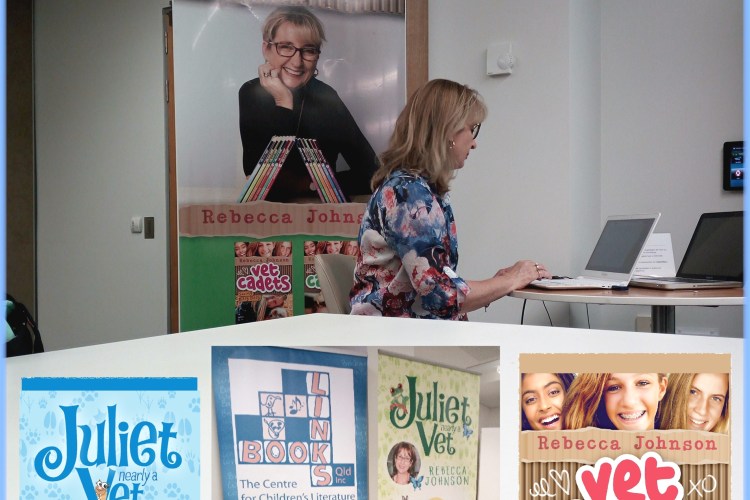
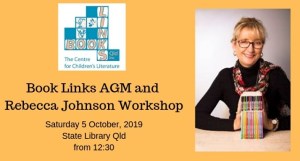
First, some info on Juliet Nearly A Vet children’s series before I launch into my one and a half hour experience hosted by Book Links and Write Linksat their centre for children’s literature.
JULIET NEARLY A VET series by REBECCA JOHNSON
Juliet wants to be a vet when she grows up, but when she decides she needs to start practicing, her wonderful misadventures begin. With gorgeous illustrations by local illustrator Kyla May.
“Hi! I’m Juliet. I’m ten years old. And I’m nearly a vet! We’re off on a school camp to the rainforest. Chelsea, Maisy and I are excited about all the different animals we might spot on our nature walks and torchlight treks. Chelsea is NOT excited about the creepy crawlies we might find! I’ve brought my vet-kit along just in case we find any animals in need of help . . .”
A wonderful series about three smart, funny, animal-loving girls solving mysteries and causing chaos at their country boarding school.
“Abbey, Hannah and Talika are new recruits at Willowvale boarding school’s Vet Cadets program. Mrs Parry, their science teacher, has given each of the girls a chick to raise and train, but not everyone is happy about it! When a game of horseback hide-and-seek turns into a matter of life and death, rules are broken and the friends’ courage sorely tested. This time, a solution might be out of the Vet Cadets’ hands . . .”
Rebecca Johnson is an award-winning Australian author and primary-school science teacher who has written more than 100 children’s books. Her works include the Steve Parish Story Book collection, Juliet Nearly A Vet series, Vet Cadet series, Insect series, and Steve Parish Reptiles & Amphibians Story Book range.
Rebecca Johnson spoke about how she became a published author and what inspired her stories. Her two current series are based on her own childhood experiences, both as a young vet ‘assistant’ and then as a horse-riding teenage animal detective.
Her writing style has allowed her to find the balance between working part-time and writing. She talked about the importance of verbal pitching in the early part of a writer’s career; know your story and speak passionately about it.
Rebecca was open and honest in all she discussed, particularly the challenges of marketing your first book once it has been published. On the subject of payment, royalties and earning a decent income, Rebecca felt a book series worked better.
I jotted down a number of points; from having an agent, to evolving your books as your reading audience grows. Interestingly, in this age of the internet, Rebecca hasn’t physically met Kyla May, her book illustrator.
A fascinating aspect from Rebecca’s talk is her use of a book tie-in and children’s conventions based on her Juliet Nearly A Vet books. She ordered 1,000 vet kits child-size with working stethoscopes and white lab coats—spectacular to say the least. And children obviously have a wonderful time learning about animals and caring for their toy pets!
CONCLUSION
My main takeaway from this workshop was “Write what you know, do the hard yards, continually promote your books” as well as attending events, libraries, Book Week. I applaud Rebecca Johnson for the detail and length of her workshop, and the fact that she happily answered every question.
POSTSCRIPT
A friend of mine, children’s writer Artelle Lenthall, challenged me to nominate 7 of my favourite bookcovers and post one every day for 7 days on Facebook. I have chosen 7 of my favourite bookcovers from Juliet Nearly A Vet series and will post them at 7.00pm each evening.
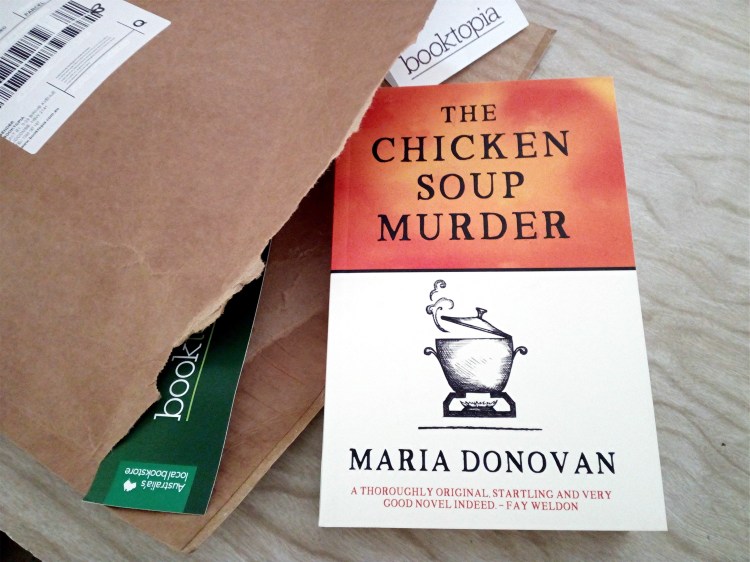
I was waiting for the delivery of a book written by UK author Maria Donovan. The title and synopsis of ‘The Chicken Soup Murder’ hint at a delicious yet deadly coming-of-age mystery.
There was scratching at the front door and our well-trained pet dragon stood there with a grin on his face. He had collected the parcel from the letterbox in anticipation of a treat. I patted him on the head and said ‘Good boy’ then picked up the parcel. He whined. I laughed. ‘Okay, I’ll get a couple of nuts’.
Inside the door, I placed the parcel on the sideboard. Underneath was an old rusty toolkit containing old rusty bits and pieces. I selected a couple of flange nuts and one bolt, gave them a squirt with WD40, and went back outside.
Part of the game was a quick toss-and-gulp and if you weren’t ready you’d miss it. I closed the front door on the slobbering noises and went to find a pair of scissors. The Booktopia cardboard was tough but I wrested it open.
And there was the pristine book I had so eagerly awaited! At the moment, I’ve only read up to Page 20 so I am sorry to disappoint you but my book review will be in another blog post further down the track. As my auntie used to say ‘Keep you in suspenders.’
Who’d have thought it? Margaret Eleanor Atwood (1939- ) author of The Handmaid’s Tale, Alias Grace, The Blind Assassin and more than forty other books of fiction, poetry, critical essays and a graphic novel has written children’s books.
Margaret Atwood also wears various hats, from activist through literary critic, inventor, environmentalist and award-winner with honours and degrees, yet for me this news was surprising. Not so surprising is the quirky nature of her children’s stories!
♦ With grateful thanks to online friend and blogger BookJotter Paula Bardell-Hedley for alerting me to these little gems within a comprehensive list of Margaret Atwood’s literary output—
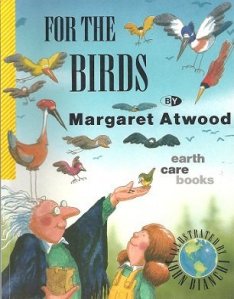
Up in the Tree (1978) Anna’s Pet (with Joyce Barkhouse) (1980) For the Birds (1990) Princess Prunella and the Purple Peanut (1995) Rude Ramsay and the Roaring Radishes (2003) Bashful Bob and Doleful Dorinda (2004) Up in the Tree (facsimile reprint) (2006) Wandering Wenda and Widow Wallop’s Wunderground Washery (2011) A Trio of Tolerable Tales (illustrator Dušan Petričić) (2017)
Being a kidlit fan, I immediately wanted to read several of those earlier Atwood books but found they (like this non-fiction For The Birds) were no longer in print, or libraries, but may be available through state archives or second-hand book merchants. I will track down her first children’s book Up in the Tree (with her own illustrations and hand-lettering, quite possibly written for her young daughter) because the story intrigues me.
Along the way, Wandering Wenda and Widow Wallop’s Wunderground Washery was adapted into the children’s television series The Wide World of Wandering Wenda aimed at early readers with different adventures using words, sounds, and language.
Happily, in 2017, three of Atwood’s books were re-published, printed and bound in Canada into one compilation A Trio of Tolerable Tales. I was able to buy a new copy with Serbian Dušan Petričić gorgeous drawings. Atwood’s alliteration is absolutely awesome!
♦ Here are my reviews of these alliteration-filled, tongue-twisting tales…read on….
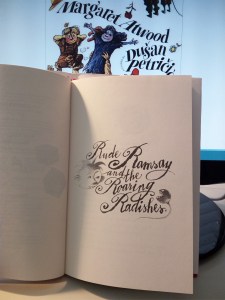
♦ Rude Ramsay and the Roaring Radishes
The reader follows the adventures of Ramsay and Ralph the red-nosed rat as they traverse various repulsive obstacles to find a round, Roman-vaulted rat hole leading to food nirvana – round red radishes ready to be devoured. The radishes revolt and start to attack but thankfully owner Rillah comes on the scene. She forgives their trespass and shows them around her romantic rectory, rotunda, rococo artworks and rumpus room. There’s a bit of a ruckus with Rillah’s relatives Ron, Rollo and Ruby, so Ramsay & Co beat a hasty retreat back outside and romp rapturously under a radiant rainbow. There is a very clever twist regarding the radishes and how they repel intruders! A fun story which needs patience on the part of the reader, especially reading it out aloud for small children. Laughs are guaranteed and you will marvel at how many ‘R’ words exist in the English language. GBW.
♦ Bashful Bob and Doleful Dorinda
Bashful Bob was abandoned in a basket outside a beauty parlour and nobody claimed him. There is a neglected dog park across the street and the resident dogs are Bob’s best buddies. There is a beagle, a boxer and a borzoi who believe “We must be benevolent” and they look after young Bob. On the next block lives Doleful Dorinda. She’d been dumped with despicable relatives who say “Dorinda is a dope” and make her sleep beside biohazard material. Her food is awful and she is treated like a slave. Finally Doleful Dorinda runs away and meets Bashful Bob on the vacant block. You will have to read this story to find out how their names were turned into Brave Bob and Daring Dorinda but it makes a jolly rollicking tale especially if you like dogs! The plot and resolution are more conventional, even with the proliferation of ‘B’ words. A flowing, tangible fairytale and I found it easy to absorb. GBW.
♦ Wandering Wenda and Widow Wallop’s Wunderground Washery
Wenda is a willowy child with wispy hair and wistful eyes. Her parents are whisked away by a weird whirlwind and thereafter Wenda wanders aimlessly. She makes friends with Wesley woodchuck and they share food scraps and wodges of wieners until one day they are kidnapped by Widow Wallop. She takes them to her Wunderground Washery to “wash whites whiter than white” every day. Between the drudgery, they feel sorry for Widow Wallop’s white Welsh ponies and three other waifs, Wilkinson, Wu and Wanapitai. Together they plot their daring escape, only to encounter wolves along the way. How will they evade Widow Wallop’s clutches now? There is an unexpected reveal at the end! I think some of the scenes may disturb younger children, particularly those with separation anxiety. Older readers will chortle at the profuse ‘W’ words and idiosyncratic wordplay. GBW.
♥Gretchen Bernet-Ward
QUOTATION: “Comfort with reading begins in childhood, when parents or other loving adults read to children. It creates a ‘safe’ place where — nevertheless — dangers can be explored (and, in children’s books, hopefully, overcome)…. I think my children’s books function as protected spaces for me. I look at darker things quite a lot, but the kind of children’s books I write are light, and have happy endings…. That’s a relief, when I can manage it.”
—Margaret Atwood, author.
♦ The interior of this book is printed on paper that contains 100% post-consumer recycled fibres, is acid-free and is processed chlorine-free so there’s nothing to worry about, Wenda.
This post will bore anyone without children in their lives.
Dads Read recognises that fathers reading to their children strengthens literacy, models positive reading behaviour and builds children’s self-esteem around reading, especially for boys.
Dads Read is an early childhood literacy initiative, developed by State Library of Queensland in 2010 and launched statewide in 2012 as part of the National Year of Reading, to promote family literacy. The program continues to expand and is now being delivered throughout Queensland and South Australia and plans are underway in Tasmania.
You can host your own event with their resources. I’ve seen this program in action with a dedicated group. Children choose a book, a slice of pizza and sit with their fathers to read.
Discrimination doesn’t apply, the Dads Read message is based on the simple but true premise that reading 10 minutes a day to your children is not only quick but also essential.
Dads Read aims to:
Raise awareness of the important role fathers play in their children’s development.
Inform fathers of the importance and benefits of reading to children from their early years, even before they start school.
Promote reading as a family.
Encourage fathers to read to their children and promote the value of reading.
Provide fathers with the tools to give them the confidence to read with their children.
My father was my reading mentor, instilling interest in books, and Dads Read program follows research which highlights the importance of dads reading to their children during their early developmental years. As little as 10 minutes a day improves children’s literacy levels and stimulates creative and critical thinking.
‘Investment in early childhood is the most powerful investment a country can make’. World Health Organization, 2007.
The Dads Read program has helped:
Address a real and significant issue which is at the core of our wellbeing as individuals, families, employers and communities: the need to be literate.
Support literacy development and help to develop the skills of Australia’s future workforce by building everyday skills for sustainable communities.
Build literacy levels among our younger generation while promoting family literacy and boosting the ability of reading in adults.
Connect families and communities in a cost effective and invaluable way.
You have the month of September to sign up to the new Indigenous Literacy Day fundraising campaign and fill your virtual shelf with books for children in remote communities. Participate in the launch on Wednesday 5 September and discover how to fill a bookshelf for children in the remote Australian outback.
It’s something new, something a little different, something the Indigenous Literacy Foundation believes you’ll enjoy sharing with your friends and family, and something that gives you the opportunity of ensuring kids in remote communities have access to quality, new books.
Commencing on Indigenous Literacy Day (5 September 2018) the new ‘Fill a Bookshelf’ fundraising campaign aims to raise $300,000 to help ILF gift 30,000 new books to schools and service organisations in remote communities where books are scarce.
How does it work? The idea is simple…
Sign up online to create a fundraising page and receive an empty virtual bookshelf.
Ask family, friends, colleagues to donate a virtual book to your page (in the form of a donation)
Fill your virtual bookshelf!
Change the lives of Indigenous children.
Your donations will help buy new, carefully selected books for children who have none. To put it quite simply – without your support, in a very real sense – bookshelves in remote Indigenous communities are empty.
All children in Australia deserve the same opportunities – in education, employment, health and wellbeing. Evidence shows that literacy is the pathway to CHOICE for these opportunities, and BOOKS are the building blocks for literacy. If you believe this too, sign up today!
The Indigenous Literacy Foundation
PO Box 663 Broadway NSW 2007
Australia
Indigenous Literacy Day is a national celebration of Indigenous culture, stories, language and literacy. Indigenous Literacy Day aims to raise awareness of the need to support literacy in remote and isolated Indigenous communities of Australia.
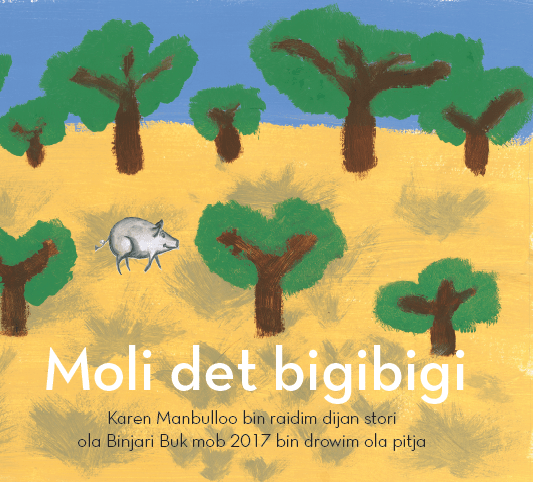
‘Moli det bigibigi’ (Molly the Pig) a new children’s picture book written by Karen Manbulloo, from the remote Binjari community near Katherine in the Northern Territory. Written in Kriol and English, ‘Moli det bigibigi’ is a story based on a real-life pet pig of the Binjari community, found in the bush by Karen’s brother.
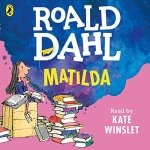
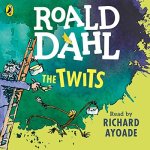
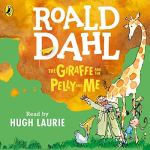
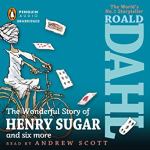
Fabulous stage and screen actors reading gloriously fun books. I listened to eight beautifully narrated sound clips by Kate Winslet, Hugh Laurie, Richard Ayoade, Miriam Margolyes, Stephen Fry, Andrew Scott, Chris O’Dowd––and I’ve just drooled over Dan Stevens short reading of Roald Dahl’s famous ‘Boy’. What a selection!
Reviewed by Rachel Smalter Hall for Book Riot way back in 2013 who gushed:
“Rioters, I’m so excited. I just can’t hide it. I’ve been holding my breath to share this with you for weeks! The new upswing in audiobook publishing has sent lots of publishers to their backlist to record beloved classics, and one of my favorite projects in this vein is from Penguin Audio, who just released several Roald Dahl audiobooks in July and will release several more this September. The series features some of the UK’s best known screen and stage actors. Here are sound clips from eight of the narrations that have got me squealing like a thirteen-year-old at a slumber party.”
I SAY IT’LL MAKE YOUR EARS HAPPY––SMILES GUARANTEED
TAP ON EACH INDIVIDUAL TEASER WHICH I HAVE CAREFULLY SELECTED FOR YOU FROM A LOVINGLY CURATED ROALD DAHL SOUNDCLOUD PLAYLIST
I found their voices soothing, hypnotic and hilariously infectious.
What more can be said except ENJOY!
♥Gretchen Bernet-Ward
I do reviews not advertisements but––Thanks to Penguin Books Ltd and Book Riot who say “Sign up for our newsletter to have the best of Book Riot delivered straight to your inbox every two weeks. No spam. We promise. To keep up with Book Riot on a daily basis, follow us on Twitter, like us on Facebook, , subscribe to the Book Riot podcast in iTunes or via RSS. So much bookish goodness––all day, every day.”
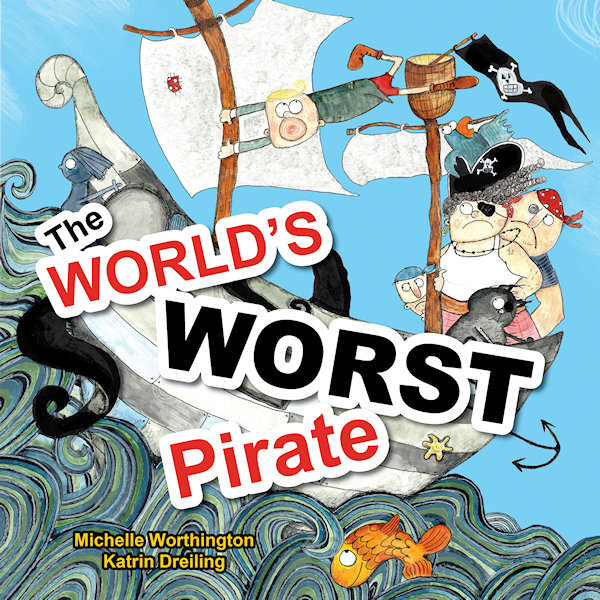
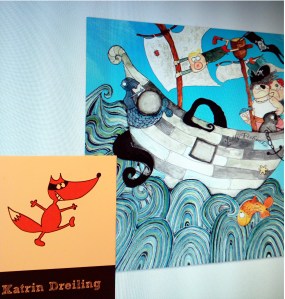
Katrin Dreiling went from language teacher to illustrator and received prestigious recognition for her picture book illustrations in “The World’s Worst Pirate”. This book, written by Michelle Worthington and published by Little Pink Dog Books, has been awarded Notable Book of 2018 by Children’s Book Council of Australia.
Willkommen! Welcome!
It’s wonderful to have you here, Katrin, I love your beautiful art techniques and I’m excited to learn about your journey as a children’s book illustrator. First, here’s a sneak peek at this special pirate story:
William is The World’s Worst Pirate so does that suggest he’s rude and nasty? Read on…
“Pirates are swashbuckling, treasure hunting, buccaneers of the seven seas. But if your mother is the Pirate Captain and you can’t stand on deck without getting seasick … that makes William The World’s Worst Pirate.” However, young William does have a special talent. Can he use it when the ship is under attack? Save the day, me hearty!
Q&A illustrator background
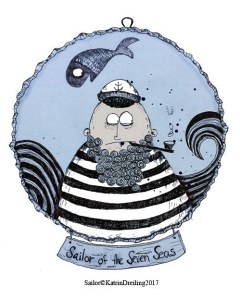
Katrin Dreiling, originally from Germany, loves to come up with quirky creations that inspire children to get creative. She enjoys giving colourful and messy art classes and says “Children are the true perfect grown-ups. Their hearts and minds are pure and good and it is important to nurture this – I strive to do that with art.” On the studious side, she provided the characters for animated University lectures and Government staff coaching videos that attracted over 320,000 views worldwide. In her free time, Katrin relaxes with her husband, three children and their Golden Retriever.
Q1. What is your favourite part of “The World’s Worst Pirate”?
Thank you, Gretchen, for this interview! My favourite part text-wise is when the Kraken attacks and everyone is supposed to run for their lives. Then there is a silence and Will quietly throws a cupcake to tame the beast. I like the contrast between noise and quietness and that it is such a peaceful, gentle approach. In terms of illustrations I think I like the cover the best. I just really enjoyed doing those ocean waves.
Q2. Of all your creations, who is your best loved character so far?
That would be Anton the Pig. This character has been in the works for a while now and so I really got used to him being around. He is also very sweet-hearted and funny and reminds me of a certain someone…
Q3. Where did the inspiration for this character come from?
Anton and his world are certainly inspired by my German background. The region I grew up in is known for their excessive bicycle riding because it’s very flat. So Anton is a passionate cyclist but I merged the landscape with a lot of ideas I picked up while living in Brisbane, Queensland. The inspiration for Anton’s story, though, came from years of working with children at school and my own three kids.
Q4. How would you describe your creative process on an average day?
My working day usually starts with a good walk with my Goldi to keep him happy and clear my head. Then I usually work down a list of things I have to do for my illustrating business. Once this is done I start creating. This can include simple sketching, commission work or extending my portfolio.
Q5. Do you like working in a group or home-office environment?
I am very happy to work by myself from home but I do seek professional input from other industry professionals on a regular basis. There is the Brisbane Illustrators Group where I made many good friends, WriteLinks and our local SCBWI group. I think it is very important to stay connected in which ever way you prefer, be that online or in real life.
In costume The World’s Worst Pirate book launch
Q6. Was it enjoyable working with writer Michelle Worthington?
Absolutely loved working withMichelle Worthington and would always choose to do so again. She is professional, smart and supportive and I felt very appreciated in my illustrating.
Q7. What is it like collaborating with an editor and publisher?
In the case of Little Pink Dog Books it was the perfect synergy between author, publisher and illustrator. Kathy and Peter Creamer were very inspired to keep this project a creative process which involved everyone in the same measure, and I believe the result reflects this very well. When I worked with other publishers it was a different, yet also enjoyable experience. I had to meet more firm requirements and learned new things along the way. I think you have to be adaptable as an illustrator in order to deliver the best possible outcome for the project.
Q8. Do you like to work with artistic freedom or a strict deadline?
I can do both 😊
Q9. Have you stayed up past midnight to finish an assignment?
Yes. I have worked through nights but if the work does not feel like work it is not a problem.
Q10. Have you ever received harsh criticism for your work?
I have been very lucky so far and mostly received constructive criticism which I value a lot. It’s easy to get too complacent and lose distance to your work. This is why I regularly book in for portfolio assessments with editors to get a fresh perspective on my work.
Q11. What is your favourite medium to work with and why?
I mix a lot of media together because I enjoy many things at the same time. I seem to always come back to ink in some form, though.
Q12. What colour would you be if you were an extra pencil in the box?
Black.
Q13. What are your thoughts on hand-painted vs computer generated artwork?
It works really well TOGETHER if you know how to.
Q14. Who are your favourite artists and have they influenced you?
Absolutely adore the work of Beatrice Alemagna. She has inspired me to go my own way, like she did. Then there is the quirky and unconventional style of Russell Ayto that I love. I think both artists truly work to delight and inspire children.
Q15. Are you involved in teaching workshops for children?
Yes, I will be giving workshops with Michelle Worthington to children at selected libraries in Brisbane during school holidays in July 2018. Also I give workshops for both children and grown-ups at a bookstore in Red Hill, Brisbane, as well as giving regular extra-curricular art classes once a week at New Farm State School.
Q16. Do you have a special creative goal for this year or is it a secret?
For my Anton the Pig story, I’d like to finish the manuscript and illustrations completely. Also getting published by one of the ‘big’ publishing houses has always been my dream and I’m still working towards this goal.
And this Q&A draws to a close
My sincere thanks, Katrin, for your personal insights into the world of picture book illustrating. I am sure you will reach your goal and I look forward to reading all about Anton!
Hey, is anyone else left wondering who that 'certain someone' is and why Katrin would be a black pencil...
With a knowing smile, this Victorian-style book of manners is reminiscent of the period of parenting when misbehaving children were given orders and told dire consequences would ensue if they did not obey. Despite warnings, when a child in this book ignores an instruction, there is an aftermath of great magnitude.
Page 28 “Jesephany and Keziah were unruly and wild…”
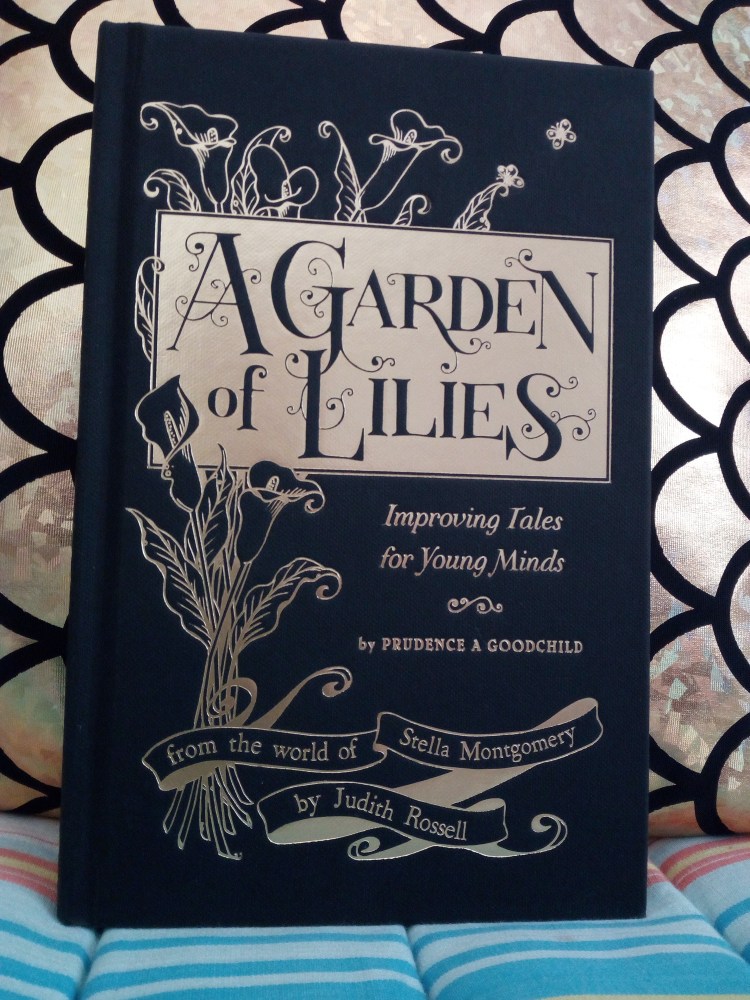
In “A Garden of Lilies: Improving Tales for Young Minds – by Prudence A Goodchild” children’s author and illustrator Judith Rossell has produced an atmospherically illustrated and tightly written volume. She has also mastered the art of a left-right jab, hitting with swift endings which leave the reader breathless.
Each punchy short story closes with a judicious moral. For example, Isadora daydreamed too much during her chores. One day she daydreamed while idly brushing her hair. Let’s just say she didn’t get to finish the task. “Moral: For hair that’s glossy, clean and bright, Two hundred strokes, both morn and night”.
After Isadora’s tale, there is what appears to be a lovely page entitled “Care of the Hair” with a recipe for making Soft Soap which “…will improve both the texture and colour of the hair” until things get a bit nauseating. Apart from kitchen scraps, the mixture must boil for hours until it forms a clear, thick jelly.
“A Garden of Lilies: Improving Tales for Young Minds” by Prudence A Goodchild (author Judith Rossell) ABC Books Australia
Basically the stories are about kids being kids and the 21st century reader should see the endings for what they are – a sample of Victorian etiquette and psychology which we would not dream of using on children today. Right? Okay, explain that to your child and laugh.
This slim book is approximately sixty pages (with attractive binding and colour plates) and scattered throughout are “Interesting Facts” and helpful hints like An Economical Recipe for a Plain Cake, A Useful Compass, Parlour Games and my personal favourite, An Album of Sea-Weeds. I will work on drying and pressing seaweed during my next holiday! Hmm, would seaweed smell like that starfish I once brought home?
In closing, I will give a shout-out to Mr Lindon of Woolloongabba, Queensland (Page 45) who grew a giant marrow. I think he must have read the book’s suggestion To Grow a Giant Marrow which signifies “A Garden of Lilies” is indeed a versatile volume!
I cannot give you a childproof safety rating but I think it is suitable for a sliding age scale and my own rating is 5-star.
♥Gretchen Bernet-Ward
Judith Rossell — Biography
Judith Rossell is the multi-award-winning author-illustrator of the bestselling Stella Montgomery series (Withering-by-Sea, Wormwood Mire, A Garden of Lilies and forthcoming Wakestone Hall). Judith has written thirteen books and illustrated more than eighty, and her work has been published in UK, US, Germany and translated into more than twenty languages. Before beginning her career in children’s books, Judith worked as a government scientist (not a mad scientist, a normal kind of scientist) and also for a cotton-spinning company (which made threads for T-shirts, denim jeans, mops and teabag strings). Judith lives in Melbourne, Australia with a cat the size of a walrus.
ACCLAIM FOR WITHERING-BY-SEA AND WORMWOOD MIRE:
Indie Awards – Winner 2015, Shortlisted 2017
Australian Book Industry Awards – Winner 2015, Shortlisted 2017
CBCA Awards – Honour Book 2015, Notable Book 2017
Davitt Awards – Winner 2015, Shortlisted 2017
Prime Minister’s Literary Awards – Shortlisted 2015
ABA Booksellers’ Choice Awards – Shortlisted 2017
Australian Book Design Awards – Shortlisted 2017
Aurealis Awards – Shortlisted 2015

























 Q1. What is your favourite part of “The World’s Worst Pirate”?

 Q10. Have you ever received harsh criticism for your work?
 Q14. Who are your favourite artists and have they influenced you?
 Information:



 Thoughts Become Words