Book Covers Tell Too Much

Books Bookshelf Old Volumes

Can you tell a book by its cover?  Sure you can!  Just the same as an individual’s personality and clothing can tell something about them, a book lures the reader with an enticing cover image.  That visual reveal, a hint of what’s hidden within the book is a very important marketing tool.

A contemporary bookcover, no matter what the genre or category, has to be identifiable.  It has to look good on publicity material, it has to create a mood and it has to appeal to its target audience.  The font style, back cover blurb and all-important artwork join together to get you interested enough to part with your money.  Unless you are borrowing the book from your local library.  Nevertheless, you will still be interested in that lurid hardback in your hand because it promises so much…just look at that out-of-context quote from a famous author who said “chilling depth” and “sizzling romance” from a “writer with imagination”.

Millions of modern eye-catching bookcovers are perfectly serviceable and practicable and sensible and don’t mislead the intended reader.  It can be argued that bookcover images only hint at a small portion of the entire book.  But, as a person who reads books very closely, I disagree.  I like to make my own assumptions and not be misled by skewed artistry.

Thus I start my LONG bookcover show-and-tell, documenting that which has annoyed me for some time – the all-to-obvious artwork on bookcovers, those illustrations which give the game away.

  • The reveal: I loathe it when the crime bookcover shows the pivotal moment in the book. A dead giveaway!  Is that the graphic artist’s fault for reading the front and back page?  Is it the publisher’s fault for handing out the last chapter?
  • Bookcover clue giveaway: I have just finished a police procedural and the creepy black-and-white cover photo with a rundown house on the hill encircled by barbed wire is actually where the bodies are buried. No kidding, I knew every time the detective went up that hill, he was darn stupid.  Or the one with the sketch of a child on a rocking horse holding a scythe over her shoulder – storyline crumbles before it starts.  Worth mentioning that a rocking horse was not even in the story.
  • Vignettes snipped from a chapter: Like historical fiction “Golden Hill”, where a sketch of the hero is seen on the bookcover leaping across a roof top in true Hollywood style, no doubt aimed at action-loving readers, when the bulk of the story revolves around cruel social hierarchy.
  • A mystery novel: Well, murder actually because several people end up getting killed. This illustration managed to ruin the first three punchlines in the first three chapters.  Not to mention the good guy is seen working in the downstairs office window when his office is upstairs.  Plus the red motorbike heading up the road outside is meant to be him, at the same time.  Lovely drawing but couldn’t they have chosen something more accurate?
  • Overcooked Clones:  There’s the hand frozen in ice (guess how the victim dies) there’s the bridge across the river (guess how the victim dies) there’s the threat (a big dark old building) there’s a corrupt political serial killer millionaire mowing his way through rich widowed neurotic socialites on board his yacht (guess how the victims die) or bones poking out of the earth…black crow…wolf in snow…lonely highway…stark tree…dropped gun…body part…the train racing through the underground station…all overdone crime tropes.
  • To quote Tim Kreider, essayist: “The main principles of design—in books…is your product must be bold and eye-catching and conspicuously different from everyone else’s, but not too much! Which is why the covers of most contemporary books all look disturbingly the same, as if inbred.”  Which leads into––
  • Dark silhouette: I, for one, thoroughly dislike the brooding male or female silhouette in a heavy coat, head down, walking toward a menacing city skyline/bridge on a rain-soaked evening. Boring!  The stock standard photo silhouette has been on countless bookcovers for years.  Think of Lee Child.
  • Expected bookcovers or Clone II:  Why does (1) Romance have the obligatory well-developed over-muscled man and well-developed bust-overflowing woman, and (2) Literary fiction has a sedate, toned, almost elegant layout with a design which purrs good taste?  (3) Non-fiction is so varied it usually has just a colour photo with a word overlay.  (4) Historical fiction will have a woman in period costume gazing at house or hillside.  (5) Children’s books, fantasy and science fiction have a place all their own.  Renegades breaking up the predictable.
  • Flip side: An irrelevant illustration. There are obscure bookcovers like “The Midnight Promise” with two hands shaking as though in agreement when the Promise is nothing like that image.  At least it gave me something to ponder.
  • World-wide: I’m commenting on English language publications and referring to p-books and e-books. I’ve mentioned arbitrary books I have read and tried not to name them.  However, the same book published in different countries gets a different bookcover.  This is where designers and image stock can become tricksy.  I have seen translated children’s books looking very adult, young adult books looking too adult, and adult books looking sugary sweet, e.g. cosy mystery covers with blood-thirsty content between the pages.

Book Sliced Up on Plate with Knife

BONUS:  Terry Pratchett’s bookcovers by artists Josh Kirby and Paul Kidby tell a detailed story.  With fiction, decide how closely you should look.  Decide if you want to undermine the plot.  You may not even notice pictorial clues!  Ask yourself if you are exercising your own freewill, or are you conditioned by a generic bookcover image.

Link to superb 20th century bookcovers from The Paris Review:
https://www.theparisreview.org/blog/2018/02/22/twelve-illustrated-dust-jackets/

Today, the mass market book illustrators, the image makers, appear to acquire design inspiration from their clinical, perfectly sculptured computer programs.  Perhaps they should visit an art gallery, or see what’s shakin’ in the real world, then tell that miserable silhouette model to get lost.

Never stop reading!

Gretchen Bernet-Ward


Postscript : A Tiny Bit of History : Literature has changed in more ways than one over the centuries.  Illuminated manuscripts gave way to smaller volumes with dust covers/jackets in 1820s Regency, then refined in 1920s to make hardback books more attractive.  Before this the majority of bookcovers were a plain single colour with gold embossed wording and little adornment.  Swanky ones did have lithographs or a portrait frontispiece.  It is considered that 1930s paperback printing changed the course of bookcover art.

Lorna Doone by R D Blackmore

Teatowel of Ignominy

Ever do something just for fun?  Sure you have.  From an impromptu picnic to cooking a lavish dinner.  Sporty things, family things, shopping expeditions or entering a competition in the name of fun.

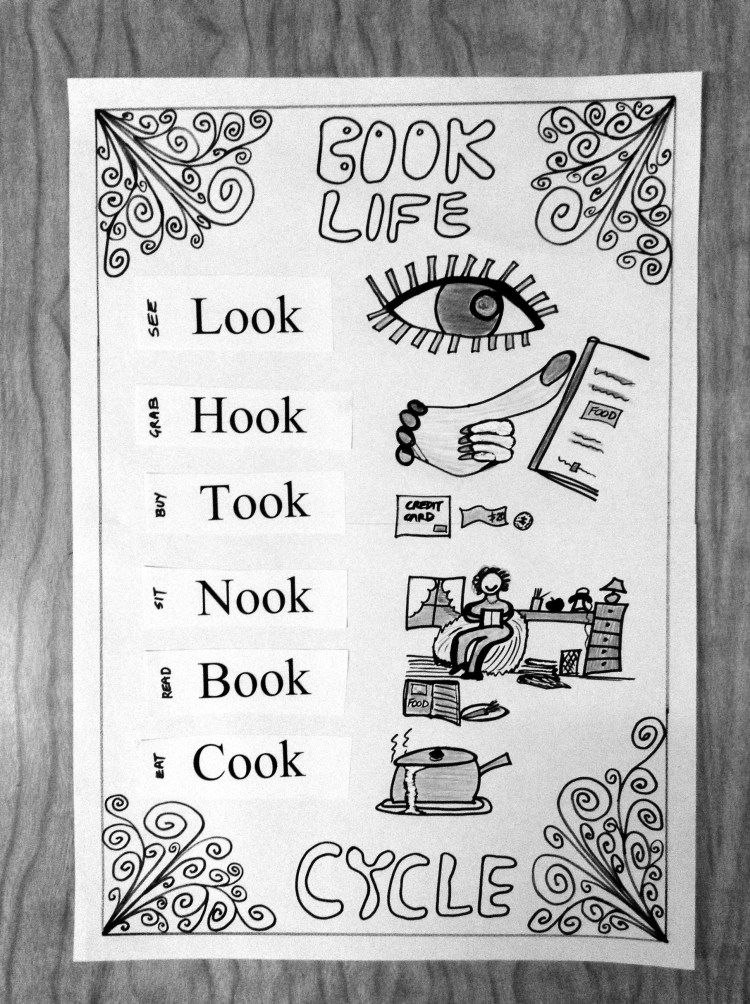
Recently I designed a book-themed teatowel for fun.  There was a prize involved but I won’t dwell on that because I did not win.  However, it did spawn this blog piece…

Tea Towel Design 03
G-B-W©Book Lifecycle artwork (Australia)

For those born into a dishwasher world, I will elaborate.  A teatowel is used to dry crockery and cutlery.  It is made of an oblong piece of linen or cotton material, naturally absorbent, hemmed on all sides and printed with a design.  The design is printed on one side, in portrait position.  Teatowels can be any colour, any theme, but traditionally the same fabric and size.  They can also be displayed poster-like on a kitchen wall.  The following teatowels are not ignominious!

Tea Towel Design 04
Raspberry Thistles©Scott Inness (Scotland)

Tourist destinations sell souvenir teatowels, the most glorious ones are those in public art galleries.  Gift shops offer cute ones with flowers, teacups, recipes or cow designs.  Craft groups use them as fund-raisers, while cookware stores display matching sets of oven mitt, apron and teatowel with a trendy designer logo.

Tea Towel Design 06
Friesian Cows©Rodriquez (Australia)

I have a large proportion of Australian flora and fauna too well-laundered to show here.  The examples displayed are the best I could find in the kitchen drawer.  A lovely giraffe print from Western Plains Zoo, Dubbo NSW, was singed from a cooking incident.  My recently purchased Cecily teatowel (below) is part of a book-themed series from New Zealand.  It will not suffer the fate of another limited edition teatowel which, shock horror, was used to wipe the stove griller.

Tea Towel Design 08
Cecily©Moa Revival (New Zealand)

Teatowels sound old-fashioned and domesticated but they can become the focus of teenage washing-up disputes and used as a weapon to flick people.  Snap!

Tea Towel Design 05
Babushka Dolls©Ladelle (Australia)

Apparently teatowels originated in Victorian England and were used at teatime to keep the china in good condition.  Baked goods were often laid on a teatowel to cool or alternatively kept moist under a teatowel.  The name is different in different countries, in Australia a dishtowel/dishcloth is used for more heavy duty cleaning.

Teacup 001
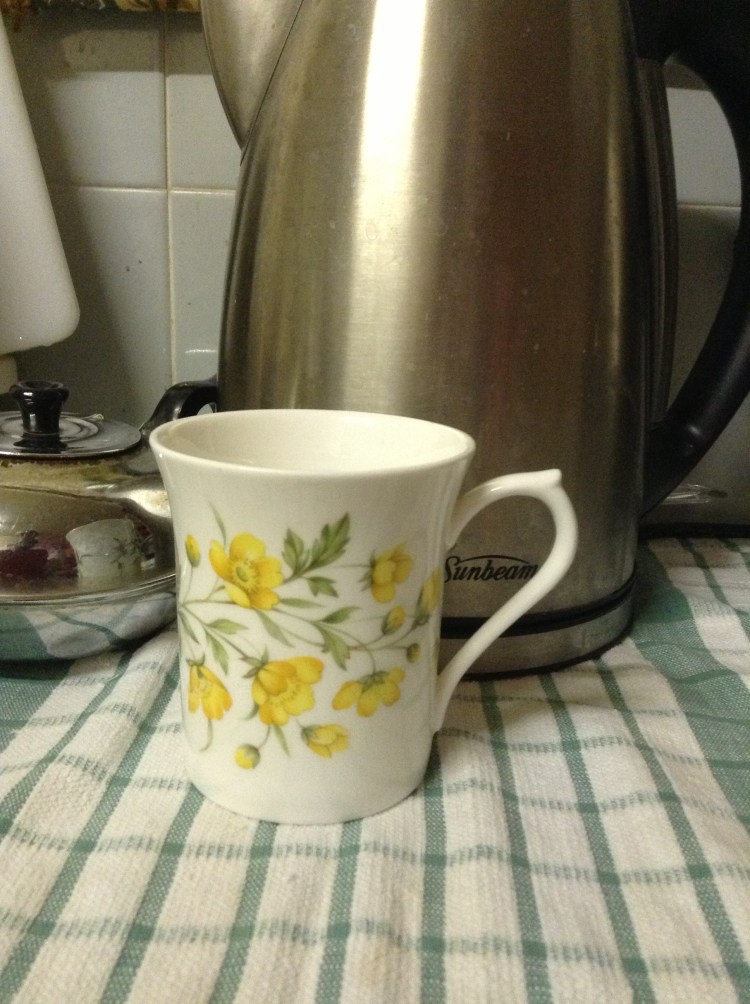
Tidy teatowel (Unknown)

No doubt there is an online history of teatowels and teatowel aficionados around the world, but I am content in the knowledge that I have owned many useful hard-working ones over the years.  Lightly imbued with nostalgia and sentiment, some were gifts, most I have bought, and one I designed myself which is not destined to be printed.  That’s a good thing.

Gretchen Bernet-Ward


BONUS:
My blog post is laden with afternoon tea foodie photographs
https://thoughtsbecomewords.com/2018/03/11/afternoon-tea-and-fancy-food/
Extra teatowel image courtesy of The National Trust UK
https://www.nationaltrust.org.uk/

IMG_20180403_120406
Made with care in UK for The National Trust 100% cotton.

Screensaver

Sherwood Toilet Block Hives Park 01
Illusion

Walking in a park, I saw this wall of trompe l’oeil on the side of a public convenience block and just had to photograph it.  The illusion, the trick of the eye was something special which I appreciated more after I saw my photograph.  It was painted by local Sherwood (Brisbane) artists with the name Half Dozen Group of Artists Inc.

One of my favourite pastimes is to change my screensaver image.  I do it on my PC and iPad regularly.  Silly obsession, I know, but it gives me a smile when I log on each day.  I take my own photographs wherever I might be, and have a supply of snapshots and artwork amassed from family and friends over the years.  Some work well, some don’t.  “Framing and focus” was the old adage.

Stripey Street Cat 02
Searching

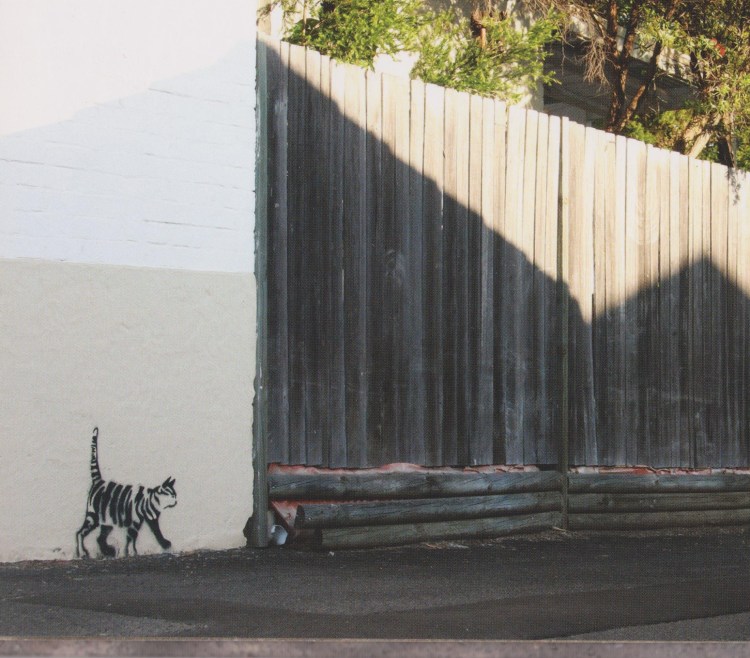
There is a children’s picture book entitled “The Stripey Street Cat” by Peter Warrington and Rachel Williams which is a photographic series of stencilled street art images of a stray cat.  They tell the story of Stripey who is looking for a lost friend, meeting various other Newtown (Sydney) cats along the way.

An illustration I use regularly which attracts attention for all the wrong reasons is this one of Snoopy typing away in the middle of the night with a cigarette in his mouth.  I’m anti-smoking but there’s something naughty about making an icon like Snoopy do such a thing.  The artist is unknown but I think he’d have a good sense of humour.

Gretchen Bernet-Ward

Snoopy Author
Serious


Do You Doodle?

Snail
Snail

Do you still doodle on a notepad or scrap of paper?  When telephones were fixed items, every office had a blotter with notepad and pen handy.  Home phones had a dedicated area littered with paper and old envelopes for note-taking or scribbling a quick message with a stubby pencil.  Doodling came into its own while listening to your boss rant or your mother dispense advice.  It is quite possible that fifty percent of paper used in the world prior to computers and internet access was used for doodling while on the telephone.

It seems we only used half our brain when talking on the phone and, as evidenced today, we had to be occupied with something else at the same time.  Lo, mobile phones were born!  Or in other countries, lo, cell phones were born! With access to a myriad of mind-occupying pastimes.  And you can personalise any device; doodling without pen or paper.  I don’t think it’s necessary to launch into the historic progress of communications over the centuries but I can guarantee it will get more and more streamline, more and more accessible and more and more invasive.  Computer art is not really doodling…

I love curlicues and my featured doodle was penned while I was listening to a podcast so perhaps there is still a time and place for doodling.  I don’t know where that snail came from but I can use any number of tech devices, themes and programs to jazz him up.  Do I want to? Nah, think I’ll just leave him on an old piece of recycled A4 paper.

Happy indeedydoodling!

Gretchen Bernet-Ward


Large Portions of Fast-Paced Comedy

Queensland Theatre Review “Noises Off” QPAC Playhouse Saturday 3 June 2017

Stage Door
Theatre

“Noises Off” theatre production is loud on laughs.

My first experience of Michael Frayn’s stage play “Noises Off” was in 1983 at Savoy Theatre, London, so I was keen to see how Queensland Theatre would handle a 21st century production in Brisbane.  Currently running at QPAC Playhouse, I was already attuned to the chaos about to transpire.

The Queensland Theatre cast cleverly mirror a blemished performance by a supposed theatre troupe in Weston-super-Mare.  This play within a play is an hilarious bedroom farce of abundant innuendo, silly mix-ups and a display of Libby Munro’s white underwear.  Simon Burke neatly portrays director and libertine Lloyd Dallas with a droll delivery, and Nicki Wendt and Hugh Parker evolve nicely as bemused husband and wife.  Cast flexibility is spectacular, especially athletic Ray Chong Nee who channels Roger Tramplemain, and Louise Siversen as spry housekeeper Mrs Clackett.

Strong language crops up but it appears that most dialogue, costumes and props are relatively unchanged, with crafty set design advancing the action behind-the-scenes.  Authentic director Sam Strong has handled “Noises Off” with finesse and his cast of nine prove that Brisbane audiences can absorb large portions of fast-paced comedy without losing the plot.

Gretchen Bernet-Ward

Noises Off Stage Set
Set Design