I am a member of U3A, University of the Third Age, an organisation designed for retired or semi-retired people over 50. My focus has been creative writing but U3A provides an opportunity for members to try something different, meet new people, and share and enhance their knowledge and skills in a friendly environment.
World-wide, U3A is making a substantial contribution to societies by helping members to remain healthy and active longer.
University of the Third Age promotes learning for personal enjoyment and well-being for seniors. Keeping the brain active, doing interesting things and making new friends are essential for helping older Australians maximise their chances of independence.
U3A Brisbane is one of many similar U3A branches throughout Australia. Formed in Brisbane in 1986, they are a volunteer organisation. Brisbane locations provide leisure, arts and educational courses to local members at low cost each term.
Classes are conducted on Zoom and in person at a number of venues subject to Covid-19 restrictions.
CLICK A LINK! ENHANCE YOUR SKILLS OR DISCOVER A NEW ONE:
My Health for Life is a free lifestyle program funded by the Queensland Government and designed and delivered by the Healthier Queensland Alliance. The Alliance is a group of non-Government organisations working in partnership with the Government and Health and Wellbeing Queensland to improve the health of Queenslanders.
The organisations involved are:
Diabetes Queensland
Stroke Foundation
National Heart Foundation of Australia
Queensland Primary Health Networks (PHN)
Ethnic Communities Council of Queensland ECCQ)
Queensland Aboriginal and Islander Health Council (QAIHC)
The following are thanked for their counsel and support:
Health and Wellbeing Queensland (HWQld)
Queensland Health
Brisbane South Primary Health Network Positive Impact Program
Victoria Life! Program
Network of providers and coaches
The people of Caboolture who helped develop this program.
I am currently participating in a free fortnightly My Health for Life Program and after just three group sessions (with a physiotherapist, alternating exercises indoors and out in the park) I feel positive about ‘tweaking’ my lifestyle and eating habits for the better, e.g. increased movement and decreased intake of tea and bikkies.
Also, I was given a Group Coaching Program workbook which is filled out each session to keep my healthy eating on-track and planning for success. A Wellbeing Book, or Guide to Good Health, is included in the pack (in an environmentally friendly carry bag) which offers support, tips on motivation, monitoring your progress, etc, as well as overcoming challenges.
NATURALLY THERE IS NO GUARANTEE THAT EXERCISE WILL MAKE YOU MORE ATTRACTIVE
THAT’S JUST MY TAKE ON FEELING GOOD INSIDE AND OUT!
If you are interested, there is a free health check on the My Health for Life website. Give it a go. In my group there are couples, an asthmatic, a diabetic and a man who has had heart surgery. You’ve got a lot of life to live.
My suggestion—sign up and step away from the screen—do it now!
Do you keep a favourite wall calendar? Do you keep an image from a favourite wall calendar? Do you even buy a wall calendar? Well, I do.
Each year late in December I peruse the newsagents and stationery stores for The One. The wall calendar with good images and good size squares to write in. The paper is also important, not too shiny otherwise the ink smudges, and not too thin otherwise the pages tear and have a tendency to flop forward. I then have to resort to sticky tape to hold old months out of the way of a new month. Sometimes I use glider clips (paper clips, metal things bent to slide over paper and hold it together) or if I don’t like the calendar much, I glue the old months together.
Occasionally it annoys me where the hole is punched in some wall calendars because it can affect the hanging process on my coat-hook (in the bedroom) the nail (in the kitchen) and the picture hanger (in the study) and enlarge the hole.
One of the calendar ‘things’ which has been a major item on our Christmas list for many, many years is a Bunch-Of-Dates. A delightful play on words (perhaps conjured up by a light-hearted printer) it consists of a shaped metal frame which goes through the two holes in a square block of paper containing 365 day leaflets plus a tiny yearly calendar and national holiday dates. An added bonus is daily quotations from inspiring people.
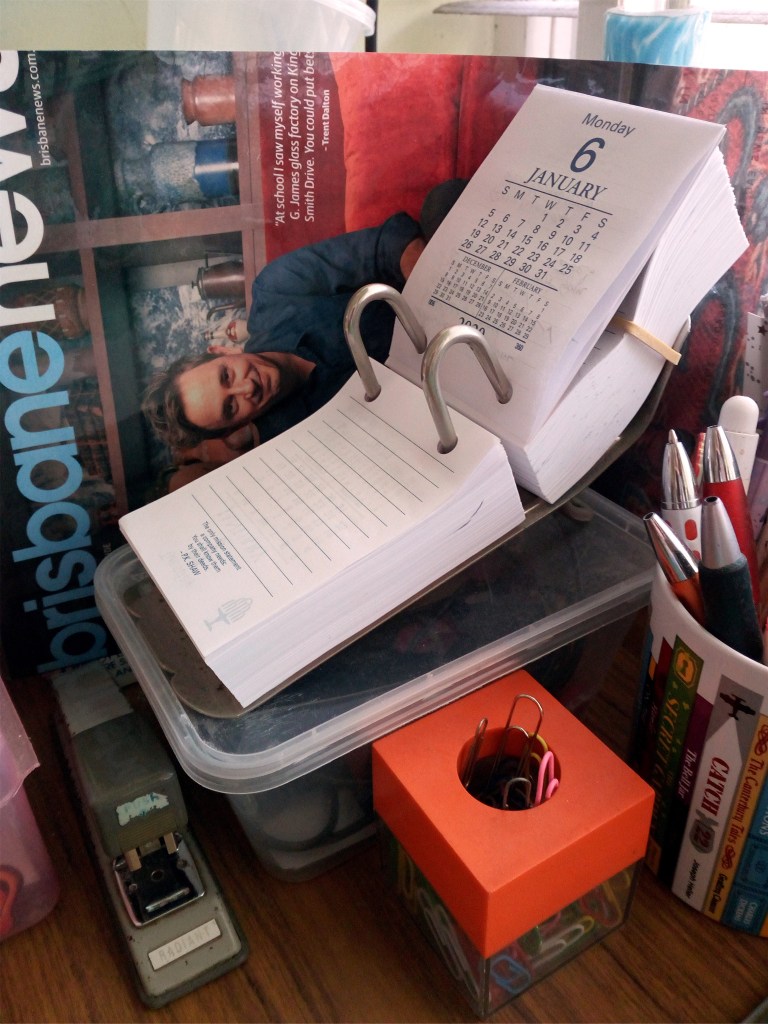
This pre-internet invention sits on office desks and when the workers begin their day, they flip over yesterday’s date to reveal all the chores they have to do today. Every job I ever worked in from 1970s onward had Bunches-of-Dates sitting on staff desks or the reception desk. Yes, I actually still use this old-fashioned device and it is right beside me on my left-hand side. The date at the top (see photo) with lines at the bottom. Yesterday, Sunday 5th January 2020, it had approximately seven things written on it, e.g. shopping for a light bulb and To Do things like fill bird bath with water.
You can buy the Bunch-Of-Dates refills for a couple of dollars (a range of office calendars and diaries are printed by Collins Debden) and every year after 1st January, they are renewed across the country.
If they are not used by lazy coworkers who try to remember things and when they can’t, they blame it on you for not reminding them, their blank Bunch-Of-Dates can be used as scrap paper for note-taking. I sometimes find some thin old wire, like a twist-tie, which I thread through the holes and firmly bind 365 unused days together. Just the right size for cryptic notes to colleagues or wayward family members.
Happy New Year 2020…
Lately I have taken to keeping the last year’s used Bunch-Of-Dates (with exclamation marks, little drawings, council reminders) because sometimes I jot down an important number and don’t transfer it over to my Contacts file. At this point, I must mention that I have an electronic calendar. It is most ingenious but no matter how ingenious, it still needs input. I am very sparing with what I type into my electronic calendar otherwise a lengthy tirade will pop-up at me in the morning when I least expect it.
Another thing; I never ever put stuff on my mobile phone. Silly, I guess, but they need to be charged and friends say ‘my battery died’ whenever they are late. An old-school piece of paper in your pocket will never let you down. That, and a pen, is all you need to survive in the world of words.
But, you ask, what about keeping your favourite calendar photographs? Goodness, I don’t know where to start!
I have many beautiful scenery images, all totally scribbled on the back, all years old. But I love them and I often remember the month that went with them. Except for the one I framed which is three elephants and their passengers splashing down a river in a jungle. The shallow water is jade green, as vivid as the lush tropical foliage. There is a feeling of both pleasure and menace.
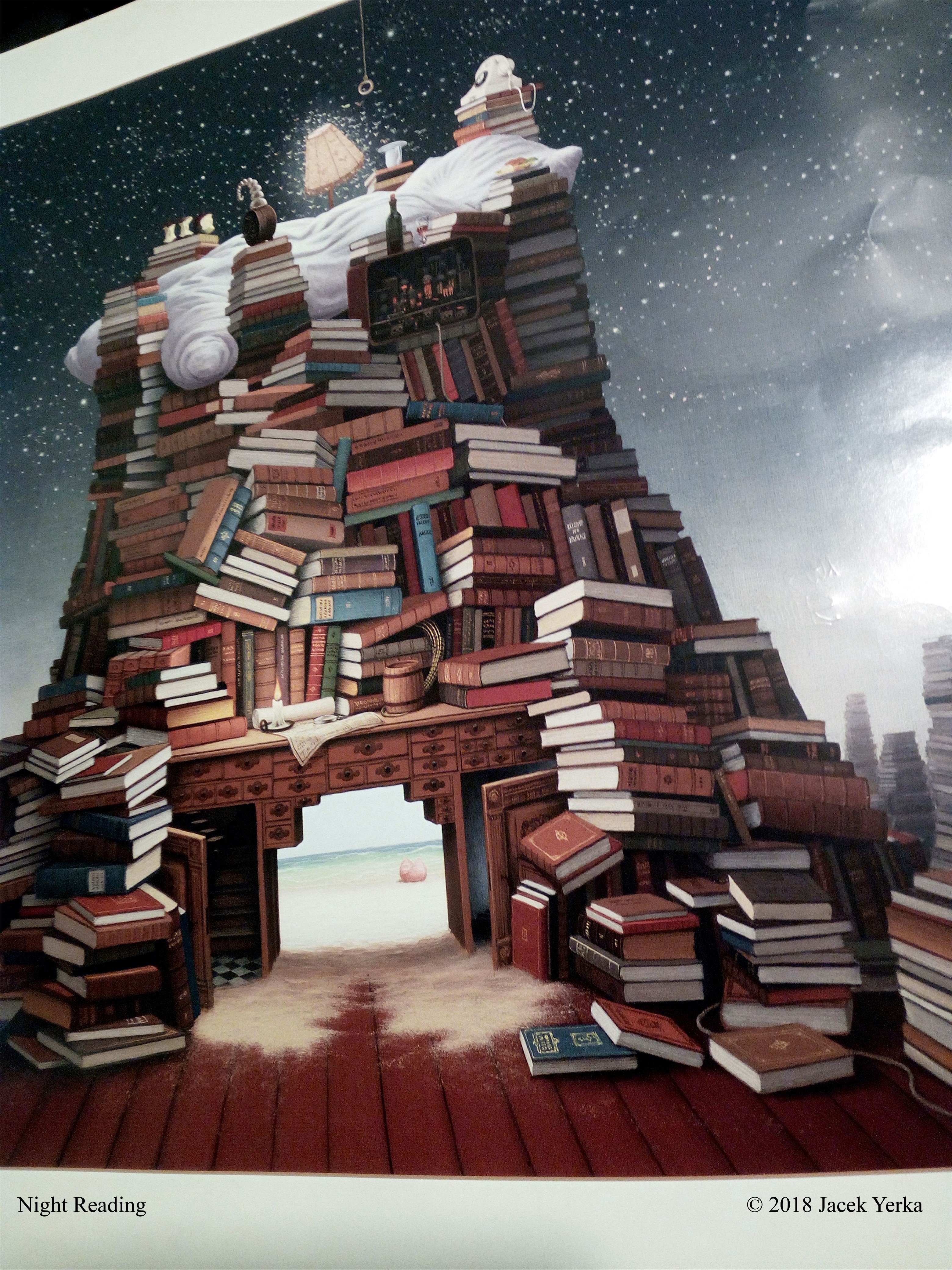
Anyway, a person in my familia has taken a shine to Polish artist Jacek Yerka’s fantasy style and I began to enjoy the ones where he puts hundreds of bookstacks in quirky settings. I kept this one (see above) perhaps not his strangest, but I get a lot of pleasure out of it.
Every so often I have a surplus calendar, a gift or whatever, so I hammer in an extra nail and hang it up, not as prominent as those I love but I give it hanging space.
And this year? Oh joy, this year I discovered an Australian Jumbo Big Huge calendar with gigantic squares! It will take anything I wish to write on it and leave room for more—the down side of this extravagant calendar is no pictures. There is a tiny strip along the top showing a beach or mountain or city but nothing else. And one of these images is repeated, not a good look in my eyes. Ho-hum, can’t have everything.
In the kitchen my next favourite is Chickens, not cooked, just hens displaying glorious feathers in beautiful country settings. Pecking through, it looks like April hens are ahead of the flock photogenically. I will have to let you know who gets preserved at the end of the year. Just a minute, I’ll write a note on my calendar…
♥ Gretchen Bernet-Ward
This is not an advertisement, just a bit of calendar styling.
THING ONE Reading—The Chain by Adrian McKinty THING TWO Looking—A Lemon in Disguise THING THREE Thinking—Don’t Rush the Little Wild Ramblers
THING ONE—READING—The Chain by Adrian McKinty—
The Chain took me by surprise. I had no idea what the title referred to until nice normal cancer patient Rachel O’Neill turns into a desperate, frenzied, tigress of a woman ready to kill to protect her cub Kylie.
Adrian McKinty has written 14 books and I’ve read them all, so I know he can write ‘other stuff’. Guns, cops, drugs and tricky, desperate situations. But never with the strong emotion which The Chain evoked in me.
The sequence of events is based on real bandits who kidnap people and hold them to ransom until their families pay to have them released. Not very nice, and neither is what happens to Rachel and Kylie. This sophisticated version of The Chain involves snatching a child and holding them prisoner to save your own child who has been captured and the next person snatches a child and holds them prisoner until their child is released, etc…with brutal consequences for broken links.
Hachette Australia bookcover 2019
The winners in all of this are The Chain initiators who demand that huge sums of money be paid into their off-shore account otherwise they will force the family to kill your child. The fear, panic and high stress levels are well realised and the pressure applied to Rachel and her ex-army drug addicted brother-in-law Pete (he goes into Bruce Willis mode) never lets up.
Half way through the plot, things take a sharp u-turn (Australian version is chuck-a-youie) but the reader has to trust the writer to follow-through. Trust him I did. And the result was definitely worth it. As always, McKinty writes in his own unique style. There are warnings of social media over-exposure which ring true and even though this suspense thriller is set well and truly on American soil, it holds a universal truth ‘Watch over your children’.
A poetic excerpt from The Chain, Chapter 40, Sunday 11.59 p.m. “She merges with the traffic. The highway hums. The highway sings. The highway luminesces. It is an adder moving south. Diesel and gasoline. Water and light. Sodium filament and neon. Interstate 95 at midnight. America’s spinal cord, splicing lifelines and destinies and unrelated narratives. The highway drifts. The highway dreams. The highway examines itself. All those threads of fate weaving together on this cold midnight.” Author Adrian McKinty 2019
WordPress link to my previous post reviewing McKinty’s Rain Dogs.
I am wrestling with my new Goodreads account.
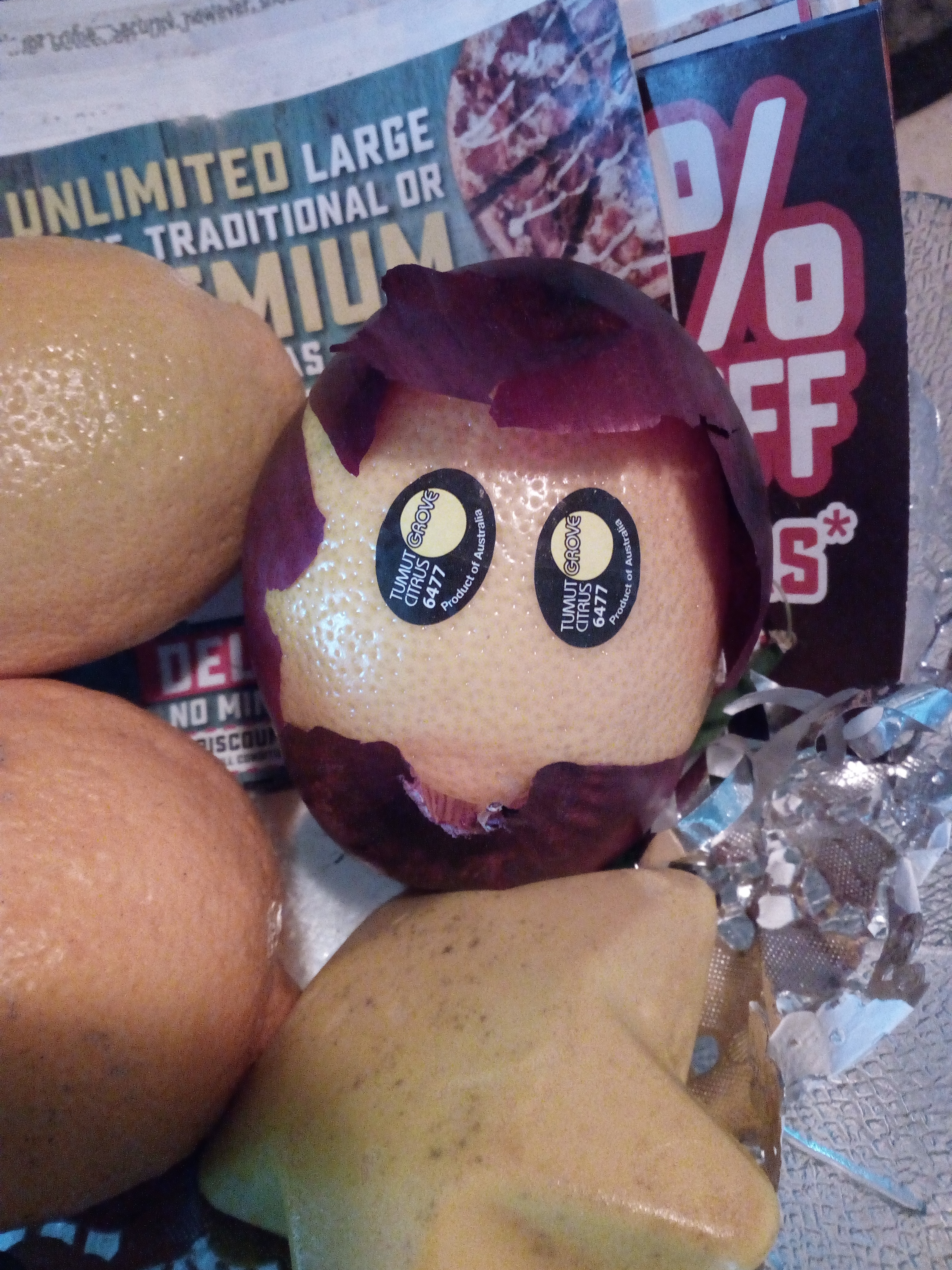
THING TWO—LOOKING—A Lemon in Disguise—
Saw this lemon doing undercover surveillance in an abandoned fruit bowl. He looked a bit out of place with his onion skin hair.
THING THREE—THINKING—Don’t Rush the Little Wild Ramblers—
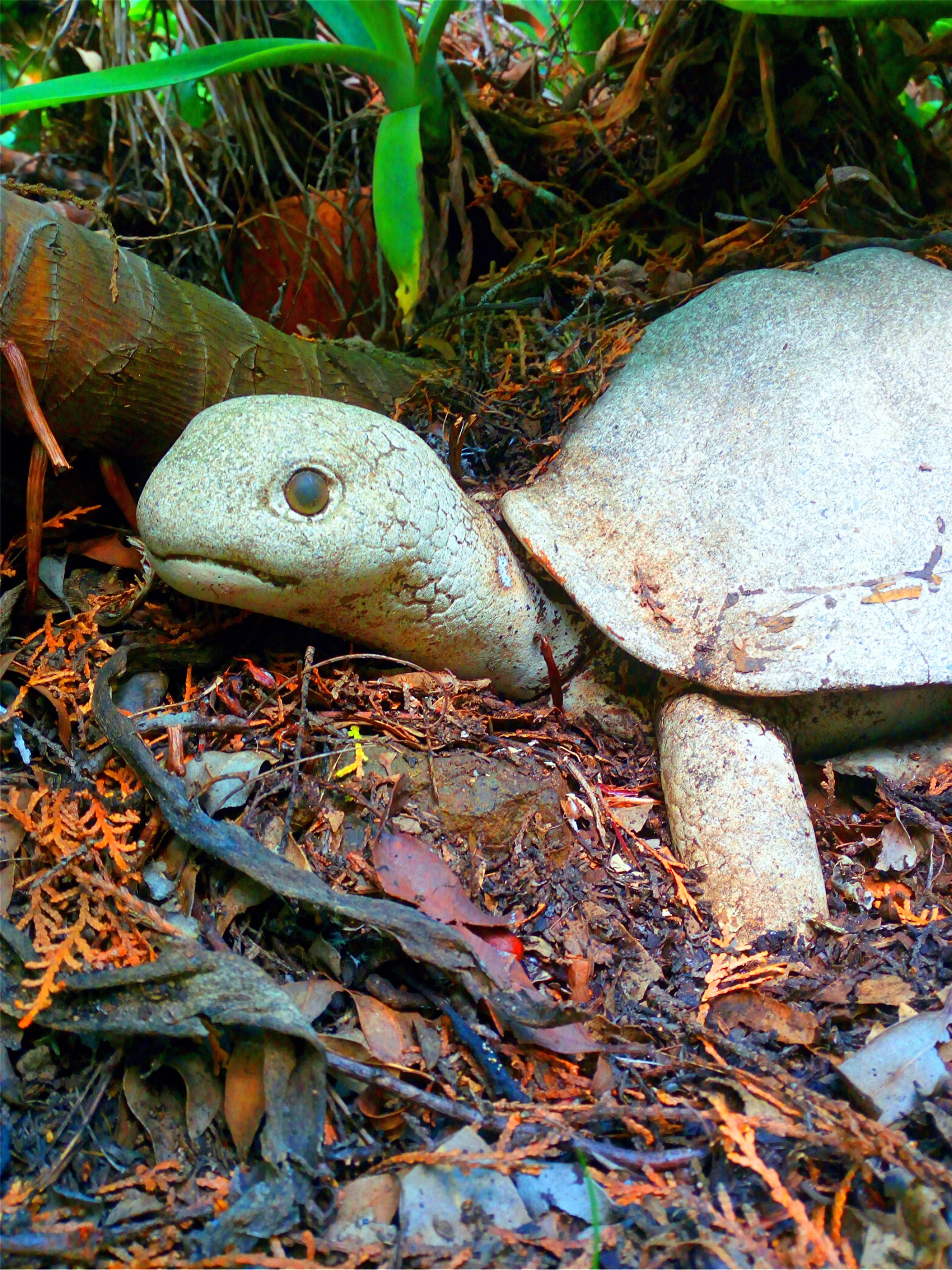
This beautiful quote from Wilder Child Nicolette Gowder struck a cord with me. I thought about young family members who were forever picking up small objects and bringing them home after school. Everything was of interest when out walking, items had to be investigated for smoothness, brightness, weight or lightness. The best treasures were those which once were alive, like a crab claw, rat skull or insect exoskeleton.
I thought about my mother who used to point out the delicate things in nature, things which tend to get overlooked. I inherited her spy-eye for detail especially seed pods. She was more of a beachcomber…but always putting those glistening seashells back where she found them ♥ Gretchen Bernet-Ward
One post in three parts, Reading Looking Thinking, a neat idea started by blogger Paula Bardell-Hedley. Check outBook Jotter her informative, interesting and book-related website!
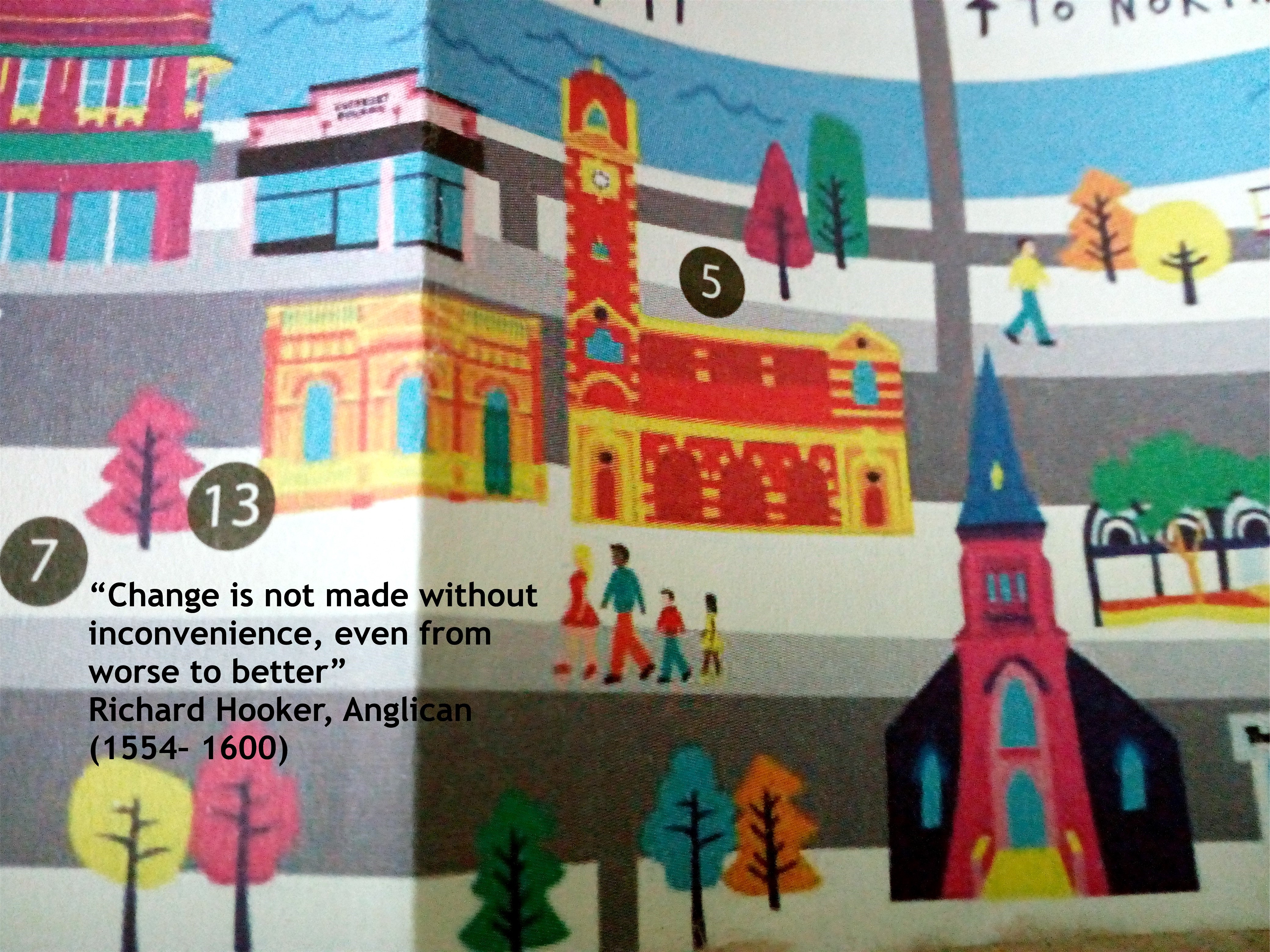
Richard Hooker (March 1554 – November 1600) was an Anglican priest and an influential theologian. Hooker’s emphases on reason, tolerance and inclusiveness considerably influenced the development of Anglicanism. He was the co-founder (with Thomas Cranmer and Matthew Parker) of Anglican theological thought.
Readers of my blog often go straight to my current post which detours Photo Of The Week on my Home page. I’ve gathered together some of my favourite shots—just in case you’ve missed a couple!
This faded old book jumped out at me. I believe interconnections exist everywhere in many forms but none so strongly as with books.
I spied this hardback ‘In Search of Wales’ by H.V. Morton, with sixteen illustrations and a map, resting on one of the tables at UQ Alumni Book Fair. It was published by Methuen & Co. Ltd London in 1932 and purchased by the Parliamentary Library in Queensland, Australia, on 27 July 1932. My photographs don’t convey the substance of this volume.
Apart from my purchase giving me a tenuous Queensland connection, since I have been blogging I have come to know bloggers from Wales like Book Jotter, and people with ties to Wales, so I guess I was curious to find out some early 20th century history.
There is a city named Ipswich, west of the capital Brisbane, Queensland, and it has Welsh heritage from the founding families, the legacy of coal mines, and street names I can’t pronounce. It was going to be our capital city but being situated inland away from sea ports (and always hotter in summer) Brisbane took over the coveted position.
When I look at the B&W images in this book, I can’t help but feel strong emotion for those Welsh families, the people who came to Queensland in 1851 and started afresh. Whether it was out of necessity, assisted passage, general interest or just sheer bravery, it was a long way to come to start a new life in a totally different land.
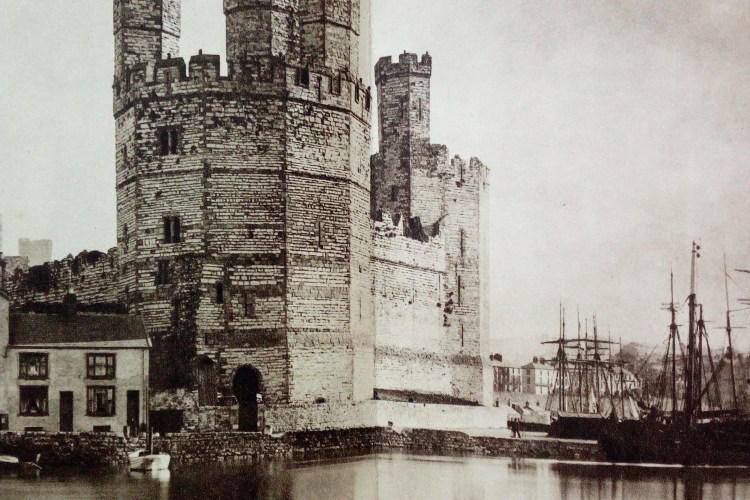
The three photos (below) are 1. Cornfields, 2. Druid ceremony conducted by the Archdruid at the Gorsedd Stone, 3. Cockle women of Penclawdd on the seashore. It looks cold! Throughout there are two-page spreads of dramatic valleys, stoney castles and heartbreaking portraits of mining men and soot-covered boys.
My new old book was deleted from the Old Parliament Library catalogue on 22 October 1996 and I wondered where it had been since then. ‘Oh well,’ I thought, ‘I am enjoying it now on 10 May 2019’. Then I saw a small pencilled Dewey notation on the back cover map UL914.29 Mor. It had probably languished in the University Library.
As yet I haven’t tracked down all the details of author, Henry Vollam Morton, and even though he was a well-known journalist and travel writer, the information in the final pages doesn’t give much away. There is an insightful personal comment (photo below) which ends with three tiny icons, perhaps foreshadowing today’s social media links.
Further material tells me that the author’s book ‘…is more than a travel book, it is a sensitive interpretation of a country’s people and their history.’ He wrote a series called ‘The Search Books’ and further along it reads ‘Since that time Mr Morton’s gay and informative travels…have gained him thousands of readers.’
At this late stage, a book review would be rather tricky—okay, it would be hard for me to get my head around. H.V. Morton travels far and wide through Wales and writes in depth. The voice, the style of that era (nicer than brash Bill Bryson) is easy to read and written in a friendly, personal way with warmth in every chapter. Allowing for the off-key words we don’t use today, there is factual information and humorous stories, and in Chapter Six he asks the usual traveller’s question and receives a great reply—
“The first village, commonly and charitably called Llanfair, provides the stranger with an impossible task among the Welsh place-names.
Its title is: Llanfairpwllgwyngyllgogerychwyrndrobwllllandysiliogogogoch This is no joke. It is only too true! The full name, however, is never used but it appears only slightly amputated in the Ordnance Survey maps.
The postal name is Llanfair P.G. or Llanfairpwll. I entered the first inn and said to those who were drinking in the bar ‘I will buy anyone a drink who can pronounce the full name of this place.’
There was an ominous silence until an old man, finishing his beer, stood up and sang it! ‘And what does it mean?’ I asked. ‘It means,’ I was told, ‘the Church of St Mary in a wood of white hazel near a rapid whirlpool and near St Tysilio’s cave close to a red cave’.”
Sounds magical to me. Daith yn hapus!
♥Gretchen Bernet-Ward
Another beautiful coincidence – it is not springtime in Australia, it is cool autumn weather. Yet these daffodils, a Welsh symbol, were outside my local supermarket the day after I purchased the book at UQ Alumni Book Fair.
Australians really love their pet pals – one in three won’t go on holidays because it would mean leaving their pet behind. A recent survey examined the lifestyle of 1,000 pet owners regarding the impact pets have on their travel habits. I found the results interesting.
National Seniors and Trusted Housesitters research demonstrates that with 5.7 million households owning a pet in Australia (over 13 million people) roughly four million people choose to stay at home rather than holidaying due to concerns about their pet’s well-being.
Apparently those who did take a break (69%) said they had felt guilty when leaving their pet behind, while over one-third of Australian pet owners (36%) have turned down a weekend away, citing being unable to arrange pet care as the reason.
Pets often disrupt their owners’ social lives, with 18% of respondents having regularly missed social engagements in favour of staying at home to ensure their pets were cared for. Of those surveyed, 6% avoided going on dates, choosing their pets over romance.
When it comes to Australian pet owners who regularly take holidays, 29% opted for a trusted pet sitter versus putting their pet in a boarding kennel (21%), while 35% of pet owners organised friends or family to care for their furry friend.
One in four participants said they would never travel overseas or interstate without their pet. Presumably this pet is a dog and the owner is wealthy!
In a British study of veterinary experts conducted by Trusted Housesitters UK, 100% believed animals responded better to a new carer than a new environment, as animals were particularly bonded to their home. Is there bias in this result?
I’m not making any pronouncements for-or-against. I’ve loved and cared for every one of my darling pets and by making arrangements in advance, none ever stopped me from travelling away from home. But the guilt was there.


















 Thoughts Become Words