THAT debate rages on. THAT is an overused, unnecessary word, a redundant filler which bulks out your manuscript and changes just about anything into THAT nothingness.
Increasingly, ambiguous THAT is being used instead of ‘who’ and ‘which’ or more descriptive words to introduce a defining clause. This is happening universally in writing today; THAT is slowing and neutralising sentences.
Seven examples where THAT is incorrect or useless, write your own, you get my drift:
She said that it was in her best interest – delete.
They walked down the stairs that are rather grand – use which.
He visits the koala that he sponsors – delete.
Judy thinks Angela is the sort of woman that enjoys tennis – use who.
He assumed that they all wanted to singalong with him – delete.
It takes a minute to realise that Sue is talking – delete.
Tom has to tell her that her dog has been stolen – OK-ish.
A pronoun is a word taking the place of a noun. THAT is a demonstrative pronoun and used in the right context it has a legitimate reason to exist, e.g. ‘That’s a good idea’.
It is perfectly valid when THAT appears in character dialogue, but when a writer indiscriminately uses THAT in other areas of their work, I find it needlessly clunky.
Of course, you can change a passive voice to an active voice, or use the rule ‘Who is a person, THAT is an object’. Remember ‘Who, what, when, where, why’ to help you decide.
On the other hand, there’s always exceptions. Use your own discretion as to where you like or don’t like THAT, and where THAT actually does fit in your sentence. Once you become aware of THAT, you will probably get rid of it unless you use American English.
CHALLENGE
Read through text or a draft you have written in the last month.
Check for how many time you use the word THAT.
Are you surprised at your usage?
Could you use a more expressive word than THAT?
Could you condense your word count by omitting THAT?
Read a novel or document and watch for THAT exploitation.
If there’s a ‘Ditch THAT’ campaign running, I will sign up!
Why? Because current literary exertion is being spent on THAT, an overworked and superfluous word. What more can I say about THAT? Or, what more can I say?
How pathetic! We have 24 glorious hours in a day and only one is chosen! And it’s not even held simultaneously around the country! Have you read your one hour today?
This year Australian Reading Hour falls on Thursday 20 September 2018 and the nominal time in the evening is 6pm to 7pm. But individual reading and group reads will be happening all day to avoid important sporting fixtures, special events and venue opening hours, and to accommodate the different time zones in Australia.
Fair enough, however, it’s still one lousy hour! What is the Australian Reading Hour committee thinking? There are 8760 hours in one year, so use some more of them.
If more hours aren’t forthcoming next year, why not (1) disrupt your sporting fixtures (2) put the special event on hold (3) pause during venue opening hours (4) delay that visit to the gym and (5) forget a few things to stop and READ for ONE lousy hour!
Meanwhile, find a really quiet, cosy place and settle down alone. Betcha read for longer than an hour!
Or gather a group together at school, work, bookshops like Avid Reader, the library, the park or get the family together in your own home and read, read, read for one lousy hour.
One hour isn’t going to kill you, the world won’t crumble around you – but you and the adults and children of Australia will visit another place through the pages of a book. For one lousy hour…
This post will bore anyone without children in their lives.
Dads Read recognises that fathers reading to their children strengthens literacy, models positive reading behaviour and builds children’s self-esteem around reading, especially for boys.
Dads Read is an early childhood literacy initiative, developed by State Library of Queensland in 2010 and launched statewide in 2012 as part of the National Year of Reading, to promote family literacy. The program continues to expand and is now being delivered throughout Queensland and South Australia and plans are underway in Tasmania.
You can host your own event with their resources. I’ve seen this program in action with a dedicated group. Children choose a book, a slice of pizza and sit with their fathers to read.
Discrimination doesn’t apply, the Dads Read message is based on the simple but true premise that reading 10 minutes a day to your children is not only quick but also essential.
Dads Read aims to:
Raise awareness of the important role fathers play in their children’s development.
Inform fathers of the importance and benefits of reading to children from their early years, even before they start school.
Promote reading as a family.
Encourage fathers to read to their children and promote the value of reading.
Provide fathers with the tools to give them the confidence to read with their children.
My father was my reading mentor, instilling interest in books, and Dads Read program follows research which highlights the importance of dads reading to their children during their early developmental years. As little as 10 minutes a day improves children’s literacy levels and stimulates creative and critical thinking.
‘Investment in early childhood is the most powerful investment a country can make’. World Health Organization, 2007.
The Dads Read program has helped:
Address a real and significant issue which is at the core of our wellbeing as individuals, families, employers and communities: the need to be literate.
Support literacy development and help to develop the skills of Australia’s future workforce by building everyday skills for sustainable communities.
Build literacy levels among our younger generation while promoting family literacy and boosting the ability of reading in adults.
Connect families and communities in a cost effective and invaluable way.
You have the month of September to sign up to the new Indigenous Literacy Day fundraising campaign and fill your virtual shelf with books for children in remote communities. Participate in the launch on Wednesday 5 September and discover how to fill a bookshelf for children in the remote Australian outback.
It’s something new, something a little different, something the Indigenous Literacy Foundation believes you’ll enjoy sharing with your friends and family, and something that gives you the opportunity of ensuring kids in remote communities have access to quality, new books.
Commencing on Indigenous Literacy Day (5 September 2018) the new ‘Fill a Bookshelf’ fundraising campaign aims to raise $300,000 to help ILF gift 30,000 new books to schools and service organisations in remote communities where books are scarce.
How does it work? The idea is simple…
Sign up online to create a fundraising page and receive an empty virtual bookshelf.
Ask family, friends, colleagues to donate a virtual book to your page (in the form of a donation)
Fill your virtual bookshelf!
Change the lives of Indigenous children.
Your donations will help buy new, carefully selected books for children who have none. To put it quite simply – without your support, in a very real sense – bookshelves in remote Indigenous communities are empty.
All children in Australia deserve the same opportunities – in education, employment, health and wellbeing. Evidence shows that literacy is the pathway to CHOICE for these opportunities, and BOOKS are the building blocks for literacy. If you believe this too, sign up today!
The Indigenous Literacy Foundation
PO Box 663 Broadway NSW 2007
Australia
Indigenous Literacy Day is a national celebration of Indigenous culture, stories, language and literacy. Indigenous Literacy Day aims to raise awareness of the need to support literacy in remote and isolated Indigenous communities of Australia.
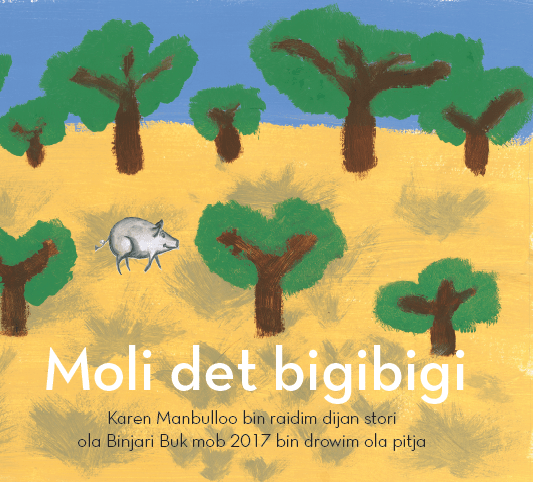
‘Moli det bigibigi’ (Molly the Pig) a new children’s picture book written by Karen Manbulloo, from the remote Binjari community near Katherine in the Northern Territory. Written in Kriol and English, ‘Moli det bigibigi’ is a story based on a real-life pet pig of the Binjari community, found in the bush by Karen’s brother.
This fun tag was brought to my attention by productive book blogger Paula Bardell-Hedley of BookJotter fame. Originally created by Beth of Bibliobeth the idea is to share a picture (aka ‘shelfie’) of your favourite bookshelf and then answer ten questions related to the titles displayed.
Visit Beth’sblog to see more info, the logo and tag and view posts by participating bloggers. Then launch your own unique Q&A Shelfie by Shelfie.
I think many readers will find these titles unfamiliar…
Part of Gretchen’s book shelves.
1. Is there any reason for this shelf being organised the way it is or is it purely random?
Short answer is ‘subliminally shelved’. Long answer is there are many bookshelves in our home and until I decided to participate in Shelfie by Shelfie I didn’t realise that most of my books are grouped. Either when they arrived or over a period of time, I’m not sure. There are clumps like non-fiction, poetry, humour, crime, fantasy and (not all shown) Australian content.
2. Tell us a story about one of the books on this shelf that is special to you, i.e. how you got it / a memory associated with it, etc.
Hard to pick just one. I know some of the authors (or received uncorrected bound proofs to review prior to publication) but my all-time special one would have to be ‘My Beachcombing Days: Ninety Sea Sonnets’ by Brisbane poet John Blight. His daughter, a family friend, gave it to me as a birthday gift in the same year as disastrous flooding hit the city. The flood waters also coincided with me securing a glam job in a travel agency which had 12 inches of river mud throughout the ground floor office.
3. Which book from this shelf would you ditch if you were forced to and why?
No contest! It would be Tom Keneally’s ‘Shame and the Captives’ a semi-factual diatribe about World War II prisoners-of-war from Italy and Japan who are held in a compound in Gawell, New South Wales, but allowed to work on a local farm. It does have its altruistic moments but there’s bloodshed aplenty and the ‘uncertainty and chaos’ never worked for me.
4. Which book from this shelf would you save in an emergency and why?
‘Withering-by-Sea’ written by children’s author and illustrator Judith Rossell. Young heroine Stella Montgomery is the epitome of someone I would have loved to have known when I was a child. I did read a lot of British kids books! Set in Victorian England, the story is both adventurous and creepy. Apart from dressing up as a mature-age Stella Montgomery for library Book Week, two years ago I had my copy of the book signed by Judith Rossell when I attended her writers workshop in historic Abbotsford Convent, Melbourne.
5. Which book has been on this shelf for the longest time?
Hmm, that would be a toss-up between Nobel Prize for Literature winner Patrick White ‘The Cockatoos’ and Miles Franklin ‘My Brilliant Career’ both yellowing reprints dated 1974 and 1979 respectively. I guess Mr White wins.
6. Which book is the newest addition to this shelf?
Another toss of the coin. ‘Truly Tan Hoodwinked!’ (Book 5) kids chapter book written by Jen Storer, and ‘Care of Australian Wildlife: For Gardeners, Landholders and Wildlife Carers’ by Erna Walraven, a 2004 revised edition but in mint condition and recently purchased in a second-hand bookshop. The most adorable teeny tiny Koala baby is on the front cover. The Koala wins by a nose.
7. Which book from this shelf are you most excited to read (or re-read if this is a favourites shelf?)
I have a ‘thing’ for DBC Pierre, expat Aussie writer, and admire his off-kilter books. I own two of his novels (the rest were loans) and love ‘Breakfast with the Borgias’ which I willingly re-read; and I’m usually not a re-reader. Perhaps the fact that one of the characters is named Gretchen has something to do with it.
8. If there is an object on this shelf apart from books, tell us the story behind it.
There is a small cardboard cut-out figure of Lisa Simpson from TV series The Simpsons which probably came with a McDonalds meal deal. Lisa is holding an armload of books and in the show she is the lone advocate of literacy and learning. I always like to think she influenced a generation of TV viewers to read. And that she’s happy on this shelf.
9. What does this shelf tell us about you as a reader?
It doesn’t tell you that I borrow hugely from my local library; or that I read too many e-books; nor that my current audio book is, ironically, ‘The Book Case’ by Dave Shelton narrated by Colleen Prendergast. It does shout that I’m an Australian reader.
I read most genres and most writers regardless of nationality (translated helps!) but I keep coming back to Australian authors. In an online book forum, I recall an American reader saying he only read American books because he understood them. He didn’t mean the language, he meant emotional ties, recognition, connection. That’s what I get from Australian books, nevertheless, I do think we have to step outside our comfort zone.
10. Choose other bloggers to tag or choose a free question you make up yourself.
A free question I can make up sounds good. NOTE I do not activate Comments, you will have to answer it in your own Shelfie by Shelfie blog post.
BONUS QUESTION: Do you discuss the books you read in a face-to-face situation, online book reviews, or clutch your latest read to your chest saying ‘my precious, my precious’?
Happy reading, blog stars!
♥Gretchen Bernet-Ward
For modern Australian book reviews I can recommend blogger and bookseller Simon McDonald https://writtenbysime.com/ while this list contains notably mature Australian authors: Thea Astley
Bruce Beaver
Geoffrey Blainey
Martin Boyd
Christopher Brennan
David Campbell
Peter Carey
Marcus Clarke
James Clavell
Bryce Courtenay
Geoffrey Dutton
Len Evans
John Farrow
R.D. FitzGerald
Miles Franklin
Joseph Furphy
Helen Garner
Germaine Greer
Kate Grenville
Charles Harpur
Alexander Harris
Shirley Hazzard
Xavier Herbert
Dorothy Hewett
A.D. Hope
Janette Turner Hospital
Robert Hughes
Joseph Jacobs
Colin Johnson
Elizabeth Jolley
Henry Kendall
Thomas Keneally
Jill Ker Conway
Henry Kingsley
C.J. Koch
Leonie Judith Kramer
John Dunmore Lang
Ray Lawler
Henry Lawson
Norman Lindsay
Ern Malley
David Malouf
Furnley Maurice
James Phillip McAuley
Hugh McCrae
Colleen McCullough
Les Murray
Oodgeroo Noonuccal
Bernard Patrick O’Dowd
Vance Palmer
Eric Partridge
Hal Porter
Peter Porter
Katherine Susannah Prichard
Henry Handel Richardson
Steele Rudd
Nevil Shute
Peter Singer
Kenneth Slessor
Christina Stead
Alfred George Stephens
Douglas Stewart
Kylie Tennant
P.L. Travers
Ethel Turner
Arthur William Upfield
Morris West
Patrick White
David Williamson
Tim Winton
Judith Wright
Markus Zusak
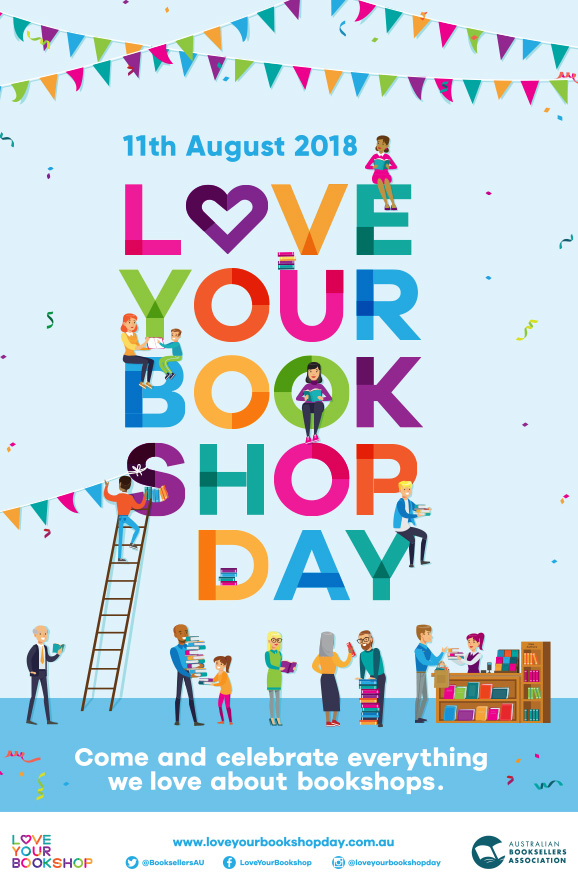
This year bookshops across Australia are throwing a party and you are invited!
Here’s what their invitation says––
Love Your Bookshop Day is a chance to celebrate what makes your local bookshop great. Whether it’s for their amazing staff, their carefully curated range or specialisation, a book launch or a must-see events program, we encourage you to visit your favourite bookshop on Saturday 11th August 2018 and join in with the celebrations.
Don’t forget to use the tag #loveyourbookshopday and share why your bookshop is special using the hash tag #whyIlovemybookshop
DESTINATION: I’m definitely going to visit Where The Wild Things Are, a wonderfully absorbing children’s bookshop in groovy West End, Brisbane. See ya!
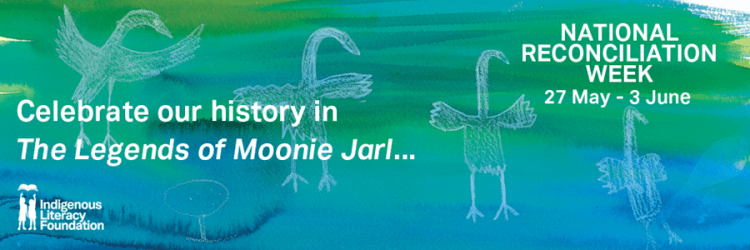
Read a story which is thousands of years old. I’d like to share the email I received from Mr Miller on National Sorry Day and to commemorate National Reconciliation Week––
“My name is Glen Miller, I am a Board Director of the Indigenous Literacy Foundation and a descendant of the Butchulla people of the Fraser coast (Queensland). Today we acknowledge the 10th anniversary of National Sorry Day, a milestone in Australia’s history. This National Day of Healing is at the heart of our steps towards reconciliation. Tomorrow marks the beginning of National Reconciliation Week and we reflect on this year’s theme: ‘LEARN, SHARE, GROW – DON’T KEEP HISTORY A MYSTERY’. Here, we are invited to explore our past as a country; learn, share and acknowledge the rich histories and cultures of the First Australians; and develop a deeper understanding of our national story.
“Today I would like to share a story that is thousands of years old, that has been passed on from one generation to the next, and nearly came to be lost…
“For many thousands of years the Butchulla people have been travelling between Queensland’s K’Gari (Fraser Island) and the mainland; catching winter mullet in stone fish traps set along Hervey Bay and trading with the mob up around the Bunya mountains. There are three laws that the Butchulla people live by: 1) What’s best for the land comes first, 2) If you have plenty, you must share, and 3) Do not touch or take anything that does not belong to you.
“While these were the laws that were taught to the children, they were also told stories that describe the origin of the land: The Legends of Moonie Jarl. These stories tell how the wallaby got its pouch, how the boomerang was invented, and how the little firebird came to have that bright scarlet spot on its back. These stories were told to me as a boy by my uncle Wilfy in the The Legends of Moonie Jarl. The year was 1964 and it was the first Aboriginal children’s book published and authored by Aboriginal people.
“Three years after its publication, Indigenous people were finally recognised as Australian citizens and 50 years on the stories continue to be shared among the Butchulla people. In 2014, our Foundation re-published The Legends of Moonie Jarl so now the stories are available to share with all Australian children.
“A book isn’t just for reading; it’s more powerful than the information it provides. Reconciliation Week is an opportunity to look at the truths that need to be told and celebrate our stories. This National Reconciliation Week I invite you to learn and share these rich histories and cultures of Indigenous people, and develop a deeper understanding of our national story. Please support the work of our Foundation by purchasing a copy of The Legends of Moonie Jarl or making a donation.”

Like me, not everyone has a degree in English grammar, check further: