Jasper Fforde 2018-2019 Author Events

Excited beyond belief when I found out Jasper Fforde, my all-time favourite post-modern author, has some cool events coming up!  Including another book.  And the eponymous Fforde Ffiesta rolls around again next year.

If any reader attended a US event, or may be attending a future UK event, I’m jealous but hoping I will read your WordPress review.  Of course, I will be writing about Jasper Fforde’s Brisbane Writers Festival 2019 special guest appearances in September!  See itinerary below—

Gretchen Bernet-Ward

Photos by Mari Fforde (hover to see date)
Information from Jasper Fforde website (see below)


APPEARANCES

 Jasper Fforde says:  As usual, please call the venue to check times and dates before you set out just in case I am kidnapped by badgers, eager to promote their dangerous monochrome agenda.
Gretchen says: New book “Early Riser” is now available.  Read my review here
https://thoughtsbecomewords.com/2018/12/14/early-riser-jasper-fforde-book-review/\


2018


Feb 21st-22nd, Casper, Wyoming:
Wyoming Humanities Festival 2018

Book signing and lectures. I’ve never been to Wyoming, and the frightfully pleasant people at Casper have been asking me for a while. Talk and Book Signing Courtesy of Windy City Books, and a lecture plus Q&A the following day. Full details at the Humanities Festival website.


1-2nd March 2018, Cardiff Library:
Crime & Coffee Festival, Cardiff

First Crime and Coffee Festival at Cardiff Library. More details to follow, but I am assured the coffee is the crime, and there will be no actual murders of crimes taking place. Either days, or both, details to follow. Cardiff Library Website.


24th May-3rd June 2018
Hay Festival, Hay-on-Wye, Wales:
May or may not be attending this year––One of the UK’s most imaginative and entertaining authors creates hilarious, often absurd but always compelling adventures within bizarre and zany worlds.  Jasper Fforde’s hugely popular The Last Dragonslayer series is packed with trademark magic and invention.”
Information brochure Hay Festival, Wales.
Gretchen’s book review The Last Dragonslayer.


August 2018
Launch of Early Riser in the UK:

About bloody time too, say I.  Likely 1st to 12th August.  More details to follow.


August 13th – 18th, 2018, Wales:
Ty Newydd writing retreat, Wales

With Belinda Bauer, the course is called: Crime Fiction: A Twist in the Tale and from their website: “This course is designed for those who would like to write best-selling crime fiction – with a twist. Whether you’re writing your first novel, are switching from another genre, or have only dreamed of being a published author, we hope you’ll enjoy this down-to-earth, fun, and practical course. In workshops and one-to-one mentoring sessions, we will be sharing our tried and tested methods of creating character, plot and tension, while helping you to avoid some common pitfalls. We’ll offer advice on a range of issues, from writer’s block and the art of pitching, to how to cope with bad reviews!”
For more details, please mouse you way to the Ty Newydd Website.


2019


Early Riser Tour Jasper Fforde


25th-26th May 2019, Swindon, UK:
Fforde Ffiesta VIII, Swindon, UK

These Festivals are held biannually and oh, what ffun we have – and hopefully a lot more to talk about this year as I will have at least one more book published… Their website is here.


NEWS FLASH !!

THURS 5 SEPTEMBER TO SUN 8 SEPTEMBER 2019, BRISBANE, AUSTRALIA

VENUE: BRISBANE WRITERS FESTIVAL, SOUTH BANK, QUEENSLAND
https://bwf.org.au/2019/brisbane-writers-festival/artists/jasper-fforde-1

Jasper Fforde itinerary will be:

Event 1 – Workshop ‘Writing Futures’ with Jasper Fforde at QWC: Learning Centre, State Library of Queensland.

Event 2 – Panel ‘Dream Worlds’ at Cinema B, Gallery of Modern Art, South Bank.

Event 3 – Conversation ‘Early Riser’ at The Edge, State Library of Queensland.

Event 4 –  Book Club ‘Meet Jasper Fforde’ River Decks, State Library of Queensland.

Event 5 –  Lecture / Special Closing Address by Jasper Fforde, The Edge, State Library of Queensland.

Jasper Fforde at Brisbane Writers Festival Sept 2019


FUTURE ENGAGEMENTS


March 02031:   Asteroid belt and Saturn (technology permitting) More details TBA.

October 02042:   81-year-old Fforde talks to other members of old people’s home: “I used to be a novelist, no really, I did. Is it lunchtime?” More details TBA.

July 02175:   Semi-lifelike cloned Ffordesque replicant to tour Gamma Quadrant in the Cygnus Cluster. More details TBA.

Setember 03431:   Much improved Fforde cloned back to life to face execution for sedition; all works consigned to erasure.

Janfebry 008910:   Last evidence of Fforde’s books vanish forever with the removal of the ‘Formerly Thursday Street’ plaque from what is now W23-61 Rd in the conurbation known as EuroWest-79.

00012972:    Visiting archaeologists from Thraal-7 discover incomplete copy of Well of Lost Plots from excavation in landfill. Deciphering takes seven hundred years and a further four hundred years of academic scrutiny before being accepted as historical fact.


More ffun, books, merchandising, photos  Jasper Fforde Grand Central
For those who like a bit of backstory  Wikipedia – Author Jasper Fforde
Twitter  @jasperfforde
Instagram  Jasper Fforde
Facebook   Jasper Fforde Writer

NEWS FLASH 2020

JASPER FFORDE HAS CONFIRMED FORTHCOMING BOOKS!

“Dark Reading Matter”  Bookworld and Thursday Next – adult
“Dragonslayer IV”           Ununited Kingdom and Jennifer Strange – young adult
“Shades of Grey II”         Colours and Eddie Russett – adult
“The Constant Rabbit”   Racism and Mrs Constance Rabbit – adult – available now


Book Covers Tell Too Much

Books Bookshelf Old Volumes

Can you tell a book by its cover?  Sure you can!  Just the same as an individual’s personality and clothing can tell something about them, a book lures the reader with an enticing cover image.  That visual reveal, a hint of what’s hidden within the book is a very important marketing tool.

A contemporary bookcover, no matter what the genre or category, has to be identifiable.  It has to look good on publicity material, it has to create a mood and it has to appeal to its target audience.  The font style, back cover blurb and all-important artwork join together to get you interested enough to part with your money.  Unless you are borrowing the book from your local library.  Nevertheless, you will still be interested in that lurid hardback in your hand because it promises so much…just look at that out-of-context quote from a famous author who said “chilling depth” and “sizzling romance” from a “writer with imagination”.

Millions of modern eye-catching bookcovers are perfectly serviceable and practicable and sensible and don’t mislead the intended reader.  It can be argued that bookcover images only hint at a small portion of the entire book.  But, as a person who reads books very closely, I disagree.  I like to make my own assumptions and not be misled by skewed artistry.

Thus I start my LONG bookcover show-and-tell, documenting that which has annoyed me for some time – the all-to-obvious artwork on bookcovers, those illustrations which give the game away.

  • The reveal: I loathe it when the crime bookcover shows the pivotal moment in the book. A dead giveaway!  Is that the graphic artist’s fault for reading the front and back page?  Is it the publisher’s fault for handing out the last chapter?
  • Bookcover clue giveaway: I have just finished a police procedural and the creepy black-and-white cover photo with a rundown house on the hill encircled by barbed wire is actually where the bodies are buried. No kidding, I knew every time the detective went up that hill, he was darn stupid.  Or the one with the sketch of a child on a rocking horse holding a scythe over her shoulder – storyline crumbles before it starts.  Worth mentioning that a rocking horse was not even in the story.
  • Vignettes snipped from a chapter: Like historical fiction “Golden Hill”, where a sketch of the hero is seen on the bookcover leaping across a roof top in true Hollywood style, no doubt aimed at action-loving readers, when the bulk of the story revolves around cruel social hierarchy.
  • A mystery novel: Well, murder actually because several people end up getting killed. This illustration managed to ruin the first three punchlines in the first three chapters.  Not to mention the good guy is seen working in the downstairs office window when his office is upstairs.  Plus the red motorbike heading up the road outside is meant to be him, at the same time.  Lovely drawing but couldn’t they have chosen something more accurate?
  • Overcooked Clones:  There’s the hand frozen in ice (guess how the victim dies) there’s the bridge across the river (guess how the victim dies) there’s the threat (a big dark old building) there’s a corrupt political serial killer millionaire mowing his way through rich widowed neurotic socialites on board his yacht (guess how the victims die) or bones poking out of the earth…black crow…wolf in snow…lonely highway…stark tree…dropped gun…body part…the train racing through the underground station…all overdone crime tropes.
  • To quote Tim Kreider, essayist: “The main principles of design—in books…is your product must be bold and eye-catching and conspicuously different from everyone else’s, but not too much! Which is why the covers of most contemporary books all look disturbingly the same, as if inbred.”  Which leads into––
  • Dark silhouette: I, for one, thoroughly dislike the brooding male or female silhouette in a heavy coat, head down, walking toward a menacing city skyline/bridge on a rain-soaked evening. Boring!  The stock standard photo silhouette has been on countless bookcovers for years.  Think of Lee Child.
  • Expected bookcovers or Clone II:  Why does (1) Romance have the obligatory well-developed over-muscled man and well-developed bust-overflowing woman, and (2) Literary fiction has a sedate, toned, almost elegant layout with a design which purrs good taste?  (3) Non-fiction is so varied it usually has just a colour photo with a word overlay.  (4) Historical fiction will have a woman in period costume gazing at house or hillside.  (5) Children’s books, fantasy and science fiction have a place all their own.  Renegades breaking up the predictable.
  • Flip side: An irrelevant illustration. There are obscure bookcovers like “The Midnight Promise” with two hands shaking as though in agreement when the Promise is nothing like that image.  At least it gave me something to ponder.
  • World-wide: I’m commenting on English language publications and referring to p-books and e-books. I’ve mentioned arbitrary books I have read and tried not to name them.  However, the same book published in different countries gets a different bookcover.  This is where designers and image stock can become tricksy.  I have seen translated children’s books looking very adult, young adult books looking too adult, and adult books looking sugary sweet, e.g. cosy mystery covers with blood-thirsty content between the pages.

Book Sliced Up on Plate with Knife

BONUS:  Terry Pratchett’s bookcovers by artists Josh Kirby and Paul Kidby tell a detailed story.  With fiction, decide how closely you should look.  Decide if you want to undermine the plot.  You may not even notice pictorial clues!  Ask yourself if you are exercising your own freewill, or are you conditioned by a generic bookcover image.

Link to superb 20th century bookcovers from The Paris Review:
https://www.theparisreview.org/blog/2018/02/22/twelve-illustrated-dust-jackets/

Today, the mass market book illustrators, the image makers, appear to acquire design inspiration from their clinical, perfectly sculptured computer programs.  Perhaps they should visit an art gallery, or see what’s shakin’ in the real world, then tell that miserable silhouette model to get lost.

Never stop reading!

Gretchen Bernet-Ward


Postscript : A Tiny Bit of History : Literature has changed in more ways than one over the centuries.  Illuminated manuscripts gave way to smaller volumes with dust covers/jackets in 1820s Regency, then refined in 1920s to make hardback books more attractive.  Before this the majority of bookcovers were a plain single colour with gold embossed wording and little adornment.  Swanky ones did have lithographs or a portrait frontispiece.  It is considered that 1930s paperback printing changed the course of bookcover art.

Lorna Doone by R D Blackmore

‘Kitty Peck Music Hall Murder Mysteries’ Kate Griffin Book Review

London winter 1880, Limehouse, and chorus girls are disappearing from music halls in Paradise, the criminal precinct run with ruthless efficiency by the ferocious and opium addicted Lady Ginger aka The Lady.

Kitty Peck and the Music Hall Murders
Published 2013
(First book in the Kitty Peck series)
A novel by Kate Griffin

Seventeen-year-old Kitty Peck, a seamstress at The Gaudy, is summoned by The Lady and blackmailed to perform a hair-raising act every night to uncover vital information about the missing girls.  Kitty is taunted by The Lady who withholds the truth about her family, particularly her beloved brother Joey.  Before long Kitty becomes the talk of London with her daring show and the plan begins to work.  Gradually she’s drawn into the world of high society ‘toffs’ and embroiled in depravity and murder.  With only her two friends Peggy and set painter Lucca for support, Kitty is shocked to find herself facing an adversary more horrifying than The Lady crime baron.

First of all, the pace and atmosphere is superb throughout the books.  Immediately I was right in the action and swept along on a very dark ride.  The characters evolve nicely and flesh out into interesting and tortured human beings who find themselves in rather bizarre circumstances.  They have subplots with much to hide, emotions seesaw as their personal history gradually unfolds.

There’s a heavy dose of Cockney slang which, due to an Anglophile father, I picked up quickly enough.  Some reveals are to be expected but one took me by surprise!  The novels have adult content.  However, don’t expect true romance.  It’s the Queen Victoria version of an action movie.  Grim, grimy, cold, damp London of the 19th century is a backdrop to dirty deeds done by black-hearted people and Kitty must keep her wits about her to survive.  The endings are cliff-hangers which lead into each book.

Kitty Peck and the Child of Ill-Fortune
Published 2015
(Second book in the Kitty Peck series)
A novel by Kate Griffin

Due to spoilers, I cannot reveal too much about Book Two or Three.  Certain text in the following review has been taken from the book blurb:

London’s East End, March 1881 and Kitty Peck, a spirited but vulnerable young woman, is the reluctant heiress to Paradise, the criminal empire previously overseen by the formidable Lady Ginger aka The Lady.  Kitty is now The Lady, with all that entails; servants, buildings, stock, music halls and vicious crime barons.  Far from the colour and camaraderie of the music hall where Kitty had been working, this newfound power brings isolation and uncertainty, and a disdainful lawyer Telferman.

Desperate to reconnect with Joey, her estranged brother, Kitty travels to Paris with Lucca.  She is unable to refuse the request of a handsome stranger to take a child back to London.  Within days of their return, it’s clear she has been followed by someone, and this someone is determined to kill the child and anyone who stands in their way…starting with Kitty.

There are mesmerizing and harrowing scenes throughout this book which serve to shape Kitty and her world.  More of the secondary characters emerge and betrayal rears its ugly head.  Tension builds as Kitty nears the deadline to meet the other Barons of London, merchants, jewellers, bankers, the controlling elite who are rotten to the core. Will they break her and destroy the Paradise she has inherited?

Kitty Peck and the Daughter of Sorrow
Published 2017
(Third book in the Kitty Peck series)
A novel by Kate Griffin

London, the hot summer of 1881, and the streets of Limehouse are thick with coal smoke and opium; and Kitty Peck is choking on the ever-present bitterness of evil.  At eighteen Kitty has inherited Paradise, she is The Lady of a sprawling criminal empire on the banks of the Thames.  Determined to do things differently from the fearsome Lady Ginger, she now realises that the past casts a menacing and treacherous shadow.

Plagued by city heat, haunted by a terrible secret and facing more deaths, Kitty is stalked by a criminal league intent on humiliation and destruction; she should never go out alone.  But she’s ready to fight for the future of everyone she cares for and more.  Including journalist Sam Collins?

Always difficult to review books with clever twists and turns one cannot expose.  ‘Descriptive’ and ‘gripping’ hardly does them justice.  Sense of place, POV and clothing are beautifully transcribed.  There is one minor point I noticed when reading––there is little mention of food.  Tea and gin are drunk habitually, and champagne is used as a lever, but food is not often consumed.  No matter, they are gritty stories which had me on the edge of my seat.  While it is not an era I would like to inhabit, I can highly recommend this series with a shiny five star rating.

To be concluded in Book Four – Kitty Peck and the Parliament of Shadows – Coming July 2019

“Even though Paradise was riddled with rot, I reckoned I could make it a cleaner place for the poor types who came with the dirty trades. I could make them all love me, I thought.  I was wrong about that. I’ve been wrong about so much.”  My book review to be advised.

ABOUT THE AUTHOR
Kate Griffin was born within the sound of Bow bells, making her a true-born Cockney.  She has worked as an assistant to an antiques dealer, a journalist for local newspapers and now works for The Society for the Protection of Ancient Buildings.  “Kitty Peck and the Music Hall Murders”, Kate’s first book, won the Stylist / Faber crime writing competition and she has written other genres.  Kate’s maternal family lived in Victorian Limehouse and her grandmother told her many stories of life around the docks.  Kate lives in St Albans, north of London.

Further reading  Author Kate Griffin is interviewed by Sarah Oliver  a close look at her lifestyle and writing methods.

Gretchen Bernet-Ward

Goodbye to Facebook Again

Facebook Poke 02

After taking one year off to immerse myself in the art of writing, my time is up.

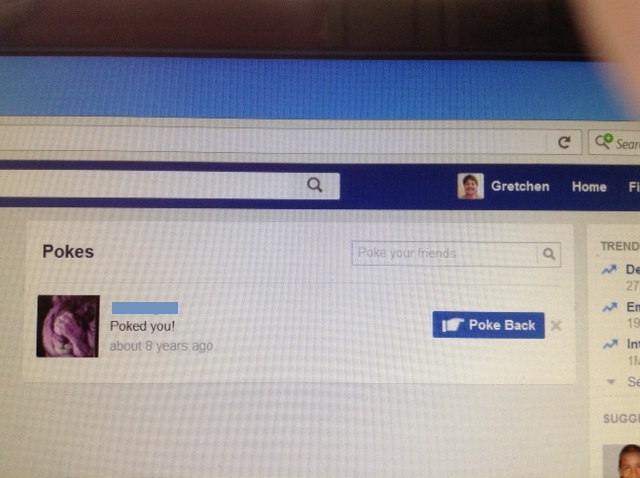
New Year’s resolution: I will no longer be posting regularly on Facebook because it is the most all-consuming part of my day and ultimately hollow.  Eight years ago I dropped out, as evidenced by the snapshot of this unanswered Poke.  Author Jen Storer of Girl & Duck, The Duck Pond and Scribbles creative groups can be pleased she was the one who drew me back into social media to nurture my writing dream – you light up my life – thank you.

My unFacebooking is not due in any way to the calibre and overall enjoyment of the wonderful ‘friends’ I made, I will miss virtually following your daily journeys in writing and illustration.  Conversely, we all are living two lives, the one on Facebook and the real one.

My departure is due to the links, Likes, highlights, comments, feeds, Facebook layout and general entanglements with people whom I do not know on a real level.  It may feel personal but it is not; and I need to grasp reality, my home, my family and my proper writing.
A visit from a little red hen named Took got me back out into our overgrown garden and I realised the computer screen is destroying my creativity rather than enhancing it.

My WordPress blog will continue https://thoughtsbecomewords.com/

“Year’s end is neither an end nor a beginning but a going on, with all the wisdom that experience can instil in us” – Hal Borland, American author.

Happy New Year 2018, everyone, and much fulfillment!

Gretchen Bernet-Ward


Postscript
: According to the 2017 Deloitte Media Consumer Survey, daily social media usage in Australia is down from 61 percent to 59 percent in 2017, and 20 percent of Australian social media users say they are no longer enjoying their time on the platforms.  Likewise, almost one third (31 percent) of survey respondents said they have temporarily or permanently deactivated one or more of their social media accounts in the past year.  Fake news is killing the media star with 58 percent of respondents agreeing that they have changed the way they access online content given the prevalence of fake news.  So, folks, I am not alone!

Australian Editors and Publishers Set Bar Too High

I have come to the conclusion that the Australian publishing industry and its associated editors and reviewers have set the bar way too high for Australian writers.  Emerging authors have a pretty slim chance of being published with huge odds against hitting the big time.

Strong-willed literature-controlling gurus rule our domestic market like school teachers from the 1950s.  They seek perfection, the best book of the year, often cerebral stuff ignored by half the population, and they disregard perfectly serviceable down-to-earth Aussie authors.  Also, when did parochialism creep in, e.g. Melbourne is the hub of all things literary?  Let’s focus on inclusive Australian content.  Oh, and stop changing words to suit international readers, they’re cool, they can work it out.

Publishing houses receive thousands of unsolicited manuscripts each year and the selection process is fierce.  Only a handful of authors are chosen, gather a following, write more books and hopefully make money.  The untried crime writer, for example, may not appeal to the literati judges, but, hey, there’s always that coterie of readers who will love them.  The way it is now, their work may never see the light of day.  Dive deep into that slush pile!

Book Publishing 04
Sure, there’s always the internet, WordPress, e-books, self-publishing, writing competitions (see below) and a gazillion non-traditional ways to be seen but nirvana is a publishing deal with a real-deal publishing house.


“Relax,” I say to publishers from my seat of ignorance.  “The shock of ebooks has faded, so forget micro-niche and churn out those books, get those names in print.”  What?  Too much of a risk, not financially viable?  Yeah, I guess that’s right.  Nobody wants risk in business.  I say “Lighten up, people, offer a broader spectrum of books to the general public”.  Stop book snobbery because, meanwhile, mediocre books with typos are flooding in from overseas and I’m getting a bit sick of it.

Did I hear our aspiring authors cannot compete with the overseas calibre?  Our readers are not savvy, interested or sincere enough to try a reasonably good newbie?  Come off it!  Peel back those layers.  An Australian author or reader is as good as the next person but needs the exposure, the push, the shove, the necessary connections and circumstances to make it work.

Chips on shoulders, the need to prove we Australians are well-read, has past. Forget the Cultural Cringe, dismiss ‘benchmark’ literary awards and too perfect prose and embrace the mass production of typically Australian-written and illustrated books and be proud of them.

Gretchen Bernet-Ward

FURTHER READING:  https://journals.uic.edu/ojs/index.php/fm/article/view/3353/3030  with quote taken from “Non-Traditional Book Publishing” by Jana Bradley, Bruce Fulton,  Marlene Helm, Katherine A Pittner in “First Monday” Journal and, although somewhat passé, it shows foresight.  EVEN FURTHER READING:  https://www.theliftedbrow.com/liftedbrow/2017/11/22/keep-your-eyes-on-the-prize-unpublished-manuscript-competitions-and-you  The Lifted Brow is a not-for-profit literary publishing organisation based in Melbourne, Australia, and Martin Shaw’s article explains an awful lot about the hidden terms and conditions of competition entry.

{NB. Gretchen has reviewed books, worked in the library industry and reads extensively.  As an aspiring writer, she may have shot herself in the foot}

Am I Sharing With The World Or Just Getting Stuff Out Of My Head?

Please Shut The Gate Sign

Writers need to write but do readers need to read?

From early on I made the decision not to Like a post unless I had read it.  As you can guess, its hard to do.  Every day millions of posts circulate around the world on countless blogging platforms and social media sites to such an extent that most of them will NEVER be read.  At least, not fully.  I think I am pretty safe in saying that.  We are doing the modern equivalent of shutting the gate after the horse has bolted.

Which brings me to the heading of my post.  I will answer my own question.  It is preferable to get things out of your head and onto a page for personal satisfaction rather than thinking you are making a useful contribution to the world.  Plenty of specialists are making useful contributions but I guarantee they are writing to a niche audience, not the world.

Another decision (note I use the word ‘decision’ because we are given choices then have to make one decision) I made is not to seek Likes and Followers and not to maintain a prolific output to pursue a high profile.  I have not activated my Comments because the majority of blogging sites appear not to have worthwhile comments or replies and, if they do, the bulk of them are from fans bordering on sycophant behaviour.

I’m not a tortured genius nor do I have a singular agenda so I am way down the favourites listicle.  I am happy doing my own thing and don’t pine for kindly Likes.  However, I am very grateful for those Likes and Followers I do have because I feel confident they have actually read my blog posts.  You can tell by my Home page that I am not going to stick to a theme, although I do have Photo Of The Week and I’m loosely hung up on the importance of literacy.

Why did I write this post?  I will probably feel differently tomorrow but today I wanted to get it out of my head.

Gretchen Bernet-Ward

Silent Reading and Socio-Cultural Development

Reading Readers 04

Among scholars, says Thu-Huong Ha, there is a surprisingly fierce debate around when European society transitioned from mostly reading aloud to mostly reading silently.  Thu’s latest article for Quartzy shines a light on the evolution of reading silently––

Finding Space
“The beginning of silent reading changed Westerners’ interior life”
By Thu-Huong Ha
Tuesday 19 November 2017

People think of reading as the introvert’s hobby: A quiet activity for a person who likes quiet, save for the voices in their head.  But in the 5,000 or so years humans have been writing, reading as we conceive it, an asocial solo activity with a book, is a relatively new form of leisure.

For centuries, Europeans who could read did so aloud.  The ancient Greeks read their texts aloud.  So did the monks of Europe’s dark ages.  But by the 17th century, reading society in Europe had changed drastically.  Text technologies, like moveable type, and the rise of vernacular writing helped usher in the practice we cherish today: taking in words without saying them aloud, letting them build a world in our heads.

Among scholars, there is a surprisingly fierce debate around when European society transitioned from mostly reading aloud to mostly reading silently—some even say the ancients read silently just as much as they read aloud—but there is one scene in literature they agree is crucial.  In St. Augustine’s Confessions, the titular professor describes the reading habits of Ambrose, the bishop of Milan:

“But when Ambrose used to read, his eyes were drawn through the pages, while his heart searched for its meaning; however, his voice and tongue were quiet. Often when we were present—for anyone could approach him and it was not his habit that visitors be announced to him—we saw him reading in this fashion, silently and never otherwise.”

The fact that this was so remarkable to Augustine, some scholars argue, is because in the 400s, silent reading wasn’t really a thing.

Other researchers say that this passage is meant more to point out Ambrose’s rudeness.  “It’s really that Ambrose would go on reading silently while he was there, like someone going on texting while you’re trying to talk to them,” says D. Vance Smith, a medievalist in the Princeton English department.  “[Augustine is] surprised by his rudeness at not reading out loud to share with him.”

Reading Readers 05

“The default assumption in the classic period, if you were reading around other people, you’d read aloud and share it,” says Smith. “For us, the default is we’ll read silently and keep it to ourselves.”

If silent reading was in fact rare or rude in ancient times, then at some point the expectation of readers in society shifted.  As late as the 1700s, historian Robert Darnton writes, “For the common people in early modern Europe, reading was a social activity.  It took place in workshops, barns, and taverns.  It was almost always oral but not necessarily edifying.”

But by the time Marcel Proust was writing in the late 1800s, his narrator hoping for time to read and think alone in his bed, reading privately had become more of a norm for wealthy, educated people who could afford books and idle bedroom rumination.

This came with the spreading of literacy and diverse kinds of reading material.  Writes Darnton, records from until as late as 1750 showed that people who could read had only a few books: perhaps the Bible, an almanac, and some devotionals, that they read and re-read. But by 1800, he writes, people were reading more voraciously—newspapers and periodicals—and by the late century they had branched out into children’s literature and novels.

Reading Guy 06

As reading shifted away from the social, some researchers believe this helped create what we now call an interior life.

Writes Alberto Manguel in his 1996 book, A History of Reading:

“But with silent reading the reader was at last able to establish an unrestricted relationship with the book and the words.  The words no longer needed to occupy the time required to pronounce them.  They could exist in interior space, rushing on or barely begun, fully deciphered or only half-said, while the reader’s thoughts inspected them at leisure, drawing new notions from them, allowing comparisons from memory or from other books left open for simultaneous perusal.  And the text itself, protected from outsiders by its covers, became the reader’s own possession, the reader’s intimate knowledge, whether in the busy scriptorium, the market-place or the home.”

“Psychologically, silent reading emboldened the reader because it placed the source of his curiosity completely under personal control,” librarian Paul Saenger writes in his 1997 book, Space between Words.  “In the still largely oral world of the ninth century, if one’s intellectual speculations were heretical, they were subject to peer correction and control at every moment, from their formulation and publication to their aural reception by the reader.”  As Saenger writes, asocial reading helped facilitate intellectual rigor, introspection, criticism of the government and religion, even irony and cynicism that would have been awkward to read aloud.

This strange new trend of reading to oneself naturally had its detractors.  Sceptics thought silent reading attracted day-dreamers and the “sin of idleness,” as Manguel writes.  And worse: it let people learn and reflect without religious guidance or censure.  Silent reading by the late 19th century was so popular that people worried that women in particular, reading alone in bed, were prone to sexy, dangerous thoughts.

Reading Girl 57

There isn’t much consensus between historians on why people would have started reading silently.  Saenger hypothesizes that a shift in the way words were laid out a page facilitated the change.  Latin words once ran all together, makingithardtoparsethem. Saenger argues that Irish monks, translating Latin in the seventh century, added spaces between words to help them understand the language better.  This key design change, he argues, facilitated the rise in silent reading.

M. B. Parkes, in his 1992 book “Pause and Effect: Punctuation in the West” argues something similar.  He writes that a “grammar of legibility”—the visual changes made to texts, like punctuation and word spaces—changed the way we read.  This early book technology was premised on the idea that the scribes, the people writing, didn’t know who their readers would be, or how fluent they might be in reading Latin, and so had to find a standardised way of telling them how to read: pause here; these are two separate words; this is a long “a.”

This scholarship applies for the most part to the Latin-based writing and reading of Europe.  In other major reading cultures of the world like Chinese, whose script doesn’t have spaces between words, and whose literature depends heavily on prosody, silent reading may have developed differently.

Mainstream historical accounts would have us think that the end of oral reading in the Middle Ages was part of the Renaissance, a new European preoccupation with the individual.  But it’s possible humans’ desire for privacy, the carving out of a little pocket in which to escape by way of a book, was there all along.  We just needed a little help getting there.

Written by Thu-Huong Ha for Quartzy newsletter, a weekly dispatch about living well in the global economy.  Original webpage The Beginning of Silent Reading was also the Beginning of an Interior Life.

Gretchen Bernet-Ward

Let Your Heart Be Light

Jen Storer is an established Australian children’s author brimming with imagination and inspiration. This post encapsulates her talent, personality and future plans. Jump into The Duck Pond and start paddling with emerging writers and illustrators!
Gretchen Bernet-Ward

girlandduck's avatarGirl and Duck

Hello!

I like writing blog posts at Christmas. No one expects much. Do they?

IMG_3967Writing: I finally finished Truly Tan: Baffled! (book seven) and delivered it to my publisher on time (working right up until December 15, the day it was due). Phew! Next year I’ll be waaaay more organised. Ahem.

Finalising: We signed off on Danny Best: Me First! Check out the full cover. Talk about The Best! 😉 Due out in Feb 2018.

DB_MEFIRST_FC2Receiving: I received a Christmas card from a Tan reader. The letter attached said, I know you like wolves. So here’s a card with a fox on it. God, I love my readers.

IMG_3984 2

Planning and: pondering 2018. I have some lovely plans for girl and duck, including a Scribbles Boot Camp in Feb, and an IRL (in real life) Scribbles master class in Melbourne in May. We will also be launching the Girl and Duck…

View original post 518 more words

Portraits of Readers Part Two

Initially I was gathering images for a compilation to promote reading but, instead, my gallery became a montage of book-reading men and boys over the last two centuries, photographed and painted, famous or otherwise.  With every viewing, the images reshuffle.  A montage of book-reading women and girls can be found under Part One.

Reading is rightness!

Gretchen Bernet-Ward

Portraits of Readers Part One

Initially I was gathering images for a compilation to promote reading but, instead, my gallery became a montage of book-reading women and girls over the last two centuries, photographed, painted, and one carved in marble.  With every viewing, the images reshuffle.  A montage of book-reading men and boys can be found under Part Two.

Reading is rightness!

Gretchen Bernet-Ward