The Great Book Swap is a fantastic way to celebrate reading, and raise much-needed funds for remote communities. Schools, workplaces, libraries, universities, book clubs, individuals and all kinds of organisations can host one. The idea is to swap a favourite book in exchange for a gold coin donation.
Here’s a letter from Executive Director Karen Williams—-
“The Great Book Swap is back and registrations for 2021 are now open. Register your school, library or organisation to hold a Great Book Swap anytime throughout the year. Last year the pandemic stopped many individuals, schools and organisations from hosting a Great Book Swap, but we’re hoping 2021 will be our biggest year yet.
“We are aiming to raise $350,000 to gift 35,000 culturally relevant books to children in remote Australia and we need your help! Visit our new-look website, and access some great features and resources to help make fundraising easier, fun and more successful than ever.
“Why not check to see if a Great Book Swap aligns to your organisation’s Reconciliation Action Plan, or you can ask your employer to match donations? It is also a great conversation starter to get teams talking and sharing their reading interests and passions.
“Get ready to celebrate reading, hold your business or organisation to their social responsibilities, and raise funds for an excellent cause.”
Holding the Great Book Swap brought us together as a team, we had a chance to share our love of reading and raise money for an excellent cause.”—-Alice Dickins, Heide Museum of Modern Art.
It’s March and that means Wales Readathon time! Book Jotter has launched this exciting yearly event with an eye-opening post featuring a Royal Welsh Fusiliers regimental mascot, a Great Orme goat named Fusilier Shenkin IV. You can read his life story and details on #dewithon21 in the following post… oh, and perhaps join us as we Read Wales…
Dewithon is an opportunity for book bloggers around the world to discover Welsh writers and their works (fiction, non-fiction, poetry, plays, in fact anything written in English or Welsh with links to the nation of Wales).
We will begin our 31 days of celebration on Monday 1st March 2021 (St. David’s Day), with an official page appearing thereafter to display all your Dewithon-related posts. There are plenty of useful links and reading suggestions at DHQ (Dewithon Headquarters) and in our Wales Readathon Library, but please do not hesitate to ask for help if you are struggling to get started. You are free to read and write on any literary subject relating to Wales, so please dechrau darllen (start reading)!
Dewithon With a Difference
It became apparent quite recently that some members of our global book blogging community were having difficulties obtaining certain UK…
Why does Google dismay me? Make me groan, make me feel deflated? And what’s Star Wars got to do with it?
Give me five minutes and I will tell you why…
Google images can show me anything and anyone from anywhere in the world. Every famous person I ever knew when I was growing up in the 20th century. Every one of the legendary, beautiful, talented, celebrated people who shared my life (vicariously) now have their lives electronically, digitally, chronologically recorded for all time—and not unexpectedly they have all grown old.
But it is unexpected to me.
They were my idols, my inspiration and now they are looking like my grandfather or my grandmother. Eek! Am I shallow?
Okay I’m older too, but (discreet cough) less so…
Every single person born on this planet has the prospect of growing old. Sadly, millions don’t make it due to many varied and tragic reasons; one of which the world is currently experiencing.
Ageing is a normal occurrence in life, and while celebrities may try to subvert nature’s course (I am not a fan of surgical enhancement and 82 year-old Jane Fonda is finally quitting) ageing is a dreadful fact we all have to acknowledge.
That doesn’t mean I have to like it.
It doesn’t mean I should stop using Google.
Hang on, there are distinguished vocations which seem to be exempt, the more august their features, the better their kudos. Even authors seem to be allowed a few saggy features. But I digress.
I should not (cannot) ignore it.
What old age means to me is that I will never ever get used to seeing a vibrant, happy, slim, trim, gorgeous male, female, androgynous (term used back then) human being with a fabulous personality, body, voice, career, sink slowly into their old age, creeping ever closer to the eternal departure lounge.
I am callously referring to celebrities of stage and screen, actors, singers, bands, artists, e.g. the upper stratosphere of very public stardom.
With or without their cosmetic surgery I am trying to maintain the love and respect. But those dreaded Before and After shots. Gosh, these days I wouldn’t even recognise most of them in the supermarket.
“Hold on,” you shout in an agitated fashion, “don’t be so cruel and superficial! They still have their brains (hopefully) and their photo albums, family, friends and big mansion. Stop making out they are turning into something akin to Frankenstein’s monster.”
Relax, dude. All I am saying is that when I see a wrinkly (another 20th century word) I am looking at the face of my own mortality. That’s what I will look like eventually. So will you. Is it fair? Of course not. Ageing can be slowed but will only cease when we do.
The best we ordinary citizens can hope for is an active life, good health care and a reasonably good digestive tract. After all, I can hide away, I can grow old without someone shoving a camera in my face and asking me about a 1980s indiscretion I can’t even remember.
Hmm… I vaguely recall that night when…
Captain’s Log, Star Date—oops, wrong ship.
In a city far, far away, a young couple finished their late night coffee. They strolled past the refurbished Regent Theatre cinema complex where earlier they had been unlucky not to get tickets to see the star-studded Australian premiere opening of the latest greatest movie, that box office smash, the record breaking 1980 “Star Wars Episode V: The Empire Strikes Back” still in-session behind closed doors.
A cool August night in Brisbane City and the main street, Queen Street, was quiet. Back then it was a through road not a pedestrian mall, no trees in planters, no CCTV, no security patrols, no shops open, just dull street lighting and carparks which closed before midnight.
Apart from her shoulder pads slipping, the young woman had to adjust her big fluffy hairdo every time she was pitched forward when her high heels jammed in the brickwork pavement. As the couple reminisced on some of the amazing sci-fi special effects they had seen in the first Star Wars movie, a doorman (possibly the manager) said “Good night, gentlemen.”
This young couple turned and saw a short man and a tall man (both in tuxedos) walk through a side door of the closed cinema and step onto the pavement in front of them. These two gentlemen looked left and right, assessed the situation and while not exactly puzzled, they obviously expected to see a limousine waiting.
Dazed, the young couple stopped and smiled at them. The taller of the two men, who looked remarkably like Billy Dee Williams, aka Lando Calrissian, smiled back and said “Is it always this quiet around here?”
She wanted to say “As soon as the pubs and cinemas close here’s nothing for it but go home.”
The young man said “There are usually some after-parties. You could try Lennons.”
The shorter man, Mark Hamill, aka Luke Skywalker, laughed. “Maybe that’s where we’re headed.” Seconds later a small dark blue car zoomed down the street and pulled in beside the group.
“That’s our ride,” said Mark, “nice to meet you.” He opened the back door of the car and hopped inside. He gave the couple a cheery wave and turned to speak to the driver.
The Lando Calrissian look-alike (possibly bodyguard) shook the young man’s hand and said “Great little town you got here” and he opened the car door and sat in the front seat. Before he shut the door, he added “Have a good night.”
The couple responded by returning the remark, feeling silly and star-struck. They stood like statues until the vehicle and its celebrity cargo disappeared into the night. At that point, they turned to each other and shouted “Yippee!” and proceeded to make happy noises like “Wow” and “Can you believe it?” and “That was Luke Skywalker!”
There was not another living soul, or car or bus, on Queen Street with them. It didn’t even matter that they had no pen or paper for autographs, it didn’t even matter why that famous young star was leaving the venue early, and it certainly didn’t matter that mobile phones and instant video were many years away.
Star Wars Encounter 1980
This couple had met and spoken to Mark Hamill, and a man who looked curiously like rogue Lando Calrissian. What a bonus, right outside the movie theatre where they had yet to see the Brisbane screening of “The Empire Strikes Back”, a George Lucas film franchise destined to spawn an empire of its own.
The young couple, er, mainly the woman, squealed “Wait till the others hear about this!”
This second instalment of the original Star Wars trilogy features Luke, a Tatooine farmboy who rose from humble beginnings to become one of the greatest Jedi the galaxy has ever known, and Lando who is introduced as an old friend of Han Solo.Newspaper archives report the Brisbane premiere was Saturday 2nd August 1980 and other States followed.
My point being?
In September 2021 Mark Hamill will be 70, and in April 2021 Billy Dee Williams will be 84—and that is “Senior” class.
Where did the time go?
I will have to find the phone number for Dr Who’s call box.
ABC News and Lucasfilm are both part of parent company Disney.
Radio personality Laurel of Radio 4KQ had a similar encounter that night. As a teen, Laurel was inside the Regent Theatre with autograph book at the ready. Her experience was more tangible than mine but nevertheless both memorable moments.
Spreaker Podcast of Laurel meeting Mark Hamill back in 1980.
Lamb House is one very interesting residence! And it is uncommon to find such architecture in Brisbane still intact.
StateLibQld_1_110380_Home,_also_known_as_Lamb_House,_Kangaroo_Point,_Brisbane,_ca._1904, B&W image held by John Oxley Library, State Library of Queensland, Public Domain, https://commons.wikimedia.org/w/index.php?curid=12662188
Lamb House needs restoration.
A heritage-listed villa, Lamb House is situated at 9 Leopard Street, Kangaroo Point, Brisbane, Queensland, Australia. It was designed by Alexander Brown Wilson and built from c.1902 to c.1908. It was added to the Queensland Heritage Register on 21 October 1992 and has been languishing unattended ever since.
Brisbane City Council is proposing amendments to some of its citywide provisions in Brisbane City Plan 2014 (City Plan) and submissions are now open for Major amendment package K – Lamb House. Council has opened consultation for Lamb House character protection.
Queensland Heritage Register states that “Lamb House, erected c.1902, is a rare surviving example of a grand, intact Federation period residence in the Brisbane district” and this Wikipedia entry practically screams Period Drama—
“Lamb House is a large, two-storeyed, red brick residence with a multi-gabled roof clad in terracotta tiles. Conspicuously situated above the Kangaroo Point Cliffs at the southern end of the suburb, overlooking the South Brisbane and Town reaches of the Brisbane River…”
“Queen Anne influences are evident in the timber and roughcast gable infill designs, the ornate cement mouldings to the entrance portico-cum-observation tower, and the elaborate chimney stacks and tall terracotta chimney pots.”
“The original plans indicate vestibule and stairwell, dining, drawing and morning rooms, kitchen and service areas on the ground floor, and six bedrooms and a bathroom on the first floor.” Plus “The residence has substantial grounds with mature trees and gardens.”
The proposed changes to Lamb House (situated on Leopard and Wild Streets, Kangaroo Point with a stunning view of the Brisbane River, city botanical gardens and CBD) support Council’s commitment to protect the unique character of Brisbane, considering the property’s local landmark identity, and the character and streetscape values of the area.
These proposed changes include:
Zoning changes to lots held by Lamb House to become Character residential (Character zone precinct)
Updates to overlay maps to apply the Traditional building character overlay.
Adding the Significant Landscape tree overlay to the weeping figs on the lots on Leopard Street, Kangaroo Point.
Please consider making a submission because community input is vital for informing major amendments toCity Plan;andBrisbane City Councilis now seeking feedback on the proposed changes. You canHAVE YOUR SAYand submissions must be received by 11.59pm on Sunday 13 December 2020.
Residents can talk to a Council planner to ask questions or seek clarification on the proposed changes. Register for a free Talk to a Planner session from 23 to 25 November 2020 at these locations:
For more information visit the Brisbane City Council website, email the project team, telephone Council on 07 3403 8888 or write to Strategic Planning.
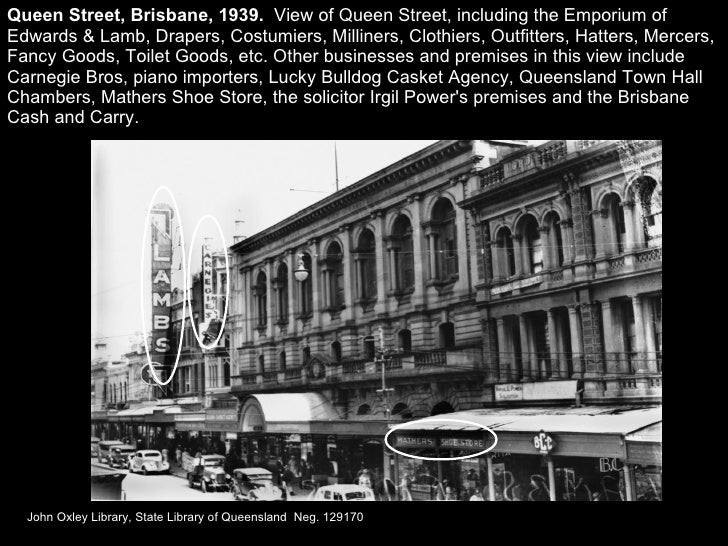
Lamb House, built in 1902 for Queen Street draper John Lamb (one half of Edwards & Lamb Emporium specialising in Drapery, Millinery, etc) is still owned by the Lamb family, Joy Lamb. Heritage-listed Lamb House and surrounding gardens are well worth preserving in my opinion. It might make up for the destructive Joh Bjelke-Petersen era and the wrought iron lace which disappeared during the midnight demolition of the landmark Bellevue Hotel in 1979, and give Brisbane a proper past for the future to appreciate.
DEAR READER, IF HISTORICALLY INCLINED, PLEASE CONTACT BRISBANE CITY COUNCIL. I ADORE OLD HERITAGE LISTED BUILDINGS – THEY MUST BE PRESERVED. BUT I HAVE NO CONNECTION WITH DECISIONS REGARDING LAMB HOUSE. I WATCH FUTURE EVENTS WITH INTEREST, AND SINCERELY HOPE THIS UNIQUE OLD HOME CAN BE REVIVED. GBW 2020.
A BIG WIN for the local suburb Kangaroo Point and City of Brisbane residents.
After reading Lucy V Hay’s two informative books “Writing and Selling Thriller Screenplays” and “How NOT to Write Female Characters” the next logical step was to subscribe to her website and learn more.
The first thing I noticed was that Lucy is very active and her site holds a plethora of information. Then I was delighted to receive a free copy of The Lynmouth Stories, three of Lucy’s short stories titled “In Plain Sight”, “Killing Me Softly” and “Hell and High Water”, twisters which certainly pack a psychological punch.
Here’s what it says on her website—
Lucy is an author and script editor, living in Devon with her husband, three children and six cats. She is the associate producer of Brit Thrillers Deviation (2012) and Assassin (2015) both starring Danny Dyer. See Lucy’s IMDB page HERE and other movies and short films she’s been involved in, HERE.
In addition to script reading and writing her own novels, Lucy also blogs about the writing process, screenwriting, genre, careers and motivation and much more at her blog Bang2write, one of the most-hit writing sites in the UK. Sign up for updates from B2W and receive a free 28 page ebook (PDF) on how NOT to write female characters, HERE or click the pic on her website.
ADDENDUM—For a free copy of The Lynmouth Stories and more, join Lucy’s EMAIL LIST—My post heading comes from the title of Lucy’s email CRIMINALLY GOOD where she interviews fellow crime writers and asks them five questions. She says “It’s fascinating to read their answers, especially as they are all so different!” Today I have the choice of Ian Rankin, Sophie Hannah or Peter James. GBW.
RECENTLY I was fortunate enough to take a pleasant stroll in a modest yet important piece of parkland. From 1916 to the present day, ANZAC Park is one of the oldest ANZAC parks in the world – a war memorial and a green space for everyone.
I HAVE visited ANZAC Park on and off for many years and have seen some old trees removed and new ones planted, the circular roadway improved, a dog parkinstalled, children’s area expanded, the duck lagoon which overflows or dries up depending on the seasons and, of course, enjoyed many picnics sitting on a tartan rug on the sloping hillside away from the hum of the city.
APPROXIMATELY 15 minutes or 7km from Brisbane CBD, in times gone by it was a day’s outing at the end of the tram line. It is opposite the significant landmarks of Toowong Cemetery and Mt Coot-tha Botanic Gardens, linked by the Toowong pedestrian and cycle bridge recently named Canon Garland Overpass.
More on Canon Garland further down . . .
ANZAC is the acronym formed from the initial letters of the Australian and New Zealand Army Corps. This was the formation in which Australian and New Zealand soldiers in Egypt were grouped before the landing on Gallipoli in April 1915 during the First World War.
THE CONFLICT commemorated in ANZAC Park is the First World War 1914–1918 and memorial types were Garden/Avenue/Tree. Inscriptions within the park consisted of small brass and metal plaques located in front of memorial trees, bearing the details of local men from the district who died at Gallipoli and on the Western Front. No plaques remain today nor is there a stone monument.
YEARS of petitioning from a community-based campaign to honour the memory of Anglican clergyman and military chaplain Canon David Garland, the Queenslander who gave ANZAC Day to the world, culminated in the renaming of the pedestrian and cycle bridge which crosses the busy Western Freeway. Officially named Canon Garland Overpass, it pays tribute to the man who championed the formation of “ANZAC Day” as our nation’s “All Souls’ Day”.
This photo was taken as I walked across the bridge – a safe yet disconcerting experience.
Canon Garland Overpass for pedestrians and cyclists across Western Freeway at Toowong, Brisbane, looking towards Mt Coot-tha — the camera was held straight — View shows the enclosed AU$5.4 million overpass constructed between 2008-2009 and later renamed “Canon Garland Overpass” after the man who pioneered ANZAC Day. The bridge provides a safe way for pedestrians and cyclists to cross the busy Western Freeway with links to and from ANZAC Park to Mt Coot-tha Botanical Gardens, historical Toowong Cemetery, Western Freeway Bikeway, main bus routes and local cafes. The overpass features a 60 metre-long freeway-crossing, 160 metres of elevated structure and fully enclosed screen protection — https://garlandmemorial.com/2019/10/09/canon-garland-overpass/
AFTER A LIFETIME of service to the community, Canon Garland (1864–1939) was buried across the road in Toowong Cemetery, not far fromThe Stone of Remembrance and The Sword of Sacrifice. The official unveiling of these two memorials makes stirring reading. On 25 April 1924, they were unveiled by the Governor-General as Australia’s first “national” ANZAC Memorial, thanks to the tireless efforts of Canon Garland.
FROM ITS POSITION on the corner of Wool Street and Dean Street, and Mt Coot-tha Road, Toowong, ANZAC Park has easy access to places mentioned above as well as bushland walks and picnic areas withinMt Coot-tha Reserve.
JUST TO CONFUSE things, an ANZAC monument stands in Toowong Memorial Park, a heritage-listed memorial park at 65 Sylvan Road, Toowong, City of Brisbane, Queensland, Australia. The Toowong War Memorial is composed of brown Helidon freestone and was built to commemorate those men of the district who died in service or were killed in action in World War One. It was designed by George Rae and built c.1922 by Toowong monumental stonemasons Andrew Lang Petrie & Sons. It was added to the Queensland Heritage Register in September 2007. This monument sits on a hill and has twelve small stone pillars around it.
Sandwiches — cheese and tomato, egg and lettuce, corned beef and salad, chicken and mustard mayonnaise.
I am writing this post on 1st September 2020, the first day of Spring, so time to get outside and breathe that fresh air – don’t forget the picnic rug!
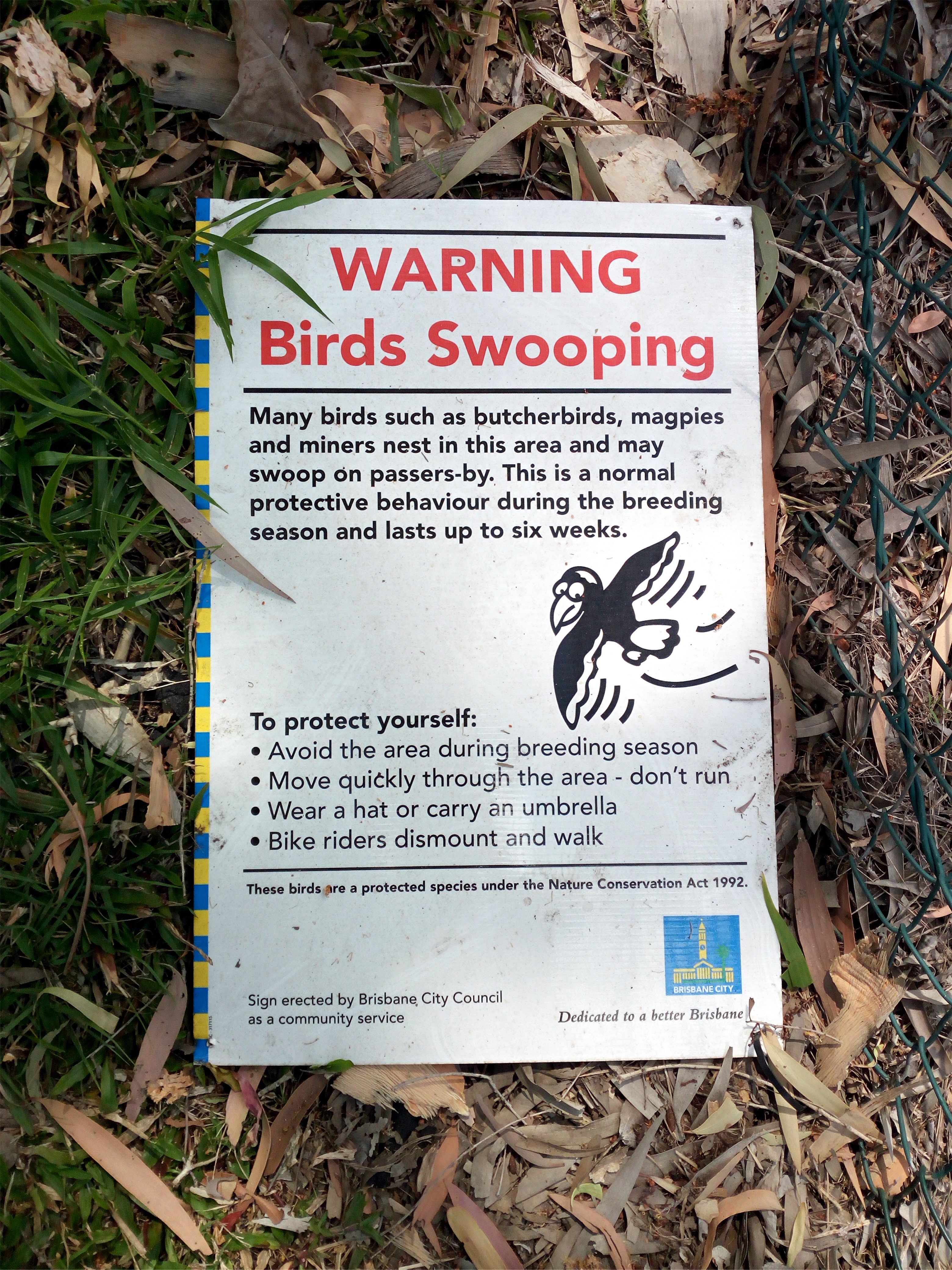
This sign had fallen off the fence onto grass under a eucalypt tree but whether caused by human or bird intervention is anyone’s guess. GBW.
Magpies in Australia are well-known for swooping humans and pets during their breeding season between July and December, but peak swooping month is September in Brisbane. This is normal defensive behaviour in springtime as the birds are trying to protect their eggs or newly hatched young in the nest.
Walk the long way home! Swooping season can be a nuisance to some people, but often Magpies will accept the presence of people within their territories (they do get to know human families) however when attacks do occur, they usually take place within a hundred metre radius around the tree containing their nest.
I know from experience that a sudden rush of wings and a sharp, snapping beak at the side of your head is a very scary thing.
While most Magpie attacks are mild, they could cause serious injury to your eyes and head. Seven tips to protect yourself against swooping birds:
(1) Wear a hat or carry an umbrella
(2) Wear sunglasses to protect your eyes
(3) Do not interfere with the birds or their nest
(4) Watch the birds while walking away quickly and calmly
(5) A bird is less likely to swoop if it knows you’re watching
(6) If you ride a bike, dismount and walk
(7) Never aggravate a Magpie as this can make the bird defensive and lead to a more severe swooping attack next time.
Some people paint big eyes on their bike helmets or stick drinking straws on their hats to repel Magpies, but I’m not sure these ideas work. Wearing head protection stops wayward claws from tangling in hair.
Magpies are vocal birds with a carolling call. They adapt well to open and cleared environments and thrive in large areas of lawn (like parks, golf course, school grounds) which provide foraging sites, and where there are scattered trees available for nesting, and a water source.
Usually Magpies eat garden pests and insects but they are inventive when it comes to cat food. In my photo sequence this one peered into the car scrounging for a snack.
The nest of a Magpie is bowl-shaped and made from dry sticks with a lining of grass, bark and other fibres. The clutch size is usually around three to four blue-grey eggs, though this varies according to season, predators and health of the parents. Magpie lifespan is about 25 years and I have had two hanging around my place for several years. Both parents raise their young and guard their territory and they are a natural part of my outdoor life.
PLEASE NOTE The Australian Magpie (Cracticus tibicen) is a native Australian bird and is PROTECTED under the State Wildlife Legislation (Nature Conservation Act 1992). It is a serious offence to harm Magpies and penalties apply for attempting to harm them. Information Brisbane City Council Biodiversity Living with Wildlife.
Australia was once a continent graced by flamingos. These tall pink birds are more associated with Africa and the Americas, but a long time ago they called Australia home. For at least 20 million years, flamingos thrived on vast Australian inland lakes, until a drying of the outback ended their reign, perhaps a million years ago.
The Lake Eyre region in South Australia once had three species, more than Africa today. Altogether Australia had at least six flamingo species, including the Greater flamingo – the main flamingo in Africa. Australian museums have accumulated more of their fossils than of some regular Australian birds such as parrots. At some sites their remains lay near those of outback crocodiles, dolphins and lungfish.
Flamingos are still regarded as Australian birds, for a very tenuous reason. In 1988 a Greater flamingo dropped in on North Keeling Island, a remote Australian territory 2750km north-west of Perth, staying a couple of months. Greater flamingos are found in Asia and southern Europe as well as Africa and this one had wandered over from India or Sri Lanka.
In Adelaide Zoo you could have seen the only flamingo left in Australia, a Chilean flamingo known warmly as ‘Chile’. She was thought to have been imported in the late 1970s. For quarantine reasons flamingos are now forbidden imports, which means that Australia is destined to become a flamingo-free zone unless another long-legged pink nomad wanders over from Asia.






 Lucy is an author and script editor, living in Devon with her husband, three children and six cats. She is the associate producer of Brit Thrillers




 PLEASE NOTE
 Source
  Thoughts Become Words