Bluey and the Bin Chicken
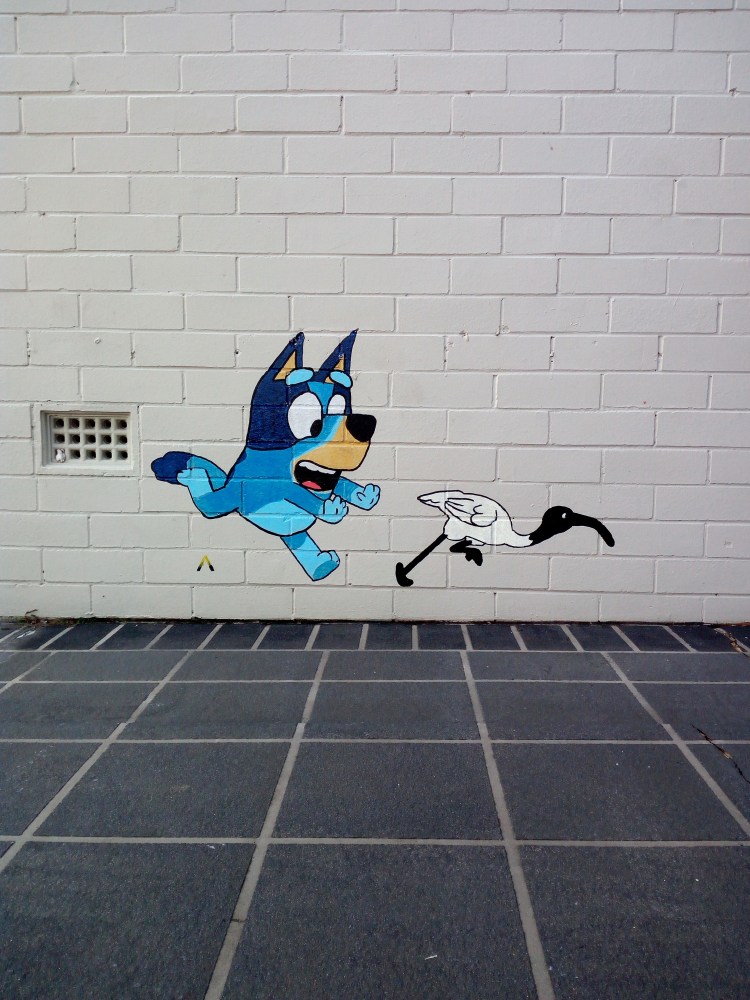
Bluey and the Bin Chicken https://www.sethius.art/ Photo Gretchen Bernet-Ward 2024

Is our cartoon star Bluey from Brisbane (seen here in the suburb of Sherwood) living up to the Blue Heeler herding tag, or did the Ibis shout “Chasey! Bet I can beat you!” My money is on the Ibis because, unlike an Emu, the Ibis can fly.

The Australian White Ibis was once known as the Sacred Ibis but is sadly now often referred to as a “bin chicken, tip turkey or dumpster diver”. They tend to be opportunistic scavengers and can often be spotted at rubbish tips and in city parks. However, they are harmless to humans.

But first some facts on Bluey:
Bluey is an Australian animated television series for school children which premiered on ABC Kids. The cartoon program was created by Joe Brumm and is produced by Queensland-based company Ludo Studio. The stories follow Bluey, an anthropomorphic six-year-old (later seven-year-old) Blue Heeler puppy who is characterised by her abundance of energy, imagination and curiosity about the world. The young dog lives with her father, Bandit, mother, Chilli, and her younger sister Bingo who regularly joins Bluey on adventures through imaginative play. Other characters featured each represent a different dog breed. Overarching themes include focus on family, growing up and Australian culture. Ostensibly for children, the program is watched by all age groups. Bluey was created and produced in Queensland and the capital city Brisbane inspires the show’s settings.

Info https://www.bluey.tv/


The Australian Museum website has White Ibis details but here’s some further reading—

The Australian white ibis (Threskiornis molucca) is a wading bird of the ibis family, Threskiornithidae. It is widespread across much of Australia. It has a predominantly white plumage with a bare, black head, long downcurved bill, and black legs. While it is closely related to the African sacred ibis, the Australian white ibis is a native Australian bird. Contrary to urban myth, it is not a feral species introduced to Australia by people, and it does not come from Egypt.

Historically rare in urban areas, populations have disappeared from natural breeding areas such as the Macquarie Marshes in northern New South Wales and urban populations in Sydney. However, the Australian white ibis has established in urban areas of the east coast in increasing numbers since the late 1970s; it is now commonly seen in and around WollongongSydneyMelbourneAdelaideDarwin, the Gold CoastBrisbane and Townsville. In recent years, the bird has also become increasingly common in Perth, Western Australia and surrounding towns. As yet it has not been sighted in Tasmania. 

Aussies love a good nickname and, as mentioned, due to the Ibis increasing presence in the urban environment and its habit of rummaging in garbage, this protected species has acquired a variety of colloquial names such as “bin chicken”. In recent years these birds have become an icon of Australia’s popular culture, regarded with glee by some and passionate dislike by others. I don’t hinder their Ibis lunch in the park and they (so far) don’t disrupt mine.

Gretchen Bernet-Ward 2024
Pink Cockatoo Variant

Title “Jak-Kul Yak-Kul” acrylic art on canvas by Hervey Bay Queensland artist Will Hazzard https://willhazzard.com.au/

Love at first sight when I saw Will Hazzard’s adorable cockatoo with plumage which goes against nature to dramatic effect!

My photograph was taken in Maryborough and this 81.3cm x 81.3cm painting was exhibited at the 38th Hervey Bay Annual Competitive Art Exhibition by Gallery 5 – Hervey Bay Art Society in July 2022.

Established in 1983, this annual art exhibition hosts seven award categories with styles ranging from traditional to contemporary. Will Hazzard’s striking work won Second Prize in the Australian Flora & Fauna Section.

Will is 21 years old and autistic. Art became a form of therapy with his autism diagnosis at age 9. His paintings aim for a connection with animals, the environment and the land on which he lives.

Click below to visit his website of wildlife art.

Gretchen Bernet-Ward

Will Hazzard

https://willhazzard.com.au/2022/07/30/hervey-bay/

Follow on Twitter

Will Hazzard @Will_Hazzard

Opens profile photo

Quick Stories #7 Artist as a Child

Moggill Farmhouse Brisbane Queensland © Elle 2019

Ten Days Ten Short Stories

One a day for ten days. I write when I can, do the best I can, and I am willing to put my work out there! My thoughts are Don’t Be Embarrassed, Don’t Make Excuses, Don’t Stop Writing.

Recently I completed a 10-week term on Fridays with U3A Brisbane Creative Writing Group on Zoom and enjoyed the prompts, feedback and general literary discussions.  The writers in the group are quite diverse in style and writing content.

The wordcount limit is 500 words and while I found their prompts were ‘forcing’ me to come up with something different each week, I really enjoyed doing it.  I was quickly learning how to keep them short and sweet.  Edit, edit, edit.

My characters are good, bad and ugly and the majority of the time I had no idea where they came from!

I say write for yourself first and don’t be precious about your words.  For better or worse, here are mine—the three prompts (courtesy of AWC Furious Fiction) were 1. The story’s first sentence must contain only four words. 2. The story must include something being shared. 3. The story must include the words paint, shift, wave and toast.

Artist as a Child

His pose seems unrehearsed.   Gavin sits with one shoe raised on the chair, leg bent.  His elbow rests on his elevated knee, arm dangling.  A persuasive artist, gallery patrons arrive and gladly absorb his relaxed aura.

This unperturbed look is the impression he gives to anyone who doesn’t know him better.  Apart from guest appearances, he is an horrendously difficult person to be around.

Oil paint, turpentine soaked rags, brushes, and canvas torn from frames habitually litter the studio floor.  Thus I dispute the saying “order out of chaos”.  If Gavin could do that, he would never paint a single picture.

One of his latest, and most important works, was completed in an afternoon of ranting and raving when a courier delivered the right set of three wooden easels wrapped in the wrong brown paper.

“It’s for an art installation.  It has to be unwaxed brown paper!”  He paced the concrete floor.  “The whole idea is to paint in situ.”

The courier didn’t want to understand the significance.  He was already backing out the door, having encountered Gavin’s artistic temperament once before.

“Take it up with the boss,” he said, sliding our huge door shut with a thud.

Gavin pulled irritably at the neckline of his t-shirt which had seen better days, soon to join the castoffs on the floor.  “Sabotaged!”

“I can order a roll of brown paper from the newsagent.”  I tried not to sound too down-trodden.

Gavin hissed “Elle, I don’t want stuff they cover school books with!”

I let my office diary drop, scattering a zodiac of tiny seed pods across the work bench.

“Improvise, Gavin.” I said calmly.  “You may find it works better without the absorbency.”

I dabble, you see, landscapes.  His eyes lit up and I almost heard his brain creak.

He accepted help to shift the easels closer to the window for natural light, jostling unfinished works aside.

We share the art studio, an unusual arrangement for siblings considering one is famous and the other does not want to be.

I had declined to organise tonight’s chat and chew platters, believing that I already fill the role of sales and booking manager so catering was a bit too much.  The honorary title of art advisor suits me.  Nowhere does it state I must “arrange tiny scraps of organic food on dry toast.”

When our spendthrift patron Lady Augusta arrives, she gives me a quick wave before aiming straight at Gavin to discuss her eighth portrait sitting.  Goodness knows where these works end up.

Gavin quickly grabs an illustrated catalogue, head down, apparently ready to discuss technique with a notable art critic. He tells the critic “They want me on the cover.” I wince.

Guests are moving aside as Lady Augusta swoops, all fluttering chiffon and swinging pearls. Nevertheless the exhibition is a success and I sell my lone painting; at the evening’s highest price.

——© Gretchen Bernet-Ward 2021——

“Generally, emerging writers don’t write every day; some writers don’t stretch themselves; some writers don’t share their work; some writers fear feedback; just do it!” Gretchen Bernet-Ward

Old Masterpieces from New York to Brisbane

Finally reached the end of the queue © Gretchen Bernet-Ward 2021

On a sunny Friday morning, waiting to enter GOMA Queensland’s Gallery of Modern Art, I did not photograph the great long queue of people. However, there were no privacy issues, every single person was wearing a mask. Patiently observing restrictions, we were all determined to view the European Masterpieces exhibition on loan from The Met, Metropolitan Museum of Art, New York.

Once inside, after a quick squirt of lavender hand-sanitiser, directions from the highly organised gallery staff were followed, and metered groups were ushered through the necessary sign-in to enter a specially designed viewing area. I say ‘area’ but it was more like roaming around inside someone’s home. Admittedly a large home with muted lighting and grey walls but it was what hung on those walls that definitely became awe-inspiring.

The galleries were split into three groups:

1. Devotion and Renaissance

2. Absolutism and Enlightenment

3. Revolution and Art for the People

From Giovanni di Paolo (Paradise, 1445) to Claude Monet (Water Lilies, 1916) I have written a quick overview of my visit—and I only took a handful of photographs. There are 65 works of art on display, and so famous they do not need my documentation.

Deep down I have to confess that the age and history of many of the paintings captured my attention more than the artwork itself. Scary moments frozen in time, dramatic posturing, gloomy scenes were not the order of the day for me. I loved the works with life and action and, let’s face it, realism.

French painter Georges de La Tour’s work ‘The Fortune Teller’ (see main entrance photo above) finally made sense to me when I saw it for real. It’s not about the old fortune teller at aLL.

GBW 2021

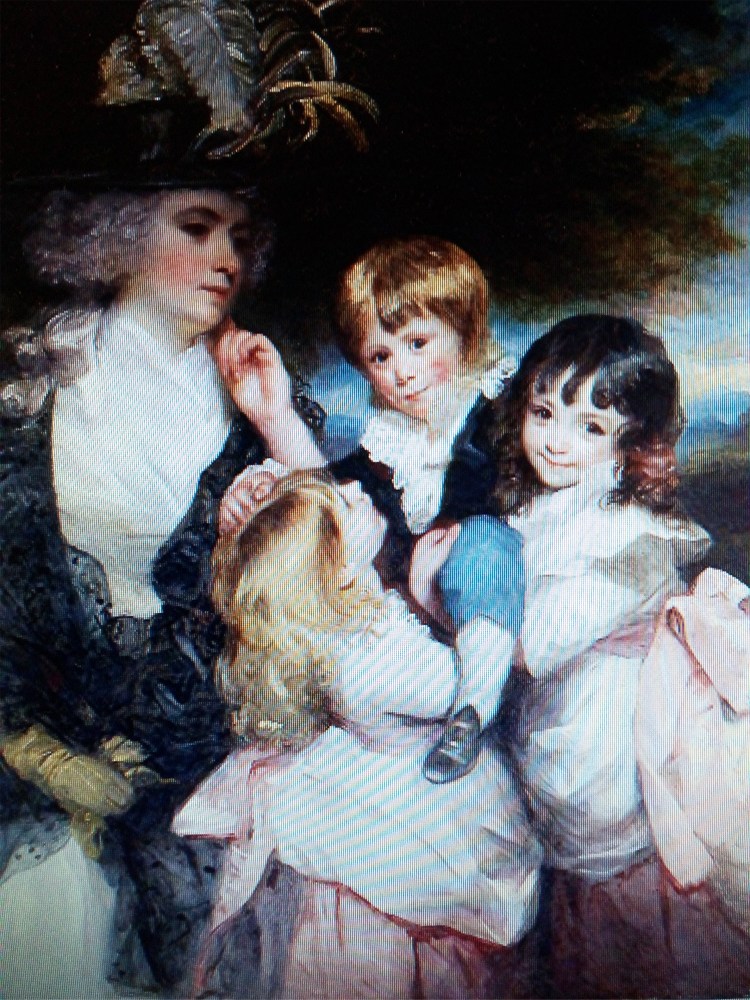
I liked the ‘essence’ of Lady Smith (Charlotte Delaval) and her children George, Louisa and Charlotte, in this family portrait where she appears lost in thought while her children tussle beside her, glancing at the viewer. The portrait by Sir Joshua Reynolds (England) was commissioned by Lady Smith’s husband, a baronet and member of Parliament. Expressing cultural ideals of femininity and upper-class childhood, this work was a popular exhibit at the Royal Academy in 1787 the year it was painted.

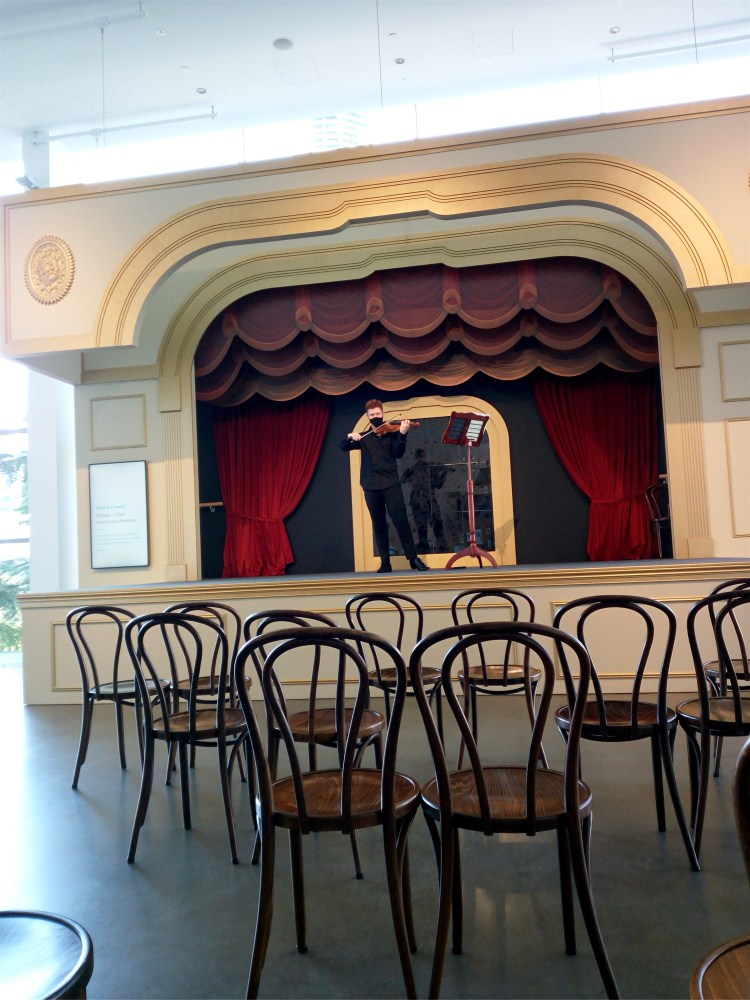
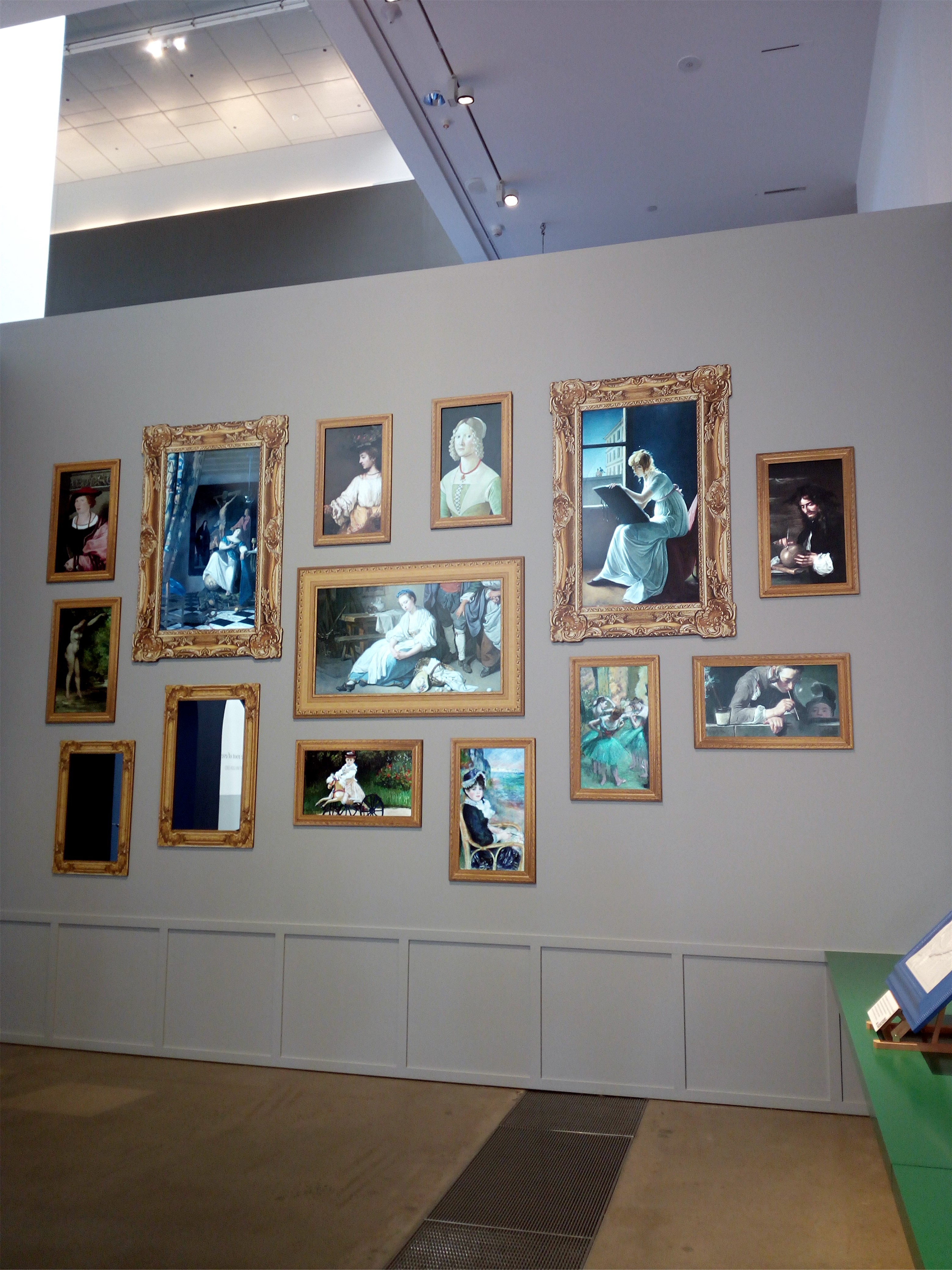
I wandered past El Greco, Rubens, Caravaggio, Vermeer, Goya, Rembrandt, Renoir, et al, and was drawn towards the sound of violin music. I left the dimmed rooms and walked into a brightly lit area where a lone violinist was playing. He finished with a flourish and an elderly gentleman and myself clapped enthusiastically but he appeared a tad embarrassed, nodded his thanks and exited the stage.

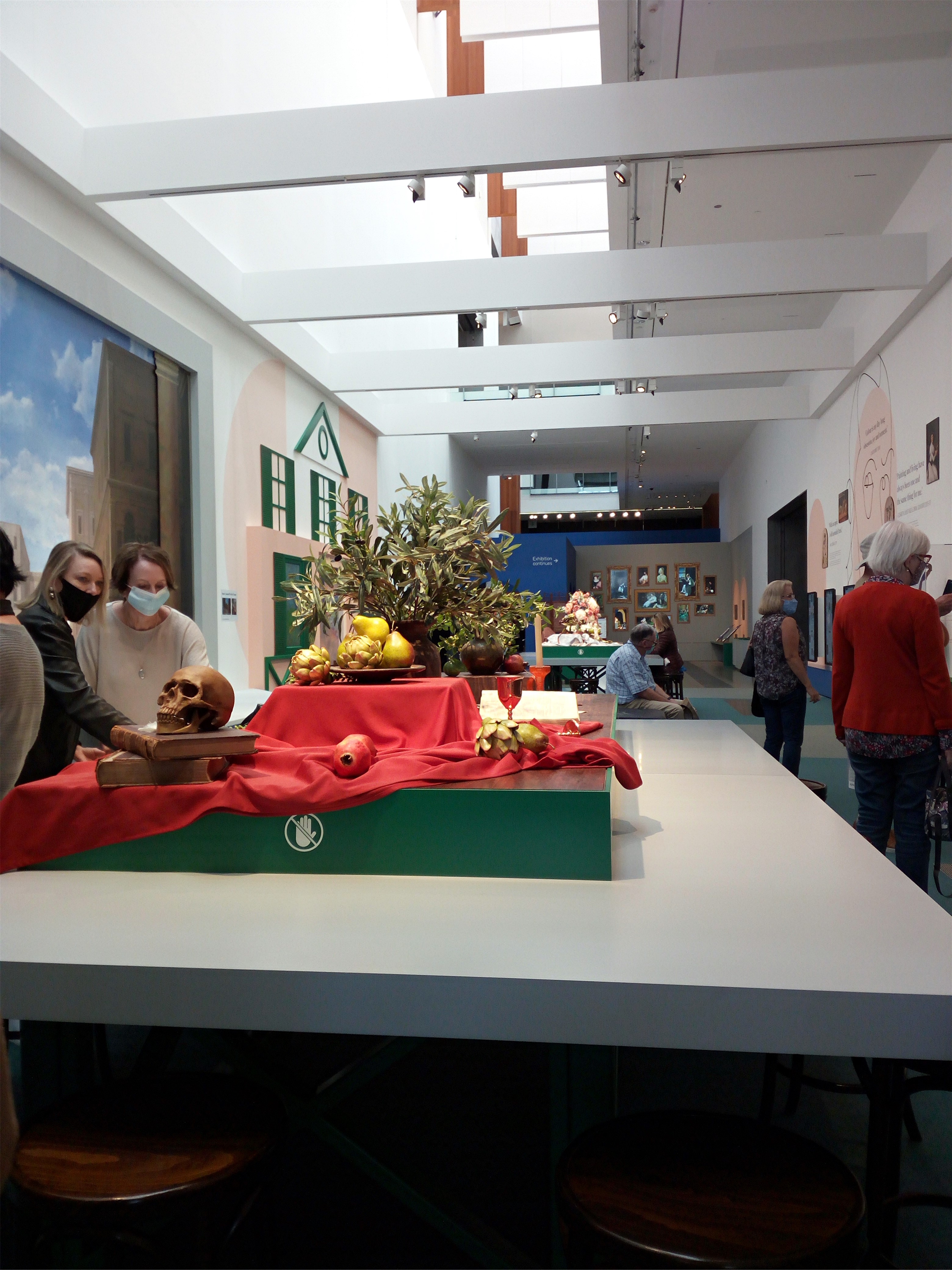
Directly behind me was The Studio, a long gallery set out with still life objects for the budding artist to create a modern masterpiece. There is a Renaissance backdrop for live models at special times. My eyes were drawn to the interactive displays and ‘paintings’ which brought the original art to life. Shades of Harry Potter, both clever and spooky!

The theatrette was not heavily patronised and after hearing the big bosses talk, I decided to seek out one of my favourite colourful artists and that is Paul Gauguin (France 1848-1903). His ‘Tahitian Landscape, 1892’ is smaller and less vibrant than I expected. A pleasant rural scene (below left) but not his usual tropical effervescence.

Claude Monet (France 1840-1926) and his sombre ‘Water Lilies’ wished me bon voyage and I was back into the real world.

As any person who frequents an exhibition knows, the exit is via the gift shop. This low-key store had some nice items but I wasn’t feeling it. The Library Café was looking inviting.

When I thought about the great works of art I had just seen, I pondered which one I could single out, which one I thought was the cream of the crop. The pleb in me rather enjoyed a large 1670 work by Jan Steen (Netherlands) ‘Merry Company on a Terrace’ for its rich vibes and domestic disorder. The original is bigger and brighter than the image (above right) shown here.

I think perhaps Covid-19 had something to do with the way I responded to the Met Masterpieces… and it was interesting to see how each century lightened the mood.

GBW 2021

To quote architect and designer Frank Lloyd Wright (1867 – 1959) “Respect the masterpiece, it is true reverence to man. There is no quality so great, none so much needed now.”

Gretchen Bernet-Ward

—–European Masterpieces—–

12 June 2021 – 17 October 2021
GOMA | Gallery 1.1 The Fairfax Gallery, Gallery 1.2, Gallery 1.3 Eric & Marion Taylor Gallery | Ticketed

https://www.qagoma.qld.gov.au/whats-on/exhibitions/european-masterpieces

Happy galley visitors © Gretchen Bernet-Ward 2021

Review ‘In My Father’s House’ by Indrani Ganguly

IMG_20200110_124943

When I first picked up Indrani Ganguly’s memoir-style book, I dipped into a couple of stories.  It soon became apparent the pages contained a thoughtful mixture of poetry, artwork, travellers’ tales, photographs and fiction stories in a layout designed to gently lead the reader though Indrani’s world.

Chapters are grouped under different headings, the kind of book which anyone can read and everyone will find something that touches them.

The content captivated me with a mix of fact, fantasy and deep emotions initially triggered by Indrani’s return visit to her father’s house and her old room which had been left untouched since she moved out.  This is where her thoughts begin to unfold, first with artwork and poems then a retrospective short story about her family titled ‘Menagerie Manor’.

Jewellery Gold 04As luck would have it, being a fan of crime novels, the first short story I read was ‘A Candle for Bob Carter’ in which plain-clothed Chief Inspector Bob Carter is on jewel-guarding duty at a swanky fancy dress Christmas party during a hot Australian summer.  ‘We’ll turn the air-conditioning up dear,” says Leila as the sound system booms the obligatory yet incongruous ‘I’m Dreaming of a White Christmas’.  Such a fun twist at the end.

Indian Goddess Maa Durga Devi 03Under the tribute heading Women Worldwide, I read in awe as determined elderly ladies went ‘Walking in the Land of the Gods’.  Later I laughed out loud after reading ‘Durga Down Under’ a rather irreverent look at Durga, the Supreme Hindu Mother Goddess.  The accompanying poems resonated with me, particularly ‘A Woman’s Solitude’ a brief respite before a hectic day.  Under the title Travel Tales, Indrani writes with clarity and insight, transporting me to spectacular locations around the world.  My favourite is Shimla in the Himalayas which also has a lovely photo of Indrani and her daughter Gitanjali on rugged little ponies.

In this deceptively compact hardback volume there is a lot to read and think about.  ‘In My Father’s House’ is more than a treasury of family memories, Indrani’s words entertained and enlightened me.  She is in tune with diverse levels of society and human nature as well as comfortable within herself and her writing.

IMG_20190805_153244In her foreword, Indrani says ‘I continue to look both backwards and forwards for ideas and inspiration’.  I have already read and blogged her historical novel ‘The Rose and The Thorn’ and look forward to more literary adventures.
Gretchen Bernet-Ward


AUTHOR PROFILE

IMG_20191122_183130Indrani Ganguly was born into a Bengali family in Lucknow and now lives in Brisbane with her husband, son and daughter.  She travels extensively around Australia, India and other countries.

She studied English Honours in Lady Shri Ram College, Delhi University, has a masters in Sociology from Jawaharlal Nehru University, and a PhD on the impact of British occupation on revolution and reform in Burdwan, now in West Bengal.

‘In My Father’s House’ was published 2015 by Unique Publications Delhi, and her novel ‘The Rose and The Thorn’ was published 2019 by Boolarong Press Brisbane.
Indrani’s website: https://indraniganguly139.wordpress.com/blog/

It’s a long way… to the shops… or how I designed and produced my first range of earrings

Beautiful designer earrings don’t just happen, they are created by sheer love and dedication and Zoë Collins of Hoodlum Friends says “All the years of fiddling around, making mistakes, learning what it feels like to create things I love, and things I hate (and things I feel lukewarm about)… it all lead down a path to 287 pairs of unique, very limited edition drops, hoops, studs…”

Follow Zoë Collins creative journey and be inspired, and maybe think about treating yourself to an original pre-Christmas gift right now! Gretchen Bernet-Ward

Zoë Collins's avatarThis is Hoodlum Friends, by Zoë Collins.

Have you *cough* heard about those earrings I made? NO?! Come on! I’ve been talking talking talking about them, like an excited kid talking about his new transformer (trust me, the kid is non-stop transforminationing).

Earrings are not my first foray into product design. Many years ago I tried my hand at greeting cards. I tried to set up a shop selling prints, I tried Society6, and more recently Redbubble. Most of these forays into selling my artwork were… overwhelming to set up, and underwhelming in self-esteem indicators and sales performance. (Most were well before social media). You see, I had very little experience as a designer and as an illustrator. I knew technically how to make greeting cards, how to set up files for print, how to draw a little — but looking back on those early cards (I still have some! ha!) I can see they are lacking…

View original post 654 more words

Coach Departing Now, Folks

IMG_20190729_162917
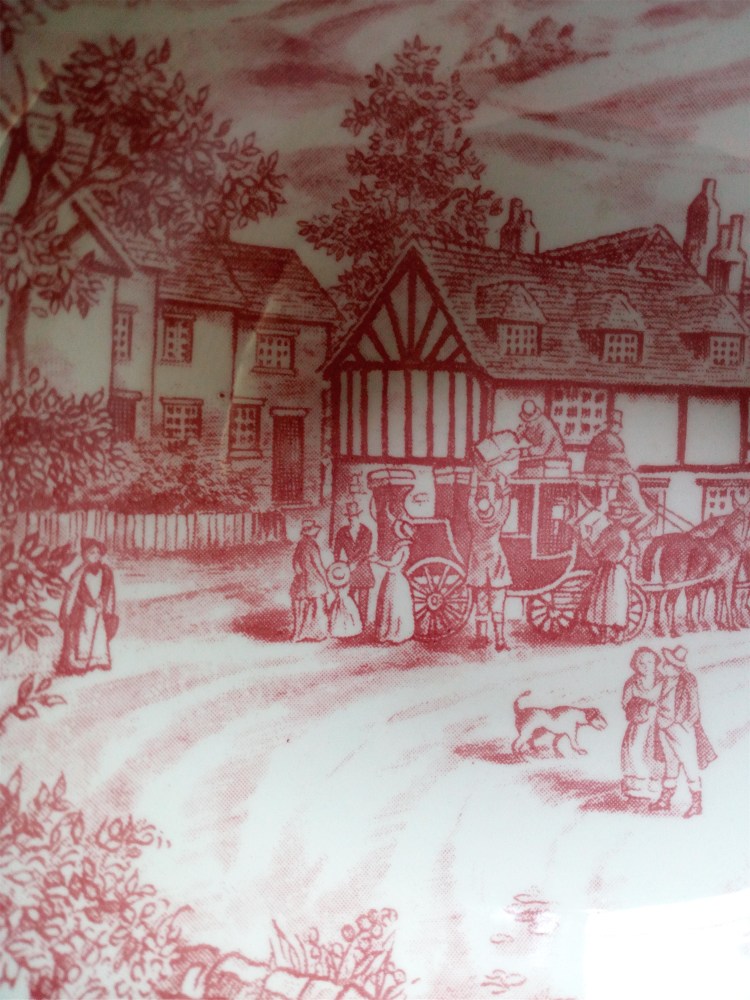
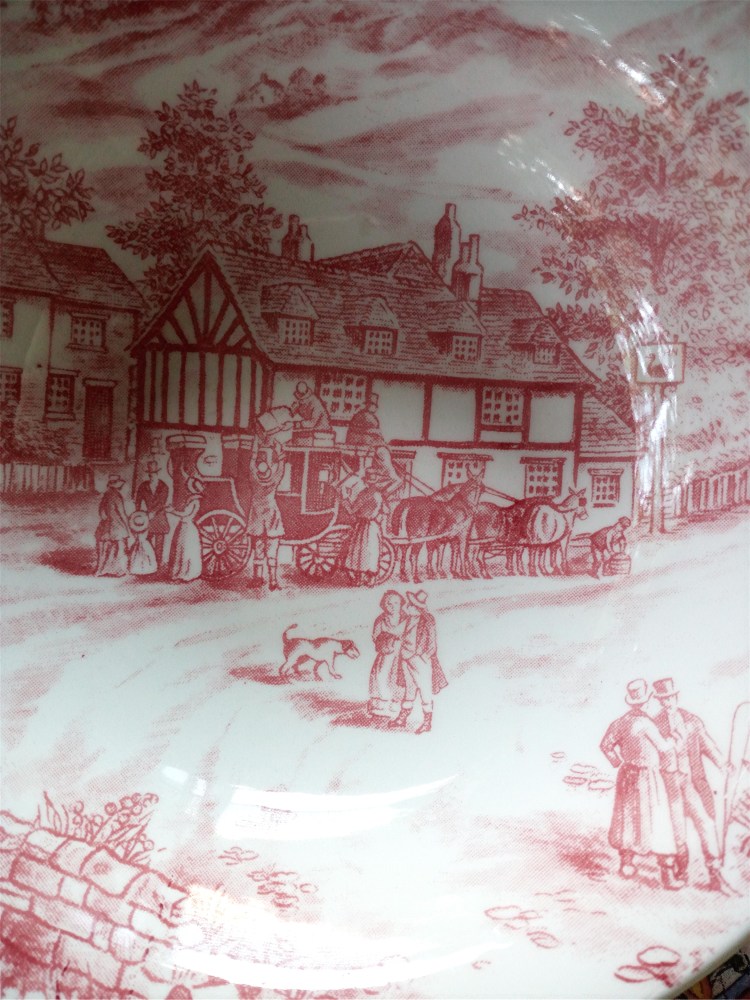
Made in England – china dessert bowl – date and manufacturer unknown.

A rather dramatic story is unfolding in my breakfast bowl.

Cereals and desserts have been eaten from this bowl for over thirty years and yet I have never properly looked at the picture on it.

A few days ago I had a shock when I scooped up the last spoonful of my Weet-Bix (similar to the UK Weetabix, both invented by Bennison Osborne, an Australian) and saw there was a castle on the hill.  I kid you not, I had never seen that castle before!

Allow me to acquaint you with some backstory.  Originally there was a set of six china bowls (15 centimetres or 6 inches across) and originally my parents owned them.  Unfortunately porridge, domestic accidents, and heating leftovers in the microwave have whittled them down.  Of the surviving two, one has a nasty looking fault line appearing.  Therefore, the bowl I have photographed may be the end of the ceramic line.  Or the end of the beginning of a coach trip.

So far, so boring—but wait.  Although this bowl is old, I have to be honest and say it is not an antique.  In fact the picture may have been embossed on like a transfer and glazed over.  Never mind, I’m getting to the point, well, ten points actually—

  First there is the brooding castle on the hill; quite a substantial pile.  A name doesn’t immediately spring to mind but I’m working on it.

  Nestled halfway down the hill is a gamekeeper or crofter’s cottage.

  In the valley at the base of the hill is a small village.  An unaccompanied lady is standing on the side of the unpaved road which runs past the Duck Inn.  She isn’t over-dressed and uses a walking cane.  Her gaze is towards the two gentlemen opposite, chatting beside the milestone.  Perhaps this marker reads “London 100 miles” but I can’t decipher it.

  One of the toffs (lord of the manor) is holding a buggy whip.  He would not have ridden a horse down from the castle in a top hat.  He could be the lady’s son and heir up to no-good, he spends too much time in the tavern.  Or she may be his old faithful nanny, instructed to keep an eye on him.  Or yet again, she could be the wife of the man canoodling in the middle of the road.

  We see two lovers canoodling in the middle of the road.  The man is keener than the woman, and a dog is either giving them a wide berth or coming around behind the man to nip him on the ankle.

  Unbeknown to the busily occupied people, a cat slinks into the rear footwell of the coach.  Earlier he had been shooed away but being a feline named Nosey…

  Outside the Duck Inn (a duck is painted on the sign) the coach boy is making final preparations for the horses’ feedbags.  He loves them ‘orses.

  The coach driver is ready and waiting.  He’s heard rumours that Dick Turpin is lurking in the vicinity (if I’m in the right century) and wants to get going well before nightfall.  The innkeeper loaned him a pistol and it digs into the small of his back.

  Seven people are milling about.  At least four are passengers judging by the loading of a trunk on the roof, a well-wrapped parcel in somebody’s hands, and a family group perhaps saying goodbye.  The husband could be off to London on business and the daughters are sad but the wife is glad he’s out of her hair for a few days.

  Lastly, a curtain twitches at one of the attic windows of the Duck Inn.

There are leafy details in the background and in the foreground the stone wall appears to be crumbling.  I have looked for birds but only managed to spy a tiny number 9 in the garden beneath the Duck Inn sign.  A maker’s mark?

And that’s it.  There are no hallmarks or stamps on base of the bowl except the words “Made in England”.  I have no idea if the picture is fake-aged or has been copied from an earlier (original) tableware design.

One thing is for sure, it has given me a good idea for an historical short story.  Visual prompts are another way to overcome writer’s slump.  Look hard at any image and you will find a story to tell.

Check your kitchen cupboards, your own crockery may have a narrative in the making!

Gretchen Bernet-Ward

NAIDOC Week 2019

NAIDOC Week Poster 2019 02

NAIDOC Week 7 July – 14 July 2019

‘Awaken’ artwork by Kaurna and Narungga woman Charmaine Mumbulla.  Charmaine cares deeply about the 2019 National NAIDOC theme, and about the celebration of Indigenous art and history.

“Early dawn light rises over Uluru, symbolising our continued spiritual and unbroken connection to the land.  The circles at the base of Uluru represent the historic gathering in May 2017 of over 250 people from many Aboriginal and Torres Strait Islander nations who adopted the Uluru Statement from the Heart.  Our message, developed through generations, is echoed throughout the land: hear our voice and recognise our truth.  We call for a new beginning, marked by a formal process of agreement and truth-telling, that will allow us to move forward together.”

Learn more about poster winner Charmaine Mumbulla.

Download a copy of the National NAIDOC Poster and Teaching Guide.

Website https://www.naidoc.org.au/

Indigenous Network https://www.indigenous.gov.au/regional-network

As a National NAIDOC poster winner, Charmaine Mumbulla is excited to be part of NAIDOC history.  Charmaine plans to celebrate NAIDOC Week by taking her children to the National Centre of Indigenous Excellence to celebrate Aboriginal and Torres Strait Islander culture and achievements with a community BBQ and entertainment.  Charmaine will also be doing some workshops at her children’s school and making their favourite morning tea…Johnny cakes with lilly pilly jam.

NAIDOC Week 2019 Artist Mumbulla News

Gretchen Bernet-Ward

My Monoprinting Experiment

French artist Paul Gauguin (1848 – 1903) used monoprinting to created beautiful works of art.  Most were not acknowledged in his lifetime but I had the opportunity to try his technique.

The workshop I attended was run by Brisbane Botanic Gardens Mt Coot-tha.  Everyone met at the BCC Library and then walked down to the activity room.  Our instructors were Frances and Lee-anne and their introduction covered the evolution of Australian native plants, the background to Gauguin’s work and monoprinting.   A monoprint is a one-of-a-kind print that forms part of a series.

It was a two-hour class with about twelve people and we were itching to get started.  We couldn’t wait to peruse the beautiful and aromatic array of Australian native plants ready to make our imprints.

Here is my quick overview


IMG_20190319_111613

Beginners Guide to Monoprinting


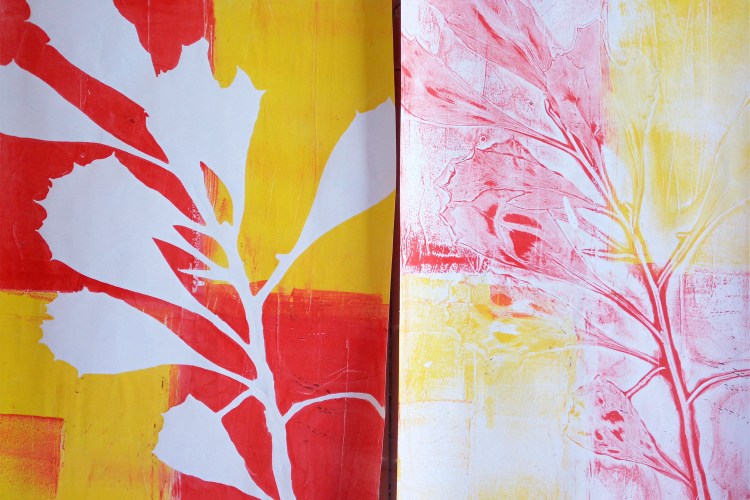
  • You may have read that monoprinting is an age-old printmaking method which produces a single image.  I’d have to say that is only partially correct – the image can be reversed or added to several times, each time producing a different image.  (See my coloured prints above).


  • I rolled out four paint blobs (yellow and red) on an acetate pad, added a leafy tree branch and a clean sheet of paper on top before smoothing it out flat.  Peel off.  Two for the price of one!  I placed ferns and leaves with the branch, added fresh paper on top, pressing down hard.  I reversed the procedure and did ‘mirror’ images.


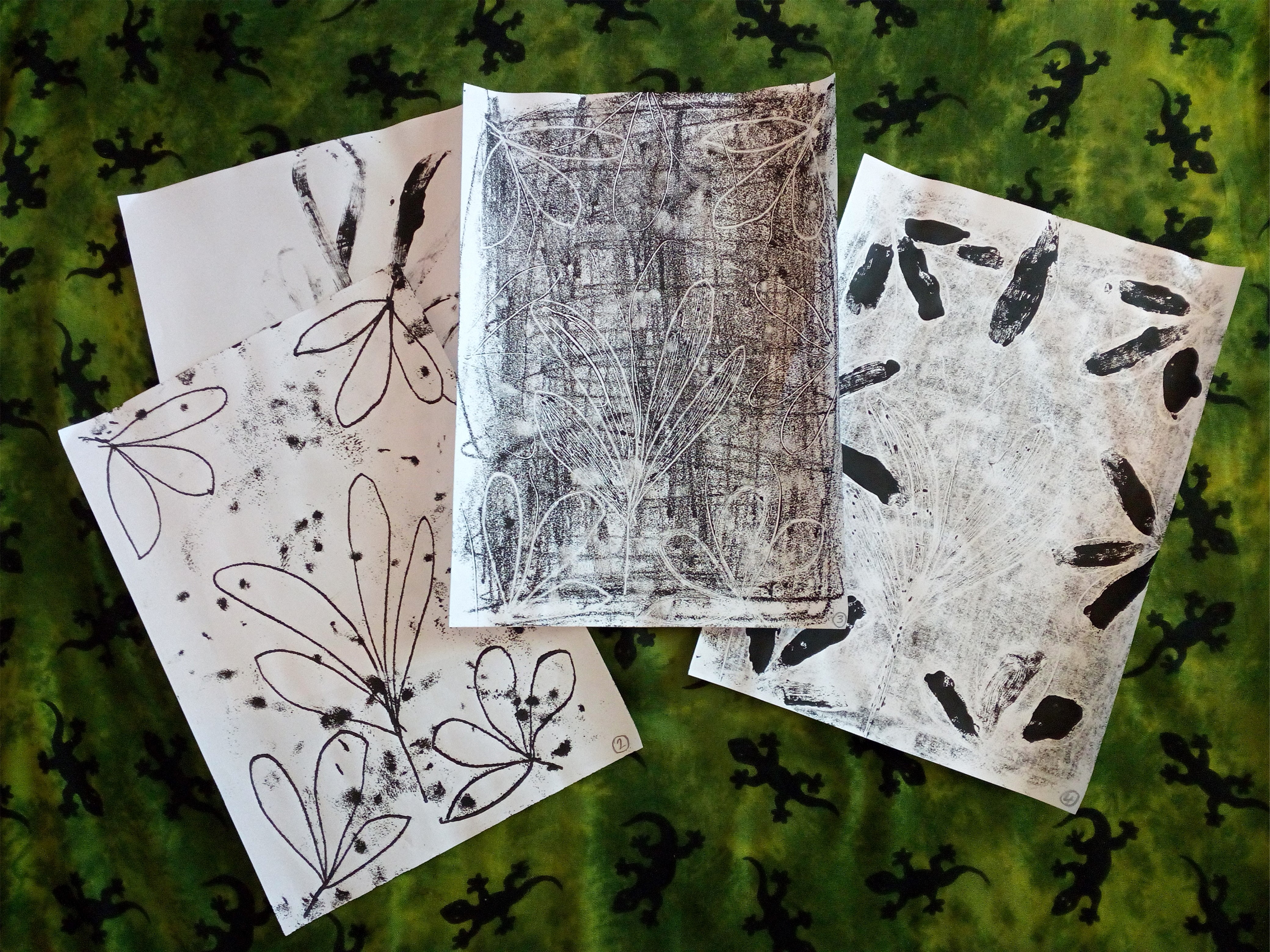
  • You may have heard that you need lino or woodcarving tools.  I used a wooden chopstick to press and draw my B&W designs.  There were several which didn’t make the grade and I tried to choose the better ones.  (See my black and white prints below).


  • It is thought that you need to work on a glass plate or gel plate, but a sheet of tough plastic (clear heavy acetate) works well with monoprinting paints and is easy to clean.  Of course, you can upscale your equipment when your hobby turns into a money-making enterprise.


  • A special roller isn’t really necessary to spread the paints, you can use a small rubber roller with a plastic handle.  No flattening press needed.  Once the overlay paper is in place, you can use your hands to smooth the paper flat, or add background patterns through the paper with the tips of your fingers.  


  • Pigmented paints and printing inks produce colours which look great but the traditional black-and-white looks dramatic.  I didn’t achieve any depth to my work but the middle black-and-white print (below) is reversed and the hatching in the background was done with the backs of my finger nails.


  • We ran out of time and I would have loved to have dabbled more.  The free class I attended supplied the equipment – plus afternoon tea – and the paper used was office A4 size.  It was porous enough and strong enough to take my amateur efforts.


IMG_20190319_110512
My words of encouragement “You have to try it, muck around with it, get messy and see what happens”

The trick is to work fast, especially in Queensland temperatures, because the paint will dry quickly.  Drying caused one of my prints to have a ghostly quality.  That was part of the fun – the results were often a surprise.

Monoprinting is a forgiving and flexible technique, experimental yet satisfying, and several participants achieved a pleasing degree of botanical detail worth framing.

Gretchen Bernet-Ward