Monica McInerney’s Writing Regimen

Monica McInerney Bookcover 02

An interview extract on the writing regimen of Monica McInerney, best-selling Australian-born, Dublin-based author of twelve novels, Monica was voted into the top ten of Booktopia’s “Australia’s Favourite Novelist” poll 2014, 2016 and 2018.

The following quote is from Books+Publishing Q&A and Monica mentions two of her earlier novels which I can highly recommend:


Q:  Could you describe your approach to writing and your working regimen?

A:  “I spend about six months plotting in my head before I sit at the computer and start writing.  There’s usually an overlap between my books.  I had the idea for ‘At Home with the Templetons’ about three months before I finished ‘Those Faraday Girls’.  Similarly, I had the idea for what will be my next book halfway through writing the ‘Templetons’.

I aim for 2,000 words a day minimum in the early stages of writing, getting very attached to the word-count button.  A day always comes when the word count is irrelevant, when all I want to do is be at the desk writing.

The final six months are usually seven days a week.  I edit as I write, and also show the manuscript to two people in the early stages, my husband, who is a journalist, and my younger sister, who is an editor.  I completely trust their feedback, and their encouragement keeps me on track until the manuscript is as polished as I can make it before sending it to my publishers.  I also love deadlines.  They terrify me into finishing.”


Monica McInerney Author

Author http://www.monicamcinerney.com/
Interview Books+Publishing https://www.booksandpublishing.com.au/
Booktopia https://www.booktopia.com.au/


Synopsis of Monica McInerney’s latest novel ‘The Trip of a Lifetime’

“I always thought memories were unchangeable. Set in stone, shaped by the years. But there are always others too, ones you haven’t let yourself remember ...”
The wilful and eccentric Lola Quinlan is off on the trip of a lifetime, taking her beloved granddaughter and great-granddaughter with her.  More than sixty years after emigrating to Australia, she’s keeping a secret promise to return to her Irish homeland.  But as she embarks on her journey, the flamboyant Lola is still hiding the hurtful reasons she left Ireland in the first place. What – and who – will be waiting for her on the other side of the world?
Books by Monica McInerney:
  •    The Trip of a Lifetime
  •    Hello from the Gillespies
  •    The House of Memories
  •    Lola’s Secret
  •    At Home with the Templetons
  •    All Together Now
  •    Those Faraday Girls
  •    Family Baggage
  •    Alphabet Sisters
  •    Spin the Bottle
  •    Upside Down Inside Out
  •    A Taste For It

Gretchen Bernet-Ward

Q&A Katrin Dreiling Children’s Illustrator

Katrin Dreiling World's Worst Pirate 04

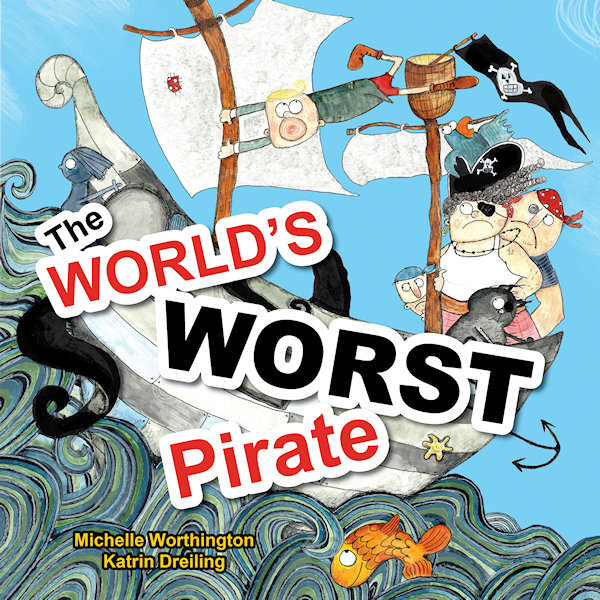
Katrin Dreiling went from language teacher to illustrator and received prestigious recognition for her picture book illustrations in “The World’s Worst Pirate”.  This book, written by Michelle Worthington and published by Little Pink Dog Books, has been awarded Notable Book of 2018 by Children’s Book Council of Australia.

Willkommen! Welcome!

It’s wonderful to have you here, Katrin, I love your beautiful art techniques and I’m excited to learn about your journey as a children’s book illustrator.  First, here’s a sneak peek at this special pirate story:

William is The World’s Worst Pirate so does that suggest he’s rude and nasty?  Read on…

“Pirates are swashbuckling, treasure hunting, buccaneers of the seven seas.  But if your mother is the Pirate Captain and you can’t stand on deck without getting seasick … that makes William The World’s Worst Pirate.”  However, young William does have a special talent.  Can he use it when the ship is under attack?  Save the day, me hearty!

Q&A illustrator background

Katrin Dreiling, originally from Germany, loves to come up with quirky creations that inspire children to get creative.  She enjoys giving colourful and messy art classes and says “Children are the true perfect grown-ups. Their hearts and minds are pure and good and it is important to nurture this – I strive to do that with art.”  On the studious side, she provided the characters for animated University lectures and Government staff coaching videos that attracted over 320,000 views worldwide.  In her free time, Katrin relaxes with her husband, three children and their Golden Retriever.


Katrin Dreiling World's Worst Pirate 02Q1. What is your favourite part of “The World’s Worst Pirate”?

Thank you, Gretchen, for this interview! My favourite part text-wise is when the Kraken attacks and everyone is supposed to run for their lives. Then there is a silence and Will quietly throws a cupcake to tame the beast. I like the contrast between noise and quietness and that it is such a peaceful, gentle approach. In terms of illustrations I think I like the cover the best. I just really enjoyed doing those ocean waves.

Q2. Of all your creations, who is your best loved character so far?

That would be Anton the Pig. This character has been in the works for a while now and so I really got used to him being around. He is also very sweet-hearted and funny and reminds me of a certain someone…

Q3. Where did the inspiration for this character come from?

Anton and his world are certainly inspired by my German background. The region I grew up in is known for their excessive bicycle riding because it’s very flat. So Anton is a passionate cyclist but I merged the landscape with a lot of ideas I picked up while living in Brisbane, Queensland. The inspiration for Anton’s story, though, came from years of working with children at school and my own three kids.Katrin Dreiling World's Worst Pirate 08

Q4. How would you describe your creative process on an average day?

My working day usually starts with a good walk with my Goldi to keep him happy and clear my head. Then I usually work down a list of things I have to do for my illustrating business. Once this is done I start creating. This can include simple sketching, commission work or extending my portfolio.

Q5. Do you like working in a group or home-office environment?

I am very happy to work by myself from home but I do seek professional input from other industry professionals on a regular basis. There is the Brisbane Illustrators Group where I made many good friends, WriteLinks and our local SCBWI group. I think it is very important to stay connected in which ever way you prefer, be that online or in real life.

Katrin Dreiling World's Worst Pirate 06
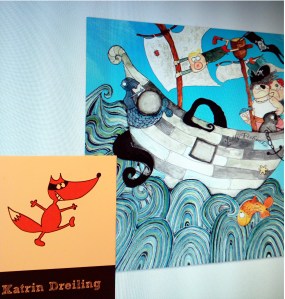
In costume The World’s Worst Pirate book launch

Q6. Was it enjoyable working with writer Michelle Worthington?

Absolutely loved working with Michelle Worthington and would always choose to do so again. She is professional, smart and supportive and I felt very appreciated in my illustrating.

Q7. What is it like collaborating with an editor and publisher?

In the case of Little Pink Dog Books it was the perfect synergy between author, publisher and illustrator. Kathy and Peter Creamer were very inspired to keep this project a creative process which involved everyone in the same measure, and I believe the result reflects this very well. When I worked with other publishers it was a different, yet also enjoyable experience. I had to meet more firm requirements and learned new things along the way. I think you have to be adaptable as an illustrator in order to deliver the best possible outcome for the project.

Q8. Do you like to work with artistic freedom or a strict deadline?

I can do both 😊

Q9. Have you stayed up past midnight to finish an assignment?

Yes. I have worked through nights but if the work does not feel like work it is not a problem.

IMG_20180422_234859Q10. Have you ever received harsh criticism for your work?

I have been very lucky so far and mostly received constructive criticism which I value a lot. It’s easy to get too complacent and lose distance to your work. This is why I regularly book in for portfolio assessments with editors to get a fresh perspective on my work.

Q11. What is your favourite medium to work with and why?

I mix a lot of media together because I enjoy many things at the same time. I seem to always come back to ink in some form, though.

Q12. What colour would you be if you were an extra pencil in the box?

Black.

Q13. What are your thoughts on hand-painted vs computer generated artwork?

It works really well TOGETHER if you know how to.

Katrin Dreiling The Princess and The Pea 02Q14. Who are your favourite artists and have they influenced you?

Absolutely adore the work of Beatrice Alemagna. She has inspired me to go my own way, like she did. Then there is the quirky and unconventional style of Russell Ayto that I love. I think both artists truly work to delight and inspire children.

Q15. Are you involved in teaching workshops for children?

Yes, I will be giving workshops with Michelle Worthington to children at selected libraries in Brisbane during school holidays in July 2018.  Also I give workshops for both children and grown-ups at a bookstore in Red Hill, Brisbane, as well as giving regular extra-curricular art classes once a week at New Farm State School.

Q16. Do you have a special creative goal for this year or is it a secret?

For my Anton the Pig story, I’d like to finish the manuscript and illustrations completely. Also getting published by one of the ‘big’ publishing houses has always been my dream and I’m still working towards this goal.


And this Q&A draws to a close

My sincere thanks, Katrin, for your personal insights into the world of picture book illustrating.  I am sure you will reach your goal and I look forward to reading all about Anton!

Hey, is anyone else left wondering who that 'certain someone' is and why Katrin would be a black pencil...

Gretchen Bernet-Ward

Katrin Dreiling World's Worst Pirate 05Information:
Katrin Dreiling Illustrations https://www.katrindreiling.com/
Instagram https://www.instagram.com/katrinartworks/
Facebook https://www.facebook.com/katrinartworks/
Twitter https://twitter.com/dreiling_katrin

‘A Garden of Lilies’ Tales from Judith Rossell

IMG_20180409_162238
Page 39 “Peregrine was a disobedient child…”

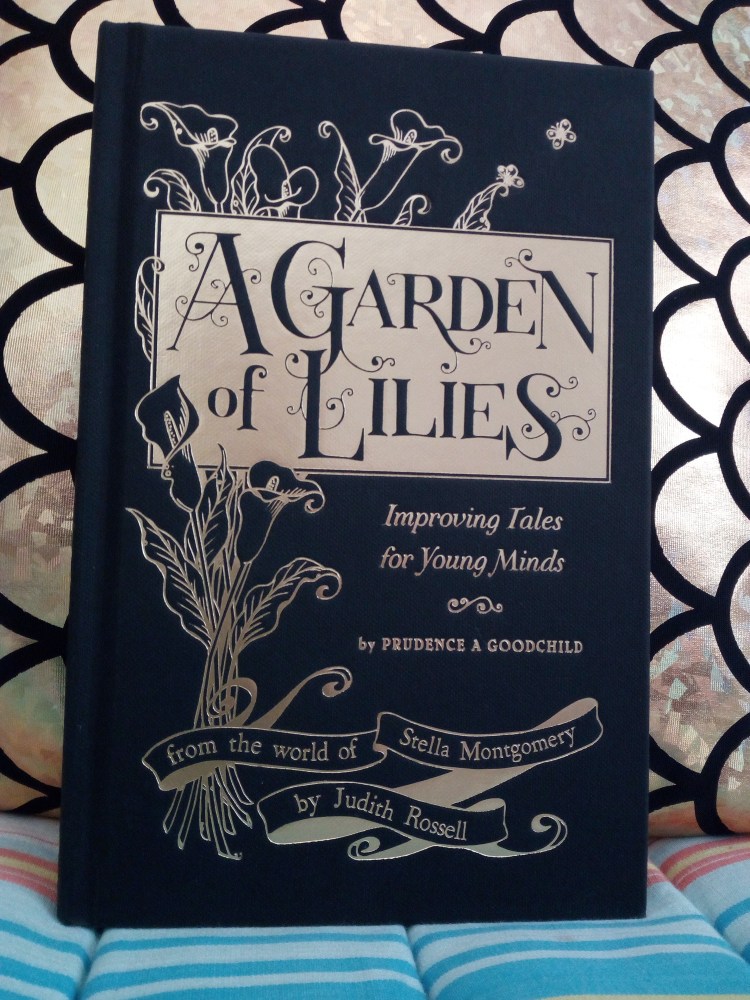
With a knowing smile, this Victorian-style book of manners is reminiscent of the period of parenting when misbehaving children were given orders and told dire consequences would ensue if they did not obey.  Despite warnings, when a child in this book ignores an instruction, there is an aftermath of great magnitude.

IMG_20180410_133833
Page 28 “Jesephany and Keziah were unruly and wild…”

In “A Garden of Lilies: Improving Tales for Young Minds – by Prudence A Goodchild” children’s author and illustrator Judith Rossell has produced an atmospherically illustrated and tightly written volume.  She has also mastered the art of a left-right jab, hitting with swift endings which leave the reader breathless.

Each punchy short story closes with a judicious moral.  For example, Isadora daydreamed too much during her chores.  One day she daydreamed while idly brushing her hair.  Let’s just say she didn’t get to finish the task.  “Moral: For hair that’s glossy, clean and bright, Two hundred strokes, both morn and night”.

After Isadora’s tale, there is what appears to be a lovely page entitled “Care of the Hair” with a recipe for making Soft Soap which “…will improve both the texture and colour of the hair” until things get a bit nauseating.  Apart from kitchen scraps, the mixture must boil for hours until it forms a clear, thick jelly.

IMG_20180410_134735
“A Garden of Lilies: Improving Tales for Young Minds” by Prudence A Goodchild (author Judith Rossell) ABC Books Australia

Basically the stories are about kids being kids and the 21st century reader should see the endings for what they are – a sample of Victorian etiquette and psychology which we would not dream of using on children today.  Right?  Okay, explain that to your child and laugh.

This slim book is approximately sixty pages (with attractive binding and colour plates) and scattered throughout are “Interesting Facts” and helpful hints like An Economical Recipe for a Plain Cake, A Useful Compass, Parlour Games and my personal favourite, An Album of Sea-Weeds.  I will work on drying and pressing seaweed during my next holiday!  Hmm, would seaweed smell like that starfish I once brought home?

In closing, I will give a shout-out to Mr Lindon of Woolloongabba, Queensland (Page 45) who grew a giant marrow.  I think he must have read the book’s suggestion To Grow a Giant Marrow which signifies “A Garden of Lilies” is indeed a versatile volume!

I cannot give you a childproof safety rating but I think it is suitable for a sliding age scale and my own rating is 5-star.

Gretchen Bernet-Ward


Judith Rossell — Biography

Judith Rossell is the multi-award-winning author-illustrator of the bestselling Stella Montgomery series (Withering-by-Sea, Wormwood Mire, A Garden of Lilies and forthcoming Wakestone Hall).  Judith has written thirteen books and illustrated more than eighty, and her work has been published in UK, US, Germany and translated into more than twenty languages.  Before beginning her career in children’s books, Judith worked as a government scientist (not a mad scientist, a normal kind of scientist) and also for a cotton-spinning company (which made threads for T-shirts, denim jeans, mops and teabag strings).  Judith lives in Melbourne, Australia with a cat the size of a walrus.

ACCLAIM FOR WITHERING-BY-SEA AND WORMWOOD MIRE:
Indie Awards – Winner 2015, Shortlisted 2017
Australian Book Industry Awards – Winner 2015, Shortlisted 2017
CBCA Awards – Honour Book 2015, Notable Book 2017
Davitt Awards – Winner 2015, Shortlisted 2017
Prime Minister’s Literary Awards – Shortlisted 2015
ABA Booksellers’ Choice Awards – Shortlisted 2017
Australian Book Design Awards – Shortlisted 2017
Aurealis Awards – Shortlisted 2015

DHQ: Wales Dewithon19

My foray into reading Welsh authors began with Jasper Fforde (Thursday Next) Paula Brackston (Shadow Chronicles) and Bill James (Harpur & Iles) and now, thanks to Book Jotter Paula Bardell-Hedley and Dewithon19, I have a wonderful list to continue reading in more depth.  “dw i’n hapus iawn!”

Find more about reading, writing, reviewing Welsh literature on Dewithon19–––

Paula Bardell-Hedley's avatarBook Jotter

#dewithon19 logo

1st to 31st March 2019

Welcome to DHQ (Dewithon Headquarters), the nerve centre for Reading Wales 2019!

The people of Wales celebrate St David’s Day annually on 1st March – the date of our patron saint’s death in 589 CE. In honour of this traditional anniversary, and also in recognition of the time of year when daffodils (the national flower of Wales) explode into bloom, we will hold the very first Dewithon – Dewi being the diminutive form of the Welsh name Dafydd (David).

Throughout March 2019 the international book blogging community will be invited to write about the literature of Wales. This will include reviews and articles about novels, non-fiction publications, short story anthologies, biographical works (by or about Welsh writers), travelogues, volumes of poetry (or single poems), essay collections, or indeed any texts with a meaningful connection to Wales.

You may write in either Welsh or…

View original post 505 more words

Assassin and the Actress ‘Reckoning: A Memoir’

A highly charged and deeply honest memoir, ‘Reckoning’ combines research into the life of assassin and Polish World War II survivor Zbigniew Szubanski , father of Australian actress Magda Szubanski, and Magda herself as she struggles to come to terms with her father’s legacy and forge her own career within the world of television and movies.  This absorbing, eloquently written book contains remarkable revelations of wartime espionage, emotional family ties and facing the truth, and I was enthralled to the very last page.

First published in 2016, ‘Reckoning’ is Magda’s debut novel, and courageously written.  I must admit my initial thoughts were ‘Wow, she’s brave putting that in writing’ but it made me love this book even more.  Definitely a five-star read!  Magda relates one of those true stories from childhood to adulthood which hits the right cord with just about everyone.  We’ve had similar feelings and domestic issues and career changes and sexuality debates and, yes, sadly, the father we got to understand a little too late.

‘Reckoning’ has gone on to bigger things but here’s the first results:
Winner Nielsen BookData Booksellers Choice Award, 2016
Winner Book of the Year, Australian Book Industry Awards, 2016
Winner Biography of the Year, Australian Book Industry Awards, 2016
Winner Douglas Stewart Prize for Non-Fiction, NSW Premier’s Literary Awards, 2016
Winner Indie Award for Non-Fiction, 2016
Winner Victorian Community History Award Judges’ Special Prize, 2016
Shortlisted Matt Richell Award for New Writer of the Year, Australian Book Industry Awards, 2016
Shortlisted Dobbie Literary Award, 2016
Shortlisted National Biography Award, 2016

Website https://www.textpublishing.com.au/books/reckoning
Twitter https://twitter.com/magdaszubanski

ABOUT THE AUTHOR
Magda Szubanski is one of Australia’s best known comedy performers.  She lives in Melbourne and began her career in university revues before writing and appearing in a number of comedy shows.  Magda created the iconic character of Sharon Strzelecki in ABC-TV series ‘Kath and Kim’.  She performs in theatre productions and has acted in movies – notably ‘Babe’ and ‘Babe Pig in the City’ – and currently ‘Three Summers’ directed by Ben Elton and ‘The BBQ’ directed by Stephen Amis.

Gretchen Bernet-Ward

DBC Pierre Writes at Feverpitch

DBC Pierre Photo Montage 02
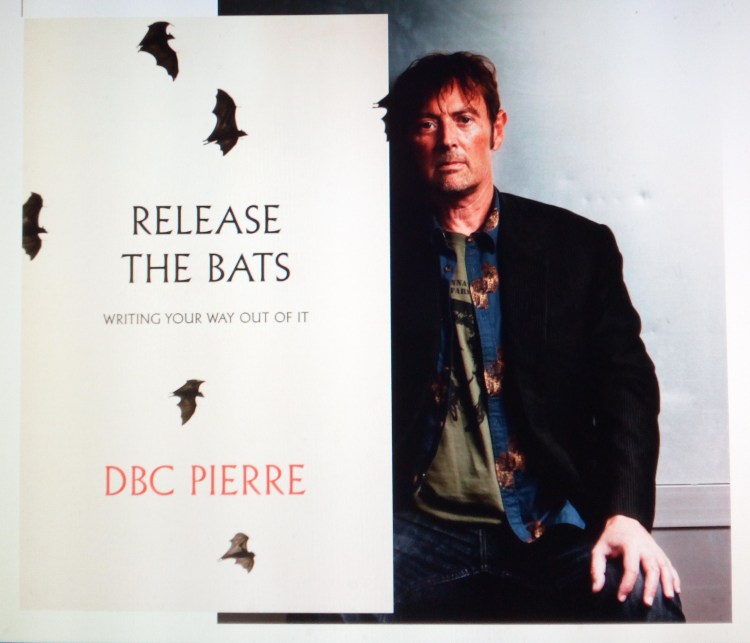
Photograph of novelist DBC Pierre by Murdo MacLeod for The Guardian.

“I wrote 300 pages in five weeks,” says novelist DBC Pierre, who made his debut with Vernon God Little, a Booker Prize winner, and delivers writing guidance in his contemporary work Release the Bats.

I enjoyed his gutsy and wildly perceptive advice which perhaps appeals to a ‘pantser’ style of writing rather than a ‘plotter’ but the quotable gems will stick with me.  Wisdom with a 21st century twist and language to match.

“A few pages into writing and find yourself drowning, as I did.”  DBC Pierre.

“When I started to write,” says self-confessed bad boy DBC Pierre in The Guardian interview, “I wasn’t particularly well-read, but I found two things critical. Together they can turn a pile of thoughts into a novel, in case you’re at a loose end next weekend, or are in prison. They’re also helpful if you’ve swum a few pages into writing and find yourself drowning, as I did.”

“The first might seem stupid but I actually found it the main hitch in getting words down and ‘letting rip’, ‘sticking with it’, and all that noble stuff we’re supposed to do. ‘The responsibility of awful writing’ was Hemingway’s twist on his own phrase ‘the awful responsibility of writing’. As the man who also said ‘first drafts are shit’, he pointed to a truth: if the key to finishing a novel is sticking with it, then the main challenge is to face writing crap.”

DBC Pierre Vernon God Little Bookcover

“All I liked after writing the first page of Vernon God Little was the voice. It had things to say about everything. I could feel it wanting to say them. But I went on to write 300 pages that didn’t make a book. I wrote them in five weeks, in a fever, without looking back. And at the end, I still liked the voice – but it hadn’t really said anything. Or rather, it had said plenty but nothing else had really happened. I soon found advantages to having done it that way.”

“Even writing 50 pages of crap gives a sense of achievement.”  DBC Pierre. 

“For one thing, I would usually find it hard to move on to page two if I didn’t like page one. I bet you could wallpaper the planet with books that never got to page two. And it’s a circular trap, in that some of the energy you need to forge ahead and push your page count up is generated by forging ahead and pushing your page count up. Even crap gives a sense of achievement when you get to 10, 20, 50 pages of it. When you don’t get past page one, you lose the spur. After that, the thing spirals into bad feeling and dies while you check email.”

“Half the problem is the expectation that we’ll see finished writing at once, more or less in its place. But I wouldn’t have written what I wrote if I’d thought about structure and form at the time. Obviously, if we’re writing about a boy going to the river, we make him go to the river. I don’t mean write without an idea – just that better ideas will come later. They attract each other and grow. We write crap in the meantime. It can work like a compost.”

“If you watch a dieter breaking their diet, you’ll see that they gobble things before they can stop themselves, before the internal arguments, before the shame. Guiltily and fast: that’s how to approach a first draft. A free writer is not something you are, but a place you can go. To start that climb: speed. Don’t look down. Keep a note of your page or word count, watch it grow like an investment. Amp yourself up. When we do things this way, a phenomenon comes to bear that justifies our approach: art. Some of what we write will crystallise for reasons we can’t explain, and the story comes into a life of its own.”

“If the job gets boring, loosen up…throw in a new character.”  DBC Pierre.

“Eventually, take that feverish pile, bravely or drunk, and read it back. Get over the cringing and find a glimmer, see what sentence or idea intrigues or excites you. Start from there and build out. If the job gets boring, loosen up, take a tangent, throw in a new character. In this process, the work begins to show itself. We show ourselves. When gems have grown into paragraphs, paragraphs into pages, look again. Find the part that works best and lift the rest up to it. This is how it climbs, by following what pleases us most.”

“We can’t compete with Shakespeare or Hemingway, nor should we try. Our particular feeling is all we can bring to this party, and our whole job should be to wrestle it into a story that works for us alone. After that we can dress it for others to read. A different job entirely. Save that for a strong coffee on a Monday.”

One of three different interviews by Chris Wiegand, Dave Simpson and Homa Khaleeli.  Wed 22 Feb 2017 06.00 AEDT “Culture” The Guardian newspaper.
https://www.theguardian.com/culture/2017/feb/21/frank-turner-dbc-pierre-creative-industry-advice
Heading : So You Want To Be An Artist? Then Let The Pros Show You How It’s Done.

You can also read my book review of Breakfast With The Borgias by DBC Pierre.

Gretchen Bernet-Ward

Jasper Fforde 2018-2019 Author Events

Excited beyond belief when I found out Jasper Fforde, my all-time favourite post-modern author, has some cool events coming up!  Including another book.  And the eponymous Fforde Ffiesta rolls around again next year.

If any reader attended a US event, or may be attending a future UK event, I’m jealous but hoping I will read your WordPress review.  Of course, I will be writing about Jasper Fforde’s Brisbane Writers Festival 2019 special guest appearances in September!  See itinerary below—

Gretchen Bernet-Ward

Photos by Mari Fforde (hover to see date)
Information from Jasper Fforde website (see below)


APPEARANCES

 Jasper Fforde says:  As usual, please call the venue to check times and dates before you set out just in case I am kidnapped by badgers, eager to promote their dangerous monochrome agenda.
Gretchen says: New book “Early Riser” is now available.  Read my review here
https://thoughtsbecomewords.com/2018/12/14/early-riser-jasper-fforde-book-review/\


2018


Feb 21st-22nd, Casper, Wyoming:
Wyoming Humanities Festival 2018

Book signing and lectures. I’ve never been to Wyoming, and the frightfully pleasant people at Casper have been asking me for a while. Talk and Book Signing Courtesy of Windy City Books, and a lecture plus Q&A the following day. Full details at the Humanities Festival website.


1-2nd March 2018, Cardiff Library:
Crime & Coffee Festival, Cardiff

First Crime and Coffee Festival at Cardiff Library. More details to follow, but I am assured the coffee is the crime, and there will be no actual murders of crimes taking place. Either days, or both, details to follow. Cardiff Library Website.


24th May-3rd June 2018
Hay Festival, Hay-on-Wye, Wales:
May or may not be attending this year––One of the UK’s most imaginative and entertaining authors creates hilarious, often absurd but always compelling adventures within bizarre and zany worlds.  Jasper Fforde’s hugely popular The Last Dragonslayer series is packed with trademark magic and invention.”
Information brochure Hay Festival, Wales.
Gretchen’s book review The Last Dragonslayer.


August 2018
Launch of Early Riser in the UK:

About bloody time too, say I.  Likely 1st to 12th August.  More details to follow.


August 13th – 18th, 2018, Wales:
Ty Newydd writing retreat, Wales

With Belinda Bauer, the course is called: Crime Fiction: A Twist in the Tale and from their website: “This course is designed for those who would like to write best-selling crime fiction – with a twist. Whether you’re writing your first novel, are switching from another genre, or have only dreamed of being a published author, we hope you’ll enjoy this down-to-earth, fun, and practical course. In workshops and one-to-one mentoring sessions, we will be sharing our tried and tested methods of creating character, plot and tension, while helping you to avoid some common pitfalls. We’ll offer advice on a range of issues, from writer’s block and the art of pitching, to how to cope with bad reviews!”
For more details, please mouse you way to the Ty Newydd Website.


2019


Early Riser Tour Jasper Fforde


25th-26th May 2019, Swindon, UK:
Fforde Ffiesta VIII, Swindon, UK

These Festivals are held biannually and oh, what ffun we have – and hopefully a lot more to talk about this year as I will have at least one more book published… Their website is here.


NEWS FLASH !!

THURS 5 SEPTEMBER TO SUN 8 SEPTEMBER 2019, BRISBANE, AUSTRALIA

VENUE: BRISBANE WRITERS FESTIVAL, SOUTH BANK, QUEENSLAND
https://bwf.org.au/2019/brisbane-writers-festival/artists/jasper-fforde-1

Jasper Fforde itinerary will be:

Event 1 – Workshop ‘Writing Futures’ with Jasper Fforde at QWC: Learning Centre, State Library of Queensland.

Event 2 – Panel ‘Dream Worlds’ at Cinema B, Gallery of Modern Art, South Bank.

Event 3 – Conversation ‘Early Riser’ at The Edge, State Library of Queensland.

Event 4 –  Book Club ‘Meet Jasper Fforde’ River Decks, State Library of Queensland.

Event 5 –  Lecture / Special Closing Address by Jasper Fforde, The Edge, State Library of Queensland.

Jasper Fforde at Brisbane Writers Festival Sept 2019


FUTURE ENGAGEMENTS


March 02031:   Asteroid belt and Saturn (technology permitting) More details TBA.

October 02042:   81-year-old Fforde talks to other members of old people’s home: “I used to be a novelist, no really, I did. Is it lunchtime?” More details TBA.

July 02175:   Semi-lifelike cloned Ffordesque replicant to tour Gamma Quadrant in the Cygnus Cluster. More details TBA.

Setember 03431:   Much improved Fforde cloned back to life to face execution for sedition; all works consigned to erasure.

Janfebry 008910:   Last evidence of Fforde’s books vanish forever with the removal of the ‘Formerly Thursday Street’ plaque from what is now W23-61 Rd in the conurbation known as EuroWest-79.

00012972:    Visiting archaeologists from Thraal-7 discover incomplete copy of Well of Lost Plots from excavation in landfill. Deciphering takes seven hundred years and a further four hundred years of academic scrutiny before being accepted as historical fact.


More ffun, books, merchandising, photos  Jasper Fforde Grand Central
For those who like a bit of backstory  Wikipedia – Author Jasper Fforde
Twitter  @jasperfforde
Instagram  Jasper Fforde
Facebook   Jasper Fforde Writer

NEWS FLASH 2020

JASPER FFORDE HAS CONFIRMED FORTHCOMING BOOKS!

“Dark Reading Matter”  Bookworld and Thursday Next – adult
“Dragonslayer IV”           Ununited Kingdom and Jennifer Strange – young adult
“Shades of Grey II”         Colours and Eddie Russett – adult
“The Constant Rabbit”   Racism and Mrs Constance Rabbit – adult – available now


Book Covers Tell Too Much

Books Bookshelf Old Volumes

Can you tell a book by its cover?  Sure you can!  Just the same as an individual’s personality and clothing can tell something about them, a book lures the reader with an enticing cover image.  That visual reveal, a hint of what’s hidden within the book is a very important marketing tool.

A contemporary bookcover, no matter what the genre or category, has to be identifiable.  It has to look good on publicity material, it has to create a mood and it has to appeal to its target audience.  The font style, back cover blurb and all-important artwork join together to get you interested enough to part with your money.  Unless you are borrowing the book from your local library.  Nevertheless, you will still be interested in that lurid hardback in your hand because it promises so much…just look at that out-of-context quote from a famous author who said “chilling depth” and “sizzling romance” from a “writer with imagination”.

Millions of modern eye-catching bookcovers are perfectly serviceable and practicable and sensible and don’t mislead the intended reader.  It can be argued that bookcover images only hint at a small portion of the entire book.  But, as a person who reads books very closely, I disagree.  I like to make my own assumptions and not be misled by skewed artistry.

Thus I start my LONG bookcover show-and-tell, documenting that which has annoyed me for some time – the all-to-obvious artwork on bookcovers, those illustrations which give the game away.

  • The reveal: I loathe it when the crime bookcover shows the pivotal moment in the book. A dead giveaway!  Is that the graphic artist’s fault for reading the front and back page?  Is it the publisher’s fault for handing out the last chapter?
  • Bookcover clue giveaway: I have just finished a police procedural and the creepy black-and-white cover photo with a rundown house on the hill encircled by barbed wire is actually where the bodies are buried. No kidding, I knew every time the detective went up that hill, he was darn stupid.  Or the one with the sketch of a child on a rocking horse holding a scythe over her shoulder – storyline crumbles before it starts.  Worth mentioning that a rocking horse was not even in the story.
  • Vignettes snipped from a chapter: Like historical fiction “Golden Hill”, where a sketch of the hero is seen on the bookcover leaping across a roof top in true Hollywood style, no doubt aimed at action-loving readers, when the bulk of the story revolves around cruel social hierarchy.
  • A mystery novel: Well, murder actually because several people end up getting killed. This illustration managed to ruin the first three punchlines in the first three chapters.  Not to mention the good guy is seen working in the downstairs office window when his office is upstairs.  Plus the red motorbike heading up the road outside is meant to be him, at the same time.  Lovely drawing but couldn’t they have chosen something more accurate?
  • Overcooked Clones:  There’s the hand frozen in ice (guess how the victim dies) there’s the bridge across the river (guess how the victim dies) there’s the threat (a big dark old building) there’s a corrupt political serial killer millionaire mowing his way through rich widowed neurotic socialites on board his yacht (guess how the victims die) or bones poking out of the earth…black crow…wolf in snow…lonely highway…stark tree…dropped gun…body part…the train racing through the underground station…all overdone crime tropes.
  • To quote Tim Kreider, essayist: “The main principles of design—in books…is your product must be bold and eye-catching and conspicuously different from everyone else’s, but not too much! Which is why the covers of most contemporary books all look disturbingly the same, as if inbred.”  Which leads into––
  • Dark silhouette: I, for one, thoroughly dislike the brooding male or female silhouette in a heavy coat, head down, walking toward a menacing city skyline/bridge on a rain-soaked evening. Boring!  The stock standard photo silhouette has been on countless bookcovers for years.  Think of Lee Child.
  • Expected bookcovers or Clone II:  Why does (1) Romance have the obligatory well-developed over-muscled man and well-developed bust-overflowing woman, and (2) Literary fiction has a sedate, toned, almost elegant layout with a design which purrs good taste?  (3) Non-fiction is so varied it usually has just a colour photo with a word overlay.  (4) Historical fiction will have a woman in period costume gazing at house or hillside.  (5) Children’s books, fantasy and science fiction have a place all their own.  Renegades breaking up the predictable.
  • Flip side: An irrelevant illustration. There are obscure bookcovers like “The Midnight Promise” with two hands shaking as though in agreement when the Promise is nothing like that image.  At least it gave me something to ponder.
  • World-wide: I’m commenting on English language publications and referring to p-books and e-books. I’ve mentioned arbitrary books I have read and tried not to name them.  However, the same book published in different countries gets a different bookcover.  This is where designers and image stock can become tricksy.  I have seen translated children’s books looking very adult, young adult books looking too adult, and adult books looking sugary sweet, e.g. cosy mystery covers with blood-thirsty content between the pages.

Book Sliced Up on Plate with Knife

BONUS:  Terry Pratchett’s bookcovers by artists Josh Kirby and Paul Kidby tell a detailed story.  With fiction, decide how closely you should look.  Decide if you want to undermine the plot.  You may not even notice pictorial clues!  Ask yourself if you are exercising your own freewill, or are you conditioned by a generic bookcover image.

Link to superb 20th century bookcovers from The Paris Review:
https://www.theparisreview.org/blog/2018/02/22/twelve-illustrated-dust-jackets/

Today, the mass market book illustrators, the image makers, appear to acquire design inspiration from their clinical, perfectly sculptured computer programs.  Perhaps they should visit an art gallery, or see what’s shakin’ in the real world, then tell that miserable silhouette model to get lost.

Never stop reading!

Gretchen Bernet-Ward


Postscript : A Tiny Bit of History : Literature has changed in more ways than one over the centuries.  Illuminated manuscripts gave way to smaller volumes with dust covers/jackets in 1820s Regency, then refined in 1920s to make hardback books more attractive.  Before this the majority of bookcovers were a plain single colour with gold embossed wording and little adornment.  Swanky ones did have lithographs or a portrait frontispiece.  It is considered that 1930s paperback printing changed the course of bookcover art.

Lorna Doone by R D Blackmore

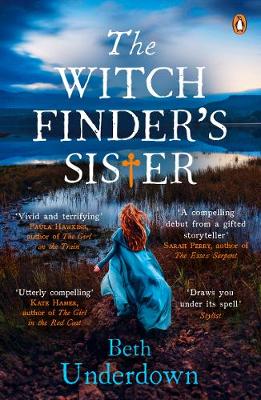
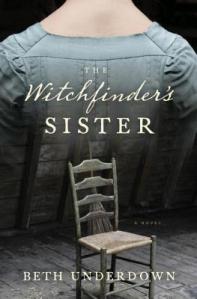
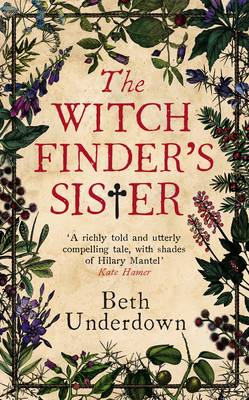
‘The Witch Finder’s Sister’ by Beth Underdown

A witch-finder compiles his list … To me, prologues are an unnecessary extension of the backcover blurb and I often don’t read them.  Resistance is futile when it comes to Beth Underdown’s deep dark 17th century historical novel based on the real witch-finder Matthew Hopkins.

When I read the prologue to The Witch Finder’s Sister I tried not to become smitten with the words, tried not to be intrigued by the premise nor overcome with a desire to read what sister Alice has to say, but I am already into Chapter 8 even though historical fiction is not my preferred genre.

As absorbing as I’m finding this tale, this is not a proper book review and “no correspondence will be entered into”.  But I will say Chapter 1 is claustrophobic and tension-filled, a classic example of how thoughts become words to become other people’s thoughts.  There is an epilogue under the guise of Author’s Note which I can live without reading.  If you wish to pursue the Prologue & Epilogue debate, check out  WordPress Blogger theryanlanz A Writer’s Path

The Witchfinder's Sister Bookcover 03

I will leave the review to Suzi Feay of esteemed The Guardian newspaper:

The Witch Finder’s Sister by Beth Underdown review – puritan or serial killer?
The Guardian Review of The Witch Finder’s Sister by Beth Underdown


The Witchfinder's Sister Bookcover 01

Gretchen Bernet-Ward

Here is the prologue to The Witch Finder’s Sister by Beth Underdown––
“1645, and the Civil War in England has begun its fourth year.  It is a war about God, and how best we should worship Him.  It is a war about who should govern, and why; whether the Parliament should rule, or whether the ousted King.  It is a war of thoughts, of words printed or hurled in anger: but this is also a war of guns.  Last year, at Marston Moor, more than four thousand men were killed.  Before this, women have seldom been hanged for witchcraft – one or two, every five years, or ten.  Eight were sentenced in Pendle, thirty years ago, when the land still knew peace.  But now this country is falling apart at the seams.  Now, all England is looking the other way: so there is nothing to stop Matthew Hopkins stepping forward.  Starting to make his list of names.”

‘Work-Life Balance is a Myth’ Review

Integrate by John Drury
Whole-of-life plan

Traditional work-life balance means separate compartments in our lives, but lines can become blurred, pressure can build and conflicts emerge.  Instead of working against each other, integration means all parts can work together to achieve a positive outcome for our lifestyle expectations.  Then realisation that your work-life balance is “out of kilter” will no longer apply.  I wish I had read this book before my divorce!

John Drury is a presenter, trainer, facilitator, and author of new book “Integrate” which challenges busy people to rethink their approach to life and work.  “The demands of work have never been greater.  A balancing act is not the answer.  Work-life integration is the only way forward in a 24/7 world” says Drury, whose painful personal experience with burnout, and subsequent recovery while in a senior leadership role, motivated him to start helping other high achievers create and maintain a realistic lifestyle.

In his book, Drury outlines a way to align all the parts of your life so they work in unison.  He says “This takes effort, but it’s well worth it and the end result will give you a schedule far easier to work with than just a big juggling act which no-one ever seems to make work.”  He believes that you must look after yourself at your very core; respect your health, your wellness, your relationships and your work commitments.

In John Burfitt’s interview, Drury explains that self-care and implementing achievable self-management strategies are essential.  Drury goes on to say that once important areas are defined and outlined, it becomes a matter of making decisions and planning goals “And you must do that, as a goal without a plan is just a wish.”

Integrate by John Drury 02
Image is an edited extract from Chapter 3 of “Integrate: Why work-life balance is a myth and what you need to create a fulfilling lifestyle” by John Drury  John Drury.biz

Further reading: “Integrate” by John Drury

Gretchen Bernet-Ward