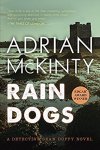
‘Rain Dogs’ by Adrian McKinty

Adrian McKinty 04
Ulster Riot

It’s 1987 and things are still nasty in riot-torn Northern Ireland.  The Troubles in Ulster won’t go away.  A dreaded mercury tilt bomb causes a fatality in the Royal Ulster Constabulary ranks when least expected. In fact, many things happen when least expected.  The old ‘dead body in the locked room’ scenario rears its ugly head again.  The unassailable Carrickfergus Castle location is picturesque but the freaky circumstances are not.  Pretty reporter Lily Bigelow’s body is found sprawled in the snowy courtyard at the base of the castle keep.  The castle is locked.  Nobody went in and nobody came out, so what’s the deal?  The facts don’t add up and it’s a case of did she fall or was she pushed?

Northern Ireland MapWithout much to go on, DI Sean Duffy of Carrickfergus RUC uses dogged police work, video tape footage, and many repeat suspect interviews, until small pieces slowly emerge.  There is an outline to this puzzle but can it be filled in?  Convincing evidence is hard to come by.  Much in all as I love Sean, I do think he took two matters at face value even though I was shouting at him to double check.  And he does appear to be maturing, perhaps a little bit more circumspect, managing to curb his anger when insulted by hostile Larne CID Chief Inspector Kennedy at a horrific crime scene.

We are left to wonder what part Sean’s old friend and ex-cop Tony McIlroy has to play in his role as protector of the visiting Finnish delegation Mr Laakso Mr Ek & Company.  They are on a tight schedule, which involves finding a suitable factory location to manufacture Lennätin mobile phones, so these dignitaries are unhappy when Mr Laakso’s wallet is stolen.  Sean is unhappy too.  More so later when he has to interview them on the ice-road island of Hailuoto near Oulu in Finland.

The series regulars appear, solid unattractive Sergeant McCrabban and intelligent handsome DC Lawson who steals the limelight with a couple of excellent ideas.  Some of my favourite cameos are from vague Chief Inspector McArthur and major irritant Sergeant Dalziel (gotta wonder about that name) and Sean’s lady love Beth plus the ever-delightful Mrs Campbell from nextdoor, married with kids but oh-so-smouldering.  The only thing which grated on me was the dead giveaway of the chapter titles.  I like them a bit more esoteric.

It seemed to be the year for paedophilia in crime fiction; the RUC Sex Crimes Unit at Newtownabbey gets involved and Jimmy Savile puts in an appearance.  On a different note, Belfast has a visit from world heavyweight boxer The Champ, Muhammed Ali.  I do enjoy Adrian McKinty’s diversions, these little re-writings of history.  I wouldn’t class Rain Dogs as a scary thriller but in a gripping scene, Sean knew he ‘was afraid and fear releases power.  Fear is the precursor of action’.  McKinty also writes the dread and tedium of everyday life in succinct wording (without me needing grim online images) and Sean’s days are peppered with music and references.  Which incidentally are where the titles of the books are derived.

Now living in Australia, Irish-born author Adrian McKinty has again worked his magic with Sean, maybe with a little help from St Michael (or St Francis de Sales) and no doubt book six in the Sean Duffy series Police At The Station And They Don’t Look Friendly is equally as good.  At least I hope so because I don’t think readers are ready to kiss this Carrickfergus detective goodbye just yet.  I can recommend Rain Dogs if you want to sink your canines into a distinctively styled crime novel.

Books in the Sean Duffy series:

  1. The Cold, Cold Ground 2012
  2. I Hear the Sirens in the Street 2013 – my first favourite
  3. In the Morning I’ll be Gone 2014
  4. Gun Street Girl 2015 – my second favourite
  5. Rain Dogs 2016
  6. Police at the Station and They Don’t Look Friendly 2017

Gretchen Bernet-Ward
Adrian McKinty 01
The Troubles
Adrian McKinty 02
More Troubles
Adrian McKinty 03
Big Troubles

‘Breakfast With The Borgias’ by DBC Pierre

Bookcover DBC Pierre 03
Author interview March 2011 http://www.thewhitereview.org/feature/interview-with-dbc-pierre/

Correct thinking and clear vision are applied to wunderkind Ariel Panek, a computer scientist and associate professor but he is powerless when heavy fog sees him stranded overnight in the rambling, dilapidated Cliffs Hotel on the Suffolk coast.  Without connectivity, Ariel is tormented by the “no network” signal because he is overdue to talk at a conference in Geneva where he will meet his undergraduate girlfriend Zeva Neely.

Meanwhile the odd hotel staff and weird guests are making Ariel feel uncomfortable.  A bizarre set of circumstances conspire to prevent him leaving the hotel.  He must fend off unwanted attention, cut through the Borgia family secrets and subterfuge, and try to battle his way back to normality.

Reclusive, modernist Booker prize-winning author DBC Pierre has loaded this eerie Hammer Films-inspired novella with his trademark blend of social, scientific and spiritual matters.  Gradually the layers are peeled back to reveal the chilling truth behind this unsettling tale.

Gretchen Bernet-Ward

Reviewer Notes:
1.  The woman in the story who shares my first name is definitely not me!
2.  If you are reading this, Peter, I’d love you to autograph my copy of the above.
3.  My review of “Release the Bats: Writing Your Way Out Of It” by DBC Pierre.
4.  Synopsis quotation: “You can be insecure and be a writer.  You can be unsuccessful and be a writer.  You can be a bad person and be a writer … You just have to write.  That’s where it gets tricky”.

Bookcover DBC Pierre 02
Writer’s Guide

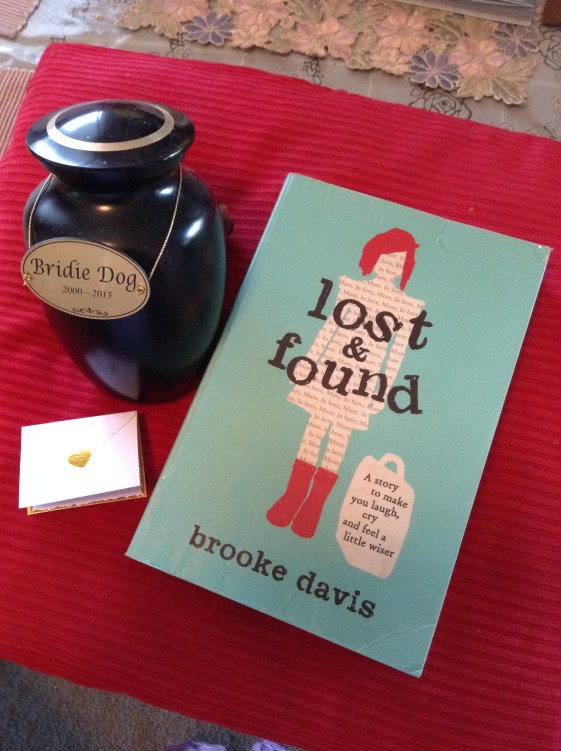
‘Lost and Found’ by Brooke Davis

IMG_3601
Millie

Millie knows that everything must die and keeps a record of assorted creatures in her Book Of Dead Things.  Sadly someone close to her becomes a dead thing too, which causes her mother to do something wrong.

Since Agatha’s husband died, she never leaves the house and shouts at people in the street as they walk by her window.  Until she sees Millie across the street.

Karl has lost his beloved wife and just moved into an aged care home.  He feels bereft as he watches his son leave.  Then he has a light-bulb moment and walks out in search of something.

All three are lost until they find each other and embark on a very unusual journey of discovery, reconciliation and acceptance.  A book with sadness, humour and eye-opening revelations as seven year old Millie Bird, eighty-two year old Agatha and eighty-seven year old Karl slowly but surely reveal what lies deep within their hearts.

Lost And Found is the debut novel of Australian author Brooke Davis which caused a literary sensation at the London Book Fair and sparked a bidding war overseas.  Davis, who suffered a deeply personal loss, said her ideas coalesced during a long train trip to Perth “A lot of the plot in my novel is based around that trip across the Nullarbor,” Davis said.  “The whole novel I think became a process of me trying to work through that loss.”

It is not written in the conventional manner, it does take a couple of pages to assimilate, but then this is half the book’s charm.  The funny bits are outrageous, the sorrowful times brought tears to my eyes especially reading about the older characters, and the outback backdrop is superb.  Millie is a delight throughout the road trip, a trip which is illogically undertaken yet surprisingly exciting.

The trio endure a bumpy ride but it comes out loud and clear that You Are Never Too Late and You Are Never Too Old.  I give it 5-star rating and hope you agree.

Gretchen Bernet-Ward

Emily Brontë Overview

Wuthering Heights Romance?

Yorkshire Country House 03
Homeward
I was a huge fan of the Brontë sisters, Emily, Anne and Charlotte.  Now I’m older, wiser and had a couple of love affairs, I see that their work, in particular Emily Brontë’s novel “Wuthering Heights”, reflects their own thwarted love lives.

Due to society, etiquette, the parsonage, limited opportunities for women in 1847, and through no fault of her own, Emily Brontë was greatly restricted when it came to writing about doomed male/female relationships.  To me, “Wuthering Heights” mirrors a lack of follow through, this inability to write a believable mental and physical connection between two people doesn’t come about because there’s no inherent knowledge behind it.  Although it could be argued that it’s a fictitious story, even in her sheltered life as a clergyman’s daughter, I think the themes of domestic upheaval, male aggression and marrying for prestige was something she may have encountered.  One man I almost felt sorry for in the novel is Edgar Linton, the second-best husband with good prospects.  To quote from Catherine “Whatever our souls are made of, his (Heathcliff) and mine are the same, and Linton’s is as different as a moonbeam from lightning or frost from fire.”

Nevertheless, I have re-read this novel and could just about smack the protagonists heads together and say “get real, guys!”  If I were Catherine I would have stayed well away from Heathcliff, walked off without a backward glance.  Either that or suggest he has counselling; obsessive and vengeful man that he is.  No, wait, they both needed counselling!  Catherine certainly had issues. She says of Heathcliff “I’d as soon put that little canary into the park on a winter’s day, as recommend you to bestow your heart on him!…He’s not a rough diamond, nor a pearl-containing oyster of a rustic; he’s a fierce, pitiless, wolfish man” but she doesn’t heed her own warning.  To add to the angst, her brother Hindley is a nasty fly-in-the-ointment with his uppity treatment of adopted Heathcliff.  Gotta have someone to abuse, hey Hindley, especially Heathcliff with his uncontrollable gypsy blood, right?

The sense-of-place is strong for me, dark, brooding Yorkshire, and I shiver when reading some of the almost poetic descriptions.  But from my viewpoint, to say Catherine and Heathcliff were passionately in love is overstating their affair when they caused each other so much misery.  Their families are destroyed and their agonising love does not redeem them in the end.  This novel is billed ‘romance’ but for me, from my modern perspective, it seems a turmoil of mixed emotions between two foolish individuals who should have known when to call it quits.

It’s a pity that Emily Brontë died young and this is the only book she wrote, published under the pseudonym of Ellis Bell.  Today we know that she could have elaborated and perhaps gone beyond the ill-fated Earnshaw family.

Yorkshire Country House 07
Dales

I want to rate “Wuthering Heights” highly but even allowing for the fact it was written in another time, another era, I can’t bring myself to go past three stars.  Don’t let me put you off, if you are into Gothic torment and unrequited love, this is the book for you!

Gretchen Bernet-Ward

Yorkshire Country House 02
Heights
Yorkshire Country House 08
Farm

Writer’s Self-Help

My Reading Tray 05
Afternoon Tea

Over the years I have read a handful of self-help books aimed at emerging authors, including the iconic Artist’s Way by Julia Cameron and famous memoir On Writing by Stephen King, but recently I came across these two quite diverse publications which really gave me a nudge in the right direction.

“Use Your Words” by Catherine Deveny 2016 published by Black Inc.
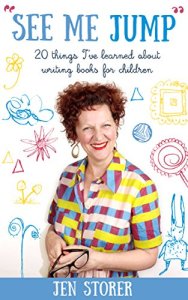
“See Me Jump” by Jen Storer 2016 published by Girl And Duck.

Catherine Deveny’s book is written in plain straight forward language, and she gets right to the heart of the matter.  There’s no place to hide once the momentum starts rolling.  Be warned, this book is for adults.  Catherine uses impolite language and bad manners to push you forward, sometimes against your will.  Then you see that glowing light at the end of the tunnel, er, book.  Well worth reading this boot-camp style book.

Jen Storer’s book is slim yet informative with small sketches dotted through the pages.  Her style is easy, encouraging, friendly and humorous.  It’s a book for adults but those with a yearning to write good books for children.  Note the chapter 4 heading “Don’t let adults fix your character’s problem” which is a must for kids literature.  Many of Jen’s sentences make memorable quotes, my favourite “Be brave. Don’t wait to create.”

Gretchen Bernet-Ward

Catherine Deveny Writer
Self-Help
Jen Storer Writer
KidLit

‘The Empty Beach’ by Peter Corris

Peter Corris Cliff Hardy Banner 01
Author Peter Corris

“The Empty Beach” is about private investigator Cliff Hardy’s routine investigation into a supposed drowning.  Beautiful client Marion Singer wants to find out the truth behind the mysterious disappearance of her wealthy husband John Singer.

The truth about John Singer, illegal trader and poker machine guru, is hard to find among the drug addicts, alcoholics and ashrams of Bondi Beach in Sydney NSW.  Not to mention the hindrance of PhD rich girl Ann Winter and creepy jailer Mary Mahoud.  Hardy soon finds himself fighting for his life when his search for the truth involves some nasty venues controlled by an underworld of violent people and lead by kingpin Freddy Ward who does not appreciate his inquisitive nature.

Being an earlier novel, Hardy is ex-army, a law student dropout, insurance company investigator turned private eye who lives by a solid set of values.  And he’s seen many gruesome murders in his time.  Throughout Hardy shows understanding and tolerance of people from all walks of life, he embraces the city sprawl and the rural ethos, and doesn’t start a fight.  But he can be tough and not play nice when it comes to his own survival.  He has a habit, when in a tight situation, of jesting at the bad guy’s expense and consequently coping a beating.  This is well illustrated in the chapter where Hardy is imprisoned inside a squash court.

Crime Scene Tape 08

My suggestion is read “The Dying Trade” the first Cliff Hardy book in Peter Corris 42-book series even though a later book “The Empty Beach” was made into an Australian movie in 1985 and remains his archetypal crime story.  Based on Peter Corris 1983 novel of the same name, this movie starred Bryan Brown as Cliff Hardy and such notables as Belinda Giblin, Ray Barrett, John Wood, Joss McWilliam and Nick Tate as the ill-fated Henneberry.

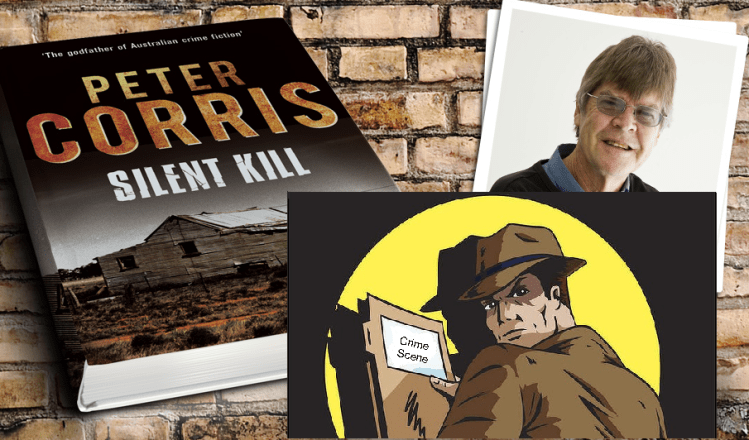
While you may like to read the more current books like “Silent Kill” (above) the earlier ones are classic Australia in the 80s and 90s and my favourite is “Wet Graves”.  They have changed with the times, think internet and iPhones, and contain physical changes to Cliff Hardy at the same time they happened to the author.  For example, smoking habits or the triple bypass heart surgery Peter Corris underwent and kindly passed on to Cliff Hardy.  The relationship breakdowns do not appear to apply too much to real life.  Corris didn’t pass on his diabetes, however, the easy-going narrative speaks volumes, both men having a genuine affection for their family, the city of Sydney, and its diverse citizenry.

Now I’ve got that out of the way, let me say that one of the most enduring (and for me, best loved) of Australian crime fiction characters is Cliff Hardy.

Fast forward to future ‘Spoilers’ and Hardy is deregistered and operates on his own initiative but still maintains a rock-solid sense of fair play in the 21st century.  To date, Hardy’s longtime friend Frank Parker is now a retired senior police officer and married to Hilde, Hardy’s ex flatmate.  The reader watches this friendship evolve through a chain of novels and it’s just as interesting as following Hardy’s love life and family expansion.  Although he still holds a torch for his late ex-wife Cyn, there’s even grandchildren.  And there’s cameos from characters like tattooist Primo Tomasetti with his graphic artwork and sleazy patter.

Cliff Hardy represents the kind of bloke many law-abiding citizens would like to have on their side, a blemish yet dependable man who’d share a joke or reminisce over a cold beverage.  When it comes to Aussie mystery solving, Hardy gets my vote every time.

Gretchen Bernet-Ward

POSTSCRIPT:  Peter Corris, journalist, historian and author of the best-selling Cliff Hardy detective series, died on 30 August 2018, aged 76.  Over 37 years, from 1980 to 2017, Corris wrote 42 Cliff Hardy novels making it the longest running series in Australia.  The final installment is titled ‘Win, Lose or Draw’.

Cliff Hardy booklist https://www.allenandunwin.com/authors/c/peter-corris
Author website http://www.petercorris.net/petercorris.net/Home.html

Empty Beach
Beachside – Vale Corris and Hardy.

Audition Time

Pandanus Palms Psychiatric Clinic 01
Luxury

“It’s like a luxury hotel in here,” said Penny to Cleo, who was draped across a chair in the lounge room of Pandanus Palms psychiatric hospital, a pink hibiscus tucked behind her ear.  They were discussing the merits of combining tropical plants and plush furniture with the plastic chandelier.
“It’s done on movie sets to create an illusion of opulence,” said Cleo.  She sat up and stretched her arms.  She gave a yelp.  “That new guy Tom grabbed me too hard in the final scene last night.”
Penny knew Tom.  “I’m sure he didn’t mean to,” she said.
Cleo surveyed the bruises on her arms.  She noticed marks on her wrists.  “The make-up people forgot to remove my scars.”
Penny was going to change the subject but fortunately Cleo yawned.
“You’re getting tired, dear.” Penny began to gather her things. “I’d better go.”
Cleo rubbed her eyes and blinked rapidly.  “Did you see him?”
Penny spun around but there was no-one else in the room.  The air was still and heavy with the perfume from a flowering orchid.  “Who?”
“The producer.  He looked in the window.” Cleo sat stiffly in the chair, staring at the window like an unblinking cat.
Penny readied herself for an outburst.  “I’ll buzz for the––” she began.
Suddenly Cleo jumped up and ran to the window.
“I won’t go back into his hell-hole of a studio.”  She tugged frantically at the heavy, brocade curtains.  Once closed, the dimness appeared to satisfy her but she paced up and down with clenched fists.  “He was checking the spot where the stunt man fell.  They don’t know why he toppled out the window.  It wasn’t in the rehearsal script.”
She went to the curtains and peeked out.  “Thank God, he’s gone.”
Penny leaned over and pushed the nurse’s call buzzer.
     “You can buzz all you want, the waiter service is atrocious,” said Cleo.  “When they do come, they hold you down and force you to eat.”
She started to twirl around the room, knocking into furniture.
Her medication is wearing off fast, thought Penny.  She felt unsafe.  “Stop it!” she shouted.
Cleo sat down on the floor, a dazed look on her face.  “It’s dark in here,” she said, wrapping her arms around her ribcage.  “This is what that lady in the buckled up jacket does.”
Penny went to the window and opened the curtains.  Summer sunlight flooded back into the room.  Cleo winced.  “That spotlight is too bright.”
“I’ll tell the lighting technician,” Penny said.  She hurried from the room and saw that the long white hallway was empty.  The staff must be at the press conference, she thought.
After straightening a painting with shaking fingers, Penny had an idea and returned to the lounge room.
“The director says the cast can take a break,” she told Cleo.
“About time.  Scene after scene and none of them mine.  I’m freezing my butt off waiting for my audition cue and it never comes.  Boredom and suicide are the same thing.”  Cleo again paced the floor.
Penny recognised the first signs of her hourly ritual. Cleo went through the motions of taking an imaginary cigarette from its packet, putting it in her mouth and lighting it. With a noise of disgust, she tossed the cigarette on the carpet.  Quickly, she stamped it out. “Have to save oxygen,” she said. “The door shouldn’t be closed.  It’s the stunt man’s idea. ‘Get off me,’ I tell him. He knows I don’t like small spaces.  The door is made of steel. Hey, HEY, can anyone hear me? This isn’t funny, guys. The sound of nothing is pressing into my ear drums. The silence will squash my head. Let me OUT!”
Penny made cutting actions with her finger across her throat.  “The cameras have stopped rolling.”
“I need warm soup,” said Cleo, her teeth chattering.  “Where’s the c-catering van?”
“Think about something else, dear,” Penny said, hoping a nurse was on the way.
“Remember when you were little?  You said if something went wrong, you’d make-believe.  It’s fun to pretend you’re another person.  You can be anything you set your mind to.”
“That box room was too strong, it over-powered my mind.”  Tears started to form in Cleo’s eyes.  “I didn’t want to play a dead person.  The box was trying to kill off my character––it wanted to be my coffin.”
“You lasted a lot longer than most people would, given the circumstances.”  Penny lead Cleo to a couch and sat with her, gently smoothing her hair.  After awhile, two people entered the room, Cleo’s doctor and a new clinical nurse.  Penny surreptitiously made the sign of the cross.
The nurse checked Cleo’s pulse then injected her in the middle of a bruise on her upper arm.  Cleo pulled back, slowly rubbing her skin.  “More pain.”
The nurse pointed to a bluish lesion and said, “I hope you gave as good as you got.”
“One of my better performances,” said Cleo, tossing her head.
With a weak smile, the doctor said, “Ready to meet your fans, Cleo?”
“No.”  Cleo turned her back and toyed with a palm frond.
They coaxed her into leaving the room and walked down several corridors until they reached an unmarked door.  When it was opened, Penny hugged Cleo and left.  She hated to watch that door close and wanted to be out of earshot before it slammed.
In the foyer of the hospital, Penny wondered how far she should carry Cleo’s delusion.  The hospital portico was swarming with staff and media representatives.
With one hand on her heart and the other on the door handle, Penny opened the front door.
A reporter pounced.
“What happened on the set of Cleo’s new movie?”
Before Penny could reply, Tom, the psychiatric nurse, ran over and grabbed her arm.
“Come with me, Penelope,” he said.  “It’s time for your medication.”

Gretchen Bernet-Ward
 

AUTHOR NOTES:

  1.  Cleo is a mentally disturbed woman. She talks in riddles and,
     due to an apparently traumatic event on a movie set, she cannot
    separate fact from fiction.  She confuses the Pandanus Palms
    psychiatric hospital with a film location.  We are lead to believe she
    has once tried suicide and that the stunt man may have caused her
    latest breakdown.
  2.  Penny has “adopted” Cleo and calls her “dear”. She cares about
    her and understanding her moods but is not able to help in a positive
    way.  She has her own set of unseen demons.
  3.  Tom is a bit player with an important part. Did he cause the bruising
     on Cleo’s arms?
  4.  The setting is a room with lavish décor but Cleo becomes cold and
    hungry.  Is she reliving an incident or just acting the part?
  5.  Is the box a padded cell or a prop gone wrong?
  6.  Does Cleo see the truth wrapped up in theatrical guise?  Is she driven
    by revenge to murder?  When the “reveal” comes at the end, can we
    guess at what was truth and what was the swirling of a delusional
    mind, aided and abetted by Penny.              

One Book at a Time?

I read three books at a time …

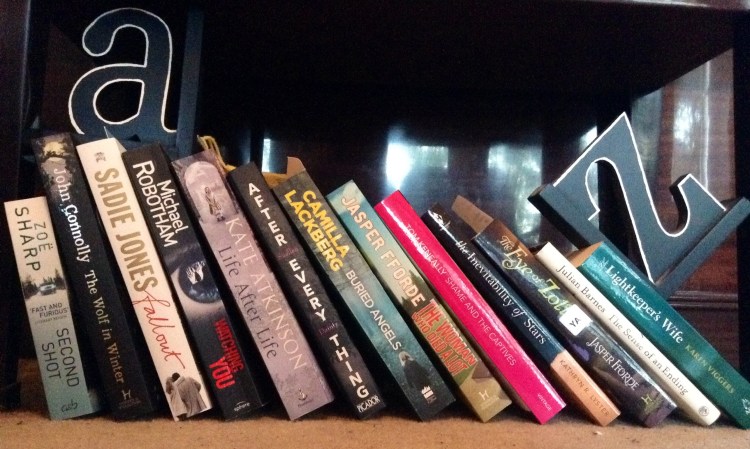
Books A-Z
Book Slide

My books are almost in every room.  All genres and categories, all shapes and sizes, new and old, popular and obscure, loved, liked and even loathed.  I will refer to them, quote them, yet perhaps not always re-read them.  I prefer the next book, the next Great Read, something new to me but not necessarily a blockbusting bestseller.

As mentioned, I read about three books at a time, not to show off, but to suit my mood during the day.  The books can be in any format, paper, ebook, large print, audio as long as it holds my attention, sparks my imagination, gets me interested or teaches me something new.  I’ve been through my non-fiction period, my classics epoch, my intellectual stage, my steampunk phase, my romance jaunt and different levels of humour, while dabbling in between with things like sci-fi fantasy and horror, but I keep coming back to perennial crime fiction.

For me, the ‘must have’ is a good strong lead character, someone I want to know about, someone I want to tag along with throughout the day, or night.  On the weekend I read in the garden under the palms with a cool drink but mainly I read at night.  A good crime novel can be detrimental to my sleep!  Apart from a nicely twisted plot, the characters are who I care about the most.  Currently my favourite murder mysteries are written by Australian and British authors.

While I enjoy writing reviews, my ego is under no illusions that anyone would find my reviews earth-shattering or even interesting.  It’s a hobby for me and my suggestion to you, dear reader, is that you should make up your own mind on any book.  Blurb can be misleading!  It would be nice to see more conflicting, controversial reviews and posts by readers who are not looking over their shoulders at freebies/writers/publishers/fans or the next thumbs up.

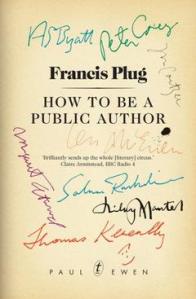
I recommend books I’ve liked and occasionally pan those I’ve disliked.  My thoughts may differ from yours so if you have never written a review, why not give it a go?  Write a couple of paragraphs and see if it deepens your appreciation of the book.  My thoughts lead me to writing down the key words and hey-presto.  Get along to book launches and author signings for insider information.  And grab a copy of “Francis Plug: How to Be a Public Author” by Paul Ewen.  Kooky, hilarious and factual, it delves into the fan/author relationship with real consequences.

Francis Plug How To Be A Public Author

NOTE:  Reading three books simultaneously for maximum brain gymnastics means, for example, one on public transport, another in a lunch break, and a third at bedtime.  Happy reading!

Gretchen Bernet-Ward


Jasper Fforde Ffun

Fforde Ffotos 012
Book Series

As a dyed-in-the-wool Jasper Fforde ffan, I recommend Shades Of Grey.  No, not that one!

Shades Of Grey deviates from Fforde’s brilliantly off-kilter, zany other-Britain adventures of Thursday Next, a LiteraTech operative for SpecOps-27, a crime fighting division inside literary fiction – literally – but there is some serious world building going on.  The Fforde trademark of inventiveness and unusual plot twists is there but the tone is sombre, the protagonist Eddie Russett lives in a tightly controlled world with a rigid hierarchy based on primary colours.  However, Eddie is not stupid and rises to the challenge of solving a perplexing mystery with the aid of some ‘colourful’ locals and a feisty Grey woman, Jane.

I have to say it is not my all-time favourite book in Fforde’s repertoire: Thursday Next wins.  I found the ending unsatisfying (except discovering where spoons go) although I do think it has been left open for a sequel.  If you’ve read the odd humour of Douglas Adams or inimitable Terry Pratchett and want a neo-noir version, try Jasper Fforde for ffun.  There’s enough books to keep you going!

Fforde has also written humorous Nursery Crimes series, and The Last Dragonslayer series about teenager Jennifer Strange.  Her agency, Kazam, employs weird and wonderful wizards who create magic and mayhem.

Check the website Grand Central http://www.jasperfforde.com/

Gretchen Bernet-Ward

Thursday Next Camoflage 001
LibCamo
Thursday Next SpecOps-27
Fangirl
Jasper Fforde Dodo 002
Pickwick Dodo

NEWS FLASH JASPER FFORDE WILL BE IN BRISBANE AUSTRALIA FOR BRISBANE WRITERS FESTIVAL, SOUTH BANK, FROM THURSDAY 5 SEPT TO SUNDAY 8 SEPT 2019.
https://bwf.org.au/2019/brisbane-writers-festival/artists/jasper-fforde-1

Jasper Fforde itinerary will be:

Event 1 – Workshop ‘Writing Futures’ with Jasper Fforde at QWC: Learning Centre, State Library of Queensland.

Event 2 – ‘Dream Worlds’ Panel at Cinema B, Gallery of Modern Art, South Bank.

Event 3 – Conversation ‘Early Riser’ at The Edge, State Library of Queensland.

Event 4 –  Book Club ‘Meet Jasper Fforde’ River Decks, State Library of Queensland.

Event 5 –  Lecture / Special Closing Address by Jasper Fforde, The Edge, State Library of Queensland.


Jasper Fforde at Brisbane Writers Festival Sept 2019

‘My Name is Lucy Barton’ by Elizabeth Strout

Mother Daughter
Mother and Daughter

Hmm . . . a puzzling book.  Good, then it dissolves into vignettes.

It is a book which sometimes comes back to me in flashes.  I didn’t love it but I didn’t hate it.

Lucy has an extended stay in hospital.  I found the mother-daughter part of the story made me think.  We all relate to our own personal experiences and I definitely got twinges when I related my mother’s attitude to Lucy’s mother – although my relationship was different.  I didn’t like her father, troubled but not nice.

Much of Lucy’s early family life came out in tiny bits here and there.  The trickle affect showed the reader the cruel hardship of her earlier life. Is that why Lucy was estranged?  Why was she locked in the old car?

It was interesting how Lucy loved her kind doctor, she got no real love or compassion from her father or her husband.  The author Sarah Payne was a great character, I wish she had been fleshed out a bit more.  I liked her comment after that cutting PTSD remark “…And anyone who uses their training to put someone down that way – well, that person is just a big old piece of crap.”

After Lucy came out of hospital, the story took on the quality of snapshots as though author Elizabeth Strout saw or heard something and jotted it down then couldn’t quite flesh it out but wanted to use it anyway.  There are very human insights but we don’t even know what Lucy wrote in her books.

Lucy’s relationship with her grown-up daughters was rather superficial but I liked the unnerving chapter about her brother, and also when she is bothered by the fact that friend Jeremy may have been the dying AIDS patient she saw in hospital.

The marble statue of Ugolino and His Sons by Jean-Baptiste Carpeaux in the Metropolitan Museum of Art fascinated Lucy but I couldn’t understand why.  It’s graphic but to me just shows the agony of imprisonment.

Overall, I guess I’d give this book three out of five stars because I’m not poetic enough to read between the lines!

Gretchen Bernet-Ward

Ugolino and Sons Statue NYC
Ugolino and His Sons