My Elusive Career as an Aspiring Writer

Attention span of a puppy? Pushed for time? “Publishing is a long game. As they say, you have to be a stayer if you want to be a player. Even if your book is only 500 words!” said Jen Storer, children’s author and chief inspirationalist at Girl & Duck.com when discussing the pitted path to publishing.  I intended writing a three-part posting on my literary travails but here they are in one glorious chunk.

Kids Storytime 02
PROLOGUE After reading countless children’s picture books for Storytime in a public library, it became obvious to me what worked and what didn’t with a live audience. I thought it was about time I tried to write my own children’s book.

WARNING – THIS IS A LONG BLOG POST WHICH RAMBLES OVER EIGHTEEN MONTHS OF MY WRITING LIFE – CAFFEINATED BEVERAGE RECOMMENDED.


CHAPTER ONE The Plan. Work up slowly with a picture book maximum of 500 words for age 0-5, step into small chapter books for age 6-8 with 20,000 words, graduate to a decent sized book of 25,000 for teenagers then launch myself into young adult. Well, perhaps not young adult, could get a bit messy in the emotions department. Hopefully, maybe, I could consider penning a series. Something humorous and fun, with a good plot and memorable characters. An attention-grabbing theme, a zany bookcover and before you can say Harry Potter, I’m flying high, riding the wave of published author!

Er, right.  The truth of the matter is that I knew full well I had no experience.  Career shattered before it began?IMG_20170531_184235

In steps the many writer’s workshops and online courses available to the newbie.  Or as they say in the trade “emerging author”.  Plus a local writer’s club SWWQ, State writers centre, Facebook groups and a conference or two.  (List of website links at end of page). Not forgetting the self-help books – anyone who’s ever written a book and had it published with moderate success seems to qualify as an adviser on the subject of literary rules. The do’s and don’ts, the routines, the voice, the need for originality, the best way to grab an editor’s attention, grammar, plot structure, plotter or pantser, show don’t tell, how to sell yourself, and the list goes on.

CHAPTER TWO First up, I enrolled in an expensive online course which certainly got me motivated but not by the moderator or the tutor. The other participants were withdrawn and really didn’t share. And the course notes were a little outdated. Yes, I know “Where The Wild Things Are” is a classic but hundreds of good, if not better, books have been published since then, with far more appeal. And I don’t really like the artwork.

Ah, artwork. You can write the words for a picture book but you can’t have it illustrated by an artist of your choosing. The publisher does that. And we all know we have different ideas when it comes to imagination and imagery. If you write and illustrate your own picture book, it has to be of exceptional standard. I can do pen and pencil drawings but they wouldn’t cut it. I’m much better with basic colour-in stuff. Which doesn’t sell.

Click link Saving

Tree Without Leaves 09

Grandpa’s Tree

Then came the face-to-face classroom workshops which were fun. Lots of buzzing people with buzzing ideas and questions. Isn’t it surprising that when it comes to reading out your own work, people clam up? Not me. I always read out my stuff and one story was later fleshed out into a decent read “Saving Grandpa’s Tree”. However, it hasn’t attracted anyone’s attention yet.

CHAPTER THREE The big thing among creatives is to attend a yearly conference or festival in another State, necessitating a weekend away. I think a conference is meant to be more serious than a festival with serious lectures, serious note-taking and serious editor appraisals.  I have a small green notebook riddled with notes. A festival has all manner of literary people chatting on stage, with microphone feedback, showing wonky PowerPoint slides, supplemented with drinks and nibbles and a lot of networking.

Daily Things Egg Bookmarks Kookaburra (3)
Just like anywhere else, unless you are seen as someone who has “made it” you are not worthy of a business card exchange. And bookmarks, phew, I could wallpaper my room with all the industry bookmarks floating around.
 

IMG_20171228_193003

At these displays of verbose literary knowledge (excluding The Duck Pond – see below) I always wear my name badge. Nobody remembers my name and I don’t remember theirs but we compare notes, likes and dislikes and complain about the way the event is organised and the length of the queues. Usually the food tastes as good as it looks.  Of course, the better the quality, the quicker the goodies are consumed. Never cram your mouth because someone will ask you a question, and never spill anything down your front because you will be asked to step up the front to speak.

I’m going to pen a small piece on the Judith Rossell weekend writers retreat I attended at historic Abbotsford Convent in Melbourne, Victoria.  Amazing vibe!  We don’t have many older buildings in Brisbane with such history.  I have organised, promoted and hosted author talks and, believe me, not all are created equal.  Will save that story for another time.

CHAPTER FOUR For well over a year, I submitted children’s picture book manuscripts to a myriad of publishers in Australia and overseas and have received only two rejections. I think the silence is worse than those two polite rejection letters. Surely, in this day and age, it wouldn’t take two seconds for the office junior to email a rejection to the poor, desperate writer at the other end.

RequiremeManuscripts.nts Of Submission occasionally want physical copies and I’ve gone the old A4 paper route, Times New Roman (no glitter in the envelope, big no-no) with clean easy-to-read layout and still not heard a word. Does that mean I’m no good or the publishing houses are totally swamped? Harking back to that office junior, who didn’t send me an email, I could get bitter. They are the first readers of unsolicited manuscripts which forces me to cry “What do they know? My literary reading is decades ahead of theirs.” Sadly, they know the trends. A new writer cannot predict trends. Nor can they single-handedly make them.

The scariest thing I’ve done (apart from hosting an avant-garde Shakespeare theatre troupe and judging a YA writing competition) was Literary Speed Dating; five minutes of torture in which you have to sell yourself and your manuscript.  A bell rings and, if you haven’t collapsed, you go to the next editor’s table.  And the next...and the next...A woman in my queue was eight months pregnant and the summer heat was ferocious but she coped better than all of us.  A book contract?  I hope the others were successful.  At least that woman has a baby now.

CHAPTER FIVE After becoming thoroughly disenchanted with the children’s book industry, I started up my own WordPress blog and thought “I’ll just do what I like and if anyone notices, that’s okay” but I didn’t hold my breath. Prepare to be amazed – 409 million people view more than 20.8 billion pages each month on WordPress, and users produce about 77.0 million new posts and 42.7 million new comments each month, an estimation of six new WordPress.com posts every second. Those stats have probably changed while I type, but it’s still a shedload of competition. It takes a lot to shine. Who’s going to read me and my miscellaneous Blogging Image 04ramblings? Recently I had 385 Followers but I culled the spammers and that number dropped back drastically.

I’ve discovered that personal stuff gets the most hits but specialising is not my thing.  Although I blog about many things, I still like the idea of kidlit. Notice that term? I’m getting good with the industry terms. Copy edit, structural edit, narrative arc, protagonist, antagonist … I subscribe to the newsletters of publishers, book stores, State organisations, libraries, writing groups, children’s literary charities and other book-reading bloggers like Paula Bardell-Hedley (see below). So far, I’ve come across a lot of WordPress book reviewers and enjoy their commentary. Personal opinion is a great thing, just not something I always agree with when it comes to books. Honesty compels me to admit that my leisure reading is not nursery rhymes, it’s a good crime novel.

CHAPTER SIX In between life, I volunteer at special events and displays at State Library and offer my free time closer to home in a charity shop bookroom. What an eye opener! Certainly a book for every customer, young or old; and quite a mixture of clientele. The shelves are browsed with all the fervent devotion of a high-end bookstore in the city. Without the price tag. And a few bent bookcovers and rusty pages thrown in. Behind the scenes, the staff are just as interesting. Again, will save that story for another time.

“But what of your picture book career?” Glad you asked. Confession time. Deep down my literary urge begins to lean towards writing for adults BUT I join Creative Kids Tales, an online group for emerging authors which specialises in children’s literature.  By this time I was doubtful that this was my true calling (after all, one can only take so many unsent rejection letters) and was oscillating between adult works and the perfect kids book.  I hung in there.

Truly Tan BooksEach month CKT features a different aspiring writer with a successfully published author. One author captured my imagination, Jen Storer of Girl & Duck.com An Enid Blyton lover, Jen shows an intelligent, vibrant nature, an honest, straight forward approach to writing and I like her children’s books, especially Truly Tan series.  Jen was starting a Facebook group The Duck Pond, inviting kidlit creatives to join, and the rest is magic.

CHAPTER SEVEN I’m pretty much a founding member of The Duck Pond and recently their creatives group Scribbles was added which I also joined. Membership grows weekly, and Jen does weekly Q&Q (questions and quacks) videos on YouTube. Apart from sudden Facebook drop-ins on screen, Jen does one-hour Scribbles Live Rounds and members tune in from around the world. Kidlit help is always at hand and the expertise of members is far-reaching.  The slogan “The rule is there are no rules” is true to its word. Jen says “Do the verk”.  Immersion is the only way and I’ve learned so much about writing books and the book industry generally.
Scribbles Live Round Participant 2018

An author/illustrator, Jen Storer believes is having fun and being messy, “Mess creates clarity”. The Scribblers course is for writers and illustrators and it encourages everyone to work without restrictions.  Quell that inner critic!  There are set Modules with exercises which you do at your own pace but following the easy guidelines so that your words just flow. I’ve experienced writing freely and unfettered and being surprised and pleased with the results. Honestly, with Jen’s prompts, I’ve had so many ideas I could be writing for years. Of course, submitting a manuscript isn’t messy, it has to be refined and polished. Jen is ex-publishing house so she know those ropes.

Now, the cruncher. I adore The Duck Pond group camaraderie and "doing the verk" but I am not a fan of the circus called Facebook. Nor do I participate in other social media like Twitter, Google, Instagram, etc. “Click this, view that, Like page” get lost. In a short space of time I have witnessed two great bloggers over-extend themselves to the detriment of their output.  I like to think I am not spreading myself too thinly!

CHAPTER EIGHT I’m loving my WordPress blog, the layout, the posts, changing photos, the full control I have over my content. Which reminds me, in the past I have submitted reviews and editorials to organisations who have edited or altered my work without my prior consent, which is apparently their prerogative, but that doesn’t mean I have to like it. I don’t – especially when they muck up a sentence to make it shorter or change paragraphing. So, dear reader, this leaves me in literary limbo.

Star Twinkle Twinkle 01CONGRATULATIONS – IF YOU REACHED THIS POINT WITHOUT SKIPPING BITS.

What is next in my literary journey? Will I shine? Over 18 months, and varying lengths of commitment, I have happily entered writing competitions (two Third Place awards and shortlisted) and completed a magazine writers course, travel writing course, children’s writing, crime writing, romance writers workshop, non-fiction-fest, lampooned the Australian publishing industry, and still don’t know what genre I want to pursue. I know it’s too late to become a ‘proper’ writer, contrary to what dear Jen Storer says in her passionate YouTube video A Slap Down For An Ageist Society I think I have missed the boat. I am passed my publishable prime. It’s no good lamenting the fact that I represent Gustav Freytag’s five-part story structure. I had a younger life to live and it didn’t include lonely, lengthy periods sitting at a keyboard. It does now.

EPILOGUE Sure, I can happily write to my heart’s content but who’s interested? Don’t answer that, please. Suffice to say I will dabble, making my miscellaneous Thoughts Become Words for my own pleasure because I can’t stop writing. Basically, that’s what it all boils down to, in the end we are doing it for ourselves. If someone else likes it, that’s a hefty bonus.

Gretchen Bernet-Ward


Paula Bardell-Hedley WP Book Blogger IN APPRECIATION – This post is dedicated to WordPress blogger Paula Bardell-Hedley for her great reviews, ideas, encouragement and super organisational skills
https://bookjotter.com/
https://thoughtsbecomewords.com/2018/04/02/dhq-dewithon19/
and I get a mention in Winding Up
https://bookjotter.com/2018/04/06/winding-up-the-week-13/


RELEVANT GROUPS AND ORGANISATIONS:
CKT https://www.creativekidstales.com.au/
AWC https://www.writerscentre.com.au/
QWC https://qldwriters.org.au/
BCC https://www.brisbane.qld.gov.au/facilities-recreation/libraries/opening-hours-locations/brisbane-square-library
CYA http://www.cyaconference.com/
KLV http://www.kidlitvic.com/
ILF https://www.indigenousliteracyfoundation.org.au/
SD https://www.storydogs.org.au/
FF https://www.fantasticfiction.com/
BWF http://uplit.com.au/
G&D https://girlandduck.com/
A&U https://www.allenandunwin.com/being-a-writer/getting-published/advice-from-a-publisher
SWWQ http://womenwritersqld.org.au/


Assassin and the Actress ‘Reckoning: A Memoir’

A highly charged and deeply honest memoir, ‘Reckoning’ combines research into the life of assassin and Polish World War II survivor Zbigniew Szubanski , father of Australian actress Magda Szubanski, and Magda herself as she struggles to come to terms with her father’s legacy and forge her own career within the world of television and movies.  This absorbing, eloquently written book contains remarkable revelations of wartime espionage, emotional family ties and facing the truth, and I was enthralled to the very last page.

First published in 2016, ‘Reckoning’ is Magda’s debut novel, and courageously written.  I must admit my initial thoughts were ‘Wow, she’s brave putting that in writing’ but it made me love this book even more.  Definitely a five-star read!  Magda relates one of those true stories from childhood to adulthood which hits the right cord with just about everyone.  We’ve had similar feelings and domestic issues and career changes and sexuality debates and, yes, sadly, the father we got to understand a little too late.

‘Reckoning’ has gone on to bigger things but here’s the first results:
Winner Nielsen BookData Booksellers Choice Award, 2016
Winner Book of the Year, Australian Book Industry Awards, 2016
Winner Biography of the Year, Australian Book Industry Awards, 2016
Winner Douglas Stewart Prize for Non-Fiction, NSW Premier’s Literary Awards, 2016
Winner Indie Award for Non-Fiction, 2016
Winner Victorian Community History Award Judges’ Special Prize, 2016
Shortlisted Matt Richell Award for New Writer of the Year, Australian Book Industry Awards, 2016
Shortlisted Dobbie Literary Award, 2016
Shortlisted National Biography Award, 2016

Website https://www.textpublishing.com.au/books/reckoning
Twitter https://twitter.com/magdaszubanski

ABOUT THE AUTHOR
Magda Szubanski is one of Australia’s best known comedy performers.  She lives in Melbourne and began her career in university revues before writing and appearing in a number of comedy shows.  Magda created the iconic character of Sharon Strzelecki in ABC-TV series ‘Kath and Kim’.  She performs in theatre productions and has acted in movies – notably ‘Babe’ and ‘Babe Pig in the City’ – and currently ‘Three Summers’ directed by Ben Elton and ‘The BBQ’ directed by Stephen Amis.

Gretchen Bernet-Ward

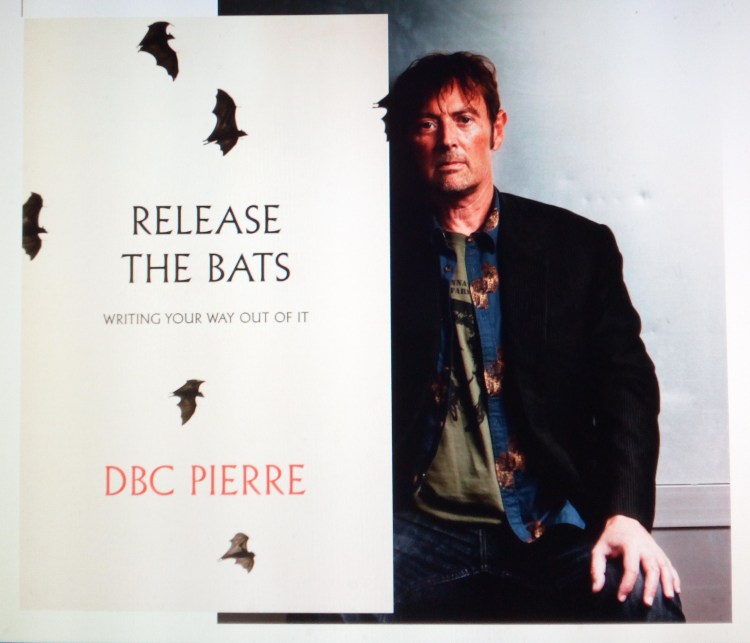
DBC Pierre Writes at Feverpitch

DBC Pierre Photo Montage 02
Photograph of novelist DBC Pierre by Murdo MacLeod for The Guardian.

“I wrote 300 pages in five weeks,” says novelist DBC Pierre, who made his debut with Vernon God Little, a Booker Prize winner, and delivers writing guidance in his contemporary work Release the Bats.

I enjoyed his gutsy and wildly perceptive advice which perhaps appeals to a ‘pantser’ style of writing rather than a ‘plotter’ but the quotable gems will stick with me.  Wisdom with a 21st century twist and language to match.

“A few pages into writing and find yourself drowning, as I did.”  DBC Pierre.

“When I started to write,” says self-confessed bad boy DBC Pierre in The Guardian interview, “I wasn’t particularly well-read, but I found two things critical. Together they can turn a pile of thoughts into a novel, in case you’re at a loose end next weekend, or are in prison. They’re also helpful if you’ve swum a few pages into writing and find yourself drowning, as I did.”

“The first might seem stupid but I actually found it the main hitch in getting words down and ‘letting rip’, ‘sticking with it’, and all that noble stuff we’re supposed to do. ‘The responsibility of awful writing’ was Hemingway’s twist on his own phrase ‘the awful responsibility of writing’. As the man who also said ‘first drafts are shit’, he pointed to a truth: if the key to finishing a novel is sticking with it, then the main challenge is to face writing crap.”

DBC Pierre Vernon God Little Bookcover

“All I liked after writing the first page of Vernon God Little was the voice. It had things to say about everything. I could feel it wanting to say them. But I went on to write 300 pages that didn’t make a book. I wrote them in five weeks, in a fever, without looking back. And at the end, I still liked the voice – but it hadn’t really said anything. Or rather, it had said plenty but nothing else had really happened. I soon found advantages to having done it that way.”

“Even writing 50 pages of crap gives a sense of achievement.”  DBC Pierre. 

“For one thing, I would usually find it hard to move on to page two if I didn’t like page one. I bet you could wallpaper the planet with books that never got to page two. And it’s a circular trap, in that some of the energy you need to forge ahead and push your page count up is generated by forging ahead and pushing your page count up. Even crap gives a sense of achievement when you get to 10, 20, 50 pages of it. When you don’t get past page one, you lose the spur. After that, the thing spirals into bad feeling and dies while you check email.”

“Half the problem is the expectation that we’ll see finished writing at once, more or less in its place. But I wouldn’t have written what I wrote if I’d thought about structure and form at the time. Obviously, if we’re writing about a boy going to the river, we make him go to the river. I don’t mean write without an idea – just that better ideas will come later. They attract each other and grow. We write crap in the meantime. It can work like a compost.”

“If you watch a dieter breaking their diet, you’ll see that they gobble things before they can stop themselves, before the internal arguments, before the shame. Guiltily and fast: that’s how to approach a first draft. A free writer is not something you are, but a place you can go. To start that climb: speed. Don’t look down. Keep a note of your page or word count, watch it grow like an investment. Amp yourself up. When we do things this way, a phenomenon comes to bear that justifies our approach: art. Some of what we write will crystallise for reasons we can’t explain, and the story comes into a life of its own.”

“If the job gets boring, loosen up…throw in a new character.”  DBC Pierre.

“Eventually, take that feverish pile, bravely or drunk, and read it back. Get over the cringing and find a glimmer, see what sentence or idea intrigues or excites you. Start from there and build out. If the job gets boring, loosen up, take a tangent, throw in a new character. In this process, the work begins to show itself. We show ourselves. When gems have grown into paragraphs, paragraphs into pages, look again. Find the part that works best and lift the rest up to it. This is how it climbs, by following what pleases us most.”

“We can’t compete with Shakespeare or Hemingway, nor should we try. Our particular feeling is all we can bring to this party, and our whole job should be to wrestle it into a story that works for us alone. After that we can dress it for others to read. A different job entirely. Save that for a strong coffee on a Monday.”

One of three different interviews by Chris Wiegand, Dave Simpson and Homa Khaleeli.  Wed 22 Feb 2017 06.00 AEDT “Culture” The Guardian newspaper.
https://www.theguardian.com/culture/2017/feb/21/frank-turner-dbc-pierre-creative-industry-advice
Heading : So You Want To Be An Artist? Then Let The Pros Show You How It’s Done.

You can also read my book review of Breakfast With The Borgias by DBC Pierre.

Gretchen Bernet-Ward

Goodbye to Facebook Again

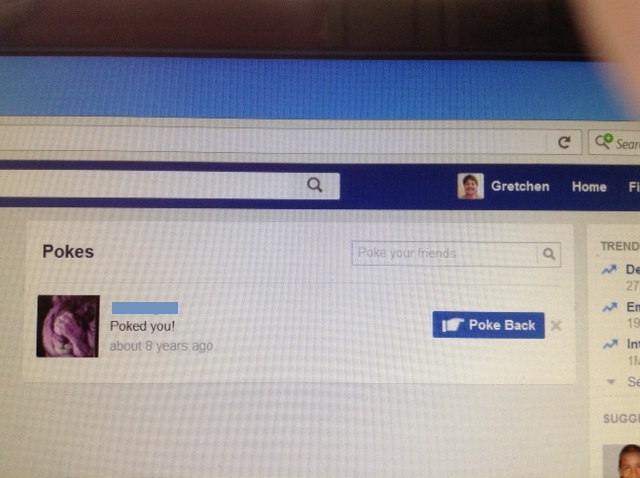
Facebook Poke 02

After taking one year off to immerse myself in the art of writing, my time is up.

New Year’s resolution: I will no longer be posting regularly on Facebook because it is the most all-consuming part of my day and ultimately hollow.  Eight years ago I dropped out, as evidenced by the snapshot of this unanswered Poke.  Author Jen Storer of Girl & Duck, The Duck Pond and Scribbles creative groups can be pleased she was the one who drew me back into social media to nurture my writing dream – you light up my life – thank you.

My unFacebooking is not due in any way to the calibre and overall enjoyment of the wonderful ‘friends’ I made, I will miss virtually following your daily journeys in writing and illustration.  Conversely, we all are living two lives, the one on Facebook and the real one.

My departure is due to the links, Likes, highlights, comments, feeds, Facebook layout and general entanglements with people whom I do not know on a real level.  It may feel personal but it is not; and I need to grasp reality, my home, my family and my proper writing.

A visit from a little red hen named Took got me back out into our overgrown garden and I realised the computer screen is destroying my creativity rather than enhancing it.

My WordPress blog will continue https://thoughtsbecomewords.com/

“Year’s end is neither an end nor a beginning but a going on, with all the wisdom that experience can instil in us” – Hal Borland, American author.

Happy New Year 2018, everyone, and much fulfillment!

Gretchen Bernet-Ward


Postscript
: According to the 2017 Deloitte Media Consumer Survey, daily social media usage in Australia is down from 61 percent to 59 percent in 2017, and 20 percent of Australian social media users say they are no longer enjoying their time on the platforms.  Likewise, almost one third (31 percent) of survey respondents said they have temporarily or permanently deactivated one or more of their social media accounts in the past year.  Fake news is killing the media star with 58 percent of respondents agreeing that they have changed the way they access online content given the prevalence of fake news.  So, folks, I am not alone!

Proof-reading Style Errors

IMG_20171225_204232
Breaking the proof-reading rules?

The style guide reads: Below are errors in style due to inappropriate or poor choices of language which can lead to boring, imprecise and inaccurate writing. In some situations, they may be relevant and suitable, but they are usually best avoided––

  • Clichés, over-used phrases, e.g. bed of roses, pretty as a picture.
  • Vogue words and trendy expressions, e.g. proactive, meaningful dialogue.
  • Colloquialisms in formal writing.
  • Parochialism in documents intended for a wide audience.
  • Jargon in documents intended for a general audience.
  • Euphemisms, e.g. pass away, upwardly mobile.
  • Overstatements, e.g. fabulous, incredible, fantastic, amazing.
  • Archaic words, e.g. herewith, thereby, hereinafter.
  • Sexist terms, e.g. man-made, nurseryman, waitress.
  • Tautologies, e.g. totally unique, completely empty.
  • Ambiguity, e.g. maybe I would if I could.
  • Unnecessary use of foreign words and phrases.

This information was retrieved from my older Word.doc files with no acknowledgements attached.  As a touch of humour, I wrote the short profile of Aunt Belinda.  I can only suppose such formal advice is for non-fiction writers.

Gretchen Bernet-Ward

Australian Editors and Publishers Set Bar Too High

I have come to the conclusion that the Australian publishing industry and its associated editors and reviewers have set the bar way too high for Australian writers.  Emerging authors have a pretty slim chance of being published with huge odds against hitting the big time.

Strong-willed literature-controlling gurus rule our domestic market like school teachers from the 1950s.  They seek perfection, the best book of the year, often cerebral stuff ignored by half the population, and they disregard perfectly serviceable down-to-earth Aussie authors.  Also, when did parochialism creep in, e.g. Melbourne is the hub of all things literary?  Let’s focus on inclusive Australian content.  Oh, and stop changing words to suit international readers, they’re cool, they can work it out.

Publishing houses receive thousands of unsolicited manuscripts each year and the selection process is fierce.  Only a handful of authors are chosen, gather a following, write more books and hopefully make money.  The untried crime writer, for example, may not appeal to the literati judges, but, hey, there’s always that coterie of readers who will love them.  The way it is now, their work may never see the light of day.  Dive deep into that slush pile!

Book Publishing 04
Sure, there’s always the internet, WordPress, e-books, self-publishing, writing competitions (see below) and a gazillion non-traditional ways to be seen but nirvana is a publishing deal with a real-deal publishing house.


“Relax,” I say to publishers from my seat of ignorance.  “The shock of ebooks has faded, so forget micro-niche and churn out those books, get those names in print.”  What?  Too much of a risk, not financially viable?  Yeah, I guess that’s right.  Nobody wants risk in business.  I say “Lighten up, people, offer a broader spectrum of books to the general public”.  Stop book snobbery because, meanwhile, mediocre books with typos are flooding in from overseas and I’m getting a bit sick of it.

Did I hear our aspiring authors cannot compete with the overseas calibre?  Our readers are not savvy, interested or sincere enough to try a reasonably good newbie?  Come off it!  Peel back those layers.  An Australian author or reader is as good as the next person but needs the exposure, the push, the shove, the necessary connections and circumstances to make it work.

Chips on shoulders, the need to prove we Australians are well-read, has past. Forget the Cultural Cringe, dismiss ‘benchmark’ literary awards and too perfect prose and embrace the mass production of typically Australian-written and illustrated books and be proud of them.

Gretchen Bernet-Ward

FURTHER READING:  https://journals.uic.edu/ojs/index.php/fm/article/view/3353/3030  with quote taken from “Non-Traditional Book Publishing” by Jana Bradley, Bruce Fulton,  Marlene Helm, Katherine A Pittner in “First Monday” Journal and, although somewhat passé, it shows foresight.  EVEN FURTHER READING:  https://www.theliftedbrow.com/liftedbrow/2017/11/22/keep-your-eyes-on-the-prize-unpublished-manuscript-competitions-and-you  The Lifted Brow is a not-for-profit literary publishing organisation based in Melbourne, Australia, and Martin Shaw’s article explains an awful lot about the hidden terms and conditions of competition entry.

{NB. Gretchen has reviewed books, worked in the library industry and reads extensively.  As an aspiring writer, she may have shot herself in the foot}

Am I Sharing With The World Or Just Getting Stuff Out Of My Head?

Please Shut The Gate Sign

Writers need to write but do readers need to read?

From early on I made the decision not to Like a post unless I had read it.  As you can guess, its hard to do.  Every day millions of posts circulate around the world on countless blogging platforms and social media sites to such an extent that most of them will NEVER be read.  At least, not fully.  I think I am pretty safe in saying that.  We are doing the modern equivalent of shutting the gate after the horse has bolted.

Which brings me to the heading of my post.  I will answer my own question.  It is preferable to get things out of your head and onto a page for personal satisfaction rather than thinking you are making a useful contribution to the world.  Plenty of specialists are making useful contributions but I guarantee they are writing to a niche audience, not the world.

Another decision (note I use the word ‘decision’ because we are given choices then have to make one decision) I made is not to seek Likes and Followers and not to maintain a prolific output to pursue a high profile.  I have not activated my Comments because the majority of blogging sites appear not to have worthwhile comments or replies and, if they do, the bulk of them are from fans bordering on sycophant behaviour.

I’m not a tortured genius nor do I have a singular agenda so I am way down the favourites listicle.  I am happy doing my own thing and don’t pine for kindly Likes.  However, I am very grateful for those Likes and Followers I do have because I feel confident they have actually read my blog posts.  You can tell by my Home page that I am not going to stick to a theme, although I do have Photo Of The Week and I’m loosely hung up on the importance of literacy.

Why did I write this post?  I will probably feel differently tomorrow but today I wanted to get it out of my head.

Gretchen Bernet-Ward

Feathered Fraudster or Duped Duck

Duck KSSS 02
Duck No: 4938

As I left the local gym, a rat scampered towards me waving a crumpled envelope.

“You’re Bertha East, right?” he squeaked. I started to explain I was Bertha West but he let the envelope flutter to the footpath and raced off. I scooped it up and saw on the back that it was from Duck No. 4938, a nodding acquaintance at the gym. The letter had been scribbled with a quill and Duck No. 4938 explained that she was currently behind bars at Critters Incarcerated. According to her letter, she was blameless of the charges levelled against her, while remaining tight-billed about her true intentions.

I was puzzled until next day the story became public knowledge. This had prompted her lawyer Henny McCluck to state that her client Duck No. 4938 was nowhere near The Duck Pond on the afternoon in question.

Apprehended with a plastic bag of crumbs under her wing, proceedings are currently underway to determine if Duck No. 4938 gobbled all the dry bread crusts before other ducks had a chance to exit the water. The Duck Pond is a popular picnic spot, a prominent sign warns Do Not Feed The Birds, and investigators are urging the child who dropped the bread crusts to come forward.

“My client pleads not guilty and hopes for early release,” said McCluck. She added that the Duckolympic champion held the coveted title of Paddling Fury and should be respected for her sporting prowess. I realised that this would not help her cause. In a photograph released today, Duck No. 4938 appeared rather haunted, her feathers askew. Lawyer McCluck can be seen loitering in the background.

Meanwhile, the letter I received from Duck No. 4938 hinted that she believes lawyer McCluck is pecking through what little grain savings she has left and asks for my support. I decided against sending a 2kg bag of cracked corn to the address she nominated and considered the letter to be some sort of scam.

The arrest had caused a flurry in the catering industry and representatives were standing in readiness to take stomach content samples.

By now social media tweets were going viral, ruffling large flocks of the feathered fraternity with #stuffedduck #duckdiving and #whatsitallaboutduckie.  Television news coverage focused on the issue of slim pickings for underprivileged water birds. Dramatic press headlines read “Feathered Fraudster” and “Dead in the Water” with an inflammatory byline from an angry drake.

“She snatched it right out from under my webbed feet!”

A shiver ran up my spine. The drake has engaged the services of Paulo Dingo, known in legal circles as ‘Hungry’.

Undisclosed sources close to The Duck Pond were striving to gain access to security camera videos which could prove Duck No. 4938 was not in the vicinity of the water’s edge at the time of the incident.

“Video footage won’t prove a thing,” said ‘Hungry’ Dingo in his scathing report on the inadequacy of the wildlife penal system. “Judge Cassowary wouldn’t know one duck from another,” he howled.

My after-lunch doze was unsettled by thoughts that blackmail and swamp weed may be at the root of the allegations. At the very least Duck No. 4938 may have been duped and become ensnared in a network of fowl crime. But why come to me? Why doesn’t she tell the truth?

The phone rang and I discovered that local Constable Steve Brolga was conducting enquiries. He said he would be undertaking a nest-to-nest search and interviewing anyone who may have seen or heard Duck No. 4938 acting suspiciously in the surrounding area.

“Keep your ears tuned for me, Bertha,” he said.

My ears twitched and I pondered the fact that Duck No. 4938 may have a secret hiding place. Unexpectedly I had the answer. A clutch of ducklings, safely hidden from the likes of ‘Hungry’ Dingo.

A guilty verdict would certainly hinder her parental responsibilities. She had to plan, she needed someone on the outside, someone who lived nearby and could go to the address in the letter. Someone she could trust to protect her family.

I confided my swirling thoughts to young Joey.
“I guess I can help,” I mused, “What’s 2kg of cracked corn anyway?”
He was dubious and thought it may have been a trap. “Or we might be followed.”

But the more we talked, the more I thought about food relief. “Maybe we could scrounge some stale bread rolls from the back of the supermarket?”

This proved to be a difficult task and I scrambled over enough plastic bags and wasted food to last me a lifetime. A couple of crows helped by flicking slices of bread out of a half-opened skip but maintained their image by cawing loudly every time one hit me on the head. Joey laughed until a mouldy slice hit him.

Next day I alerted Constable Brolga and planned to meet him at the location specified by Duck No. 4938. Joey and I set off mid-morning and arrived earlier than intended. I stopped at a rusty wire gate to confirm the address.

“This is it.” The only noise was the rustling of eucalyptus leaves.

Before I could stop him, Joey bounced out with the bulky package and pushed through the gate.
“Let’s blow this case wide open!”
I sighed and shoved the letter back in my pouch.

We hopped up a set of shallow steps to the wooden door of an old shed. Heat radiated from the corrugated iron cladding and we strained to hear any sound of ducklings from within. Flies buzzed around us, the smell was overpowering and Joey wrinkled his nose. I knocked forcefully, rattling the door.

There was scuffling and very slowly and carefully the door slid open. Suddenly we were engulfed in a tide of fluffy yellow pinfeathers and eagerly quacking bills. Joey moved forward as bright little eyes scanned our food parcel.

He held up his paw. “Who wants to be first in line?”

I felt comfortable with our decision. Whatever truths the trial may reveal, the innocent must not suffer.

Gretchen Bernet-Ward


Let Your Heart Be Light

Jen Storer is an established Australian children’s author brimming with imagination and inspiration. This post encapsulates her talent, personality and future plans. Jump into The Duck Pond and start paddling with emerging writers and illustrators!
Gretchen Bernet-Ward

girlandduck's avatarGirl and Duck

Hello!

I like writing blog posts at Christmas. No one expects much. Do they?

IMG_3967Writing: I finally finished Truly Tan: Baffled! (book seven) and delivered it to my publisher on time (working right up until December 15, the day it was due). Phew! Next year I’ll be waaaay more organised. Ahem.

Finalising: We signed off on Danny Best: Me First! Check out the full cover. Talk about The Best! 😉 Due out in Feb 2018.

DB_MEFIRST_FC2Receiving: I received a Christmas card from a Tan reader. The letter attached said, I know you like wolves. So here’s a card with a fox on it. God, I love my readers.

IMG_3984 2

Planning and: pondering 2018. I have some lovely plans for girl and duck, including a Scribbles Boot Camp in Feb, and an IRL (in real life) Scribbles master class in Melbourne in May. We will also be launching the Girl and Duck…

View original post 518 more words

Can Listicles Rot Your Brain?

Listicle List 04

Is a listicle clickbait, fun facts written for readers with short attention spans, or an orderly way to write information?

First of all, the word listicle is comprised of two words, list and article, and features numbered sentences.  The salient content is brief, frequently light on facts, often humorous and has an almost hypnotic quality.  There is a compulsion to read a listicle to the end but this can leave a feeling of dissatisfaction.  Yet, as time and the internet marches on, readers can’t get enough of them.  Accordingly, listicles have transcended dot points and editorial shortcuts to become the layout of choice for everyday writers and bloggers needing a quick and easy-to-read solution.

Listicle List 01

You know what to expect by the heading of a listicle, usually important nonsense, so opinions are divided on their usefulness.  Are they ever meant to be taken seriously?  Many people think so, but that’s probably because they are writing a how-to manual.

Back when a listicle in a magazine was called a Guide or Questionnaire, and had titles like “Ten Ways To Find Out If Your Boyfriend Really Loves You”, the format was short, numbered sentences and had ten boxes to tick ‘yes’ or ‘no’ and ended with your score.  Listicles have morphed into a more sophisticated version of this ‘filler’ yet still pretend to be useful data, advice or handy hints to enhance your lifestyle.

Listicle List 02

So, does this glossary format, this amusing fad with the cute name, continue on or can it be classed as nouveau 21st century literacy?

It doesn’t affect my reading ability (heck, I’ve re-blogged them myself) and I tend to treat a listicle as an expurgation, a beguiling and abridged version of real reading.  Just type in ‘listicle websites’ and have a look at the content.  Hardly literature at its finest even allowing for sentences stripped bare.

There are as many ‘for’ and ‘against’ stories as there are listicles.  Here are 3 of my favourite takes on listicles with apologies for not making it 10––

Listicle List 03

(1)  Excerpt from “What Is A Listicle?”
https://www.thoughtco.com/what-is-a-listicle-1691130
From Richard Nordquist comes this Garrison Keillor slice of the Darker Side Of Listicles, an interview with the writer who popularised listicles (or did he?) and asks him––

Q: Do you have any idea what damage you’ve done, Jim? You’ve made people more stupid. Some of your readers now find it hard to read paragraphs that aren’t numbered.
A: How many? A lot?

Listicle List 08

(2)  Excerpt from Mark O’Connell “Ten Paragraphs About Lists You Need in Your Life Right Now” The New Yorker, August 29, 2013
https://www.newyorker.com/books/page-turner/10-paragraphs-about-lists-you-need-in-your-life-right-now
“The rise of the listicle obviously connects with the internet’s much-discussed effect on our ability (or desire) to sit still and concentrate on one thing for longer than ninety seconds. Contemporary media culture prioritises the smart take, the sound bite, the takeaway––and the list is the takeaway in its most convenient form. But even when the list, or the listicle, has nothing really to do with useful information, it still exerts an occult force on our attention––or on my attention, at any rate. (’34 Things That Will Make ’90s Girls Feel Old.’ ’19 Facts Only a Greek in the U.K. Can Understand.’ ’21 Kinds of Offal, Ranked By How Gross They Look.’) Like many of you, I am more inclined to click on links to articles that don’t reflect my interests if they happen to be in the form of countdowns. And I suspect my sheep-like behaviour has something to do with the passive construction of that last sentence. The list is an oddly submissive reading experience. You are, initially, sucked in by the promise of a neatly quantified serving of information or diversion….Once you’ve begun reading, a strange magnetism of the pointless asserts itself.”
Note how Mark O’Connell has numbered all his paragraphs.

Listicle 06

(3)  On the flip side, here is an excerpt from pro-listicle website “Five Reasons Listicles Are Here to Stay and Why That’s OK”
https://www.wired.com/2014/01/defense-listicle-list-article/
Rachel Edidin talks about ‘active progression’ and ‘lane-markers’ and her opening comment launches straight into battle “Lists are everywhere. They’re the bread and butter of sites like Cracked and BuzzFeed, and regular content or sporadic filler at dozens more. (Yes, even WIRED). From the multimedia gallery to the humble Top 10, list-format articles – listicles – are rapidly becoming the lingua franca of new-media journalism…” and later says “… listicles are just another tool in the box.”

Listicle

Listicle List 06

Listicle List 07

If you are a listicle fan, you won’t be reading this blog post.
For those who have struggled this far, here is a bonus extra:

On a scrap of paper, I’ve just written my higgledy piggledy shopping list––or is it?

1.     Bread, flour.
2.     Milk, butter, cheese.
3.     Coffee, green tea.
4.     Apples, oranges, pears.
5.     Potatoes, carrots.
6.     Basil, thyme, rosemary.
7.     Eggs, chicken.
8.     Gnocchi, penne, ravioli.
9.     Tuna, salmon.
10.   Basmati, paella.

Did you read to the end?

Gretchen Bernet-Ward