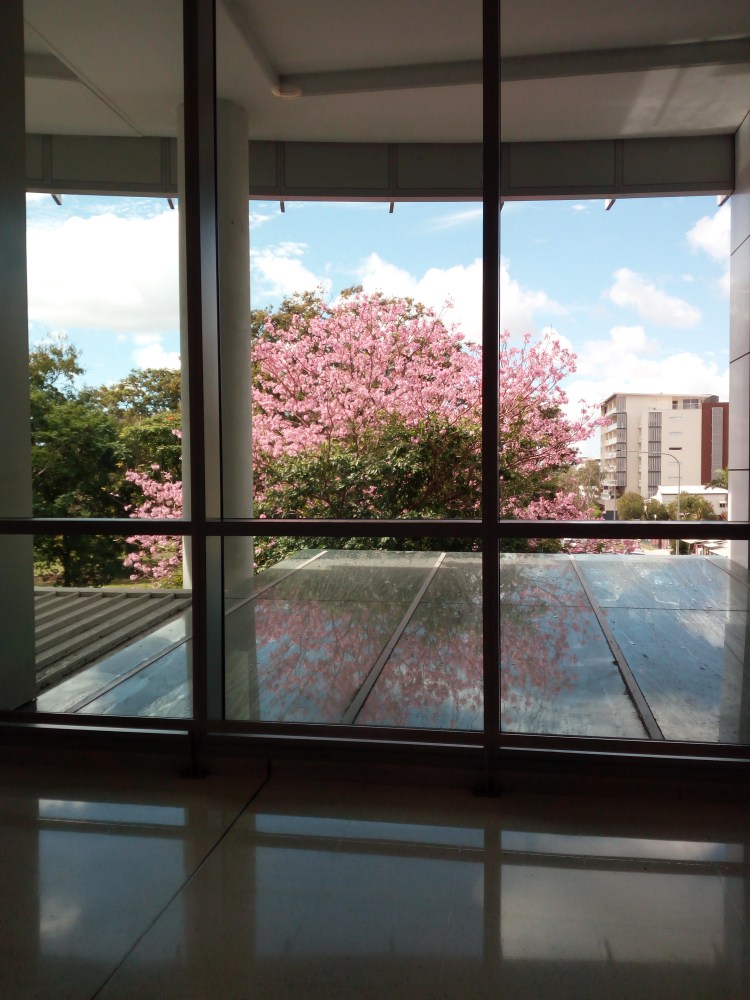
Brisbane has more tree cover than any other Australian capital city as shown by aerial imagery 12 Dec 2021.
Planners in Australia now realise residential temperatures can be reduced by planting or keeping trees that can also cut power bills by reducing air-conditioning in well-planned areas.
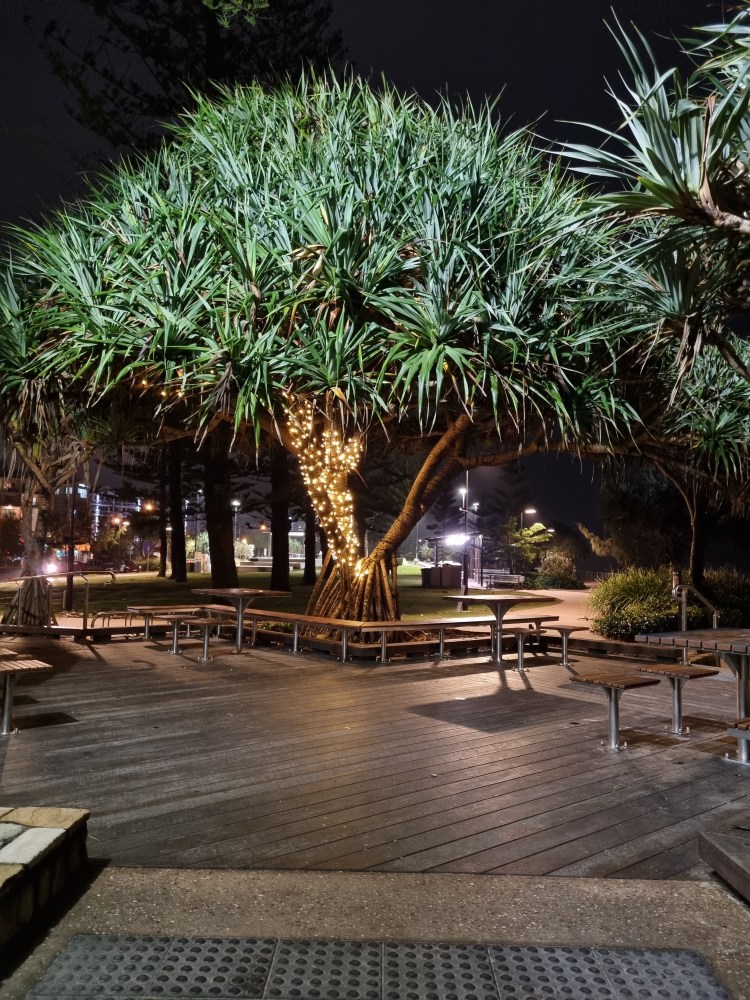
The roots grow underneath the pavement. The concrete cover acts as a mulch and protects the tree roots from being compacted too badly while providing some protection and climate-control. Sunshine and rain help to promote healthy branches and leaves.
Still, I think it’s a strong brave tree which survives inner city surroundings. This coastal one seems quite happy.
Title “Jak-Kul Yak-Kul” acrylic art on canvas by Hervey Bay Queensland artist Will Hazzard https://willhazzard.com.au/
Love at first sight when I saw Will Hazzard’s adorable cockatoo with plumage which goes against nature to dramatic effect!
My photograph was taken in Maryborough and this 81.3cm x 81.3cm painting was exhibited at the 38th Hervey Bay Annual Competitive Art Exhibition by Gallery 5 – Hervey Bay Art Society in July 2022.
Established in 1983, this annual art exhibition hosts seven award categories with styles ranging from traditional to contemporary.Will Hazzard’s striking work won Second Prize in the Australian Flora & Fauna Section.
Will is 21 years old and autistic. Art became a form of therapy with his autism diagnosis at age 9. His paintings aim for a connection with animals, the environment and the land on which he lives.
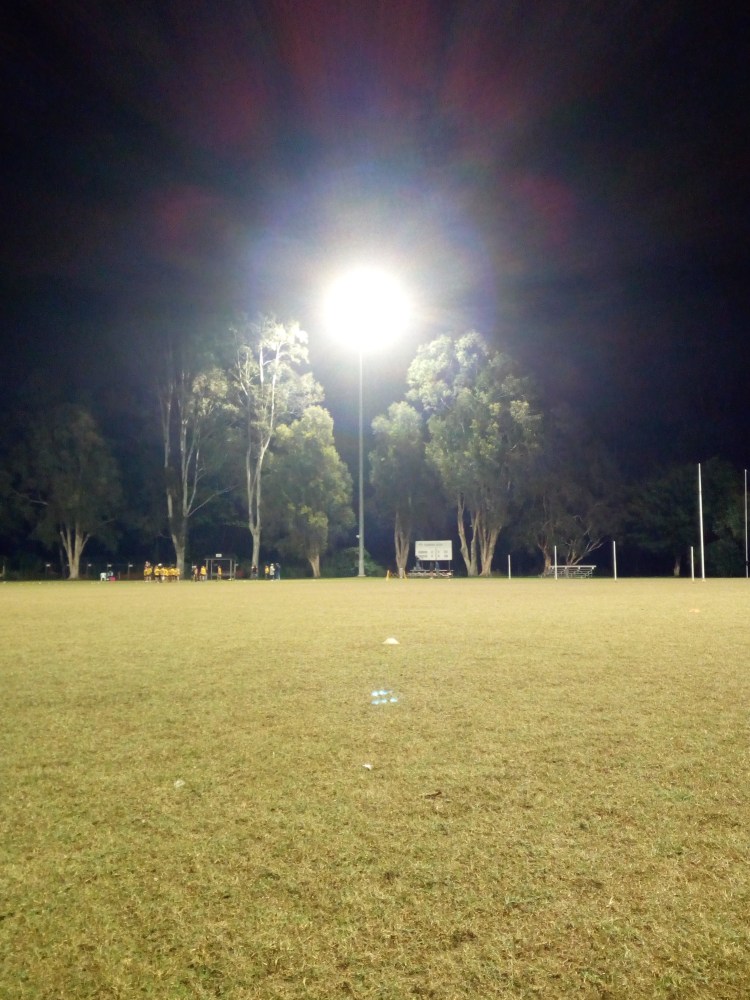
A cold, misty night on an Aussie Rules AFL football field.
The grass of the oval is damp with dew.
A junior league game is about to start and already the families and friends of the young players have donned beanies and shoved frozen fingers into jacket pockets.
The siren sounds and puffs of steam escape from cold lipsaswild encouragement is directed at the players jogging into position, each one wearing a sleeveless guernsey(different colour for each team)with large numbers on the back.
At half-time the siren sounds, sending supporters and spectators rushing to the canteen to buy hot meat pies, salty chips and coffee to fortify themselves for the rest of the game. The teams gather around their respective coach, drinking hydrating fluids and eating protein snacks.
I know goals are kicked through the white posts but AFL rules of the game are beyond me, click here if interested 😀
These keen teams have boundless energy; the youthful players are hyped up, jostling and joking, hand-passing the ball back and forth while their coaches issue last minute instructions.
The siren blares again. The teams sprint back onto the oval after a quick glance at the scoreboard which shows an incredibly close game.
The Scarlet Stiletto Awards – the 29th – are now open so it’s time to start polishing your short story or at least fire up the computer/sharpen that pencil.
A record $12,365 in prizes is on offer and this year’s Writers Victoria Award for the story with the ‘Most Satisfying Retribution’ now offers a choice of an online course worth $215 – start writing!
To download an entry form and list of FAQs, go here.
They are looking for inspiring, vivid and bold short stories by Queensland writers aged 18-25. Whether you’re just starting out or already making your mark as a writer, your creative work could win $2,000 and be published in the Griffith Review.
Have the chance to see your story published and win cash.
Enter your best work by Monday 15 August 2022, 5 pm.
The Young Writers Award is free to enter! To apply, submit a short story of up to 2,500 words.
First prize is $2000 and up to three runners-up will receive $500.
* * * * * * * * *
TIP: Always read the submission guidelines.
NOTE: I am no longer affiliated with either organisation although years ago I entered their competitions. I didn’t hear back but really enjoyed the experience and I encourage all writers to stretch their emotions and imaginations and start writing – now!
Kookaburra with yabby crayfish claw, Crows Nest, Queensland 2022
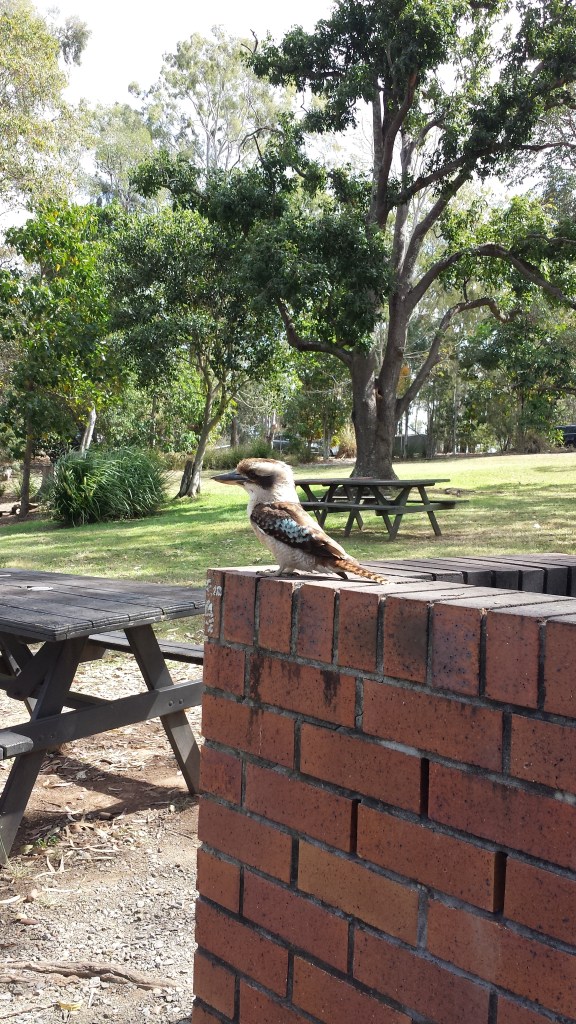
The Laughing Kookaburra can be identified immediately by both plumage and call. The cackling laugh is often used in scary jungle movies.
Laughing Kookaburras are found throughout eastern Australia. They feed mostly on insects, worms and crustaceans (like the yabby crayfish above) although small snakes, mammals, frogs and birds may also be eaten. Prey is seized by pouncing from a convenient perch. The meal is eaten whole, but larger prey is killed by bashing it against the ground or tree branch.
The kookaburra photograph (above) was taken at Crows Nest, located 44km north-east of Toowoomba on the Great Dividing Range, Queensland. It is one of the larger members of the kingfisher family with a wingspan 64cm-66cm (25in-26in).
I have always loved keen-eyed, stocky little kookaburras. Suburban kookaburras living in parkland sometimes loiter around barbecue cooking areas. They are not dangerous birds and rather stand-offish but I would not encourage them with human food. That powerful beak is better suited to nature’s diet.
Laughing Kookaburra feathers are generally off-white below, faintly barred with dark brown, and brown on the back and wings. The tail is more rufous, broadly barred with black. There is a conspicuous dark brown eye-stripe through the face, like an old-fashioned burglar mask.
My grandfather was an artist, woodcarver and bespoke furniture maker, and he designed and cast this laughing kookaburra (above) in a plaster mould. After hand-painting the kookaburra, he framed it in the minimalist style of 1960s. Both he and my grandmother (a needleworker extraordinaire) created Australian designs when many things were influenced by British and European artisans.
The kookaburra’s scientific name is Dacelo novaeguineae but the name ‘kookaburra’ is generally believed to be derived from the original term ‘grab a stick’ or ‘gougou garrdga’ in Kamilaroi/Euhlayi language.
Group kookaburra calls are best heard in early morning and at dusk, and are crazy loud if you are standing under their tree.
A group of kookaburras is called ‘a riot of kookaburras’ because of the raucous noise.
Studies have shown that kookaburras pair for life. The nest is usually a bare chamber in a naturally occurring tree hollow. The breeding season is August to January and every bird in the family group shares parenting duties. The ideal set-up really.
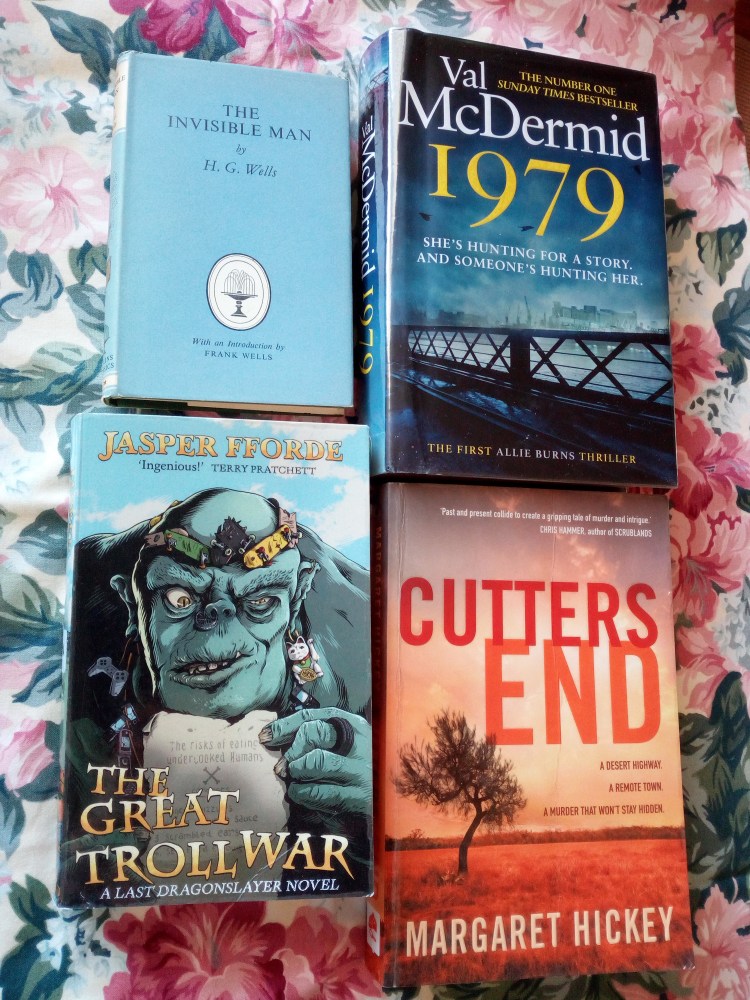
Many people read more than one book at a time and I have been doing this for several years. If one book is slow or doesn’t capture my immediate interest, I switch to another one. Plots and characters never seem to get confused because I usually read different genres.
And I always like to finish a book!
Watch out for a special blog post for my 100th Book Review. This milestone took me by surprise. I have many more reviews on Goodreads but I personalise my blog post reviews.
Have a quick look at Fantastic Fiction, my favourite go-to resource:
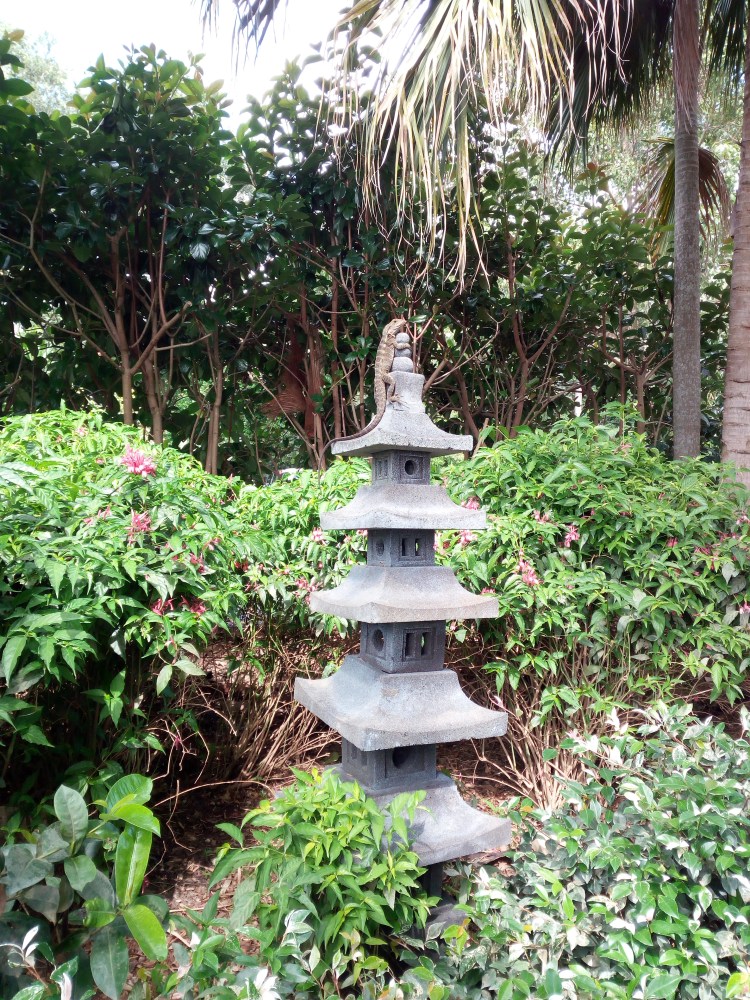
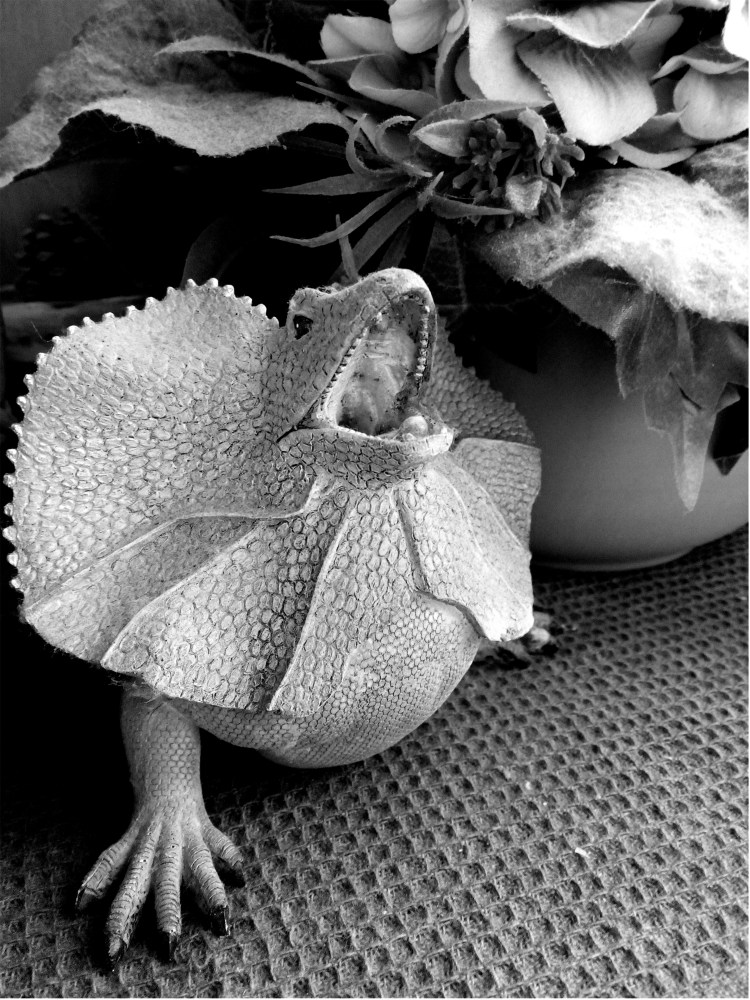
“Water Dragons are one of our most frequently encountered lizard species here in South East Queensland. They thrive just about anywhere, particularly around water sources of varied descriptions where they usually can be found in good numbers and they don’t mind the presence of people.”
“They feed primarily on small spiders and insects but will take other small vertebrates on occasion.”
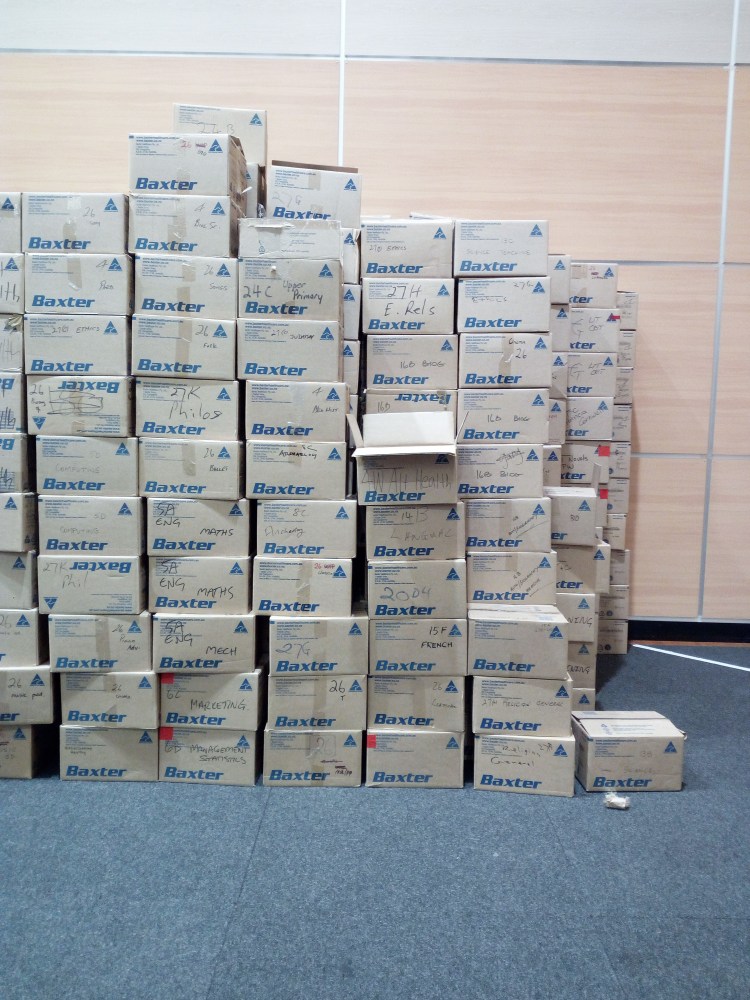
Heads up… Brisbane’s longest-running Book Fair is coming soon! The UQ Alumni Book Fair will be spread over four glorious days in April/May 2022 with heaps more than text books.
This annual fundraiser is a much awaited event for Brisbane booklovers. Based at the University of Queensland, St Lucia campus, there is something for every reader and collector.
I’ll be going with a BIG carry bag!
The Book Fair is organised by volunteers who harness their love of books and generously donate their time to help raise funds to support researchers, educators and residential scholarships for UQ students.
Come along to the Book Fair for a huge range of—-
Pre-loved books of every genre for every age group
Magazines
Sheet music
DVDs
Videos
CDs
Vinyl records
Occasional photographs, print or piece of memorabilia
Special Family Day for young readers
The Rare Book auction is biennial and next event is 2023
Register now White Gloves talk on rare Australian books at UQ Fryer Library.
This alluring information comes from The Black Stump, a Stringybark Stories newsletter, with reference to their Stringybark flagship open-themed short story award which commenced 15 November 2021 and closes 13 February 2022. Plenty of time? Maybe polish that special draft…
StringybarkShort Stories are open to Australian and international authors of all skill levels.
While the Stringybark Short Story Award2022 is open-themed, your submission does require some reference to Australia.
The size of this reference doesn’t matter says Stringybark Stories. It could be a mention of a Vegemite sandwich, or the fact that Australia is the world’s largest coal exporter. The story could be set in Australia or have an Australian in it. Stringybark doesn’t mind. Even a discussion on the habits of ‘drop bears’ is okay with them.
Head over to the StringybarkBookshop and get inspired by some great short stories from their past anthologies. Please note Stringybark Short Story Award isnot accepting poetry or illustrated tales.
Stringybark Stories have over AU$1000 in cash and books to award the winners, as well as publication in a paperback and ebook. The entry fee is the same as last year — AU$14 with discounts for multiple entries.
INFORMATIONBELOWplease check Stringybark Stories website thoroughly for details:
Subscribe to The Black StumpStringybark Stories newsletterhere.
——————————
Stringybark Stories Hints and Tips on Entering their Awards…
“Don’t let potential problems affected the likely success of your entry. The comments provided here are relevant for all short story competitions — not just Stringybark ones.”
1. Never put your name on your story. Put it on the entry form (a Stringybark requirement) or on a separate page. 2. Follow the formatting requirements. All competitions describe how they want your entry to look. We explain our requirements here. 3. Try and ensure that your entry and your payment are made as close together as possible. That is, don’t pay your entry and then submit your story a month later. It makes administration very tricky. It’s always best to do both together. 4. Related to number 3 above, if you are paying by Direct Deposit (and we love entrants who do) please remember to put your surname in the reference field so we can marry your entry and your payment. 5. Ensure that your story meets the theme of the competition!
——————————
Tempting isn’t it?! I’ve a story in mind and this is just the incentive I need.
♥ Gretchen Bernet-Ward
— Footnote —
“Any entry in any short story writing award must meet the specified wordcount.
LIFEGUARDS ON DUTY at Yeppoon situated 38 kilometres north east of Rockhampton, Queensland, the gateway to Great Keppel Island and the wonders of the Southern Great Barrier Reef.
From Yeppoon, across beautiful blue water, you can see Great Keppel Island. It has been years since I visited this coastal region and much has changed but the beaches and islands are far more accessible.
Meander down Yeppoon’s main street or stroll along the esplanade to browse beach-chic boutiques and surf stores and keep an eye out for one of the many new street art murals adorning local walls.
Kakadu stud bull
The Capricorn Coast (on the Tropic of Capricorn, the circle of latitude around the world which contains the subsolar point at the December solstice) also delivers when it comes to sourcing fine food with specialty produce like premium, export quality beef (nearby Rockhampton is the beef capital of Australia) seafood, and tropical produce. There is a wide range of restaurants, cafés and clubs catering to all tastes and budgets.
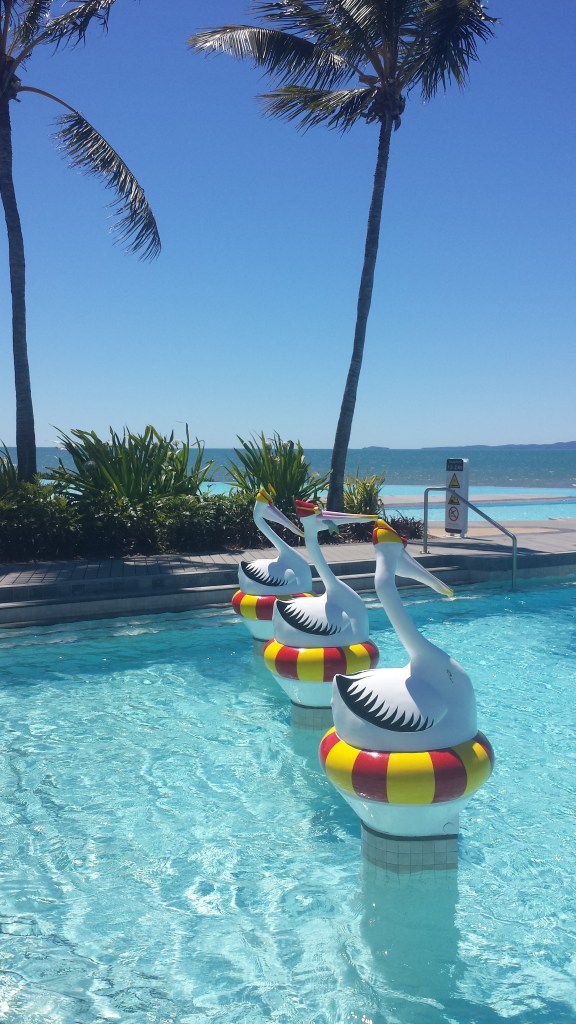
Families are well catered for in Yeppoon, with the foreshore also boasting the fantastic ‘Keppel Kraken’ zero-depth water park, open daily with fun and free activities for the kids on hot sunny days. The new lagoon pool at the southern end of Yeppoon Main Beach also has a children’s play area and dining areas.
I’d say Yeppoon is unspoiled, a relaxed and friendly little coastal town.
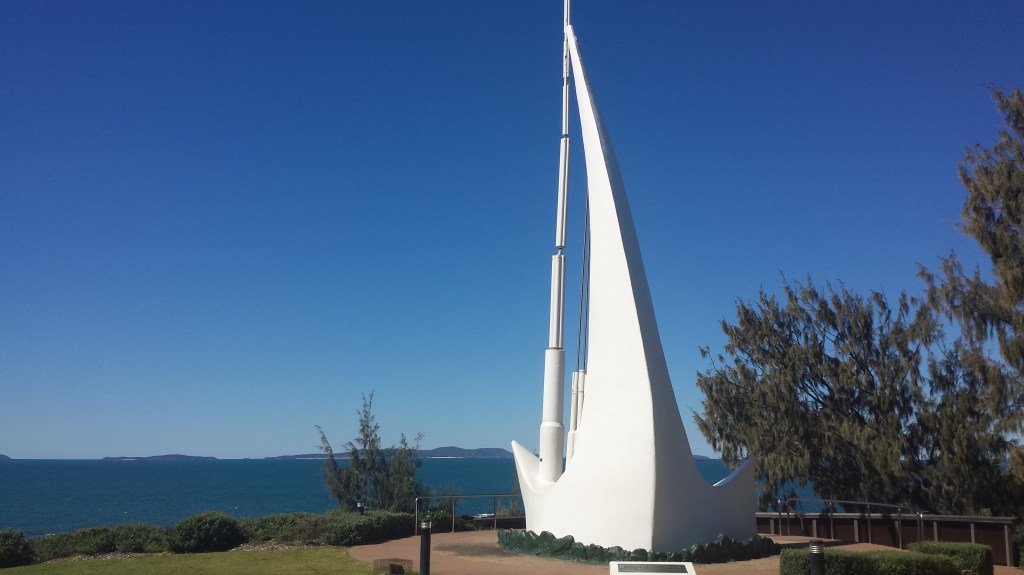
Set against a spectacular coastal vista of blue seas and Great Keppel Island in the distance, the Singing Ship at Emu Park is a majestic monument that commemorates the area’s legacy of the historical explorations of Captain James Cook, who discovered this bay in May 1770. The unique design represents the billowing sail, mast and rigging of his ship Endeavour. Concealed organ pipes use the sea breezes to create haunting musical sounds.