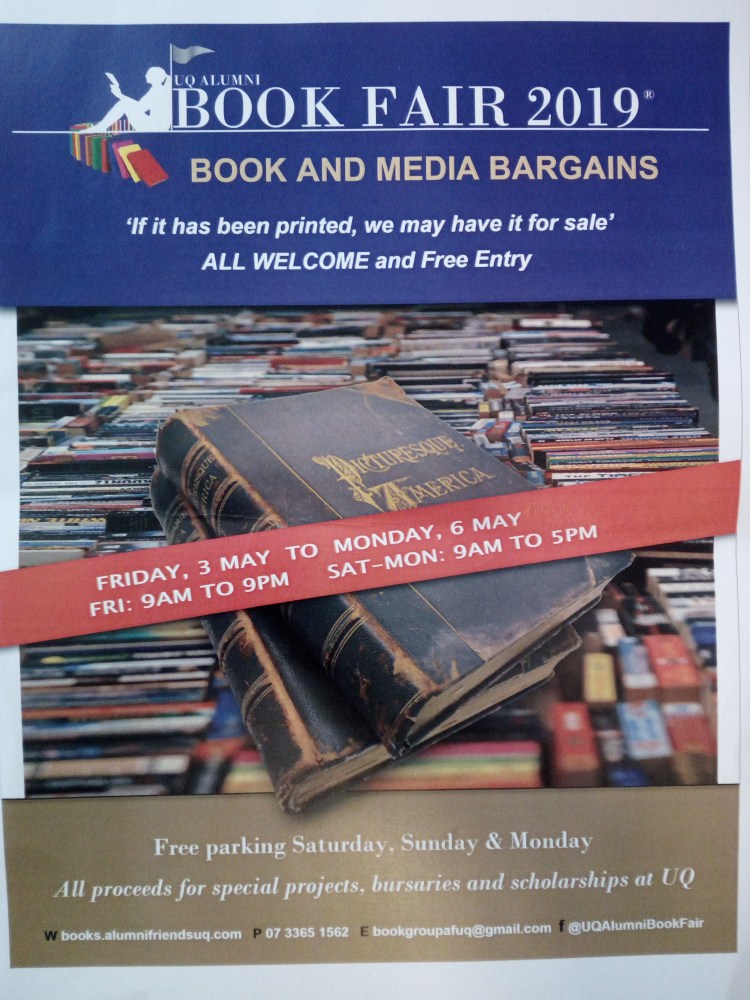
The University of Queensland Alumni Book Fair 2019 at St Lucia, Brisbane, had been in full swing for a couple of days before I arrived on the third day. One more day to go with no sign of running out of keen customers or brilliant book bargains.
The Exhibition Hall is huge!
The whole area was filled with tables covered in books of every shape, size, colour and genre. I couldn’t name every section without going cross-eyed but there were technical books, reference books, fiction, non-fiction, and fun stuff like mixed media (including old vinyl records) and cool kids books.
I could say romance novels jostled for position with items such as travel guides and political biographies but everything was grouped in an orderly manner, well marked and easy to access. I was surprised to see numerous large old dictionaries for sale, however, the eclectic poetry section caught my eye. Ooh, Bruce Dawe.
Total absorption
The whole area was spacious, clean and civilised. I expected a few gasps or cries of joy when The One, that perfect addition to a series or a special edition was found and held aloft. But no, basically the customers had their own agendas and moved calmly from book table to book table with carry bags, totally absorbed. By my estimation, I think you could expect to spend about two hours scanning and sifting through the books, more if you wanted to read pages here and there.
A corner of the UQ Alumni Book Fair 2019
Stacks of boxes
In the first photo (above) in the distance you can see a stack of book boxes, then in the second photo you see the book boxes up close. That opened box was about head-height and a volunteer told me those boxes had stretched along the walls, and every day they were emptied. Volunteers in purple t-shirts worked tirelessly the whole time I was there, unpacking, shelving, answering queries, and working at the payment points.
Afternoon tea
In the adjacent cafeteria (delicious homemade strawberry cake) I displayed some of the haul. You will spy a small red book in the left-hand photo which I have opened in the right-hand photo. The dust-jacket is missing and the previous owner had not liked naughty boy Pierre and scribbled on him in pencil but I love it. After a bit of searching, I found out this little Maurice Sendak volume is one of four, a Nutshell Library boxed set published in 1962 by HarperCollins.
Time to go
On display in the foyer of the Exhibition Hall were enlarged travel images and I couldn’t resist taking a photo of the duck and ducklings. Overall, the synchronicity of UQ Alumni Friends, Members and volunteers created an exceptional event.
Walking back to the bus stop, weighed down with my treasure, the water bubbling through the pipes of this fountain made a relaxing sound so I stopped to admire it.
As I stood there, I thought about the massive amount of books on every subject imaginable which showed how far we have come, and how much of value we have left behind.
On arrival, drinks and nibbles were a nice surprise after travelling by bus along winding streets to UQ Alumni Rare Book Auction. From then onward it was non-stop action from 6pm until 9pm in Fryer Library.
Twilight sky
Beforehand, I walked not the ‘hallowed halls’ but the beautiful arched sandstone walkways of the Great Court to the Fryer Library entrance. I caught the lift to the fourth floor where several people were mingling in the foyer beside the bidding registration table. On receiving Number 30, I hoped it was a lucky number.
Lucky number 30
I wandered in to the library, strolled through all the assembled black chairs, and entered the book viewing area. Lighting was subdued but it was easy to see the fascinating array of old books waiting patiently for my frenzied bidding. Not quite frenzied; but to jump ahead, I did offer a bid for a beautiful book, at least I think it is, which started and finished at the same amount, i.e. nobody out-bid me. Shame really because Smith, A. Croxton ‘Tail-Waggers’ Country Life, London, 1935, 147 pp has superbly rendered B&W mounted etchings by Malcolm Nicholson.
Lights, camera, action
After ascertaining if I could take photos, permission granted, I ended up being so entranced by the bidding that I didn’t take many shots. The introductions, welcome and Acknowledgement of Country were conducted (first by university librarian Caroline Williams originally from Nottingham UK) and at 6.45pm, auctioneer Jonathan Blocksidge stood behind the lectern. Game on!
Quickly, keep up
The bidding was fast and Mr Blocksidge kept the pace up, the heat on and the bids rising. There seemed to be some pretty serious collectors and possibly agents in the audience and at times the bids rose in increments so rapidly it was hard to keep track.
The highest bidder
There were absentee bidders and Lot 27 rose above the reserve price. As the night progressed – 146 lots were listed – bidding ‘wars’ occurred, particularly between two people behind me. The jousting for Lot 62, first edition of ‘Human Action: A Treatise on Economics’ made the audience applaud in appreciation. Same for Lot 66 ‘The Natural History of Man’ and Lot 86 James Cook’s ‘A Voyage Towards the South Pole’ which later culminated in Lot 105 Charles Kingsford-Smith’s personally signed copy of ‘Story of Southern Cross’ going for a huge amount.
Regrettably, the star of the show and expected highlight of the evening Lot 146 Gauss (de Brunswick) book ‘Recherches Arithmetiques’ did not meet the hefty reserve price.
Until tomorrow
The UQ team of staff and volunteers worked tirelessly throughout the evening, quiet yet ready to assist, and I think they did an excellent job. In fact, I have been reliably informed that all of the auction organisers I had contact with are UQ Alumni Friends, Members and volunteers. They were supported by the Fryer Library team (led by Manager, Simon Farley) who organised the chairs, allowed use of the library space, and provided the hospitality pre-event. A success well deserved!
I purchased and collected my precious old book of ‘Tail-Waggers’ and headed out into the cool, calm night.
Stick around for Part Three coming soon, my adventure with books, books and more books. Or better still, visit the UQ Alumni Book Fair yourself!
So excited, I’ve never been to a rare book auction. In fact, I have never been to an auction. It’s not something which cropped up in my everyday life and I must admit from what I’ve seen on television, it can get pretty fast and furious.
There’s always the horror of twitching an eyebrow and accidentally bidding for a hugely expensive volume of poetry, the only book of its kind in the world, which has to stay in a glass case. Well, not exactly, but you get the idea.
Last month, I attended a talk at University of Queensland’s Long Pocket Campus, home of the University of Queensland Press, or UQP as it is fondly known, the oldest independent publishing house in Australia with an illustrious stable of authors. I browsed some of the newly published books on offer, grabbed a coffee and sat with other attendees to absorb an informative talk from the Publishing Director, right down to choosing bookcovers.
We broke for a tasty lunch then listened to the ins-and-outs of publishing publicity, Selling The Brand. Another world really but invaluable knowledge for a writer. Our group participated in a Q&A quiz about books and authors. I threw up my hand and answered correctly, winning myself a new novel ‘The Geography of Friendship’ by Sally Piper which I will read and review.
DOWN A HILL AND UP A HILL . . .
Afterwards, we all trooped outside, down a hill and up a hill through the lush native gardens to where the Archives live. Amongst the thousands of new and used books donated every year, there are rare and valuable tomes, well-kept considering their age. On the shelving, behold every genre, every topic, every format imaginable. And nearly every item in the Junior Section held nostalgia for me. It is here I learned about the UQ Alumni Rare Book Auction 6pm on Friday 3 May 2019.
Photographed in the archives at University of Queensland, this magazine and many rare books will be auctioned in Fryer Library on Friday 3 May 2019 at 6pm.
BROWSE AND BUY – TAKE A TROLLEY – BOOK VOLUNTEERS WELCOME
I will have to leave you hanging, dear reader, because I will write Part Two when I’ve actually been to the Rare Book Auction in Fryer Library which itself is full of literary treasures. See you there?
French artist Paul Gauguin (1848 – 1903) used monoprinting to created beautiful works of art. Most were not acknowledged in his lifetime but I had the opportunity to try his technique.
The workshop I attended was run by Brisbane Botanic Gardens Mt Coot-tha. Everyone met at the BCC Library and then walked down to the activity room. Our instructors were Frances and Lee-anne and their introduction covered the evolution of Australian native plants, the background to Gauguin’s work and monoprinting. A monoprint is a one-of-a-kind print that forms part of a series.
It was a two-hour class with about twelve people and we were itching to get started. We couldn’t wait to peruse the beautiful and aromatic array of Australian native plants ready to make our imprints.
Here is my quick overview
Beginners Guide to Monoprinting
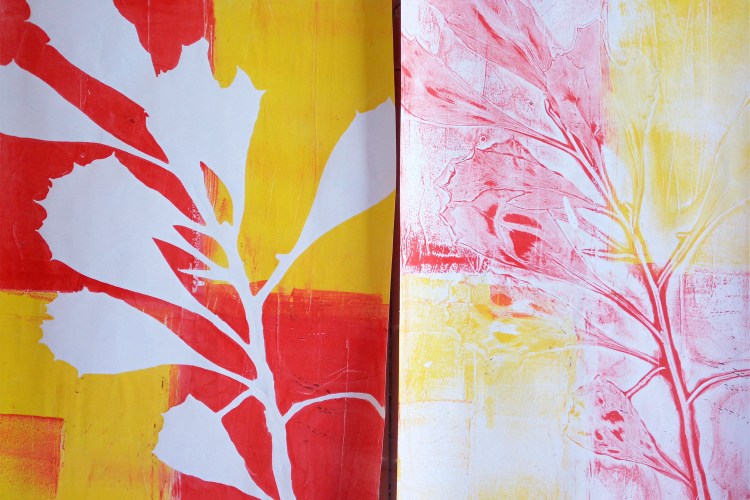
You may have read that monoprinting is an age-old printmaking method which produces a single image. I’d have to say that is only partially correct – the image can be reversed or added to several times, each time producing a different image. (See my coloured prints above).
I rolled out four paint blobs (yellow and red) on an acetate pad, added a leafy tree branch and a clean sheet of paper on top before smoothing it out flat. Peel off. Two for the price of one! I placed ferns and leaves with the branch, added fresh paper on top, pressing down hard. I reversed the procedure and did ‘mirror’ images.
You may have heard that you need lino or woodcarving tools. I used a wooden chopstick to press and draw my B&W designs. There were several which didn’t make the grade and I tried to choose the better ones. (See my black and white prints below).
It is thought that you need to work on a glass plate or gel plate, but a sheet of tough plastic (clear heavy acetate) works well with monoprinting paints and is easy to clean. Of course, you can upscale your equipment when your hobby turns into a money-making enterprise.
A special roller isn’t really necessary to spread the paints, you can use a small rubber roller with a plastic handle. No flattening press needed. Once the overlay paper is in place, you can use your hands to smooth the paper flat, or add background patterns through the paper with the tips of your fingers.
Pigmented paints and printing inks produce colours which look great but the traditional black-and-white looks dramatic. I didn’t achieve any depth to my work but the middle black-and-white print (below) is reversed and the hatching in the background was done with the backs of my finger nails.
We ran out of time and I would have loved to have dabbled more. The free class I attended supplied the equipment – plus afternoon tea – and the paper used was office A4 size. It was porous enough and strong enough to take my amateur efforts.
My words of encouragement “You have to try it, muck around with it, get messy and see what happens”
The trick is to work fast, especially in Queensland temperatures, because the paint will dry quickly. Drying caused one of my prints to have a ghostly quality. That was part of the fun – the results were often a surprise.
Monoprinting is a forgiving and flexible technique, experimental yet satisfying, and several participants achieved a pleasing degree of botanical detail worth framing.
Coming out of a hot dry summer, March weather is beginning to soften the sky and offer the cooler, more gentle mornings of autumn. There is no definite change of season, just a calmness, almost a feeling of relief after the insistent tropical heat.
Apart from, whack, an insect, there’s something serene and relaxing about strolling through a garden, touching leaves, sniffing flowers, following a creek and hearing the splash of a small waterfall through the trees.
To quote Rudyard Kipling “The Glory of the Garden it shall never pass away!” so…
Here’s what I experienced one lovely morning…
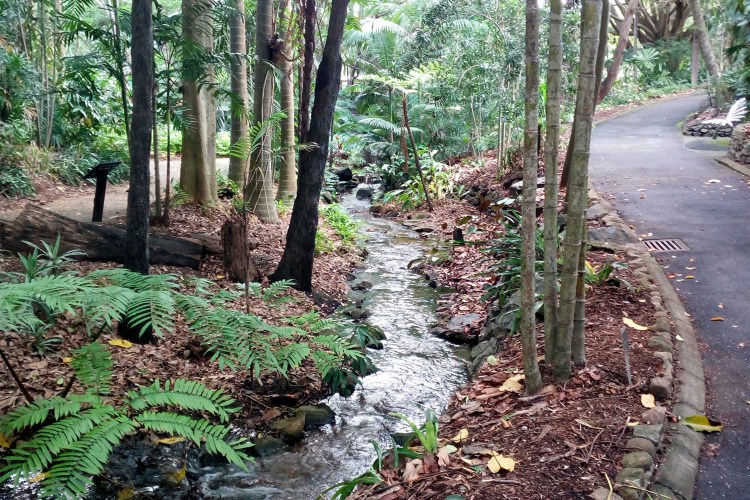
Arriving early at the Brisbane Mt Coot-tha Botanic Gardens, I strolled through a cool, green gully and thought it was strange to be in a capital city yet hear no traffic sounds. I floated along, enjoying the stillness, until my personal calm was shattered when the garden crew came on duty and the leaf- blowing brigade roared into action. I had to wait until one fellow walked out of shot to photograph Xanthorrhoea australis, the Grass-trees (below; left). The atmosphere shuffled its feathers and tranquility returned.
Wooden bridges and flowing streams…
Leisurely, I followed the meandering paths across bridges and green lawns, enjoying the mild sunshine. Strolling down a slope, I came to a bracken-lined watercourse then walked up a gentle incline towards king ferns, piccabeen palms and towering hoop pines. I’ve never fully traversed the 56 hectare (138 acre) area which displays mainly eastern Australian plants.
You can spot Eastern Water Dragons (lizards) and geckos as they scurry out of sight or get a giggle watching the many varieties of water fowl, ducking and diving in the lake. Feeding wildlife is not allowed and I couldn’t entice them into an appealing photograph.
Sculptural features are ‘casually’ placed throughout the gardens and I think the most alluring is a silver fern seat (below; left) with interesting support.
Beside the pond and beneath the trees…
The Japanese Garden (below; entrance and pond) offers soothing symmetry and a waterlily’s single bloom. Nearby the concert bandstand has grass seating surrounded by trees with foliage of different patterns and colours. Around me, there’s a multitude of subtropical shrubs, cycads and flowers with names I never remember. You will notice that I do not attempted to be horticultural! A bit further along, in the arid zone, resides a sci-fi concoction of exotic cacti. The culinary, fragrant and medicinal herb gardens are pure indulgence. But if herbs aren’t your thing, the pungent eucalypt is my favourite and walking the Aboriginal Plant Trail with its edible food plants.
Biodiversity and water reflections…
The stillness of the morning created pleasing reflections on the lagoon which is fed by rainwater captured from the hills. You can choose between typical heathland or wetland regions made easily accessible for suburban folk. The Conservation Collection includes rare and endangered species in their natural habitats and I entered the steamy, geodesic hothouse (below; left) where equatorial plants are nurtured. My face beads in sweat, it’s not a place for humans to linger too long. Time for an ice-cream!
Tropical Display Dome at Brisbane Botanic Gardens, Mt Coot-tha, is a large lattice structure (geodesic) displaying plants from the tropics. A pathway winds upwards through the dome building, wrapping around a central pond with water plants.
Look outside the Botanic Gardens…
Outside the entry are several buildings of interest: Sir Thomas Brisbane Planetarium (below; saved from extinction by a vocal community uprising) large carpark, small art studio, specialist library and auditorium providing a variety of events. I have booked a place in a workshop Monoprinting Australian Native Plants, so a blog post may be forthcoming. The new Visitor Information centre offers guided walks and Gardens Café has the ice-cream. The two white-coated fellows outside the café are entomologists, surviving statues from World Expo 88.
Pandas and children have a special treat…
The Mt Coot-tha Botanic Gardens Children’s Trail is a hide-and-seek ramble through the shady rainforest garden with special works of art dotted along the way and I couldn’t resist following it myself. Check out the wacky weathervane! And a log for native stingless Sugarbag bees. Mother and baby Panda bears enjoy the bamboo; they are a special fabrication of laser-cut aluminium by Australian sculptor Mark Andrews.
Parks and gardens change with horticultural trends. The smaller City Botanic Gardens are older and more formal, in keeping with the style of previous centuries, but I prefer the softness of Mt Coot-tha Botanic Gardens. As the world becomes more populated and natural plant life decreases, Brisbane city dwellers like me need our botanical gardens to nourish and refresh our screen-dependant interior lives.
♥Gretchen Bernet-Ward
Tropical lagoon and green algae swirls at Mt Coot-tha Botanic Gardens, Brisbane, Australia 2019
Note: Please click or tap an image to enlarge.
You may also like to read about my visit higher up the road atMt Coot-tha Lookout.
It’s a sunny, springtime day in subtropical Brisbane and we are heading towards Mt Coot-tha, the ‘mountain’ which is really a hill. The temperature is balmy and the drive is easy, out along a flat highway which decimated countless trees and native bushland.
Mt Coot-tha “Summit” Restaurant & Bar.
Ascending the steps…
We cruise by the Botanical Gardens, the Planetarium, the quarry (!), the cop with a radar speed gun, the tourists in an overheating VDub Kombi-van and climb towards the summit lookout which sits atop what was colloquially known as ‘One Tree Hill’.
Plenty more trees now, well, there is at the moment but Brisbane City Council may revert to one. The council is keen to upgrade the area, adding tourist lures like a zipline and tree-top canopy walk. Bye-bye quiet little harmless native animals and birds who take sanctuary there from the six-lane highway below.
Lunch in the shade of Kuta Café atop Mt Coot-tha, Brisbane.
Hardy plants in the sun all day.
We reach the carpark of our destination, fluke a spot, and notice the air smells eucalyptus fresh. It’s an interesting walk through various nationalities of smiling, picture-taking tourists. We join the milling crowd and peruse the Summit Restaurant & Bar menu before deciding the dollars signs are for high class meals. It is easier to tag onto the lunchtime queue at Kuta Café with its two-tiered eating decks.
Old natural stone from the surrounding area.
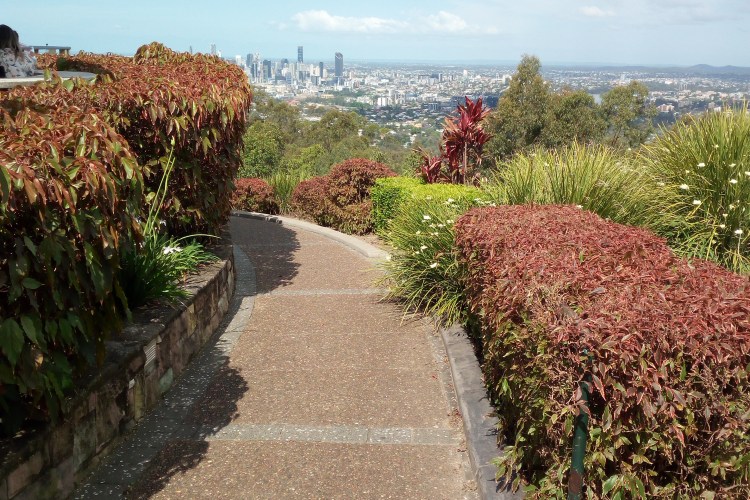
View from almost the top tier of the lookout.
I enjoy a delicious chicken salad wrap and share a huge bowl of baked potato wedges with heaps of sour cream and sweet chill sauce. After keenly snapping views towards the river and western suburbs, Brisbane CBD, and Moreton Bay with Moreton Island sandhills way in the distance, we detour the gift shop and head back to the car.
A friendly magpie lands on the car mirror, enquiring about food, but we have none to give, so it takes off—see below for this gripping encounter.
The Xanthorrhoea plant is uniquely Australian. It grows in the South East of Australia thriving in well-drained, aerated soils with low nutrient content.
Sticky-beak Magpie looking for food.
We agree not to drive the long way, the full circuit around Sir Samuel Griffith Drive which passes leafy barbecue areas, transmission towers and headquarters of local television stations.
Heading down the hillside, the city views and far-reaching scenery becomes less and less until ground level, then the highway roundabout appears, perfectly positioned opposite Toowong Cemetery.
The City of Brisbane is growing, the traffic is growing, the drivers are getting faster. Or am I turning into a grumpy older person? Time for a nap!
A local newspaper notice attracted my attention. Did I read that correctly? A camel farm excursion? Here is the true story of my expedition into camel territory.
I’d heard about camel milk and wanted to know more, so I contacted the organiser National Seniors secretary. Of course, they had me at “camels” but when I see meals included, I’m there. The itinerary read “East Coast Coach depart 9am and arrive Summer Land Camel Farm, Harrisville, morning tea and guided farm tour. Lunch at Commercial Hotel (adjoining Thirsty Camel bottleshop) before travelling home via scenic route 4pm.” Hooked and booked!
On boarding the coach, I was given a warm National Seniors welcome, and on disembarking the coach 45 minutes later, the first thing I noticed was the vast blue sky over Summer Land Camel Farm. A rolling vista spread out around me. In the distance the smudged outline of the Scenic Rim, part of the Great Dividing Range, and in the foreground hundreds of camels! It was an odd sight, camels of different sizes grazing in the paddocks, until I realised they were at home in the landscape.
Now, first let’s clear up some camel falsehoods. Camels do not spit but alpacas do. Camel footpads are better suited to protect vegetation than cows and horses. Of course, it’s common knowledge that a camel can walk over a hundred kilometres without water and carry heavier loads than a horse. But did you know that they are excellent swimmers? Who’d have thought but it’s true.
We strolled to the beautiful old Queenslander homestead where a spread of fresh scones, homemade jam and cream awaited. Then we realised what we were eating. The white fromage cream I dobbed on my scones and the milk in my coffee were not from a dairy cow but a camel. Delicious! And, as we subsequently found out, very good for our digestive tract. Camel milk is like an immune boost, an anti-inflammatory which can benefit our gut, skin and hair.
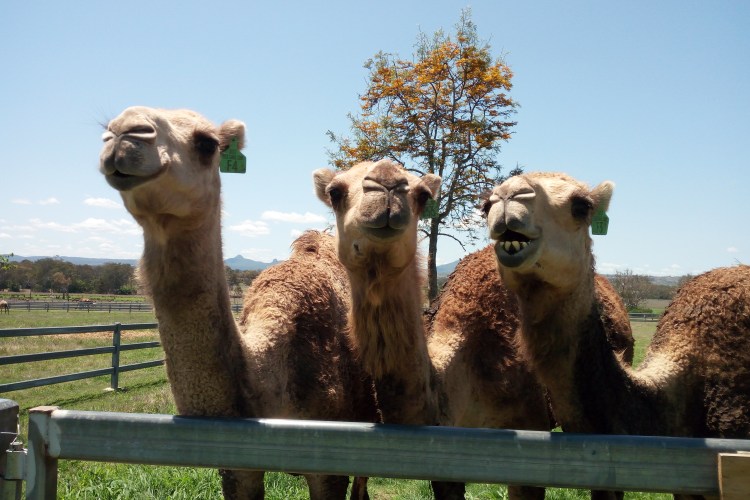
I loved meeting the camels at the fence, talking to them as they blinked their long eyelashes, obviously assessing if I had anything edible in my hand. When they saw the camera, I believe they actually posed, holding quite still while I took full advantage of this photo opportunity. See the camel on the right smiling! Everything was peaceful and the air smelt fresh. No camel aroma wafting on the breeze. Then my models wheeled away to check out an inviting dust bath.
In Australia we have dromedary camels, one hump. The dromedary is the smaller of the two species of camel and female gestation period is 13-14 months or around 410 days. I saw a baby camel, 24-hours old, all spindly legs, wobbling and flopping yet determined to stand. I asked if I could sponsor a camel, an adorable critter to watch grow up. Not yet, but one day this may be possible. In the meantime I joined the Summer Land Camels Club and harbour happy thoughts of riding a camel on my next visit.
Jeff Flood, CEO Summer Land Camel Farm, Business Strategist, Biochemist and Nutritional Immunotherapist.
Our group walked to a vast shed where the cheese, cream and milk are tested and processed. We sat in the breezeway while Jeff Flood, biochemist and immunotherapist, delivered an intelligent, informative and heartfelt talk on all things camel. Even biomes got a mention, and Jeff is very open about the farm operations. I wished my school days had involved such an absorbing field trip.
A passionate cameleer from a farming background, Jeff Flood is CEO and co-founder of Summer Land Camel Farm, the largest of its kind in Australia. Apart from playing rugby and completing several scientific degrees, he discovered that the immune protein and nutritional content of camel milk has healing benefits, showing positive results when used to treat his young son’s eczema.
Then onward to the open-air camel dairy, where we learned the long road to milking. Camel milk and by-products are not high volume in Australia but its the largest commercial-scale camel dairy operation outside the Middle East and the third largest of its kind in the world. Jeff and co-founder Paul Martin are training wild camels, breeding, researching, testing and pioneering the way. Not only for Australia but the rest of the world. Why can’t camel milk sit in the fridge next to other beverage flavourings? Camellatté has a nice ring to it.
Jeff is concerned for the welfare of camels and told us some horrible yet true stories of the brutal decimation of the wild camel population in Australia. The camel is a neglected animal among the policymakers. Incorrect data is perpetuated to this day, mainly through ignorance and government propaganda.
During the tour, it became obvious to me that camels have been given a raw deal. They are well-suited to our Australian climate and in some ways more beneficial than imported European farm animals. A bit of racism involved here? Camels do not have top teeth yet they like rugged food; they can eat feral weed plants such as prickly pear and they don’t need lush green pastures to thrive. During drought years, companion-herds of camels and cows survive better. Camels can act as watchdogs, they have the intelligence of a six year-old child which is greater than a dog. Plus they can take you on very, very long walks!
Back at the homestead, we enjoyed some taste-testing and Summer Land Camel Farm staff excelled with their hospitality. Unlike almond milk or soy milk, I had an instant attraction to camel milk. It suited my palate without the “I’ll get used to it” phase. Being lactose-intolerant, that’s a blessing. I perused items for sale; from camel milk and cheeses through to soap, hand-cream and artwork by Fiona. If you forget the Esky, cold bags can be purchased for a nominal amount and my Camel Persian Feta and other goodies were safely tucked away.
Time to head off down the road and partake of a pub lunch at the Commercial Hotel in Harrisville. After our meal, we strolled around the small township. I looked left and right before crossing the road but it wasn’t really necessary.
The coach swayed gently as we headed homeward, and I was pondering this enjoyable day out when my thoughts reached a conclusion. I had looked into the eyes of a camel and seen a friendly, interested gaze. I think the world needs more friendly interest in camels. And more camel milk in coffee!
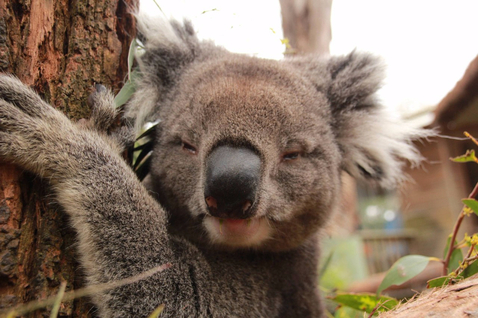
The Koala is a laidback leaf-muncher who gets hassled by the bad boys of the Aussie bush. Not by other native animals but tree-lopping developers and domestic pets. Koalas are a unique marsupial which needs human protection to survive. And eucalyptus trees, of course.
At Lone Pine Koala Sanctuary, an 18-hectare Koala conservation park in the Brisbane suburb of Fig Tree Pocket, Queensland, there is a new facility dedicated to Koala health and well-being. I paid them a visit to learn more…
Greeted by mother and baby on arrival at Lone Pine Koala Sanctuary, Brisbane. On this visit I didn’t hug a real Koala but you can!
The Koala (Phascolarctos cinereus, not a bear) is an arboreal herbivorous marsupial native to Australia. It is the only extant representative of the family Phascolarctidae and its closest living relatives are the wombats.
To quote the KOALA SCIENCE COMMUNITY dedicated to Research, Connect, Protect:
“United by a common purpose to conserve koalas across their range, Lone Pine Koala Sanctuary and Brisbane City Council worked together to build and establish the Brisbane Koala Science Institute, located at the sanctuary in Brisbane, Queensland. The Institute and this online community are further supported by Lone Pine’s not-for-profit organisation, the Research for Nature Foundation, which will help fund various South-East Queensland koala projects, in partnership with local scientists, researchers, and industry professionals.
At the unique Brisbane Koala Science Institute at leafy Lone Pine, I was pleasantly surprised at how much Koala information I absorbed in a short space of time. There are interactive (and multilingual) displays, research labs with public viewing areas and a koala observation area.
♥ Koalas have special teeth for grinding down eucalyptus leaves which ferment creating sleeping patterns which mean they can sleep more than 18 hours a day. ♥ Koalas have large, strong claws to help them climb smooth-barked eucalyptus trees. ♥ A Koala baby, joey, lives in the mother’s pouch for six months then grows up to become a big eater, consuming about one kilogram of eucalyptus leaves per day. ♥ Koalas front paws can grip small branches as they reach for the juiciest leaves. ♥ Koala lifespan is between 10 to 16 years which naturally depends on environmental conditions.
This Blue-Winged Kookaburra swooped down and kept a watchful eye on our lunch, however, it’s best not to feed human food to native wildlife.Afternoon tea, two coffees and two muffins, one caramel and the other blueberry, both with edible chocolate circles iced on top.The wishing well outside the front entrance to Lone Pine Koala Sanctuary with plenty of coins and “I Love Australia” badge.
Although I focused on the Koala, there are many more unique Australian species to see here, from kangaroos to cockatoos, eagles to emus in a beautiful bushland setting. I recommend the following link and video highlights featuring all the wildlife residents of Lone Pine Koala Sanctuary:
A quick guide to the wild birds around Long Pine Koala Sanctuary. Behind the sign, an Eastern Water Dragon lizard came out to sunbathe on the brickwork.
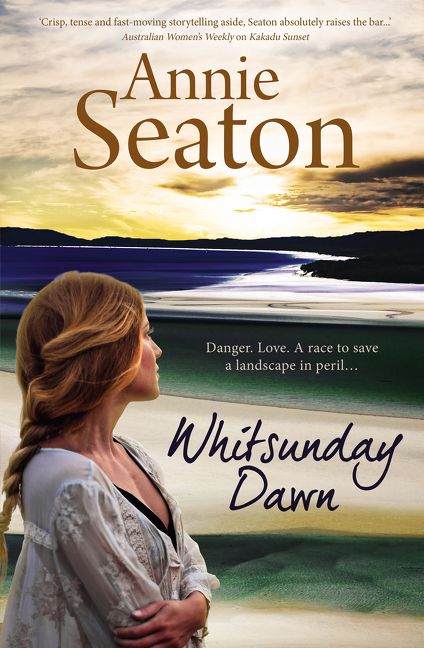
Don’t you love being on the verge of discovering a new author, that feeling of anticipating! Look at the beautiful location where romance writer Annie Seaton is holding the book launch for her latest release Whitsunday Dawn––in the Whitsunday Islands at beautiful Coral Sea Resort.
“Ecological impact, divided loyalties and the pristine beauty of the Whitsundays under threat, can mining spokesperson Olivia Sheridan expose the truth in time?” Author Annie Seaton brings to life a new era of romance and eco-adventure. Perfect for fans of Di Morrissey and a sun-kissed tropical lifestyle.
As WP readers will know, I’m not usually a romance reader but I’m rather taken by the beautiful location of this all-Australian story. Watch out for my review.
On her website Annie says “I am truly blessed to live by the beach on the east coast of Australia. I am following my lifelong dream of writing, and discovering that readers love reading my stories as much as I love writing them is awesome. It’s what keeps me at my desk each day when the garden and the beach are calling to me!
“You can read of the topical human and social issues I explore in Kakadu Sunset, Daintree and Diamond Sky. My latest release with Harlequin Mira WHITSUNDAY DAWN (August 2018) is an historical/contemporary story set in the Whitsunday Islands in 1943 and 2017.
“My inspiration comes from the natural beauty of our Australian landscapes and I’m passionate about raising awareness of the need to preserve the pristine areas that surround us.”
Will you be in the vicinity of the wonderful Whitsundays? Visit the launch of Annie Seaton’s newest book WHITSUNDAY DAWN being held on Friday 7 September 2018 at Coral Sea Resort Jetty, Airlie Beach, Queensland. A welcome drink then cash bar will be available with complimentary gourmet nibbles and canapes from the Coral Sea Resort kitchen. RSVP via Facebook https://www.facebook.com/AnnieSeatonAuthor/