Here’s a map of Queensland and video of Brisbane City which makes me think I live in a pretty good place. Nomad Girl of The Jasmine Edit films short, interesting videos around the world. She makes it look like fun; maybe I could make a video, too?
Oops, just noticed a spelling error near the Great Barrier Reef.
If you are interested in early Queensland architecture from Victorian, Federation and inter-war era, please click here to view Wikipedia Queensland Architecture
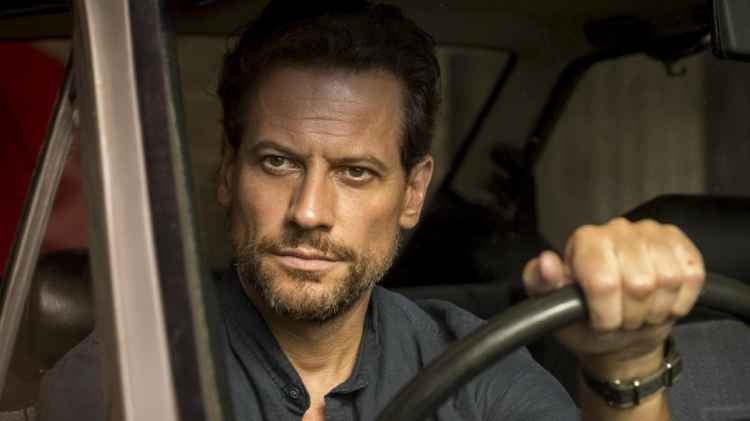
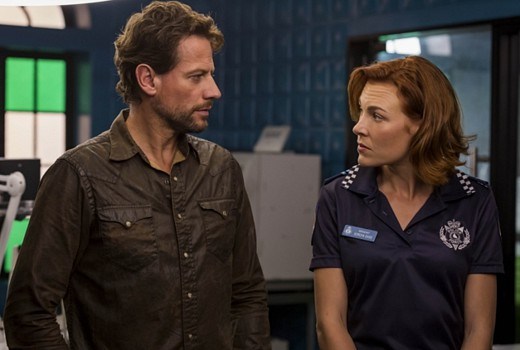
Actor Ioan Gruffudd stars as the boat-dwelling Dr Daniel Harrow in the new TV forensic drama series ‘Harrow’ filmed in Brisbane, Australia. The goal for this intellectual forensic drama, featuring an unorthodox and edgy forensic pathologist who lives aboard an untidy boat on the Brisbane River, was achieved by the combined talents of ABC Studios International and Hoodlum Entertainment.
Welsh actor Ioan Gruffudd, whose recent screen credits include movie ‘Fantastic Four’, TV series ‘Liar’, ‘Forever’ and earlier ‘Hornblower’, is now 44 and says he has more life experience to get under the skin of somebody like the flawed, smart and sarcastic Dr Harrow. Ioan, who also filmed ‘San Andreas’ in Queensland, fell in love with Brisbane, swimming with dolphins, attending theatre productions and an Ashes test cricket match at the Gabba stadium which unfortunately ended with treatment in hospital for heat stroke.
Leigh McGrath, executive producer of the 10-episode season of ‘Harrow’, says “Brisbane has got the tropical heat and humidity which I think adds a different feel to this forensic drama. Normally they are cold, they are Scandi noir, whereas we went the opposite.”
To quote The Australian newspaper journalist Justin Burke “The pilot episode presents an exquisite personal test for Harrow: does he quit his career and sail to Bora Bora as promised with his troubled, thieving, drug-addicted daughter? Or does he heed the professional challenge of grieving father Bruce Reimers (Gary Sweet), who is begging Harrow to reopen the investigation into his daughter Olivia’s death?” and “In addition to the procedural, crime-of-the-week element of the show, there is an overarching mystery that we are presented with in the opening scenes. Someone is seen dusting a body with concrete and throwing it off a small boat into the Brisbane River in the middle of the night. Who and why will be revealed in good time.”
If you click Ioan’s name (further on) you will see video footage of ‘Harrow’ filmed around inner Brisbane. Dr Harrow, a senior medical examiner, is based in the Queensland Institute of Forensic Medicine which in real life is the heritage-listed Brisbane Dental College near City Hall. Postmortems are not as easy on the eye as handsome Ioan Gruffudd.
This series is like reading a crime book with my home town in the background, I love picking out familiar landmarks and wondering how the film crew recreated a gruesome scene. The Brisbane River (Maiwar) stars but there are several familiar supporting actors to spice things up, e.g. Anna Lise Phillips, Remy Hii and Robyn Malcolm.
Keri Lee, boss of Disney’s ABC Studios Intl, is negotiating with global networks so hopefully this major drama series will be made internationally available. Meanwhile Australian viewers can watch ‘Harrow’ on ABC1 on Fridays 8.30pm 2018 or all complete episodes on iView.
In UK, Her Royal Highness has two birthdays each year: her actual birthday on 21st April and her official birthday usually the second Saturday in June. Born in 1926, at the time of writing, she is 92 years-old and still going strong. Happy birthday, Your Majesty!
The birthday of reigning monarch Queen Elizabeth II is celebrated at different times of the year throughout the world and usually accompanied by a public holiday. In Australia, each State and Territory has decreed a different day.
In Queensland (named after Queen Victoria) we have a Monday holiday in honour of the Queen’s birthday and enjoy a long weekend. This year it falls on Monday 1st October 2018 and Brisbane residents will head to official celebrations, BBQs, coastal regions, rainforest walks or just laze around at home and read a book.
♥Gretchen Bernet-Ward
“God Save Our Gracious Queen”
Royal Umbrellas
Britain’s Queen Elizabeth II holds her umbrella as she meets guests as she hosts a Garden Party at Buckingham Palace in central London on June 3, 2014. AFP PHOTO / POOL / YUI MOK
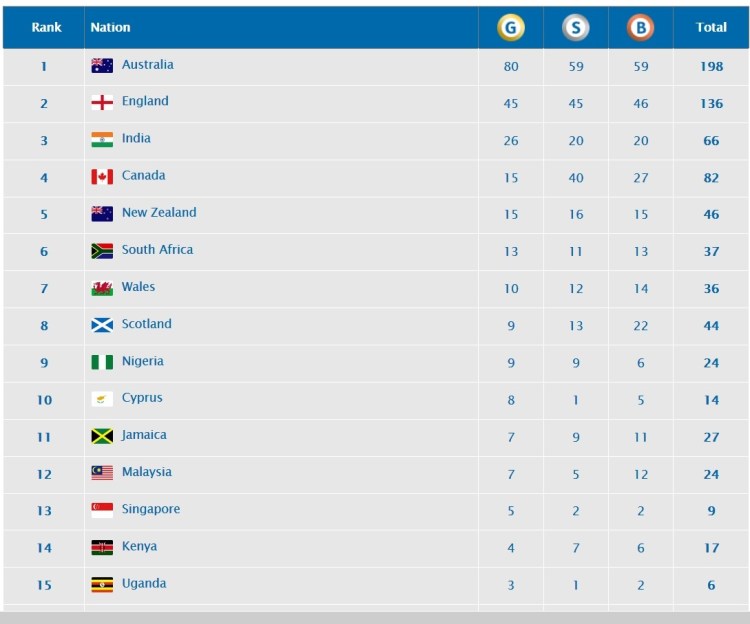
Find out interesting things like events, history, medal tally, for the Commonwealth Games . . .
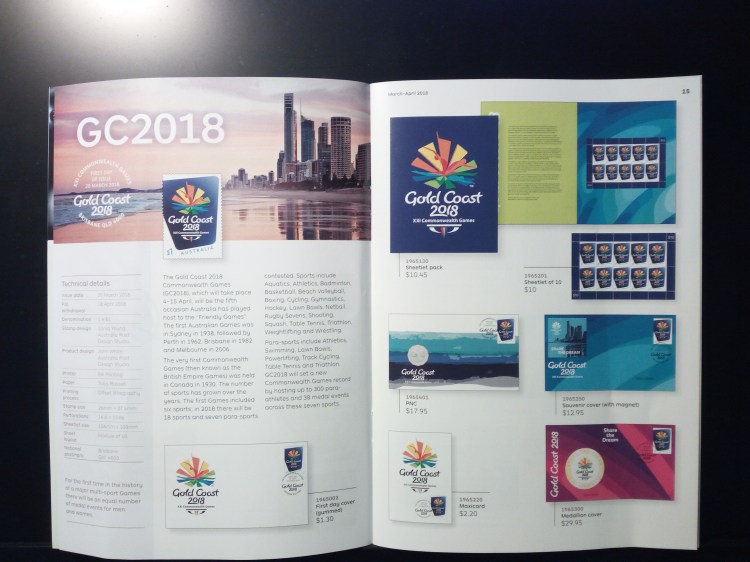
First, browsing through my Australian Stamp Bulletin, I saw that commemorative issue postage stamps will coincide with the start of XXI Commonwealth Games on the Gold Coast, Queensland, Australia. The Games sporting competitions commence 4 April 2018 and continue over 12 days until closing ceremony 15 April 2018.
I am more into literature than sporting pursuits but it’s going to be quite an event! It appears that the blue surfing koala mascot Borobi (which means ‘koala’ in the indigenous language) is on postcards but not included on the stamps so I’ve added him further down the page.
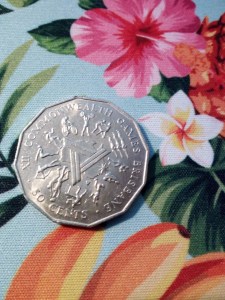
Game on! This is the second time Queensland has hosted The Games. The 1982 Commonwealth Games were held in Brisbane City from 30 September to 9 October 1982 and I actually attended. Below, I have written a little bit of Games history to bore you with facts and figures.
A brief history of the Commonwealth Games
In 1891, John Astley Cooper first wrote about a sporting competition that would bring together members of the British Empire, but it wasn’t until 1911, at the coronation of King George V, that an ‘Inter-Empire Championships’ was held. This event included teams from Australasia, Canada, South Africa and the United Kingdom.
The first official Commonwealth Games (called the British Empire Games) were held in 1930 in Hamilton, Canada. Four hundred athletes from 11 countries competed in 59 events across 6 Core sports. The Core sports have increased: athletics, boxing, lawn bowls, rowing, hockey, badminton, squash, weightlifting, rugby, aquatics (swimming and diving) and wrestling. In the past women only competed in swimming events. That’s all changed and now there’s something for everyone. Gold Coast 21st Commonwealth Games will include 18 events.
In addition to the 10 Core sports there will be:
Basketball
Beach volleyball
Cycling (road, mountain bike and track)
Gymnastics (rhythmic and artistic)
Para power lifting
Shooting
Table tennis
Triathlon
Since 1930, the Games have taken place every four years, except in 1942 and 1946 (due to World War II), and had a few name changes. Although there are 53 members of the Commonwealth of Nations, 71 teams participate in the Commonwealth Games, as a number of dependent territories compete under their own flags. The four Home Nations of the United Kingdom—England, Scotland, Wales, and Northern Ireland—also send separate teams.
Australia is the overall champion of the Commonwealth, having won 2218 medals in total, 852 in Gold. England is second with 2008 and Canada is third with 1473.
(See below for new figures 2018)
The 2018 host city – Gold Coast
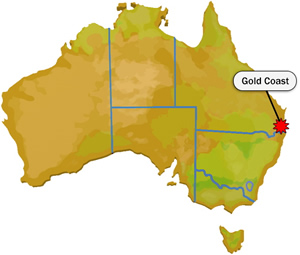
The host city for the 2018 Commonwealth Games is Gold Coast, Queensland, located just north of the Queensland/New South Wales border, and about 66 kilometres south of Brisbane. The Gold Coast is a coastal city on the Pacific Ocean with a population of around 640,000 people. It is the sixth-largest city in Australia (the largest non-capital city) and the second largest in Queensland (after Brisbane).
The Gold Coast is one of Australia’s major tourist destinations with its sunny sub-tropical climate, beautiful surfing beaches, theme parks and rainforest hinterland. More than 10 million people visit the Gold Coast every year, including around one million international visitors. It is also a film production hub with movies such as Pirates of the Caribbean: Dead Men Tell No Tales and Thor: Ragnarok being filmed there.
Maybe it’s because I was brought up by post-war parents that I am shocked at the staggering amount of food waste in Brisbane. I could not understand why our local Government has joined the world-wide campaign Love Food Hate Waste. Surely you only buy, cook and eat what you need and freeze leftovers?
Apparently for millions of households, it’s not that simple!
The Council brochure states “Love Food Hate Waste was launched in 2007 by Waste and Resources Action Program (WRAP) in the United Kingdom followed by New Zealand, Canada and Australia. With food waste making up 37% of the average Brisbane rubbish bin, 1 in 5 shopping bags of food ends up in the bin. That’s 97,000 tonnes of food thrown away every year. There are simple and practical changes which residents can make in the kitchen to reduce food waste; planning, preparation and storage of food will make a big difference to your wallet and keep Brisbane clean, green and sustainable.”
Scramble over the mat, don’t trip on the dog, here’s a tasty listicle of Council wisdom prepared earlier:
Plan meals ahead – create a meal plan based on what is already in your fridge, freezer and pantry.
Shop mindfully – stick to your shopping list!
Store food correctly – Learn how to store food to ensure it lasts as long as possible and check your refrigerator is functioning at maximum efficiency.
Cook with care – Without controlling portions, we tend to waste food when we prepare or cook too much. Remember fruit and vegetables ripen quickly and are best consumed daily.
Love your leftovers – Freeze leftovers to use for lunches, keep for snacks, or add to another main meal.
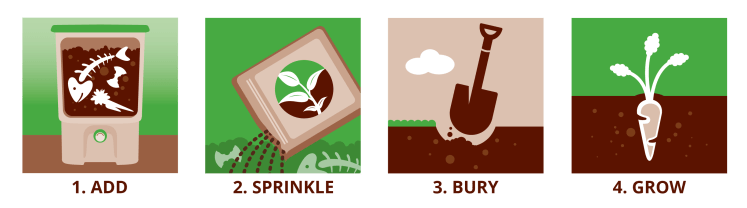
Consider composting – Turn your kitchen scraps into rich nutrients for your garden, get a Bokashi bucket, consider owning pets like chickens or guinea pigs.
Join a community garden – Composting hubs operate in selected community gardens.
Six-week food waste challenge – Every week the Council will provide step-by-step information on how you can reduce food waste in your home. Seriously.
We are over-stocked, over-fed and over-indulgent of our taste buds. Or as my dear mother would say “Your eyes are bigger than your stomach.”
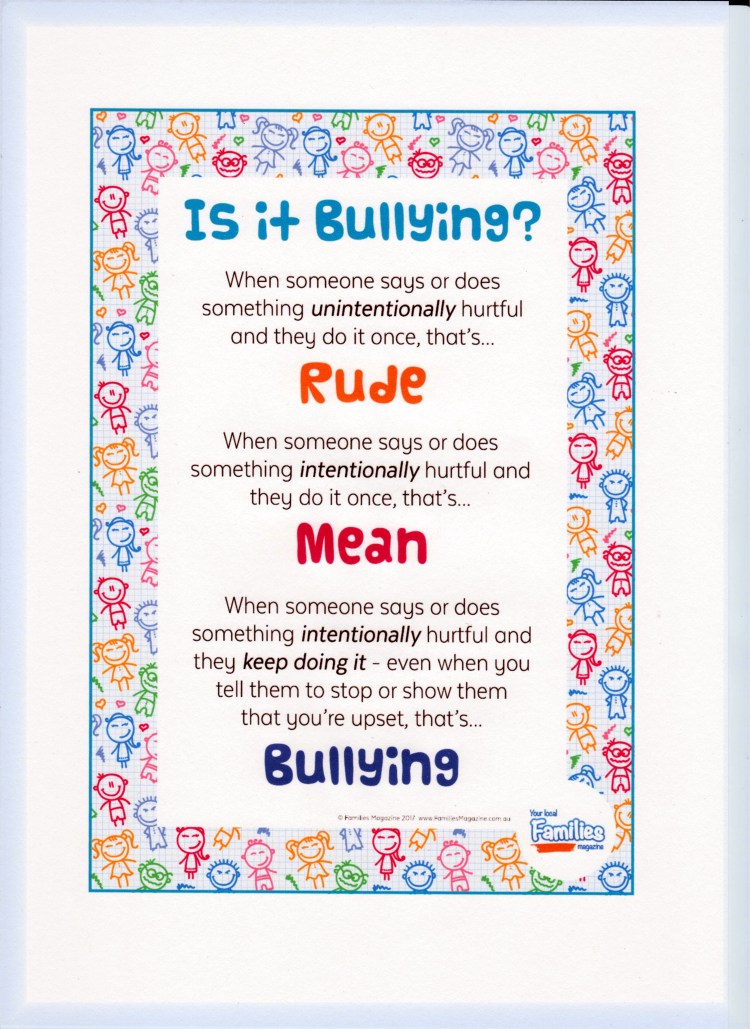
To quote Families Magazine “This poster will help your kids to differentiate and identify the difference between being RUDE, being MEAN and BULLYING.”
The self-explanatory poster is one of several free downloads on the website of Families Magazine, an A4 glossy magazine printed every two months and distributed in public libraries and places where families are in Brisbane, Ipswich, Toowoomba, Sunshine Coast and Gold Coast, Australia.
Families Magazine says “Interactions with others can be confusing. Sometimes what is considered bullying, may in fact be something else? Bullying is a repetitive behaviour that is designed to intentionally hurt or belittle another person.”
All three behaviours are upsetting to a child, but bullying is the most destructive.
Dear Diary, it’s a calm, warm July day, almost like an early Spring, but there are no butterflies or buzzing insects. The crows call to each other across the back garden and noisy miners flit back and forth like feathered investigators on an important assignment. The children in the house behind my suburban block are jumping on a netted trampoline and soon there will be a cry and a parent will take them off. The towels have been on the Hills Hoist clothes line for two days. A dried-out agapanthus head is sticking straight up out of the perennial foliage, a reminder that I am not a conscientious gardener.
TomatoesRosellaPoinsettiaAgave
So saying, in a green square pot I have grown a very tall tomato plant with fat green tomatoes (above) emerging every day. The old mandarin tree has a yearly crop of pale orange-coloured mandarins, and my rosella plants are flowering (above) while the spring onions and ginger roots carry on regardless. There are non-native plants like a small pomegranate, poinsettia bright red and blooming (above) and our huge native gum tree towers over all of us; blossom for the parrots and fruit bats. Special mention goes to our agave family. These Mexican beauties (above) love our subtropical climate and we’ve given away more young plants than I can remember.
Hoya
Coffee FlowerNest
Of course, there’s the herbs, for better or worse, always trying so hard … The trailing hoya (above) was a joy with its pink waxy flowers but recently it decided it had had enough and shrivelled up. The ancient mulberry tree went the same way, dying in the drought a few years back, followed by the peach and avocado trees. The coffee bean tree (above) survives anything. We live on a sloping hill with poor soil which is interesting because many years ago cows grazed on the lush hillsides around us. My father once said “All your good top soil has been washed downhill”. Not so long ago the rich alluvial earth along the creek at the bottom of our street was plundered and no doubt sold for landscaping.
When I first lived here, the suburb was casual with a leafy roughness about it which made for a relaxed, friendly vibe. Indeed, every home was owner/builder and most residents chose not to erect fences nor were there any footpaths. Trees were planted to shade homes from the fierce western afternoon sun and if you were lucky you had a ceiling fan. Ah, the 70s, a time of emerging from the past and forging ahead with little regard for past cultural or community identity but, in so doing, it created a unique city. Strangely, if not surprisingly, it has taken about 40 years for the people of Brisbane, Queensland, to appreciate our subtropical city. The past is now nostalgically and fondly remembered as the concrete is poured for yet another highrise apartment block.
If real estate developers would let us, we would return to our friendly, informal way of life instead of building cement block homes and painting them grey like every other capital city in Australia. To take my mind off the screeching of chainsaws as they hack down another leopard tree (above) I will write a little bit about our front garden.
Date PalmFlame TreeOrchidJacaranda
Fern
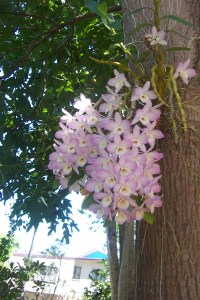
In the front garden, and I use the term loosely, there is structure and visions of edging and all, but I have let that slip. Two tall palm trees (above) on either side of the house echo early Queensland-style seen in rural areas. Tough-as-old-boots golden cane palms dot the area while I think our camellia is a Melbourne throwback. The stocky Illawarra flame tree with its pink orchids (above) was planted to complement the purple jacaranda nextdoor (viewed from balcony). I will not describe the weeds like camphor laurel, monstera or umbrella trees always springing up between the lemon scented tea-trees and more civilised shrubs. Does anyone still grow ‘mother-in-law tongue’ and ‘cast-iron’ plants? Cast iron is an unkillable broad leafed low-growing plant and I think it was beloved of early Victorians as either a hothouse or indoor plant in brass pots on wooden stands.
In the back garden, what there is left of our lawn is covered in bindii prickles thanks to lawn mowing contractors who disperse them willy-nilly via their lawn mower tyres. You can read my screed on Lawn Mower Men. There is a shallow bird bath under the eucalyptus tree for the enjoyment of noisy miner birds. On a tiled outdoor table, I have my inherited maiden hair fern (above) in a small pretty terracotta pot. The pot was thrown and fired by a neighbour and friend over thirty-five years ago. This little fern is hardier than most!
Apart from hedging bushes of murraya, or mock orange, there is no strong scent in the garden and no ornamental plantings with fragrance except a straggly French lavender potplant. Our forebears had a bit of foresight when it came to planting leafy, sheltering greenery in an otherwise hot landscape. It’s our trees which stand out, they, and others like them, represent our suburban streetscape. Long may they tower over us!






















 Thoughts Become Words